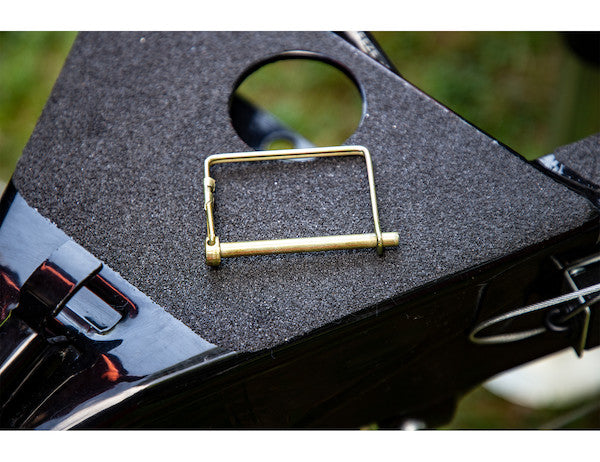
Buyers Products Snapper Pins are used as a convenient way to fasten accessories on truck equipment. Snapper lock pins join the benefits of a pin and cotter combination in a single assembly. Simply pull the wire loop over the pin to lock it in place. It quickly releases for easy removal. Snapper pins are yellow zinc-plated for corrosion resistance.
Specifications
| Clearance (in.) | 1-3/4 |
|---|---|
| Pin Dia (in.) | 9/16 |
| Usable Length (in.) | 3 |
The Snapper Pin, meticulously engineered by Buyers Products, represents a sophisticated solution for the rapid and secure fastening of accessories across a diverse spectrum of truck equipment and industrial applications. This particular model, featuring a 9/16-inch diameter and a 3-inch usable length, is further enhanced by a robust yellow zinc-plated finish, testifying to its superior performance characteristics and extended operational lifespan in demanding environments. This comprehensive description delves into the technical intricacies, material science, operational advantages, and application versatility of this essential fastening component.
At its core, the Snapper Pin is designed to streamline the attachment and detachment process, offering a significant advantage over traditional multi-component fastening systems such as clevis pins with separate cotter pins. The integrated design, where the pin and its locking mechanism form a single, cohesive unit, virtually eliminates the risk of lost or misplaced cotter pins, thereby enhancing operational efficiency and safety. The mechanism is elegantly simple yet mechanically robust: a spring-loaded wire loop is manipulated to engage a groove or recess near the head of the pin. When pulled over the pin's end, the loop seats securely, creating a positive lock that resists vibration, shock, and accidental disengagement. To release, a simple pull on the wire loop disengages it from its locked position, allowing for swift and effortless removal of the pin. This quick-release functionality is paramount in scenarios where frequent adjustments, changes, or disassemblies are required, such as in agricultural machinery, trailer hitches, or various implements where downtime for tool changes needs to be minimized.
The selection of materials and surface treatment for the Snapper Pin is critical to its performance envelope. The base material for such pins is typically high-strength carbon steel, chosen for its excellent mechanical properties, including high tensile strength and shear strength. These properties are fundamental to the pin’s ability to withstand significant loads, ensuring that attached equipment remains securely coupled even under dynamic stress conditions. The 9/16-inch diameter of this specific Snapper Pin is a direct indicator of its load-bearing capacity. Pins are subjected primarily to shear forces, which act perpendicular to the pin's axis, attempting to cut or shear it. A larger diameter directly correlates with a greater cross-sectional area, thus significantly increasing the pin's resistance to shear failure. This makes the 9/16-inch diameter suitable for applications requiring moderate to heavy-duty fastening, bridging the gap between lighter-duty components and extremely heavy industrial fasteners.
A distinguishing feature of this Snapper Pin is its yellow zinc-plated finish. Zinc plating is a widely adopted electrochemical process that applies a thin layer of zinc onto a steel substrate, acting as a sacrificial coating to prevent corrosion. The "yellow" designation refers to the chromate conversion coating applied over the zinc layer, which further enhances its protective qualities and provides a distinct yellowish hue. This chromate layer contains hexavalent or trivalent chromium compounds that react with the zinc to form a passive film. This film effectively seals the zinc, preventing its rapid oxidation and significantly improving its resistance to white rust (zinc corrosion products) and red rust (steel corrosion products). The primary mechanism of protection is galvanic corrosion: zinc is less noble than steel, meaning that if the coating is scratched or compromised, the zinc will preferentially corrode, sacrificing itself to protect the underlying steel substrate. This "self-healing" property is invaluable in applications where fasteners are exposed to moisture, road salt, chemicals, or other corrosive agents typically encountered in outdoor and vehicular environments.
Compared to other plating options, yellow zinc plating offers a balance of cost-effectiveness, corrosion resistance, and aesthetic appeal. While hot-dip galvanizing provides superior long-term corrosion protection, it results in a thicker, rougher coating that might not be suitable for the precise tolerances required for pin mechanisms. Stainless steel offers inherent corrosion resistance without a coating, but at a significantly higher material cost. Yellow zinc plating provides a smooth, uniform finish that facilitates the smooth operation of the Snapper Pin’s locking mechanism while offering substantial protection against environmental degradation, prolonging the pin’s functional life and maintaining its appearance over time. The yellow color also serves as a visual indicator of the plating’s presence and, to some extent, its integrity.
The specific dimensions of the Snapper Pin, particularly the 9/16-inch diameter and 3-inch usable length, are critical design parameters that dictate its compatibility and performance. The 9/16-inch (or 0.5625 inches) diameter ensures a snug fit within corresponding holes, typically found in pintle hooks, receiver tubes, hitch assemblies, or various agricultural and construction implements. Precise manufacturing tolerances are maintained during production to ensure that the pin can be inserted and removed smoothly without excessive play, which could lead to wear, noise, and ultimately, structural fatigue. Excessive clearance can allow for undesirable movement between connected components, potentially accelerating wear on both the pin and the mating holes, and compromising the integrity of the connection.
The "usable length" of 3 inches refers to the effective length of the pin shaft that can pass through the components being fastened, from the underside of the pin head to the point where the locking mechanism engages. This dimension is crucial for accommodating a variety of material thicknesses or multiple stacked components. A 3-inch usable length provides ample capacity for many standard applications, such as connecting drawbars, implement attachments, or securing hitch receivers that might involve several layers of steel. It is imperative that the total thickness of the material being fastened does not exceed the usable length to ensure the Snapper Pin's locking mechanism can fully engage and provide a secure connection. Conversely, a usable length that is excessively long for a thin application might result in an extended portion of the pin protruding unnecessarily, which, while not compromising the connection, could potentially interfere with other components or create a snag hazard.
The "Clearance (in.)" specification of 1-3/4 inches typically refers to the space required for the spring-loaded wire loop to fully articulate and engage or disengage the locking mechanism. This dimension is important for installers to ensure that sufficient space is available around the pin's head and shaft for unimpeded operation. In constrained environments, inadequate clearance could prevent the user from properly manipulating the wire loop, thereby hindering the quick-release function or even preventing proper installation. For instance, if the pin is installed too close to a structural member or another component, the operator may not have the necessary finger access or leverage to operate the locking wire, making the fast attachment and detachment impossible.
In terms of application versatility, Snapper Pins are indispensable in countless scenarios. In the realm of truck equipment, they are commonly employed in trailer hitches to secure ball mounts or other accessories within receiver tubes, where the quick-release function is highly valued for easy interchangeability. They are also found on utility trailers, ensuring tailgate chains or ramps are safely secured. Beyond vehicular applications, Snapper Pins see extensive use in agricultural machinery for attaching implements like plows, cultivators, or sprayers to tractors, enabling farmers to rapidly switch tools in the field. Construction equipment utilizes these pins for securing various attachments to loaders, excavators, or scaffolding components, where quick assembly and disassembly directly impact project efficiency and safety. Industrial settings benefit from their use in temporary setups, jigs, fixtures, and material handling equipment, providing a reliable and accessible fastening solution.
The inherent design of the Snapper Pin contributes significantly to operational safety. The positive locking action of the wire loop provides a visual and tactile confirmation that the pin is securely fastened, mitigating the risk of accidental detachment that could lead to equipment damage, material loss, or even personal injury. This is particularly crucial in applications involving towing, lifting, or supporting heavy loads, where fastener failure can have severe consequences. The integrated nature of the locking mechanism also prevents operator error often associated with separate cotter pins, such as forgetting to insert the cotter pin or using an incorrect size. By consolidating the fastening process into a single, intuitive action, the Snapper Pin enhances reliability across various operational contexts.
Installation of the Snapper Pin is remarkably straightforward. Simply align the pin with the mating holes, push it through until the desired components are secured, and then pull the wire loop over the end of the pin to engage the lock. Removal is equally simple: pull the wire loop away from the pin's end and withdraw the pin. For maintenance, while the yellow zinc plating provides substantial corrosion resistance, periodic inspection is advisable, especially in highly corrosive environments or applications involving frequent shock and vibration. Users should visually inspect the pin for signs of excessive wear, bending, cracks, or significant corrosion that might compromise its structural integrity. The wire loop mechanism should also be checked for proper spring tension and free movement. Light lubrication of the pin shaft and the wire loop pivot point can ensure smooth operation over extended periods, particularly in dusty or dirty conditions. Proper storage in a dry environment when not in use can further prolong the life of the zinc plating and the overall product.
When comparing the Snapper Pin to other quick-release fasteners, its advantages become clear. Unlike Lynch pins, which rely on a gravity-fed ring, the Snapper Pin's spring-loaded loop provides a more positive and secure lock, less susceptible to accidental opening from vibration or being snagged. Compared to clevis pins with traditional cotter pins, the Snapper Pin offers superior ease of use and eliminates the separate component. Other quick-release pins may employ a ball-detent mechanism, which is excellent for very fast release but may have lower shear strength ratings for a given diameter and might be more susceptible to wear in abrasive environments. The Snapper Pin strikes an optimal balance between ease of use, security, and robust construction, making it a preferred choice for a wide array of demanding applications.
In conclusion, the Snapper Pin with a 9/16-inch diameter and 3-inch usable length, protected by a yellow zinc-plated finish, is a high-performance fastening solution engineered for durability, efficiency, and safety. Its meticulously chosen materials, precision manufacturing, and thoughtfully designed locking mechanism make it an indispensable component for professionals in the trucking, agricultural, construction, and industrial sectors. Its ability to provide secure connections with rapid deployment and removal capabilities, coupled with excellent resistance to environmental degradation, solidifies its position as a superior choice for a multitude of demanding fastening requirements.