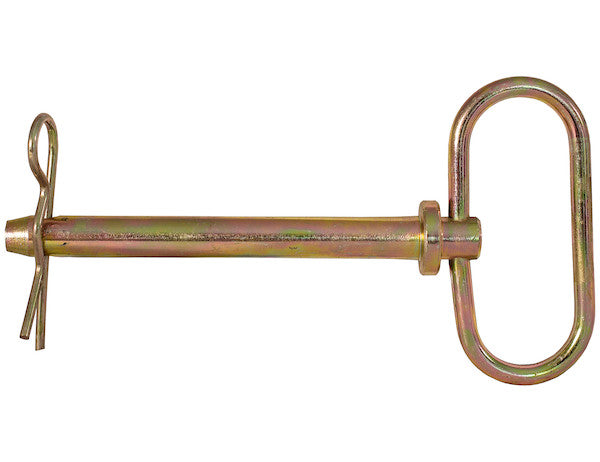
Buyers Products Hitch Pins come complete with a spring wire handle and cotter pin. Forged from 1040 steel, they are yellow zinc-plated for corrosion protection. Choose from a variety of sizes.
Specifications
| Pin Dia. (in.) | 9/16 |
|---|---|
| Usable Length (in.) | 2-3/4 |
Technical Overview: Yellow Zinc Plated Hitch Pins - 9/16" Diameter x 2-3/4" Usable Length
This document provides an in-depth technical analysis of the Buyers Products Yellow Zinc Plated Hitch Pins, specifically focusing on the 9/16-inch diameter by 2-3/4-inch usable length variant. These hitch pins are engineered for a broad spectrum of fastening applications requiring secure, quick-release coupling mechanisms. Their design, material selection, and surface treatment are optimized for durability, resistance to environmental degradation, and consistent performance across various operational contexts.
Material Specification and Properties: 1040 Steel
The core material for these hitch pins is AISI 1040 steel. AISI 1040 is a medium-carbon steel known for its excellent balance of strength, hardness, and machinability. Its chemical composition typically includes:
- Carbon (C): 0.37-0.44% - Provides strength and hardness.
- Manganese (Mn): 0.60-0.90% - Enhances strength and hot workability.
- Silicon (Si): 0.10-0.30% - Acts as a deoxidizer and improves strength.
- Sulfur (S): Max 0.050% - Generally an impurity, controlled to improve ductility.
- Phosphorus (P): Max 0.040% - Generally an impurity, controlled to improve ductility.
The medium carbon content of 1040 steel allows it to be heat-treated to achieve a desired combination of mechanical properties. While the specific heat treatment applied to these hitch pins is not detailed, the forging process followed by a suitable heat treatment (e.g., normalizing or quenching and tempering) would significantly enhance its tensile strength, yield strength, and resistance to wear and impact. Without specific heat treatment data, typical mechanical properties for 1040 steel in its normalized condition include a tensile strength ranging from 620-690 MPa (90-100 ksi) and a yield strength of 345-415 MPa (50-60 ksi), along with moderate ductility.
The choice of 1040 steel is critical for applications where the hitch pin is subjected to significant shear forces, bending moments, and cyclical loading. Its robust nature ensures structural integrity and prevents premature failure under typical operational stresses associated with towing, securing implements, and general industrial fastening tasks.
Manufacturing Process: Forging
The hitch pins are manufactured through a forging process. Forging is a metal forming process that involves shaping metal using localized compressive forces. This method offers several distinct advantages over other manufacturing techniques like casting or machining from bar stock:
- Improved Grain Structure: Forging refines the grain structure of the steel, aligning the grain flow with the pin's contours. This creates a stronger, more ductile product with enhanced fatigue resistance. Unlike machining, which can cut through grain flow, forging preserves and optimizes it.
- Enhanced Strength and Toughness: The compressive forces during forging eliminate internal voids, porosity, and other defects, resulting in a denser, less porous material. This leads to superior mechanical properties, particularly in terms of tensile strength, yield strength, and impact toughness, making the pins more resilient to sudden shock loads.
- Reduced Risk of Stress Concentrators: The continuous grain flow inherent in forged parts minimizes areas where stress could concentrate, thereby reducing the likelihood of crack initiation and propagation.
- Consistency and Reliability: Forging provides a high degree of dimensional accuracy and repeatability, ensuring that each hitch pin meets stringent quality standards and performs consistently.
The forging process for these hitch pins likely involves heating the 1040 steel billets to a plastic state and then shaping them using dies and hammers or presses. This method is particularly well-suited for components that experience dynamic loads and require a high degree of structural integrity.
Surface Treatment: Yellow Zinc Plating for Corrosion Protection
A critical feature of these hitch pins is their yellow zinc plating. Zinc plating is an electrochemical process that deposits a thin layer of zinc onto the steel substrate. This layer serves as a sacrificial coating, providing robust corrosion protection through several mechanisms:
- Sacrificial Anode (Galvanic Protection): Zinc is more electrochemically active than steel. In the presence of an electrolyte (e.g., moisture), the zinc corrodes preferentially, sacrificing itself to protect the underlying steel from rust. This mechanism is effective even if the coating is scratched or slightly damaged, as the surrounding zinc will continue to protect exposed steel.
- Barrier Protection: The zinc layer acts as a physical barrier, preventing corrosive elements (oxygen, moisture, salts, pollutants) from directly contacting the steel surface.
- Improved Aesthetics: Yellow zinc plating, achieved through a chromate conversion coating applied over the zinc, provides a distinctive golden-yellow hue. This finish is not merely aesthetic; the chromate layer further enhances corrosion resistance, particularly against white rust (zinc corrosion products), and improves abrasion resistance. The chromate layer typically contains hexavalent or trivalent chromium compounds, forming a passive layer that seals the zinc and slows its degradation.
The thickness of the zinc plating is a crucial parameter for determining its service life. While not specified, standard zinc plating for outdoor applications often ranges from 5 to 13 micrometers (0.0002 to 0.0005 inches). Thicker coatings generally provide longer protection. The yellow chromate conversion treatment further contributes to this protection, offering superior salt spray performance compared to clear or blue chromates.
For hitch pins used in outdoor environments, agricultural settings, construction, and automotive applications, exposure to moisture, road salts, chemicals, and abrasive particles is common. The yellow zinc plating significantly extends the operational lifespan of the pins by mitigating the effects of these corrosive agents, thereby reducing maintenance requirements and replacement costs.
Design and Functional Components
The hitch pin assembly includes several key components, each contributing to its functionality and security:
Pin Body
- Diameter: 9/16 inch (0.5625 inches). This dimension is critical for ensuring proper fitment into receivers, hitches, and implement attachment points. A precise diameter minimizes play, reduces wear on both the pin and the mating component, and ensures optimal load transfer.
- Usable Length: 2-3/4 inches (2.75 inches). This refers to the effective length of the pin that can pass through the mating components before the head and retainer mechanism interfere. Accurate usable length is vital for compatibility with a wide range of application thicknesses, preventing excessive protrusion or insufficient engagement.
- Head Design: While not explicitly detailed, hitch pins typically feature a robust head designed to prevent the pin from passing entirely through the connection point. This head must be strong enough to withstand compressive forces and shear stresses.
- Groove/Hole for Cotter Pin: A precisely machined groove or a through-hole at the end of the usable length accommodates the cotter pin or spring wire handle, securing the pin in place.
Spring Wire Handle
The inclusion of a spring wire handle simplifies the insertion and removal of the hitch pin. This component is typically formed from spring steel, offering a combination of flexibility and tensile strength. Its design allows for quick attachment and detachment of the cotter pin, enhancing operational efficiency. The handle often features a loop or ergonomic bend for easy gripping, even when wearing gloves or in adverse conditions.
Cotter Pin
The cotter pin is a crucial safety and retention mechanism. While the term "cotter pin" can refer to various types, in this context, it likely refers to a hair pin clip, R-clip, or a traditional split cotter pin. Its primary function is to lock the hitch pin into position, preventing accidental dislodgement due to vibration, impact, or pulling forces. The cotter pin itself is usually made from spring steel (e.g., music wire or stainless steel for corrosion resistance) and may also be zinc-plated for consistency in corrosion protection.
- Hair Pin Clip / R-Clip: These are common for hitch pins due to their ease of use and reusability. They are quickly inserted through a hole in the hitch pin and provide a secure, spring-loaded retention.
- Split Cotter Pin: A more traditional design requiring the legs to be bent after insertion. While highly secure, they are generally intended for more permanent or less frequent removal applications.
The synergy between the spring wire handle and the cotter pin system ensures a secure yet easily manipulable fastening solution, paramount for applications where quick setup and breakdown are essential.
Applications and Operational Considerations
These Yellow Zinc Plated Hitch Pins with a 9/16-inch diameter and 2-3/4-inch usable length are designed for a broad array of applications, including but not limited to:
- Agricultural Equipment: Securing implements to tractors, attaching trailers, plows, cultivators, and other farm machinery.
- Towing and Trailer Systems: Pinning trailer couplers, safety chains, and various towing accessories.
- Construction Machinery: Fastening attachments on skid steers, excavators, and other heavy equipment.
- Industrial Equipment: General-purpose fastening in manufacturing, material handling, and maintenance operations.
- Recreational Vehicles: Securing hitches for ATVs, UTVs, and small utility trailers.
When selecting and utilizing these hitch pins, several operational considerations should be noted:
- Load Capacity: While 1040 steel provides significant strength, users must ensure the hitch pin's rated shear strength and bending resistance are appropriate for the maximum anticipated dynamic and static loads of the application. Overloading can lead to catastrophic failure.
- Fitment: The 9/16-inch diameter requires corresponding holes of slightly larger diameter (e.g., 5/8 inch) to allow for easy insertion and removal, while minimizing excessive play. The 2-3/4-inch usable length dictates the maximum thickness of components that can be securely joined.
- Environmental Exposure: Although yellow zinc plating offers excellent corrosion protection, extreme or prolonged exposure to highly aggressive corrosive environments (e.g., marine saltwater without regular rinsing, strong acids/bases) may still lead to degradation over extended periods. Regular inspection and cleaning are recommended.
- Maintenance: Periodically inspect the pin for signs of wear, bending, or corrosion. The cotter pin and spring wire handle should also be checked for deformation or loss of spring tension, which could compromise retention. Replacement should occur if any component shows significant signs of degradation.
- Installation: Always ensure the cotter pin is fully engaged and properly secured to prevent accidental dislodgement of the hitch pin.
Quality Assurance and Compliance
Buyers Products, as a reputable manufacturer, adheres to stringent quality control protocols throughout the production lifecycle of these hitch pins. This typically involves:
- Material Certification: Ensuring that the supplied 1040 steel meets specified chemical composition and mechanical property standards.
- Process Control: Monitoring forging temperatures, pressures, and cooling rates to achieve optimal grain structure and material properties.
- Dimensional Inspection: Verifying critical dimensions such as pin diameter, usable length, and hole/groove placement for consistency and fitment.
- Coating Thickness Measurement: Using non-destructive techniques (e.g., X-ray fluorescence or eddy current) to ensure adequate zinc plating thickness.
- Corrosion Resistance Testing: Performing salt spray tests (e.g., ASTM B117) on representative samples to validate the corrosion performance of the yellow zinc plating.
- Mechanical Testing: Conducting destructive tests such as tensile strength, shear strength, and hardness tests on samples to confirm material integrity and performance.
Adherence to these quality standards ensures that each Yellow Zinc Plated Hitch Pin delivers reliable performance and meets the demanding requirements of its intended applications.
Conclusion
The Buyers Products Yellow Zinc Plated Hitch Pin, with its 9/16-inch diameter and 2-3/4-inch usable length, represents a robust and technically sound fastening solution. The selection of forged 1040 steel provides superior mechanical strength and fatigue resistance, essential for applications experiencing significant loads. The yellow zinc plating offers excellent, multi-layered corrosion protection, significantly extending the product's service life in challenging environmental conditions. The complete assembly, including the spring wire handle and cotter pin, ensures ease of use and secure retention. This combination of material science, advanced manufacturing, and thoughtful design makes these hitch pins a highly reliable component for a wide range of industrial, agricultural, and recreational fastening requirements.