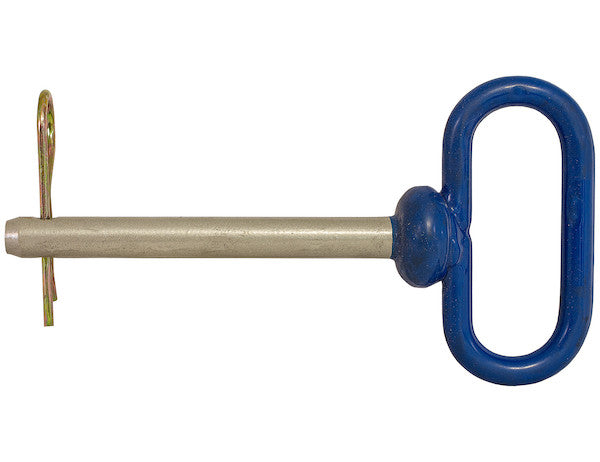
Buyers Products Poly-Coated Steel Hitch Pins have a durable powder-coated steel shank and highly visible blue poly-coated handle. Constructed from SAE AISI 1541 rated steel, hitch pins are a durable part in any application. Pins include a zinc-plated cotter pin.
Specifications
| Material | Hardened Steel |
|---|---|
| Pin Dia. (in.) | 3/4 |
| Usable Length (in.) | 4-1/2 |
Advanced Engineering and Performance Analysis of the Buyers Products Poly-Coated Steel Hitch Pin
The Buyers Products Poly-Coated Steel Hitch Pin represents a pinnacle of robust design and material science application in the realm of industrial and agricultural fastening solutions. Meticulously engineered for superior performance and longevity, this hitch pin combines advanced metallurgical properties with ergonomic and protective coatings, making it an indispensable component for demanding applications. This detailed exposition delves into the technical specifications, material science, manufacturing processes, and performance characteristics that define this essential piece of hardware.
Metallurgical Foundation: SAE AISI 1541 Hardened Steel
At the core of this hitch pin's exceptional strength lies its construction from SAE AISI 1541 rated steel. This specific grade of medium-carbon manganese steel is renowned for its excellent mechanical properties, particularly after appropriate heat treatment. The "SAE" designation refers to the Society of Automotive Engineers, indicating adherence to a widely recognized standard for steel composition and properties, while "AISI" (American Iron and Steel Institute) further categorizes its chemical composition. The "15" series of steel denotes a carbon-manganese alloy, with "41" indicating a nominal carbon content of 0.41% and a significant manganese content (typically 1.35-1.65%).
The chemical composition of SAE AISI 1541 steel is precisely controlled to impart desirable characteristics. Carbon content provides the base for hardness and strength through heat treatment, while manganese acts as a deoxidizer and significantly enhances hardenability. Hardenability is the property of a steel that determines the depth and distribution of hardness induced by quenching. A higher hardenability allows for deeper and more uniform hardening throughout the pin's cross-section, crucial for resisting shear and bending forces common in hitch applications. Silicon, typically present in smaller amounts, also contributes to deoxidation and strength. The careful balance of these elements ensures that the steel can achieve a high level of toughness and wear resistance without becoming excessively brittle.
The "Hardened Steel" specification signifies that the pin has undergone a rigorous heat treatment process, typically involving austenitizing, quenching, and tempering. Austenitizing involves heating the steel to a high temperature, transforming its microstructure into austenite. Quenching then rapidly cools the steel, transforming the austenite into martensite, a very hard and brittle phase. Finally, tempering involves reheating the martensite to an intermediate temperature for a specific duration, which reduces brittleness and increases toughness, while maintaining a high level of strength. This controlled heat treatment process is critical for developing the optimal balance of strength, ductility, and fatigue resistance required for a high-performance hitch pin. The resulting microstructure provides superior resistance to plastic deformation, shear stress, and abrasive wear, ensuring the pin maintains its structural integrity under significant dynamic and static loads.
Advanced Surface Protection: Powder-Coated Steel Shank
Beyond its inherent material strength, the steel shank benefits from a durable powder-coated finish. Powder coating is a dry finishing process where finely ground particles of pigment and resin are electrostatically charged and sprayed onto the electrically grounded component. The charged powder particles adhere to the surface until melted and fused into a smooth, uniform coating in a curing oven. This process yields a finish that is significantly more durable than conventional liquid paint.
The technical advantages of powder coating are numerous. Firstly, it provides exceptional corrosion resistance. The continuous, impermeable layer acts as a formidable barrier against moisture, chemicals, road salts, and other corrosive agents that would otherwise degrade the underlying steel. This is particularly vital for components exposed to harsh outdoor environments, preventing rust and preserving the pin's structural integrity over an extended service life. Secondly, powder coating offers superior abrasion and impact resistance. The cured polymer matrix is tough and resilient, capable of withstanding incidental impacts and constant friction from attaching and detaching implements, thereby preventing chips, scratches, and wear that could expose the base metal. Furthermore, powder coatings exhibit excellent UV stability, meaning they resist fading and degradation when exposed to sunlight, maintaining the aesthetic and protective qualities of the pin.
Ergonomic and High-Visibility Design: Blue Poly-Coated Handle
The highly visible blue poly-coated handle is a key feature that elevates the functionality and user experience of this hitch pin. The polymer coating applied to the handle serves multiple critical purposes: ergonomic comfort, enhanced grip, and visual safety.
From an ergonomic perspective, the polymer coating provides a softer, more comfortable grip compared to bare metal, especially in extreme temperatures. In cold environments, the polymer acts as a thermal insulator, preventing direct contact with frigid metal, which can be particularly important for operators in agricultural or construction settings. Conversely, in hot conditions, it reduces heat transfer from sun-exposed metal. The tactile properties of the polymer also improve grip, reducing the likelihood of slippage, particularly when hands are wet, oily, or gloved. This translates directly to improved operational efficiency and reduced hand fatigue during repeated handling.
The choice of a highly visible blue color for the poly-coated handle is a deliberate safety feature. In busy work environments, amidst machinery and various attachments, highly contrasting colors significantly improve the visibility of critical components. A bright blue handle ensures that the hitch pin is easily located, even in low light conditions or against complex backgrounds. This enhanced visibility reduces the risk of accidental misplacement, facilitates quicker attachment/detachment procedures, and contributes to overall workplace safety by making the component more discernible to operators and ground personnel alike.
The polymer itself is selected for its durability and resistance to environmental factors. It is typically formulated to withstand exposure to oils, greases, fuels, and common agricultural and industrial chemicals without degrading or becoming tacky. Furthermore, it exhibits good resistance to UV radiation, ensuring the vibrant blue color remains conspicuous over time, resisting fading or cracking that could compromise its protective and visibility functions.
Securement Mechanism: Zinc-Plated Cotter Pin
The inclusion of a zinc-plated cotter pin is integral to the overall security and reliability of the hitch assembly. While seemingly a minor component, the cotter pin plays a crucial role in preventing accidental disengagement of the main hitch pin due to vibrations, impacts, or operational stresses. The design ensures that once the main hitch pin is inserted through the appropriate connection points (e.g., a receiver and an implement tongue), the cotter pin can be inserted through a pre-drilled hole in the main pin, creating a positive mechanical lock.
The cotter pin's zinc-plated finish provides vital corrosion resistance. Zinc plating involves applying a thin layer of zinc onto the surface of the steel through an electroplating process. Zinc acts as a sacrificial coating, meaning it corrodes preferentially to the underlying steel, thereby protecting the steel component from rust and degradation. This is particularly important for a component that is frequently handled and exposed to moisture, chemicals, and abrasive contact. While the main hitch pin benefits from powder coating, the cotter pin's distinct role and frequent manipulation necessitate its own robust protective layer. The use of zinc plating ensures the cotter pin remains functional and easily operable throughout its service life, preventing seized or rusted pins that could hinder efficient operation or compromise safety.
Precision Dimensions and Application Versatility
The specified dimensions of 3/4 inch pin diameter and 4-1/2 inches usable length are critical for ensuring broad compatibility and secure engagement across a wide spectrum of applications. The "usable length" refers to the maximum effective thickness of the material (e.g., hitch receiver wall, implement tongue) that the pin can securely traverse and still allow for the insertion of the cotter pin. This precise measurement ensures that the pin is neither too short to engage fully nor excessively long, which could lead to unnecessary protrusion and potential snagging.
A 3/4 inch (19.05 mm) diameter hitch pin is a common size in many medium-duty to heavy-duty towing, agricultural, and industrial scenarios. This diameter provides a substantial cross-sectional area, which is directly proportional to its shear strength—a critical parameter for components under load. The choice of this diameter reflects a balance between load-bearing capacity and compatibility with standard implement eyes, trailer couplers, and receiver hitches. The 4-1/2 inch (114.3 mm) usable length allows for secure fastening through thick-walled receivers or multiple layers of material, common in heavy-duty machinery attachments and complex hitch systems.
This combination of diameter and usable length makes the Buyers Products hitch pin exceptionally versatile for applications such as:
- Agricultural Equipment: Connecting various implements (e.g., plows, cultivators, sprayers, wagons) to tractors, ensuring reliable linkage during demanding field operations.
- Industrial Machinery: Securing attachments on construction equipment, material handling devices, and stationary machinery requiring robust, removable pins.
- Towing Applications: Fastening utility trailers, boat trailers, and recreational vehicle trailers to tow vehicles, where a secure connection is paramount for safety and regulatory compliance.
- Utility and General Purpose: Anywhere a temporary yet highly robust connection is required, such as securing gates, scaffolding components, or specialized fixtures.
Performance Metrics: Shear Strength, Fatigue Resistance, and Environmental Durability
The engineering design and material selection of this hitch pin directly translate into superior performance metrics:
- Shear Strength: This is arguably the most critical mechanical property for a hitch pin. Shear strength is the ability of the material to resist forces that cause internal layers of the material to slide past each other. For a pin, this typically occurs at the interfaces where the pin passes through the connecting components. The high strength of SAE AISI 1541 hardened steel, combined with the substantial 3/4-inch diameter, provides exceptional resistance to shear forces, preventing failure under heavy dynamic loads. The design ensures that the pin's ultimate shear strength far exceeds typical operational requirements, providing a substantial safety margin.
- Tensile Strength: While shear is dominant, the pin also experiences tensile stresses, particularly if subjected to bending moments or if the head is pulled under certain conditions. The hardened steel provides a high tensile strength, resisting elongation and fracture.
- Fatigue Resistance: Many hitch applications involve repetitive loading and unloading, leading to fatigue stress. The careful heat treatment and material composition of SAE AISI 1541 steel enhance its fatigue life, allowing the pin to withstand countless cycles of stress without developing microscopic cracks that could propagate and lead to sudden failure. This is crucial for long-term reliability in dynamic environments.
- Environmental Durability: The multi-layer protective system (powder coating on the shank, poly-coating on the handle, zinc plating on the cotter pin) ensures outstanding resistance to a wide range of environmental factors. This includes prolonged exposure to moisture, road chemicals (e.g., de-icing salts), UV radiation, abrasive dust, and temperature extremes. This comprehensive protection prevents premature degradation, maintaining the pin's structural integrity and aesthetic appearance throughout its operational lifespan.
Manufacturing Excellence and Quality Assurance
The production of the Buyers Products Poly-Coated Steel Hitch Pin adheres to stringent manufacturing processes and quality control protocols. The steel components are likely formed through a combination of hot forging and precision machining. Hot forging refines the grain structure of the steel, enhancing its strength and toughness, particularly in critical areas like the head and shank transitions. Subsequent machining operations ensure precise dimensions, smooth surface finishes, and accurate hole placement for the cotter pin.
Following forming and heat treatment, the application of the powder coating and poly-coating is performed under controlled conditions to ensure optimal adhesion, uniform thickness, and a flawless finish. Each batch of pins undergoes rigorous quality assurance checks, including dimensional verification, material hardness testing, coating adhesion tests, and visual inspections, to ensure that every product meets the high standards set by Buyers Products. This commitment to manufacturing excellence ensures consistent product quality and reliable performance in the field.
Conclusion: Engineered for Enduring Performance
In summary, the Buyers Products Blue Poly-Coated Handle on Steel Hitch Pin is not merely a fastener; it is a precisely engineered component designed for enduring performance in the most challenging operational environments. Its foundation in SAE AISI 1541 hardened steel provides an unparalleled combination of strength, toughness, and fatigue resistance. The multi-layered protective coatings – a durable powder-coated shank for corrosion and abrasion resistance, a highly visible and ergonomic poly-coated handle for safety and user comfort, and a zinc-plated cotter pin for secure engagement and ancillary protection – collectively ensure maximum longevity and reliability.
With its specific dimensions of a 3/4-inch diameter and 4-1/2-inch usable length, this hitch pin offers broad compatibility and robust load-bearing capacity for a vast array of agricultural, industrial, construction, and towing applications. Each design choice, from the metallurgy to the ergonomic handle, is meticulously considered to deliver a product that minimizes downtime, enhances operational safety, and provides a long, trouble-free service life. For professionals demanding uncompromised quality and performance from their critical fastening hardware, the Buyers Products Poly-Coated Steel Hitch Pin stands as the definitive choice.