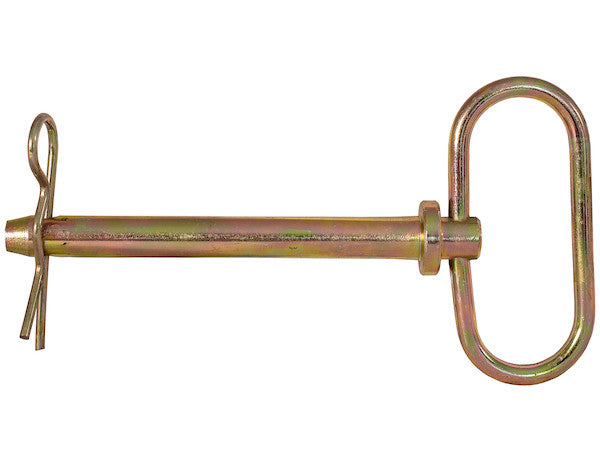
Buyers Products Hitch Pins come complete with a spring wire handle and cotter pin. Forged from 1040 steel, they are yellow zinc-plated for corrosion protection. Choose from a variety of sizes.
Specifications
| Pin Dia. (in.) | 7/8 |
|---|---|
| Usable Length (in.) | 6-1/4 |
Advanced Technical Overview: Yellow Zinc Plated Hitch Pins - 7/8" Diameter x 6-1/4" Usable Length
This technical product description delves into the engineering specifications, material science, and performance characteristics of the Yellow Zinc Plated Hitch Pins, specifically focusing on the 7/8-inch diameter and 6-1/4-inch usable length variant manufactured by Buyers Products. Designed for robust performance in demanding applications, these hitch pins represent a critical component in secure towing, agricultural, and industrial coupling systems, embodying a blend of material strength, precise dimensions, and advanced surface protection.
Material Science: Forged 1040 Carbon Steel
The foundation of this hitch pin's structural integrity is its composition: forged 1040 carbon steel. AISI/SAE 1040 steel is a medium-carbon steel, characterized by its nominal carbon content of 0.37-0.44%, alongside manganese (0.60-0.90%), phosphorus (max 0.040%), and sulfur (max 0.050%). This specific chemical composition provides an optimal balance between strength, hardness, and ductility, making it highly suitable for applications requiring significant load-bearing capabilities and resistance to impact. Forging, as a manufacturing process, is crucial here. Unlike casting or machining from bar stock, forging involves plastically deforming the metal in its solid state through localized compressive forces using hammers or presses. This process refines the grain structure, eliminating porosity and enhancing the material's mechanical properties, including tensile strength, yield strength, and fatigue resistance. The resulting grain flow is aligned with the shape of the part, making the hitch pin inherently stronger and more resistant to shear forces and bending moments commonly encountered in towing and coupling operations. Typical mechanical properties for heat-treated 1040 steel can include tensile strengths ranging from 600-700 MPa (87-102 ksi) and yield strengths from 450-550 MPa (65-80 ksi), depending on the specific heat treatment and forging parameters. The medium carbon content allows for effective heat treatment processes such as quenching and tempering, which can further optimize the pin's hardness and toughness profile for a specific application, although the standard product typically relies on the inherent strength of the forged material and surface treatment for performance.
Surface Treatment: Yellow Zinc Plating for Enhanced Corrosion Protection
A distinctive feature of these hitch pins is their yellow zinc plating. This surface treatment is not merely aesthetic but serves a critical engineering function: superior corrosion protection. The process involves electroplating, where a thin layer of zinc is deposited onto the steel substrate from an electrolyte bath. Zinc is a more electrochemically active metal than steel, meaning it acts as a sacrificial anode. In corrosive environments, the zinc layer preferentially corrodes, protecting the underlying steel from oxidation (rust). This galvanic protection mechanism is highly effective, especially where the coating might be scratched or chipped, as the zinc will continue to protect the exposed steel as long as it is electrically connected. Following the zinc deposition, a chromate conversion coating is applied. This chromate layer reacts with the zinc to form a passive film that significantly enhances the corrosion resistance of the zinc coating itself and imparts the characteristic yellow iridescent appearance. This yellow chromate finish typically provides superior salt spray resistance compared to clear or blue chromates, often exceeding 96 hours to white corrosion and hundreds of hours to red rust in standardized ASTM B117 salt spray tests, depending on the thickness of the zinc and chromate layers. The plating also offers a degree of abrasion resistance and reduces the coefficient of friction, facilitating easier insertion and removal of the pin while providing a clean, professional finish. The uniform thickness and adherence of the zinc plating are crucial, ensuring consistent protection across the entire surface of the forged component, including intricate contours.
Dimensional Precision: 7/8" Diameter x 6-1/4" Usable Length
The specified dimensions of 7/8-inch diameter and 6-1/4-inch usable length are paramount for proper fitment, security, and load capacity. The 7/8-inch (22.225 mm) diameter is a common standard in medium to heavy-duty towing and industrial applications. This diameter is critical for ensuring a snug fit within the corresponding receiver tube or mounting bracket, minimizing play and articulation that could lead to wear, noise, or premature failure under dynamic loads. The cross-sectional area of the pin directly correlates with its shear strength. A pin of this diameter, forged from 1040 steel, possesses substantial shear strength, making it suitable for trailer hitches, agricultural implements, and construction equipment requiring robust coupling. For instance, a 7/8-inch diameter pin, assuming a typical shear strength for 1040 steel, would yield significant ultimate shear capacities, often exceeding the requirements for Class IV or even certain Class V trailer hitches, depending on the application and safety factors. The 6-1/4-inch (158.75 mm) usable length refers to the effective length of the pin that passes through the mating components, excluding the head and the space required for the retention mechanism. This length is carefully chosen to accommodate a wide range of receiver widths, clevis mounts, and layered connections without excessive protrusion or insufficient engagement. Proper usable length ensures that the pin fully engages all components and allows sufficient space for the spring wire handle and cotter pin to be securely fastened. An insufficient length would prevent full engagement, compromising safety and load distribution, while an excessive length could lead to snagging or unnecessary leverage on the pin, potentially inducing bending stress. Precision manufacturing tolerances are applied to both the diameter and length to ensure consistent fitment across a broad spectrum of compatible equipment, adhering to industry standards for dimensional accuracy.
Retention Mechanism: Spring Wire Handle and Cotter Pin
The secure retention of the hitch pin is achieved through a combination of a spring wire handle and a traditional cotter pin. The spring wire handle is integrally formed into the head of the pin, offering an ergonomic grip for easy insertion and removal. The spring action provides constant tension, helping to prevent accidental disengagement, particularly from vibration. Its robust construction ensures durability even with frequent handling. The secondary, and arguably most critical, retention mechanism is the cotter pin. This simple yet highly effective fastener is inserted through a pre-drilled hole near the end of the hitch pin, effectively creating a positive mechanical lock. Once inserted, the cotter pin's legs are typically spread or bent to prevent it from backing out. This dual-retention system provides a high degree of security, ensuring that the hitch pin remains firmly in place even under severe operational conditions, preventing accidental separation of the towed or coupled components. The cotter pin itself is typically manufactured from a material like low-carbon steel or stainless steel, selected for its malleability (to allow for bending) and sufficient shear strength to resist dislodgement. The design of the cotter pin hole is optimized to prevent stress concentrations on the hitch pin while ensuring reliable retention of the cotter pin. The overall system provides both ease of use and paramount safety, critical for applications where component separation could lead to catastrophic failure.
Applications and Performance Considerations
These yellow zinc plated hitch pins, with their specific dimensions and material properties, are engineered for a diverse array of demanding applications. In automotive and trailer towing, they are ideal for securing ball mounts, pintle hooks, and other receiver-mounted accessories to the trailer hitch receiver, particularly for medium to heavy-duty trailers (e.g., utility trailers, boat trailers, small equipment trailers). In the agricultural sector, they are indispensable for connecting various implements—such as plows, cultivators, sprayers, and wagons—to tractors and other farm machinery, where robust and reliable connections are crucial due to dynamic loads and corrosive environments. Construction equipment, including excavators, skid steers, and loaders, also heavily utilizes such pins for securing attachments like buckets, grapples, and forks. Beyond these, the pins find utility in industrial settings for securing components on conveyor systems, rigging, and specialized machinery. The yellow zinc plating ensures longevity in outdoor and corrosive environments, resisting elements such as moisture, road salt, and agricultural chemicals. The forged 1040 steel provides the necessary shear and tensile strength to withstand the significant forces involved in these operations, while the precise dimensions ensure compatibility and minimize wear on both the pin and the mating components. Careful consideration of the maximum shear load and tensile load expected in the application, coupled with appropriate safety factors, is always recommended to ensure proper pin selection and operational integrity. Regular inspection of the pin for signs of wear, deformation, or corrosion is also advised to maintain peak performance and safety standards.
Manufacturing Excellence and Quality Assurance
Buyers Products maintains stringent manufacturing processes to ensure the quality and reliability of its hitch pins. The forging process is precisely controlled, adhering to established metallurgical standards to achieve the desired grain structure and mechanical properties of the 1040 steel. Subsequent machining operations ensure the precise 7/8-inch diameter, 6-1/4-inch usable length, and the accurate placement and size of the cotter pin hole, all within tight dimensional tolerances. The yellow zinc plating process is conducted in a controlled environment, ensuring uniform zinc deposition thickness and consistent chromate conversion for optimal corrosion resistance and aesthetic quality. Each batch undergoes rigorous quality assurance checks, including dimensional verification, visual inspection for plating defects, and performance testing for material integrity where applicable. This commitment to quality throughout the manufacturing chain ensures that every hitch pin meets or exceeds the specified technical requirements and delivers reliable performance in its intended application. The robust design, combined with meticulous manufacturing and advanced surface protection, positions these hitch pins as a premium choice for critical coupling applications across various industries, offering exceptional durability, security, and long-term value.