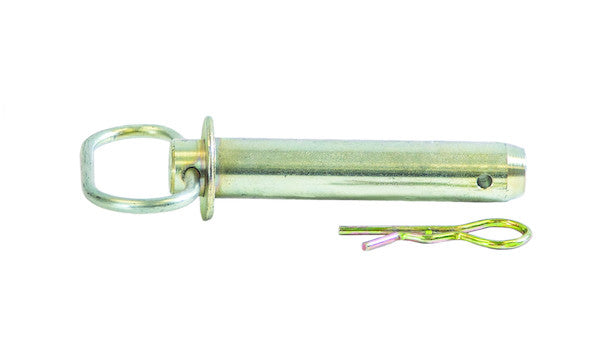
Buyers Products Hitch Pins come complete with a spring wire handle and cotter pin. Forged from 1040 steel, they are yellow zinc-plated for corrosion protection. Choose from a variety of sizes.
Specifications
| Pin Dia. (in.) | 1.0 |
|---|---|
| Usable Length (in.) | 4-1/2 |
Technical Overview: Buyers Products Heavy-Duty Hitch Pin Assembly - 1" Diameter x 4-1/2" Usable Length (Nominal 5")
The Buyers Products Hitch Pin Assembly, specifically engineered with a 1-inch diameter and a 4-1/2 inch usable length (often referred to within a 5-inch nominal category), represents a critical component in ensuring secure and reliable connections across a vast array of towing and agricultural applications. This meticulously designed assembly serves as a robust securing mechanism, indispensable for attaching implements, trailers, and other towable equipment to tractors, vehicles, and machinery with precision and unwavering stability. The core function of a hitch pin is to create a shear-resistant connection between two articulated components, preventing inadvertent disengagement due to dynamic forces encountered during operation. Understanding the intricate engineering and material science behind this specific hitch pin assembly is paramount for appreciating its performance, durability, and intrinsic value in demanding operational environments. While the product title may generally refer to a 5-inch usable length, the precise specification detailed for this particular item is a 4-1/2 inch usable length, a critical dimension for ensuring optimal fitment and functionality within designated receiver or drawbar apertures.
At the heart of this hitch pin's structural integrity is its composition: forged 1040 steel. The selection of 1040 steel is a deliberate engineering choice, reflecting a balanced compromise between strength, toughness, and manufacturability. 1040 carbon steel is a medium carbon steel, typically containing 0.37-0.44% carbon, 0.60-0.90% manganese, with trace amounts of silicon, sulfur, and phosphorus. This specific chemical composition endows the material with excellent mechanical properties suitable for high-stress applications like hitch pins. The forging process, rather than casting or machining from simple bar stock, is crucial to the pin's superior performance. Forging involves plastically deforming the metal while it is in a solid state, typically at elevated temperatures, using compressive forces. This process refines the grain structure of the steel, aligning the grains in the direction of the metal flow, which significantly enhances its strength, impact resistance, and fatigue life. Unlike cast components which often exhibit internal porosity and anisotropic properties, or machined components which might cut across grain lines, forged components possess a continuous, directional grain flow that maximizes resistance to stress concentration and crack propagation. Forging therefore ensures that the hitch pin can withstand the substantial shear, bending, and tensile forces characteristic of towing and heavy equipment operations without premature failure.
Further enhancing the longevity and reliability of the Buyers Products Hitch Pin is its comprehensive corrosion protection system. Each pin is meticulously yellow zinc-plated, a surface treatment applied through an electroplating process. Zinc plating, particularly when followed by a chromate conversion coating to achieve the distinctive yellow iridescent finish, offers a multi-layered defense against environmental degradation. The primary mechanism of zinc plating is sacrificial protection: zinc is electrochemically more active than steel. In the presence of moisture and oxygen, the zinc coating preferentially corrodes, thereby shielding the underlying steel substrate from rust formation. This sacrificial action significantly extends the service life of the pin, especially in outdoor, harsh, or corrosive environments where exposure to road salts, chemicals, and varying weather conditions is common. The yellow chromate conversion layer, applied over the zinc, provides an additional barrier and further passivates the zinc, enhancing its corrosion resistance by preventing "white rust" (zinc oxide) and improving its aesthetic appeal. This chromate layer also offers improved adhesion for subsequent coatings, though typically none are applied directly over it. Modern yellow zinc plating processes largely utilize trivalent chromium chemistries, moving away from hexavalent chromium to comply with stricter environmental regulations such as RoHS (Restriction of Hazardous Substances), ensuring the product meets contemporary sustainability standards while maintaining superior performance.
The design of the hitch pin assembly extends beyond the pin body itself to include crucial ancillary components that contribute to its functionality and user convenience. The inclusion of a spring wire handle is a thoughtfully engineered feature designed for ease of manipulation and secure handling. This handle, typically formed from high-tensile spring steel, is permanently affixed to the head of the hitch pin. Its ergonomic design facilitates quick insertion and removal of the pin, even when wearing gloves or operating in confined spaces, minimizing the risk of pinched fingers or fumbling. The spring action of the handle ensures it remains in an upright or accessible position, preventing it from drooping or obstructing other components, thereby streamlining the attachment and detachment process. Complementing the spring wire handle is the inclusion of a cotter pin, typically an R-clip or a hairpin cotter, which provides the ultimate security measure. Once the hitch pin is inserted through the appropriate apertures in the hitch receiver or implement drawbar, the cotter pin is passed through a pre-drilled hole near the shaft's end, effectively locking the main hitch pin in place. This prevents axial movement of the hitch pin, safeguarding against accidental disengagement during vibrations, shocks, or sudden load shifts that are inherent in towing and agricultural operations. The cotter pin itself is often made from spring steel, offering resilience and resistance to deformation, ensuring it can be repeatedly removed and reinserted without significant loss of retention force.
Delving into the precise technical specifications, the 1-inch diameter of this hitch pin is a critical dimension that dictates its load-bearing capacity and compatibility. A 1-inch diameter provides a substantial cross-sectional area, directly correlating to a high shear strength. This dimension is commonly utilized for medium to heavy-duty towing applications, including larger utility trailers, boat trailers, some agricultural implements, and industrial equipment requiring robust connections. Maintaining tight dimensional tolerances on this diameter is crucial for ensuring a snug fit within corresponding receiver tubes or implement eyes, minimizing slop and reducing wear on both the pin and the mating components. Excessive clearance can lead to accelerated wear, hammering, and premature fatigue failure. Conversely, overly tight tolerances can hinder insertion and removal. Buyers Products engineers their hitch pins to specific industry standards for fit, balancing ease of use with mechanical integrity. The 4-1/2 inch usable length refers to the effective length of the pin shaft that can pass through the components being joined. This dimension is vital; insufficient usable length means the cotter pin cannot be properly engaged, compromising safety. Conversely, excessive usable length, while not directly impacting safety in the same way, can lead to unnecessary protrusion, potentially snagging or creating an aesthetic concern. This 4-1/2 inch length is optimized for common hitch receiver designs and drawbar thicknesses, allowing for full engagement and secure cotter pin insertion, accommodating typical drawbar eye thicknesses and dual-wall receiver tubes. It is important for users to verify that this usable length is appropriate for their specific application to ensure maximum security and functionality.
The mechanical properties of the 1040 forged steel further underscore the superior performance characteristics of this hitch pin assembly. Shear strength is arguably the most critical property for a hitch pin, as it primarily resists forces attempting to cut through the pin. Forged 1040 steel, typically in its normalized or as-forged condition, can exhibit ultimate shear strengths ranging from 60,000 to 75,000 psi (415 to 515 MPa), significantly higher than softer steels. Its tensile strength, representing its resistance to being pulled apart, can range from 80,000 to 95,000 psi (550 to 655 MPa), with a corresponding yield strength of approximately 50,000 to 60,000 psi (345 to 415 MPa). These values indicate the material's ability to withstand substantial static and dynamic loads without permanent deformation or fracture. The forging process enhances the material's fatigue resistance, a crucial factor for components subjected to repetitive loading and unloading cycles, such as those experienced during towing over uneven terrain. The fine, uniform grain structure imparted by forging reduces stress concentration points, thereby delaying the initiation and propagation of fatigue cracks. Furthermore, the material typically possesses a Rockwell Hardness in the range of 170-210 HB (Brinell Hardness), providing excellent resistance to wear and abrasion, which is particularly important at points of contact within the hitch receiver or implement eye. This combination of high strength, toughness, and wear resistance ensures a prolonged service life and consistent performance under rigorous operating conditions, translating directly into enhanced safety and reduced downtime for equipment operators.
The versatile application profile of the Buyers Products 1-inch diameter hitch pin with 4-1/2 inch usable length spans multiple sectors, highlighting its adaptability and essential role in diverse operational contexts. In the agricultural industry, these pins are indispensable for connecting various implements, such as plows, cultivators, disc harrows, trailers, and sprayers, to tractors. Their robust construction and reliable locking mechanism ensure that heavy loads are securely managed across challenging field conditions, preventing costly disconnections that could lead to equipment damage or operational delays. Within the construction sector, this hitch pin finds application in securing attachments to excavators, skid steers, and other heavy machinery, as well as connecting job site trailers for material transport. The demanding nature of construction environments, characterized by heavy loads, continuous vibration, and exposure to abrasive materials, necessitates components that can withstand extreme stress and wear. The forged 1040 steel and zinc plating of this pin are ideally suited for such rigorous use. For general utility and commercial towing, the pin is essential for connecting gooseneck trailers, fifth-wheel hitches (as supplementary pins), and a variety of receiver-style hitches for hauling equipment, boats, or recreational vehicles. Its 1-inch diameter makes it suitable for higher-capacity towing requirements than smaller diameter pins, offering an additional layer of assurance for heavy-duty tasks. Beyond these primary applications, the pin is also used in various industrial settings for securing movable machinery components, gates, or specialized jigs, demonstrating its utility in any scenario requiring a dependable, easily removable, yet secure fastening solution.
Proper installation, routine maintenance, and adherence to safety protocols are paramount to maximizing the service life and ensuring the reliable operation of the Buyers Products Hitch Pin Assembly. During installation, it is crucial to select a hitch pin that precisely matches the diameter of the receiver tube or implement eye. The 1-inch diameter pin requires a corresponding 1-inch or slightly larger bore to allow for smooth insertion without excessive play. Ensure that the pin is fully inserted, allowing the cotter pin hole to clear the far side of the receiving component. The 4-1/2 inch usable length is designed to accommodate typical wall thicknesses, but verification is always recommended. Once inserted, the cotter pin must be securely engaged through the designated hole, ensuring it is fully closed or latched to prevent accidental dislodgement. Regular inspection of the hitch pin assembly is vital. Users should routinely check for signs of wear, such as thinning of the shaft, deformation, or bending. The zinc plating should be inspected for signs of significant chipping or flaking that could expose the underlying steel to corrosion. The cotter pin itself should be examined for fatigue or loss of spring tension, as a worn cotter pin can compromise the entire assembly's security. Any hitch pin exhibiting significant wear, damage, or compromised plating should be immediately replaced to prevent potential failures. Adhering to the manufacturer's specified load capacities for both the hitch pin and the associated towing equipment is critical. Overloading can lead to shear failure of the pin, resulting in catastrophic detachment of the towed load. By diligently following these guidelines, operators can ensure the long-term integrity of their towing connections and significantly enhance overall operational safety.
The manufacturing excellence behind the Buyers Products Hitch Pin Assembly is a testament to their commitment to quality and performance. The production process begins with the careful selection of high-grade 1040 steel stock, ensuring material consistency and purity. This stock then undergoes precision forging, a process optimized to create the desired metallurgical grain structure and robust mechanical properties. Subsequent machining operations refine the pin's critical dimensions, ensuring the exact 1-inch diameter and preparing the cotter pin hole with precise alignment. Surface preparation, including cleaning and degreasing, is meticulously performed to ensure optimal adhesion for the zinc plating. The electroplating process is tightly controlled to apply a uniform, durable layer of yellow zinc, meeting stringent thickness and corrosion resistance standards. Throughout the entire manufacturing chain, rigorous quality control measures are implemented. This includes dimensional inspections, material property verification, plating thickness checks, and visual inspections for surface defects. These comprehensive checks ensure that every hitch pin assembly leaving the facility conforms to the highest standards of engineering integrity, dimensional accuracy, and protective coating performance. This dedication to manufacturing quality is what differentiates a reliable, long-lasting hitch pin from inferior alternatives, providing users with confidence in their critical towing and securing applications.
In conclusion, the Buyers Products Hitch Pin Assembly, with its 1-inch diameter and 4-1/2 inch usable length, stands as a prime example of engineering excellence in a seemingly simple yet profoundly critical component. Its foundation in forged 1040 steel provides unparalleled strength, impact resistance, and fatigue life, addressing the rigorous demands of heavy-duty applications. The yellow zinc plating offers superior, sacrificial corrosion protection, ensuring longevity and reliable performance even in the harshest environmental conditions. The thoughtfully designed spring wire handle enhances user convenience and safety, while the integrated cotter pin provides an uncompromising secondary locking mechanism, guaranteeing secure attachment under dynamic loads. From agricultural machinery to commercial towing and industrial equipment, this hitch pin delivers a robust, secure, and durable solution for diverse fastening needs. Investing in a Buyers Products Hitch Pin Assembly means investing in safety, reliability, and the operational continuity of critical equipment, underscoring its indispensable value in any demanding application where secure connections are paramount.