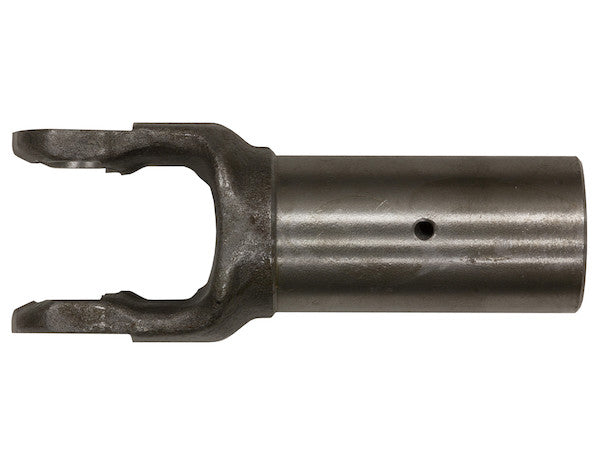
Buyers Products H7 Series Slip Yoke is a strong, durable component for your flexible coupling needs. The yoke works best with other driveline components from Buyers Products and is compatible with medium duty driveline components from other major manufacturers. It comes in a variety of bore sizes and shapes to work with your system. The slip yoke is made of forged steel to provide strength and durability. It works with the NB7A U-Joint to provide smooth and continuous torque transfer. The H7 Series End Yoke is perfect for medium duty applications with the ability to handle up to 800 inch pounds of torque at 1,000 RPM (12 HP).
Specifications
| Bore Dia/Width (in.) | 7/8 |
|---|---|
| Bore Type | Round |
| Center Line to End of Hub | 5.000 |
| Finish | Plain |
| Hub Diameter | 1.563 |
| Keyway at | 1 |
| Keyway Size (in.) | 1/4 |
| Lubricator at | 2 |
| Lubricator Thread | 1/4-28 TAPERED |
| Material | Cast Steel |
| Series | H7 |
Advanced Technical Overview: H7 Series Slip Yoke - Precision Engineered for Medium-Duty Driveline Integrity
The Buyers Products H7 Series Slip Yoke, featuring a 7/8 inch round bore with a 1/4 inch keyway, represents a critical component in the design and operation of robust medium-duty driveline systems. Engineered for precision and resilience, this slip yoke is a testament to the meticulous design principles required for effective power transmission in dynamic mechanical environments. Its primary function within a driveline assembly is to accommodate axial displacement, which arises from various operational factors such as suspension travel, chassis flex, and dynamic load variations, all while maintaining continuous and efficient torque transfer.
Understanding the Role of a Slip Yoke in Driveline Systems
In any driveline system, particularly those found in commercial vehicles, industrial machinery, and specialized equipment, maintaining constant alignment and power flow is paramount. The components of a driveline, including drive shafts, universal joints, and yokes, are subjected to complex forces and motions. A key challenge is managing variations in the effective length of the drive shaft as the distance between the transmission or transfer case output and the differential input changes. This axial movement, if not properly managed, would induce immense stress on bearings, seals, and other driveline components, leading to premature failure and operational inefficiencies.
The slip yoke is ingeniously designed to address this challenge. It is characterized by its spline interface with the drive shaft and its connection to a universal joint (U-joint), typically at the transmission or transfer case side. The internal splines of the slip yoke engage with the external splines of the drive shaft, allowing for controlled axial movement—or "slipping"—along the shaft's axis. This freedom of movement ensures that the drive shaft can lengthen and shorten as needed, preventing binding and excessive stress on the entire driveline. Without a functional slip yoke, driveline systems would be rigid, unable to absorb critical length variations, resulting in catastrophic mechanical failures and compromising the structural integrity of connected components.
The H7 Series: Material Science and Engineering for Durability
The H7 Series Slip Yoke is constructed from cast steel, a material choice that balances excellent mechanical properties with manufacturing feasibility and cost-effectiveness for medium-duty applications. Cast steel offers a combination of strength, ductility, and machinability, making it suitable for components subjected to significant torsional and bending stresses. Unlike wrought steel products, cast steel allows for complex geometries to be formed in a single process, which can enhance structural integrity by minimizing welded joints in critical stress areas.
The inherent properties of cast steel contribute significantly to the H7 Series' durability. Its microstructure provides good fatigue resistance under cyclic loading conditions, which are typical in driveline operation. Furthermore, cast steel exhibits respectable wear resistance, crucial for the splined interfaces and bearing surfaces within the yoke. The engineering design of the H7 Series leverages these material characteristics, ensuring that the slip yoke can withstand the dynamic loads, vibrations, and environmental exposures commonly encountered in medium-duty industrial and commercial settings. The plain finish of the component further underscores its industrial application, focusing on functional integrity over aesthetic embellishment, while allowing for potential post-processing like painting or coating by the end-user if specific environmental protection is required.
Precision Bore and Keyway Design: The Heart of Torque Transmission
A defining feature of this H7 Series Slip Yoke is its 7/8 inch round bore coupled with a 1/4 inch keyway. This specific bore configuration is fundamental to establishing a robust and precise mechanical connection with the mating shaft.
The 7/8 Inch Round Bore:
The precisely machined 7/8 inch (0.875 inch) round bore is designed to accommodate shafts of corresponding diameter with minimal clearance. This tight fit is crucial for several reasons:
- Accurate Centering: A snug fit ensures the shaft is accurately centered within the yoke, minimizing runout and eccentricity. This concentricity is vital for reducing vibrations and maintaining dynamic balance within the driveline system, thereby extending the life of bearings and other rotating components.
- Reduced Fretting Corrosion: By limiting relative movement between the shaft and the bore, the risk of fretting corrosion is significantly reduced. Fretting occurs when two surfaces in contact experience small oscillatory slip under load, leading to wear particles and surface degradation.
- Optimized Load Distribution: A precise fit ensures that loads are distributed evenly across the contact surfaces, preventing localized stress concentrations that could lead to premature material fatigue or yielding.
The 1/4 Inch Keyway:
The inclusion of a 1/4 inch keyway at the 1 o'clock position (as specified, implying a standard orientation convention for assembly) serves as a positive mechanical lock, fundamentally transforming the connection from a mere fit to a secure, torque-transmitting interface. A keyway is a groove machined into the bore of the yoke, designed to house a key – a separate piece of material (typically steel) that fits into corresponding keyseats in both the shaft and the yoke.
The primary functions of the 1/4 inch keyway are:
- Positive Torque Transmission: The keyway and key mechanism are designed to transmit high levels of torsional load without relying solely on friction between the shaft and the bore. This is critical for applications where sudden torque reversals or high peak torques are expected, ensuring that the shaft and yoke rotate as a single unit.
- Prevention of Relative Rotation: The key acts as a shear element, preventing any angular slip between the shaft and the yoke. This eliminates lost motion (backlash) and ensures synchronous rotation, which is vital for maintaining timing and efficiency in power transmission.
- Ease of Assembly and Disassembly: While providing a robust connection, keyways also allow for relatively straightforward assembly and disassembly of components, simplifying maintenance and repair procedures compared to permanent bonding methods.
- Standardization: The use of standard keyway sizes, like 1/4 inch, facilitates interchangeability and compatibility across various industrial applications, aligning with common shafting standards.
The combination of the round bore and keyway ensures that the H7 Series Slip Yoke provides not only the necessary axial flexibility but also an unyielding rotational connection, making it an ideal choice for demanding medium-duty power transmission scenarios.
Performance Parameters: Torque Capacity and RPM Limits
The H7 Series Slip Yoke is rated to handle up to 800 inch-pounds of torque at 1,000 RPM, which translates to approximately 12 horsepower (HP). These specifications are crucial indicators of the component's operational envelope and are central to its application suitability in medium-duty systems.
Torque Capacity (800 in-lb):
Torque is the rotational equivalent of force, representing the twisting effort applied to rotate an object. An 800 inch-pound (in-lb) rating signifies the maximum continuous torsional load that the slip yoke can safely transmit without incurring permanent deformation or immediate structural failure. In practical terms, this capacity is essential for systems that experience significant resistance to rotation, such as driving heavy hydraulic pumps, operating auxiliary equipment, or transmitting power through substantial gear reductions. Engineers must ensure that the maximum expected torque in their application, including potential transient overload conditions, remains within this specified limit to ensure long-term reliability and safety.
Rotational Speed (1,000 RPM):
Revolutions per minute (RPM) defines the rotational speed at which the component is designed to operate. A 1,000 RPM rating indicates the maximum continuous rotational velocity at which the slip yoke can perform efficiently while managing centrifugal forces, dynamic balancing, and internal heat generation. Exceeding this RPM limit can lead to increased vibration, accelerated wear of bearing surfaces, and potentially critical dynamic instability. For medium-duty applications, 1,000 RPM often correlates with the output speeds of many industrial engines, transmission power take-offs (PTOs), or hydraulic pump drives.
Power Equivalence (12 HP):
The relationship between torque, speed, and power is fundamental in mechanical engineering. Power (HP) = (Torque in lb-ft * RPM) / 5252, or in inch-pounds, Power (HP) = (Torque in in-lb * RPM) / 63025. Using the provided values: HP = (800 in-lb * 1000 RPM) / 63025 ≈ 12.69 HP. The rounded value of 12 HP indicates that the H7 Series Slip Yoke is well-suited for transmitting power levels typical of medium-duty auxiliary drives, PTO systems on smaller trucks, and various industrial machines where robust but not extreme power output is required. This rating highlights its suitability for applications such as operating smaller hydraulic pumps, powering conveyor systems, or driving various attachments on utility vehicles.
Seamless Integration with the NB7A U-Joint
The H7 Series Slip Yoke is specifically designed to work in conjunction with the NB7A U-Joint. This synergistic compatibility is not incidental but a deliberate engineering decision to ensure optimal performance and system integrity.
A universal joint, or U-joint, is indispensable for transmitting torque between shafts that operate at varying angles. It allows for angular misalignment while maintaining constant velocity, crucial in driveline systems where the driving and driven components are rarely in perfect coaxial alignment due to suspension movement, chassis flex, or inherent design. The NB7A U-Joint, when paired with the H7 Series Slip Yoke, forms a cohesive unit that efficiently manages both axial and angular displacements.
The precise dimensional and mechanical fit between the H7 Series Slip Yoke and the NB7A U-Joint minimizes wear, reduces vibration, and ensures smooth, continuous torque transfer. This integrated design approach not only simplifies component selection and assembly for system builders but also guarantees that the combined components operate within their intended performance parameters, maximizing the overall lifespan and reliability of the driveline. Using components designed to work together mitigates risks associated with mismatched parts, such as increased friction, premature fatigue, or even catastrophic failure.
Detailed Dimensional Specifications and Their Significance
Understanding the precise dimensions of the H7 Series Slip Yoke is paramount for proper system integration and performance.
-
Center Line to End of Hub: 5.000 inches (5 inches)
This measurement is critical for determining the overall effective length of the driveline assembly. It defines the distance from the center of the U-joint cross (the rotational axis of the U-joint) to the terminal end of the yoke's hub, where it typically connects to the shaft. Accurate knowledge of this dimension is essential for calculating driveline angles, ensuring adequate slip travel, and preventing interference with other vehicle or machine components. Deviations in this measurement can lead to incorrect driveline length, causing either binding (too long) or pulling apart (too short) of the slip mechanism, both of which are detrimental to system longevity. -
Hub Diameter: 1.563 inches
The hub diameter refers to the outer diameter of the cylindrical section of the yoke that houses the shaft and keyway. A robust hub diameter like 1.563 inches contributes to the overall strength and rigidity of the yoke. It provides sufficient material thickness around the bore and keyway to withstand torsional stresses, minimize distortion under load, and adequately support the shaft without deforming. This dimension also plays a role in determining the strength of the spline or keyway interface and the compatibility with specific seals if present at this interface.
Lubrication System: Ensuring Longevity and Efficiency
The H7 Series Slip Yoke incorporates a critical lubrication point, featuring a lubricator at the 2 o'clock position with a 1/4-28 TAPERED thread. This detail highlights a design commitment to maintainability and extended service life.
Lubrication is indispensable for any rotating or axially moving mechanical component. In a slip yoke, it serves several vital functions:
- Reduced Friction: Grease introduced through the lubricator (often a zerk fitting) creates a film between the mating surfaces of the splines and the internal bore, significantly reducing friction during axial movement and rotation. This minimization of friction decreases heat generation and energy loss.
- Wear Prevention: The lubricating film prevents direct metal-to-metal contact, which is the primary cause of abrasive wear, adhesive wear, and fretting corrosion. By keeping surfaces separated, the lubricant extends the operational life of both the slip yoke and the mating shaft splines.
- Corrosion Protection: Modern greases often contain additives that provide corrosion resistance, protecting the steel surfaces from rust and other forms of environmental degradation, particularly in applications exposed to moisture, salt, or harsh chemicals.
- Damping: The grease film can also help dampen minor vibrations and shocks within the driveline, contributing to smoother operation and reduced noise levels.
- Contaminant Purging: When fresh grease is added, old, contaminated grease is often pushed out, carrying with it wear particles and environmental debris, thereby cleaning the internal mechanism.
The 1/4-28 TAPERED thread specification for the lubricator ensures compatibility with standard grease gun fittings, simplifying routine maintenance. The tapered thread design provides a secure, leak-free connection for grease application. Regular lubrication according to manufacturer recommendations is crucial to harness these benefits and ensure the H7 Series Slip Yoke performs reliably throughout its service life. Neglecting lubrication can lead to accelerated spline wear, increased friction and heat, and eventually, premature component failure, leading to costly downtime and repairs.
Applications in Medium-Duty Environments
The H7 Series Slip Yoke's specifications—particularly its torque capacity, robust construction, and precise dimensions—make it ideally suited for a broad array of medium-duty applications across various industries. These environments demand reliable power transmission components that can withstand demanding operational cycles without the excessive weight or cost associated with heavy-duty counterparts.
Typical applications include:
- Utility Vehicles and Light Commercial Trucks: Used in drive shafts connecting transmissions to differentials, or in power take-off (PTO) systems driving auxiliary equipment like hydraulic pumps, generators, or winches. The ability to manage axial movement is critical as these vehicles navigate uneven terrain or operate specialized equipment.
- Agricultural Machinery: In smaller tractors, implements, or farm equipment, where power needs to be transmitted from the tractor's PTO to a driven attachment. The slip yoke accommodates the varying distances and angles as the implement moves relative to the tractor.
- Construction Equipment: In compact construction machinery, such as mini-excavators, skid steers, or concrete mixers, where auxiliary drives for hydraulic systems or attachments require flexible and robust power connections.
- Industrial Equipment: For conveyor systems, material handling equipment, specialized manufacturing machinery, or pump drives where medium power levels are transmitted and axial movement compensation is necessary due to thermal expansion, vibration, or structural flexibility.
- Marine Applications: In certain marine auxiliary drives or propulsion systems where shaft alignment is dynamic or requires axial compensation.
- Specialized Vehicles: For municipal vehicles, service trucks, or custom-built machinery that utilize PTOs for blowers, compressors, or other ancillary systems.
In all these applications, the H7 Series Slip Yoke provides the crucial interface for transmitting power reliably while protecting the driveline from detrimental axial forces, thereby extending the service life of the entire system.
Conclusion: A Foundation of Driveline Reliability
The Buyers Products H7 Series Slip Yoke with its 7/8 inch round bore and 1/4 inch keyway is more than just a mechanical part; it is a meticulously engineered component that forms a cornerstone of reliable power transmission in medium-duty applications. From its robust cast steel construction, chosen for an optimal balance of strength and durability, to its precise dimensional tolerances for the bore, keyway, and hub, every aspect of its design is geared towards unwavering performance.
Its specified torque capacity of 800 inch-pounds at 1,000 RPM, translating to approximately 12 horsepower, clearly delineates its operational capabilities, ensuring it can handle the rigorous demands of various industrial, commercial, and agricultural machinery. The intentional compatibility with the NB7A U-Joint further underscores Buyers Products' commitment to integrated system performance, minimizing design complexity and maximizing operational efficiency.
Moreover, the thoughtful inclusion of a standard 1/4-28 TAPERED thread lubricator at the 2 o'clock position highlights a proactive approach to maintainability, recognizing that diligent lubrication is key to achieving the extended service life and sustained reliability that modern applications demand. By effectively managing axial movement within the driveline while ensuring positive torque transfer, the H7 Series Slip Yoke plays a pivotal role in preventing premature wear, mitigating destructive stresses, and upholding the operational integrity of critical power transmission systems. For engineers and system integrators seeking a dependable, high-quality slip yoke for medium-duty requirements, the H7 Series offers an exemplary solution rooted in sound mechanical engineering principles.