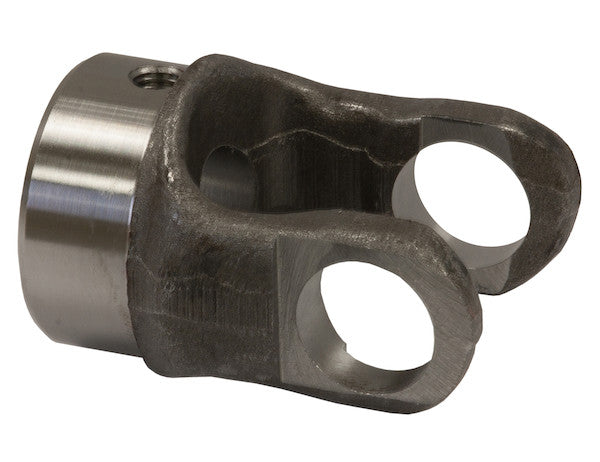
Buyers Products H7 Series End Yoke with Round Bore is a strong, durable component for your flexible coupling needs. The yoke is compatible with other major manufacturers' medium duty driveline components. It comes in a variety of bore sizes and shapes to work with your system. The yoke is made of forged steel for strength and durability. It works with Buyers Products NB7A U-joints to provide smooth and continuous torque transfer. The H7 Series End Yoke is perfect for medium duty applications with the ability to handle up to 800 inch pounds of torque at 1,000 RPM (12 HP).
Specifications
| Bore Dia/Width (in.) | 1-1/8 |
|---|---|
| Bore Type | Round |
| Center Line to End of Hub | 2.50 |
| End of Hub to Centerline of Set Screw Hole | 0.625 |
| Finish | Plain |
| Hub Dia (in.) | 2.00 |
| Joint Angle | 15 |
| Keyway At | 2 |
| Keyway Size (in.) | 1/4 |
| Material | Forged Steel |
| Series | H7 |
| Set Screw At | 4 |
| Set Screw Size | 3/8-16 |
Advanced Technical Overview: H7 Series End Yoke with 1-1/8 Inch Round Bore and 1/4 Inch Keyway
The H7 Series End Yoke, featuring a precise 1-1/8 inch round bore and a robust 1/4 inch keyway, represents a critical component in the engineering of medium-duty driveline systems. Manufactured by Buyers Products, this end yoke is meticulously designed to facilitate superior torque transmission, ensure driveline integrity, and offer extended operational longevity across a diverse range of industrial and mobile applications. Its specification profile underscores a commitment to both performance and compatibility, positioning it as an indispensable element for professionals requiring dependable power transfer solutions.
Precision Engineering: The Core of Driveline Efficiency
At the heart of any effective driveline system lies the precision of its components. The H7 Series End Yoke is a testament to this principle, engineered with exacting tolerances to meet the rigorous demands of power transmission. The primary interface for this component is its 1-1/8 inch round bore, meticulously machined to provide an optimal fit with corresponding cylindrical shafts. The round bore configuration is a standard in mechanical power transmission, offering simplicity in design while ensuring concentricity with the shaft axis. This precise diameter minimizes radial play, which is critical in preventing fretting corrosion and vibrational resonance that can lead to premature component failure. Furthermore, the smooth, uniform contact surface within the bore contributes to consistent load distribution, reducing stress concentrations and enhancing the fatigue life of both the yoke and the mating shaft.
Complementing the bore’s precision is the integrated 1/4 inch keyway, a fundamental feature for robust torque transfer. The keyway is cut to precise dimensions (1/4 inch in width) to accommodate a standard square or rectangular key, which effectively locks the yoke to the shaft, preventing rotational slippage. Positioned strategically (Keyway At: 2, implying an angular orientation, often referenced from a specific datum), the keyway ensures a positive mechanical interlock, capable of transmitting significant torsional loads without relying solely on a friction fit. The accuracy of the keyway's dimensions and its alignment are paramount; any deviation can introduce backlash or uneven load distribution, compromising the driveline's efficiency and lifespan. The keyway's design, in conjunction with the bore, establishes a secure and reliable mechanical coupling, essential for continuous and uninterrupted power flow.
Adding a secondary layer of security, the H7 Series End Yoke incorporates a 3/8-16 set screw, strategically located (Set Screw At: 4). This set screw serves as an auxiliary fastening mechanism, primarily designed to prevent axial movement of the yoke on the shaft, and secondarily to augment rotational resistance, particularly in dynamic environments characterized by intermittent or reversing torque applications. The 3/8-16 thread size indicates a robust fastening capability, and its specific angular placement allows for effective tightening and retention without interfering with other driveline components. This dual retention strategy – keyway for primary torque transmission and set screw for axial and supplementary rotational stability – exemplifies a comprehensive approach to driveline security and reliability.
Material Science and Manufacturing Integrity: Forged Steel Advantage
The selection of forged steel as the base material for the H7 Series End Yoke is a deliberate engineering choice that underscores its commitment to durability and performance. Forging is a manufacturing process that involves shaping metal through localized compressive forces, typically using hammers or dies. Unlike casting, which involves pouring molten metal into a mold, forging mechanically deforms the solid metal, resulting in a superior internal grain structure that aligns with the component’s contours. This alignment significantly enhances the material’s mechanical properties, offering several critical advantages:
- Superior Strength-to-Weight Ratio: Forged steel components possess higher tensile strength and yield strength compared to their cast counterparts, allowing them to withstand greater stresses without deformation or failure. This intrinsic strength contributes directly to the yoke's ability to handle up to 800 inch-pounds of torque at 1,000 RPM (12 HP) in medium-duty applications.
- Enhanced Fatigue Resistance: The refined grain structure and absence of internal voids or porosity (common in castings) make forged components highly resistant to fatigue crack initiation and propagation. This is crucial for driveline components that endure cyclical loading and dynamic stresses over extended operational periods.
- Improved Impact Toughness: Forging imparts excellent impact resistance, enabling the yoke to absorb sudden shock loads and vibrations without fracturing. This characteristic is particularly valuable in heavy-duty machinery and equipment where shock loads are inherent.
- Greater Ductility: While strong, forged steel also exhibits good ductility, allowing it to deform slightly under extreme loads before catastrophic failure, providing a margin of safety and often visual indicators of impending issues.
The manufacturing process further ensures a "Plain" finish, which refers to the raw, unpolished surface texture of the forged component. While not aesthetically enhanced, this finish is functionally appropriate for internal driveline components, where structural integrity and mechanical properties take precedence over surface aesthetics. The robust nature of forged steel, combined with precision machining, ensures that the H7 Series End Yoke maintains its structural integrity under challenging operational conditions, contributing to prolonged service life and reduced maintenance requirements.
Dimensional Specifications and System Integration
Understanding the dimensional specifications of the H7 Series End Yoke is crucial for proper system integration and assembly. Key dimensions include:
- Center Line to End of Hub: 2.50 inches. This measurement is vital for determining the overall length of the driveline assembly and ensuring adequate clearance within the machinery. It dictates the point at which the U-joint's centerline aligns relative to the end of the yoke's hub, impacting driveline balance and angularity.
- Hub Diameter: 2.00 inches. The outer diameter of the hub provides the necessary mass and structural integrity around the bore and keyway to safely transmit torque. This dimension also affects clearance with surrounding components and the overall strength of the yoke in torsion and bending.
- End of Hub to Centerline of Set Screw Hole: 0.625 inches. This dimension ensures that the set screw engages the shaft at an optimal depth, providing effective retention without compromising the structural integrity of the shaft or the yoke hub. Proper engagement prevents the set screw from stripping out or losing its grip under vibrational stress.
These precise dimensions allow engineers and technicians to confidently integrate the H7 Series End Yoke into new or existing driveline designs, ensuring proper alignment, fitment, and functional clearances. Adherence to these specifications guarantees optimal performance and longevity of the entire power transmission system.
Performance Capabilities and Application Context
The H7 Series End Yoke is specifically rated for medium-duty applications, capable of handling up to 800 inch-pounds of torque at 1,000 RPM, which translates to approximately 12 horsepower. These performance metrics are critical for assessing the yoke's suitability for various power transmission scenarios:
- Torque (800 inch-pounds): Torque is the rotational force that causes an object to rotate. An 800 inch-pound rating indicates the maximum continuous torsional load the yoke can sustain without failure or significant plastic deformation. This value is crucial for matching the yoke to the specific torque requirements of the driven equipment and the output capabilities of the power source.
- Rotational Speed (1,000 RPM): Revolutions Per Minute (RPM) denotes the operational speed at which the torque rating is valid. High RPMs can introduce dynamic forces and vibrations, so a component's ability to maintain its torque capacity at a given speed is a key indicator of its robust design and material integrity.
- Horsepower (12 HP): Horsepower (HP) is a measure of power, which is the rate at which work is done. It is directly proportional to both torque and RPM. The 12 HP rating provides an alternative, and often more intuitive, measure of the yoke's power transmission capacity for many application designers.
These ratings position the H7 Series End Yoke ideally for a broad spectrum of medium-duty industrial and mobile applications. Examples include, but are not limited to:
- Agricultural Equipment: Power take-off (PTO) shafts on smaller tractors, augers, conveyors, and auxiliary drives in farm machinery.
- Construction Equipment: Drives for smaller pumps, mixers, winches, and auxiliary attachments on compact utility loaders or mini excavators.
- Material Handling Systems: Conveyor belt drives, lifting mechanisms, and feeder systems in warehouses or light manufacturing facilities.
- Industrial Machinery: Drives for agitators, blowers, small compressors, and various processing equipment in manufacturing plants.
- Auxiliary Drives in Commercial Vehicles: Powering hydraulic pumps, air compressors, or other accessories on medium-duty trucks.
The "Joint Angle: 15" specification refers to the maximum permissible operating angle for the universal joint (U-joint) that mates with this end yoke. While the yoke itself is a rigid component, it is designed to interface with a U-joint that allows for angular misalignment between two rotating shafts. The 15-degree joint angle indicates the U-joint's capability to operate effectively and efficiently within this angular range. Exceeding this angle can lead to increased vibration, accelerated U-joint wear, reduced power transmission efficiency, and potential driveline failure. Proper driveline design mandates maintaining operating angles within specified limits to ensure smooth operation and component longevity. This specification highlights the need for careful system design and alignment during installation.
Compatibility and Interoperability
A significant advantage of the H7 Series End Yoke is its compatibility with other major manufacturers' medium-duty driveline components. This adherence to industry-standard dimensions and specifications ensures that the yoke can be readily integrated into existing systems or utilized as a reliable replacement part, minimizing downtime and simplifying procurement. Furthermore, its designed synergy with Buyers Products NB7A U-joints is a key highlight. Utilizing matched components from the same manufacturer ensures optimal fit, balanced performance, and a higher degree of reliability. The NB7A U-joint, when paired with the H7 Series End Yoke, forms a robust universal joint assembly capable of delivering smooth and continuous torque transfer, even across varying angular displacements, thereby maintaining driveline efficiency and reducing torsional irregularities.
Installation and Maintenance Best Practices
To maximize the operational life and performance of the H7 Series End Yoke, proper installation and routine maintenance are imperative. During installation, the mating shaft must be clean, free of burrs, and dimensionally accurate to ensure a proper fit within the 1-1/8 inch round bore and for the 1/4 inch keyway. The key must be correctly sized and seated without excessive play. The 3/8-16 set screw should be tightened to the manufacturer's specified torque to ensure secure retention, preventing both axial and rotational movement. Proper alignment of the entire driveline system, including phasing of universal joints, is critical to minimize vibration and extend the life of all components.
Maintenance practices should include regular inspection for signs of wear, corrosion, or damage, particularly around the bore, keyway, and set screw area. While the plain finish of the forged steel offers inherent durability, any significant surface degradation should be addressed. Lubrication of the associated universal joint (if applicable) and periodic re-evaluation of set screw torque are also recommended to ensure continued operational integrity. These preventative measures contribute significantly to the overall reliability and longevity of the driveline system, ultimately reducing total cost of ownership.
Conclusion
The H7 Series End Yoke with its 1-1/8 inch round bore and 1/4 inch keyway stands as a highly engineered, robust, and reliable component for medium-duty power transmission applications. Its construction from forged steel provides unparalleled strength, fatigue resistance, and impact toughness, ensuring prolonged performance under demanding conditions. The precise machining of the bore and keyway, coupled with the secondary retention mechanism of the set screw, guarantees secure and efficient torque transfer. With its defined performance envelope of 800 inch-pounds of torque at 1,000 RPM (12 HP) and compatibility with Buyers Products NB7A U-joints and other industry-standard components, this end yoke offers a versatile and dependable solution for engineers and technicians seeking optimal driveline integrity. By selecting the H7 Series End Yoke, users are investing in a component that exemplifies superior manufacturing quality, technical precision, and unwavering performance, thereby contributing to the operational efficiency and longevity of their machinery and equipment.