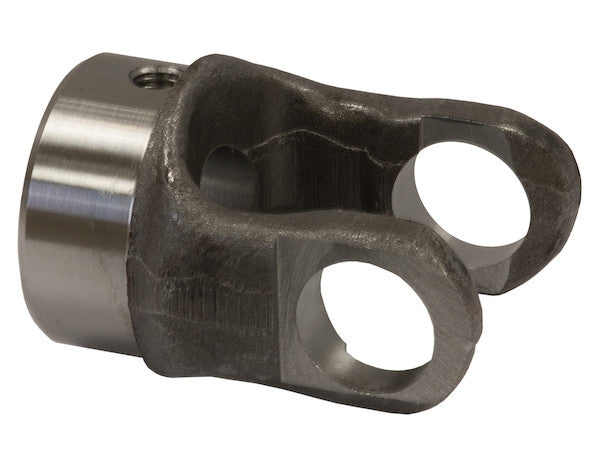
Buyers Products H7 Series End Yoke with Round Bore is a strong, durable component for your flexible coupling needs. The yoke is compatible with other major manufacturers' medium duty driveline components. It comes in a variety of bore sizes and shapes to work with your system. The yoke is made of forged steel for strength and durability. It works with Buyers Products NB7A U-joints to provide smooth and continuous torque transfer. The H7 Series End Yoke is perfect for medium duty applications with the ability to handle up to 800 inch pounds of torque at 1,000 RPM (12 HP).
Specifications
| Bore Dia/Width (in.) | 1-1/4 |
|---|---|
| Bore Type | Round |
| Center Line to End of Hub | 2.50 |
| End of Hub to Centerline of Set Screw Hole | 0.625 |
| Finish | Plain |
| Hub Dia (in.) | 2.00 |
| Joint Angle | 15 |
| Keyway At | 2 |
| Keyway Size (in.) | 5/16 |
| Material | Forged Steel |
| Series | H7 |
| Set Screw At | 1 |
| Set Screw Size | 3/8-16 |
The Buyers Products H7 Series End Yoke, featuring a 1-1/4 inch round bore and a 5/16 inch keyway, represents a critical component engineered for robust and reliable power transmission in medium-duty driveline applications. This product is meticulously designed to meet the rigorous demands of industrial and commercial environments where consistent torque transfer and exceptional durability are paramount. Its construction, adherence to established industry standards, and precise dimensional specifications ensure optimal performance and seamless integration into a wide array of mechanical systems.
Advanced Engineering and Material Science: Forged Steel Construction
The foundation of the H7 Series End Yoke's superior strength and longevity lies in its forged steel construction. Forging is a manufacturing process that involves shaping metal through localized compressive forces. Unlike casting, which involves pouring molten metal into a mold, forging mechanically deforms the metal while it is in a solid state, typically hot. This process refines the grain structure of the steel, eliminating internal voids, porosity, and other defects that can weaken a component. The result is a highly dense, uniform, and anisotropic grain flow that follows the contours of the part, significantly enhancing its mechanical properties.
Specifically, forged steel offers several critical advantages pertinent to driveline components:
- Superior Strength-to-Weight Ratio: The refined grain structure and absence of internal defects result in a component that can withstand higher stresses for its size and weight compared to cast or machined parts from similar alloys.
- Enhanced Fatigue Resistance: Driveline components are subjected to cyclical loading, which can lead to fatigue failure over time. The continuous grain flow in forged steel significantly improves its resistance to crack initiation and propagation, extending the operational life of the yoke.
- Increased Impact and Shock Load Resistance: The inherent ductility and toughness of forged steel make the H7 Series End Yoke exceptionally resilient against sudden impacts and variable shock loads, which are common in demanding applications. This minimizes the risk of catastrophic failure and ensures operational safety.
- Reduced Risk of Brittle Fracture: Forged steel typically exhibits higher notch toughness, making it less susceptible to brittle fracture, especially in cold environments or under concentrated stress.
- Consistency and Reliability: The controlled forging process leads to highly consistent mechanical properties from one part to another, ensuring predictable performance and reliability across the product line.
By utilizing forged steel, Buyers Products ensures that the H7 Series End Yoke is not merely a strong component but a highly reliable and durable asset capable of enduring the most challenging operational conditions, reducing downtime and maintenance costs.
Precision Bore and Keyway Design for Optimal Torque Transmission
The interface between the end yoke and the drive shaft is critical for efficient and secure power transfer. The H7 Series End Yoke features a 1-1/4 inch round bore, precision-machined to ensure concentricity and a snug fit with corresponding shafts. A round bore is the most common and versatile configuration, facilitating straightforward installation and broad compatibility with standard cylindrical shafts.
Complementing the round bore is a precisely cut 5/16 inch keyway. The keyway, a slot machined into the bore, serves as a crucial mechanical interlock when paired with a matching key and keyseat on the shaft. This keying mechanism is essential for transmitting rotational torque without slippage. The specific dimensions of the 5/16 inch keyway are standardized to ensure compatibility and robust engagement, providing a positive mechanical connection that prevents relative rotation between the yoke and the shaft. This method of connection is highly effective in applications requiring substantial torque transfer and prevents wear and fretting that can occur with purely friction-based connections, especially under dynamic loads.
The combination of a precise round bore and a dimensionally accurate keyway ensures:
- Positive Torque Transfer: The key directly transmits the rotational force from the shaft to the yoke, eliminating slippage even under high torque conditions.
- Accurate Positioning: The keyway assists in precise angular alignment of the yoke relative to the shaft.
- Reduced Stress Concentration: By distributing torque over a defined area, the keyway system minimizes stress concentrations that could otherwise lead to premature failure.
- Serviceability: The keyed connection allows for relatively easy assembly and disassembly for maintenance or replacement, unlike permanent bonding methods.
The specification "Keyway At: 2" implies a standard orientation or indexing for the keyway relative to another feature on the yoke, facilitating proper assembly and alignment within a driveline system.
The H7 Series Standard: A Benchmark for Medium-Duty Drivelines
The designation "H7 Series" indicates adherence to a specific set of dimensional and performance standards, positioning this end yoke within a classification designed for medium-duty applications. This series classification is crucial for system designers and maintenance personnel as it assures compatibility and interchangeability with other driveline components adhering to the same standard, including those from other major manufacturers. This cross-compatibility is a significant advantage, simplifying procurement, reducing inventory requirements, and providing flexibility in component selection and replacement.
Medium-duty applications typically encompass scenarios where power requirements are moderate but sustained, and where robustness against operational stresses is essential. Examples include auxiliary power take-offs (PTOs) on commercial vehicles, light to medium industrial machinery, agricultural equipment, construction equipment, and various material handling systems. The H7 Series components are engineered to provide the necessary strength and durability for these environments without the excessive weight or cost associated with heavy-duty components.
The H7 Series End Yoke is specifically designed to integrate seamlessly with Buyers Products NB7A U-joints. This complementary design ensures that when paired, the yoke and U-joint assembly operate with maximum efficiency, minimizing friction, vibration, and wear. The U-joint (universal joint) is a critical component that allows for angular misalignment between rotating shafts while transmitting torque smoothly and continuously. The precise fit between the H7 Series End Yoke and the NB7A U-joint's bearing cups is vital for maintaining proper articulation and preventing premature wear of the bearings and other driveline components. This integrated approach guarantees optimized system performance and extended service life.
Performance Metrics: Torque Capacity and Power Transmission
A key performance indicator for any driveline component is its torque capacity. The H7 Series End Yoke is engineered to handle up to 800 inch-pounds of torque at 1,000 RPM, translating to approximately 12 horsepower (HP). These figures are crucial for determining the suitability of the yoke for specific applications and for ensuring that the component operates within its safe working limits.
- Torque (800 in-lbs): Torque is the rotational force that causes rotation. 800 inch-pounds is a substantial amount of rotational force, indicating the yoke's ability to drive moderate loads effectively. To put this into perspective, 800 in-lbs is equivalent to approximately 66.67 foot-pounds (ft-lbs) or 90.38 Newton-meters (Nm). This capacity is well-suited for a range of medium-duty tasks, from powering hydraulic pumps and conveyors to actuating mechanical linkages.
- Rotational Speed (1,000 RPM): Revolutions per minute (RPM) represents the speed at which the component is designed to operate. 1,000 RPM is a common operational speed for many industrial and vehicle auxiliary drives. The yoke's ability to sustain this speed while transmitting significant torque speaks to its robust design and material integrity.
- Horsepower (12 HP): Horsepower is a unit of power, representing the rate at which work is done. It is directly related to torque and RPM by the formula: HP = (Torque in in-lbs * RPM) / 63,025. Using the provided figures: HP = (800 in-lbs * 1,000 RPM) / 63,025 ≈ 12.69 HP. This 12 HP rating confirms the yoke's capability for medium-duty power transmission, indicating it can efficiently transfer this amount of power without exceeding its design limits.
Operating within these specified parameters ensures the longevity and reliability of the end yoke and the entire driveline system. Exceeding these limits can lead to accelerated wear, component fatigue, and potential catastrophic failure, underscoring the importance of proper application sizing and system engineering.
Critical Dimensional Specifications and Their Importance
The detailed specifications provided are not merely numbers; they represent critical design parameters that dictate the fit, function, and performance of the H7 Series End Yoke within a driveline assembly.
- Center Line to End of Hub (2.50 in.): This dimension specifies the distance from the centerline of the U-joint bearing journals (where the U-joint crosses) to the end face of the yoke's hub. It is crucial for determining the overall length of the driveline assembly, ensuring proper clearance within the application, and accurately calculating driveline angles. Precise adherence to this dimension facilitates correct shaft engagement and prevents interference.
- Hub Diameter (2.00 in.): The hub diameter defines the outer dimension of the cylindrical portion of the yoke that accepts the shaft. A 2.00-inch hub diameter ensures adequate material thickness around the 1-1/4 inch bore and 5/16 inch keyway to withstand torsional stresses without deformation or failure. It also provides sufficient surface area for robust connection points and overall structural integrity.
- End of Hub to Centerline of Set Screw Hole (0.625 in.): This measurement dictates the axial position of the set screw hole relative to the end of the hub. It is vital for ensuring that the set screw, when installed, properly engages the shaft. Correct positioning prevents the set screw from binding on the shaft's end or from being too far recessed to provide effective clamping, which is particularly important when aligning with a pre-drilled dimple on the shaft for enhanced security.
- Joint Angle (15 degrees): While the end yoke itself doesn't "angle," this specification likely refers to the maximum operational angle that the associated U-joint (like the NB7A) can accommodate without excessive wear or vibration when paired with this yoke. Adhering to manufacturer-recommended maximum operating angles for U-joints is critical for preventing premature failure of the joint, bearings, and other driveline components, ensuring smooth and efficient power transfer.
These precise dimensions are fundamental for engineers and mechanics to select the correct components, ensure proper fit, and maintain the integrity and longevity of the driveline system.
The Role of the Set Screw: Security and Alignment
The H7 Series End Yoke incorporates a 3/8-16 set screw, strategically positioned (Set Screw At: 1) for securing the yoke to the shaft. While the keyway provides the primary positive drive mechanism for torque transfer, the set screw serves a complementary and equally important function:
- Axial Retention: The set screw clamps down on the shaft, preventing axial movement (sliding along the shaft) of the yoke. This is essential for maintaining the driveline's proper length and preventing the yoke from disengaging from the shaft.
- Enhanced Torsional Security: Although the key handles the bulk of the torque, the set screw adds an additional layer of torsional security by increasing the friction between the bore and the shaft, particularly useful during transient torque loads or sudden changes in direction.
- Alignment Maintenance: The set screw assists in maintaining the correct angular alignment established by the key and keyway, especially during periods of vibration or dynamic loading.
A 3/8-16 set screw is a common size, indicating a standard coarse thread pitch and diameter that provides substantial clamping force. Proper torqueing of the set screw during installation is critical to achieve its intended function without damaging the shaft or the yoke's threads.
Plain Finish: Versatility and Customization
The "Plain" finish of the H7 Series End Yoke indicates that the forged steel component has not undergone any additional surface coating or treatment beyond typical manufacturing processes. This plain finish offers several practical advantages:
- Cost-Effectiveness: Eliminating secondary coating processes helps to keep manufacturing costs down, which can translate into a more economical product for the end-user.
- Versatility: A plain finish allows end-users or system integrators the flexibility to apply their own specialized coatings, paints, or treatments as required by the specific operating environment. For instance, in highly corrosive environments, a user might apply a marine-grade paint or a specialized anti-corrosion coating.
- Inspection Clarity: A plain finish makes it easier to visually inspect the material for any potential surface defects or indications of wear during routine maintenance without the obstruction of a thick coating.
While plain steel may be susceptible to surface rust in humid environments, this is often a superficial concern that does not compromise the structural integrity of a forged component and can be mitigated with appropriate post-installation protection if necessary.
Applications and Operational Environments
The H7 Series End Yoke is ideally suited for a diverse range of medium-duty applications where reliability, durability, and efficient power transfer are essential. Its robust design and specified performance characteristics make it a preferred choice for:
- Agricultural Machinery: Driving components in tractors, harvesters, spreaders, and other farm implements.
- Light and Medium Industrial Equipment: Conveyor systems, pump drives, mixer drives, processing equipment, and general industrial machinery requiring reliable power transmission.
- Commercial Vehicle Auxiliary Systems: Powering PTOs for dump truck hydraulics, utility vehicle attachments, salt spreaders, and other mobile equipment.
- Construction Equipment: Small to medium-sized excavators, loaders, and compact utility equipment.
- Material Handling Systems: Forklifts, scissor lifts, and various lifting and positioning devices.
In these applications, the H7 Series End Yoke contributes to the overall operational efficiency and longevity of the machinery by providing a stable and durable link in the driveline, effectively managing the transfer of torque under varying loads and conditions.
Installation, Maintenance, and Longevity
The longevity and optimal performance of the H7 Series End Yoke are significantly influenced by proper installation and routine maintenance practices. Key considerations include:
- Accurate Alignment: Ensuring the shaft is properly aligned with the bore and the key and keyway are fully engaged.
- Secure Fastening: Correctly torqueing the set screw to the manufacturer's recommendations.
- U-Joint Installation: Proper assembly of the compatible Buyers Products NB7A U-joint, including lubrication of its bearing cups and ensuring free movement within the yoke's journals.
- Regular Inspection: Periodically checking for signs of wear, corrosion, or loosening of fasteners.
Due to its forged steel construction, the H7 Series End Yoke inherently offers a low-maintenance solution. Its resistance to fatigue and impact reduces the frequency of replacements and repairs, translating to lower operational costs and increased uptime for the equipment it serves. When installed correctly and operated within its specified parameters, this end yoke is designed to provide many years of reliable service.
Conclusion
The Buyers Products H7 Series End Yoke with its 1-1/4 inch round bore and 5/16 inch keyway is a testament to precision engineering and robust material science. Its forged steel construction, combined with meticulous dimensional accuracy and a proven design, positions it as an exceptionally strong and durable component for flexible coupling needs in medium-duty applications. With the capability to efficiently transfer 800 inch-pounds of torque at 1,000 RPM, translating to approximately 12 horsepower, it provides reliable power transmission for a wide array of industrial, commercial, and agricultural machinery. Its compatibility with standard driveline components, particularly Buyers Products NB7A U-joints, ensures seamless integration and optimized performance. This end yoke is not just a part; it's a critical investment in the reliability, efficiency, and longevity of your power transmission systems.