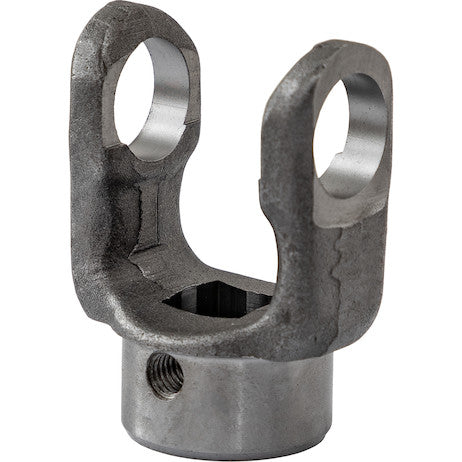
Buyers Products H7 Series End Yoke with Square Bore is a strong, durable component for your flexible coupling needs. The yoke is compatible with other major manufacturers' medium duty driveline components. It comes in a variety of bore sizes and shapes to work with your system. The yoke is made of forged steel for strength and durability. It works with Buyers Products NB7A U-joints to provide smooth and continuous torque transfer. The H7 Series End Yoke is perfect for medium duty applications with the ability to handle up to 800 inch pounds of torque at 1,000 RPM (12 HP).
Specifications
| Bore Dia/Width (in.) | 3/4 |
|---|---|
| Bore Type | Square |
| Center Line to End of Hub | 2.50 |
| End of Hub to Centerline of Set Screw Hole | 0.625 |
| Finish | Plain |
| Hub Dia (in.) | 1-5/8 |
| Joint Angle | 15 |
| Keyway At | Square |
| Keyway Size (in.) | - |
| Material | Forged Steel |
| Series | H7 |
| Set Screw At | 4 |
| Set Screw Size | 3/8-16 |
The H7 Series End Yoke with 3/4 Inch Square Bore: Precision Engineering for Medium-Duty Driveline Systems
The Buyers Products H7 Series End Yoke, featuring a precise 3/4 inch square bore, stands as a testament to robust engineering and materials science in the realm of mechanical power transmission. Designed specifically for medium-duty applications, this component is an indispensable link in flexible coupling systems, facilitating the smooth and efficient transfer of rotational power while accommodating angular misalignment between driving and driven shafts. Its integration into a driveline system underscores a commitment to reliability, durability, and operational efficiency, making it an optimal choice for discerning engineers and maintenance professionals across various industries.
Fundamental Role of the End Yoke in Power Transmission
An end yoke serves as a critical interface in a universal joint (U-joint) assembly, connecting a rotating shaft to the U-joint cross and bearing cups. Its primary function is to transmit torque from the input shaft to the U-joint, which then transfers this torque to another yoke, ultimately driving the output shaft. In scenarios involving angular displacement, such as those frequently encountered in agricultural machinery, industrial conveyors, and certain off-highway vehicles, the U-joint, with the end yoke as its foundational component, allows for continuous power flow without imposing excessive bending stresses on the shafts or associated bearings. The H7 Series End Yoke is engineered to withstand the dynamic and torsional loads inherent in these applications, ensuring a long operational life and minimizing downtime.
The H7 Series Designation: Engineered for Medium Duty
The "H7 Series" designation is not merely a product code; it signifies a specific engineering classification within Buyers Products' extensive line of driveline components. This series is meticulously designed for medium-duty applications, a category characterized by moderate torque requirements and operating speeds, often subjected to intermittent or continuous operation under varying environmental conditions. The H7 Series is engineered to strike an optimal balance between strength, weight, and cost-effectiveness for this specific operational envelope. Its design parameters, including material selection, structural geometry, and interface specifications, are optimized to ensure reliable performance without over-engineering for light-duty tasks or falling short in heavy-duty scenarios. This precise classification allows users to select components that are perfectly matched to their system's demands, thereby maximizing efficiency and component longevity.
Unpacking the 3/4 Inch Square Bore: Precision and Compatibility
The most defining characteristic of this particular end yoke is its 3/4 inch square bore. A square bore is a specialized type of shaft coupling designed to transmit torque effectively by mating with a square-profiled shaft. Unlike round shafts that rely on keyways or splines for torque transfer, a square bore inherently provides a positive, interference-fit type of engagement with a corresponding square shaft. This design offers several advantages in specific applications:
- High Torque Transfer: The full contact area of the square bore and shaft minimizes stress concentrations, allowing for efficient transmission of substantial torque without the risk of shearing associated with undersized keys.
- Simplified Assembly: For certain applications, aligning a square shaft with a square bore can be simpler than aligning splines or inserting keys, particularly in field service environments.
- Axial Movement: While primarily designed for torque, square shafts can also accommodate some degree of axial movement, which can be beneficial in applications requiring slight telescopic action, albeit not as freely as splined shafts.
- Specific Application Suitability: Square shafts and bores are commonly found in agricultural equipment (e.g., PTO shafts for implements), certain industrial mixers, conveyors, and custom machinery where a robust, straightforward, and cost-effective torque transfer method is preferred. The 3/4 inch dimension indicates a standard size, ensuring broad compatibility within its intended medium-duty context.
The precision machining of the 3/4 inch square bore is critical. Any deviation from tolerance can lead to excessive backlash, increased wear, and premature component failure. Buyers Products' manufacturing processes ensure that these critical dimensions are held to tight specifications, providing a secure and durable interface for the shaft.
Material Science: The Strength of Forged Steel
The selection of forged steel as the primary material for the H7 Series End Yoke is a deliberate engineering decision rooted in the demand for superior mechanical properties. Forging is a manufacturing process that involves shaping metal using localized compressive forces. This process fundamentally alters the metal's microstructure, resulting in several distinct advantages over cast or machined components:
- Enhanced Strength-to-Weight Ratio: Forged steel exhibits a higher tensile strength, yield strength, and fatigue strength compared to cast or even standard machined steel. The forging process refines the grain structure of the steel, eliminating internal voids and porosity, which are common weaknesses in castings. This results in a denser, more uniform material capable of withstanding higher stresses.
- Superior Toughness and Impact Resistance: The uniform grain flow achieved through forging follows the contours of the part, aligning with the direction of maximum stress during operation. This "grain flow" orientation imparts exceptional toughness and resistance to impact loads and sudden shocks, critical for components in dynamic driveline systems.
- Improved Fatigue Life: Components in rotational power transmission systems are constantly subjected to cyclic loading, which can lead to fatigue failure over time. The homogeneous microstructure and absence of internal defects in forged steel significantly improve its fatigue resistance, extending the operational life of the end yoke under repetitive stress conditions.
- Reduced Material Waste: Forging can be a near-net-shape process, minimizing the amount of material that needs to be removed through subsequent machining, leading to more efficient material utilization.
The "Plain" finish specified indicates that the component has not undergone additional surface treatments like plating or painting, preserving the inherent strength and integrity of the forged steel. While some applications may benefit from protective coatings, the plain finish is suitable for many environments where the robust nature of the steel itself provides adequate durability.
System Integration and Compatibility: A Universal Approach
The H7 Series End Yoke is engineered not only for standalone performance but also for seamless integration within broader driveline ecosystems. Its stated compatibility with "other major manufacturers' medium duty driveline components" highlights an adherence to industry standards, allowing for flexibility in component sourcing and system design. This cross-compatibility is invaluable for operators and system integrators who may need to replace components in existing setups or build custom systems using parts from various suppliers.
Furthermore, the specific mention of its compatibility with "Buyers Products NB7A U-joints" provides a clear indication of a validated, optimized pairing within the Buyers Products ecosystem. When an H7 Series End Yoke is coupled with an NB7A U-joint, users can expect:
- Optimized Performance: The design parameters of both components are complementary, ensuring efficient torque transfer and minimal wear within the universal joint assembly.
- Reduced Vibration: Properly matched components contribute to a balanced driveline system, minimizing undesirable vibrations that can lead to noise, discomfort, and accelerated wear on surrounding machinery.
- Extended Service Life: When components are designed to work together, their collective lifespan is maximized, reducing maintenance intervals and total cost of ownership.
- Simplified Sourcing: For customers seeking a complete, integrated solution, Buyers Products offers a comprehensive range of compatible components, simplifying the procurement process.
Performance Envelope: Torque, RPM, and Horsepower
The performance specifications of the H7 Series End Yoke are clearly defined, providing critical data points for engineers to validate its suitability for a given application: "up to 800 inch pounds of torque at 1,000 RPM (12 HP)." Understanding these metrics is crucial:
- Torque (800 inch pounds): Torque is the rotational equivalent of force, representing the twisting force that causes rotation. 800 inch-pounds signifies the maximum continuous torque this yoke can reliably transmit without undergoing plastic deformation or fatigue failure under ideal conditions. It's a direct measure of the yoke's strength in handling rotational loads.
- Rotations Per Minute (1,000 RPM): This figure indicates the maximum operational speed at which the yoke can sustain the specified torque. High RPMs can introduce dynamic stresses, heat generation, and vibratory challenges. The H7 Series is rated to perform efficiently at this speed, provided the system is balanced and aligned.
-
Horsepower (12 HP): Horsepower (HP) is a measure of mechanical power, which is directly related to torque and rotational speed by the formula:
HP = (Torque in inch-pounds * RPM) / 63,025. Using the given values:HP = (800 * 1,000) / 63,025 ≈ 12.69 HP. The rating of 12 HP confirms the consistent and reliable power output the yoke can handle, aligning with its medium-duty classification. This unified specification ensures that the component's capabilities are clearly communicated, allowing for precise system design and preventing over-stressing or under-utilization.
Detailed Specifications and Their Engineering Significance
Beyond the primary performance figures, the detailed specifications provide crucial insights into the precise dimensions and operational characteristics of the H7 Series End Yoke:
- Center Line to End of Hub (2.50 inches): This dimension is critical for calculating the overall length of the driveline assembly, determining clearance requirements, and ensuring proper shaft engagement within the hub. Accurate measurement is vital for preventing shaft bottoming out or insufficient insertion.
- End of Hub to Centerline of Set Screw Hole (0.625 inches): This measurement guides the correct positioning of the set screw for optimal shaft retention. It ensures that the set screw engages the shaft securely within the hub, preventing axial movement and maintaining the integrity of the torque transfer.
- Hub Diameter (1-5/8 inches): The hub diameter is a key structural dimension, indicating the external size of the portion of the yoke that houses the bore. A robust hub diameter provides the necessary material thickness to contain the stresses generated by the engaged shaft and the set screw, contributing to the overall strength and rigidity of the component.
- Joint Angle (15 degrees): While primarily a specification for the universal joint itself, its inclusion here suggests that the yoke is designed to operate effectively within a driveline system that anticipates a maximum continuous operating angle of 15 degrees. Exceeding this angle can lead to increased friction, heat, wear, and potential vibratory issues within the U-joint and the driveline system as a whole. This specification guides system designers in ensuring proper driveline geometry.
- Keyway At (Square): This reiterates the nature of the bore, confirming that the torque transfer mechanism relies on the square profile of the bore itself rather than a separate key.
- Set Screw At (4), Set Screw Size (3/8-16): The set screw is the primary means of securing the end yoke axially onto the shaft once the square bore has been engaged. The "Set Screw At (4)" likely refers to the angular position of the set screw hole relative to a reference point on the yoke (e.g., 90 degrees if reference is 0), ensuring consistent installation. The "3/8-16" size indicates a standard UNC (Unified National Coarse) thread, ensuring readily available replacement fasteners and sufficient clamping force for medium-duty applications. Proper torquing of the set screw is essential for maintaining the integrity of the connection.
Applications in Medium-Duty Environments
The H7 Series End Yoke with a 3/4 inch square bore is ideally suited for a diverse range of medium-duty industrial and mobile applications where reliable power transmission and angular flexibility are paramount. Potential applications include:
- Agricultural Equipment: Power Take-Off (PTO) shafts on smaller implements, augers, mixers, spreaders, and other farm machinery requiring square shaft connections.
- Industrial Machinery: Conveyor systems, agitators, small mixers, pump drives, light-to-medium duty packaging machinery, and other process equipment that utilize square shafts for robust torque transfer.
- Construction Equipment: Certain components in compact utility loaders, trenchers, and other light construction vehicles where power needs to be transmitted at varying angles.
- Specialized Vehicles: Custom-built utility vehicles, ground support equipment, and other specialized mobile platforms.
- General Mechanical Drives: Any application requiring a dependable flexible coupling capable of handling up to 800 inch-pounds of torque at 1,000 RPM, where a square shaft interface is preferred.
Installation and Maintenance Considerations
Proper installation and routine maintenance are paramount to achieving the full operational life and performance of the H7 Series End Yoke and the entire driveline system. Key considerations include:
- Shaft Preparation: Ensure the mating square shaft is clean, free of burrs, and within dimensional tolerances to ensure a snug fit within the bore.
- Alignment: While the U-joint accommodates angular misalignment, ensuring the driveline operates within its specified joint angles (e.g., the 15-degree maximum mentioned) is crucial. Poor alignment can lead to excessive vibration, heat, and premature wear on the yoke, U-joints, and bearings.
- Set Screw Torquing: Adhere to recommended torque specifications for the 3/8-16 set screw to ensure secure shaft retention without over-stressing the hub material.
- Lubrication: While the yoke itself doesn't require lubrication, the universal joint it supports does. Regular greasing of the U-joint cross and bearings with the appropriate lubricant is essential for minimizing friction and maximizing lifespan.
- Inspection: Periodically inspect the yoke and entire driveline for signs of wear, corrosion, cracks, loose fasteners, or excessive play. Early detection of issues can prevent catastrophic failures.
Conclusion: A Benchmark in Medium-Duty Driveline Components
The Buyers Products H7 Series End Yoke with a 3/4 inch square bore represents a meticulously engineered component designed to deliver uncompromising performance in medium-duty power transmission applications. Its construction from forged steel ensures superior strength, durability, and resistance to fatigue and impact, critical attributes for components subjected to dynamic loads. The precision 3/4 inch square bore offers a robust and efficient torque transfer mechanism, while its compatibility with Buyers Products NB7A U-joints and other industry-standard components provides unmatched flexibility for system designers and maintenance teams. With clearly defined performance metrics of 800 inch-pounds of torque at 1,000 RPM (12 HP), this end yoke is a reliable and high-value choice for a wide array of industrial, agricultural, and specialized machinery applications requiring dependable rotational power transfer under challenging conditions. Investing in the H7 Series End Yoke is an investment in the longevity, efficiency, and reliability of your driveline systems.