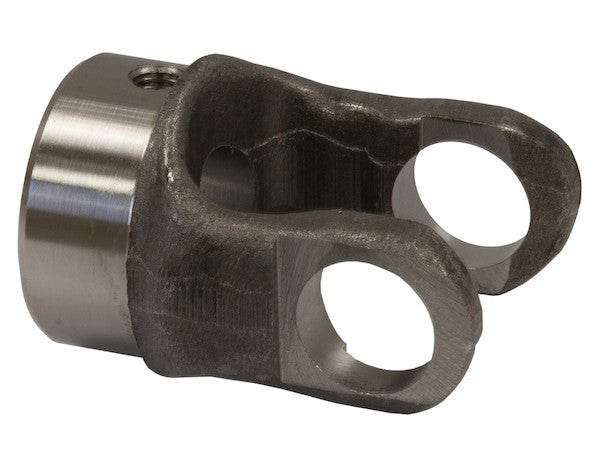
Buyers Products H7 Series End Yoke with Round Bore is a strong, durable component for your flexible coupling needs. The yoke is compatible with other major manufacturers' medium duty driveline components. It comes in a variety of bore sizes and shapes to work with your system. The yoke is made of forged steel for strength and durability. It works with Buyers Products NB7A U-joints to provide smooth and continuous torque transfer. The H7 Series End Yoke is perfect for medium duty applications with the ability to handle up to 800 inch pounds of torque at 1,000 RPM (12 HP).
Specifications
| Bore Dia/Width (in.) | 7/8 |
|---|---|
| Bore Type | Round |
| Center Line to End of Hub | 2.50 |
| End of Hub to Centerline of Set Screw Hole | 0.625 |
| Finish | Plain |
| Hub Dia (in.) | 1-5/8 |
| Joint Angle | 15 |
| Keyway At | 2 |
| Keyway Size (in.) | 1/4 |
| Material | Forged Steel |
| Series | H7 |
| Set Screw At | 4 |
| Set Screw Size | 3/8-16 |
Advanced Technical Overview: H7 Series End Yoke with 7/8 Inch Round Bore and 1/4 Inch Keyway
The Buyers Products H7 Series End Yoke, featuring a precisely engineered 7/8 inch round bore and a robust 1/4 inch keyway, represents a cornerstone component in driveline systems requiring dependable and efficient power transmission. This specialized end yoke is meticulously designed to serve as a critical interface between a rotating shaft and a universal joint (U-joint), facilitating the transfer of rotational energy while accommodating angular misalignment inherent in many mechanical setups. Its construction and detailed specifications underscore a commitment to performance, durability, and seamless integration within medium-duty applications across a diverse range of industries.
Foundational Role in Driveline Mechanics
An end yoke functions as a mechanical coupler, securing the shaft of a power source or driven component to the cross and bearing assembly of a universal joint. This particular H7 Series end yoke is engineered to integrate with a male shaft via its 7/8 inch round bore, ensuring a positive connection through the specified 1/4 inch keyway and reinforced by a 3/8-16 set screw. This arrangement is crucial for preventing rotational slippage and minimizing backlash, which are vital for maintaining synchronous rotation and preserving the longevity of connected components. The "End Yoke" designation highlights its position at either the input or output terminal of a driveline segment, connecting to a rotating shaft.
Unparalleled Material Science: Forged Steel Construction
The selection of forged steel as the primary material for the H7 Series End Yoke is a deliberate engineering decision that significantly enhances its performance characteristics. Forging is a manufacturing process where metal is shaped through localized compressive forces, often performed hot. This process fundamentally alters the grain structure of the steel, aligning it with the component's shape and creating a continuous grain flow that follows the contours of the yoke. The advantages of this metallurgical enhancement are numerous:
- Superior Strength-to-Weight Ratio: Forged steel typically exhibits higher tensile strength and yield strength compared to cast or machined steel, allowing the component to withstand greater loads without deformation or fracture.
- Enhanced Fatigue Resistance: The refined grain structure and absence of internal voids or porosity, common in casting, significantly improve the material's resistance to fatigue, extending the service life of the yoke under cyclic loading conditions.
- Impact Toughness: Forging imparts excellent impact resistance, a crucial property for driveline components that may encounter shock loads or vibrations during operation.
- Reduced Imperfections: The forging process tends to eliminate internal gas pockets, shrinkage, and other defects, resulting in a more homogenous and structurally sound component.
- Durability in Demanding Environments: The inherent toughness and structural integrity of forged steel contribute to the yoke's ability to endure harsh operational environments, including varying temperatures, abrasive conditions, and exposure to corrosive agents, particularly when paired with an appropriate finish.
The plain finish on this particular H7 Series yoke denotes a raw, untreated surface, which provides flexibility for end-users to apply specific coatings or treatments as dictated by their application's environmental requirements, or it can be used as-is in less aggressive conditions where corrosion is not a primary concern or where the yoke is housed within a protected assembly.
Precision Bore and Keyway System for Positive Torque Transmission
The 7/8 inch round bore is precision-machined to ensure a tight, concentric fit with the mating shaft. A snug fit is paramount for minimizing vibration and fretting corrosion at the interface. The "Round Bore Type" indicates compatibility with standard cylindrical shafts, a common configuration for industrial and mobile power transmission systems.
Complementing the bore is a 1/4 inch keyway, positioned at the 2 o'clock orientation. The keyway and its corresponding key (not included, typically supplied with the shaft) form a robust mechanical interlock that is the primary mechanism for transmitting torque from the shaft to the yoke. The key engages both the keyway in the yoke and a matching keyseat in the shaft, preventing relative rotation between the two components. The specified size of 1/4 inch ensures an adequate shear area for the key to handle the rated torque capacity of the H7 series. The "Keyway At: 2" specification refers to the angular position of the keyway relative to a reference point, providing critical information for assembly alignment and system design, especially in applications where rotational timing or balancing is important.
Reinforced Shaft Retention: The Set Screw Mechanism
Beyond the positive drive provided by the keyway, the H7 Series End Yoke incorporates a 3/8-16 set screw, strategically located at the 4 o'clock position. The set screw serves a dual purpose:
- Axial Retention: It secures the shaft axially within the yoke, preventing unintended withdrawal, especially under dynamic loads, vibrations, or when angular forces are applied through the U-joint.
- Supplementary Rotational Security: While the keyway handles the primary torque transmission, the set screw provides an additional layer of rotational security, particularly important in applications where transient overloads or sudden reversals might challenge the key's integrity. The set screw applies a compressive force directly onto the shaft, creating friction that resists rotational and axial movement.
The thread specification of 3/8-16 (3/8 inch nominal diameter with 16 threads per inch) indicates a common and robust fastener size, capable of applying significant clamping force. The "Set Screw At: 4" position ensures proper clearance and accessibility for installation and maintenance, while also often being diametrically opposed or offset from the keyway for balanced clamping and to avoid interference with the key itself.
Dimensional Precision and System Integration
The precise dimensional specifications of the H7 Series End Yoke are critical for ensuring proper fit, alignment, and balance within a driveline assembly. These include:
- Center Line to End of Hub (2.50 in.): This measurement defines the axial length from the center plane of the U-joint cross (the centerline where the U-joint bearings reside) to the end face of the yoke's hub. This dimension is crucial for calculating overall driveline lengths, accommodating shaft end clearances, and ensuring correct U-joint angularity. Precise control over this dimension aids in minimizing vibration and prolonging bearing life.
- End of Hub to Centerline of Set Screw Hole (0.625 in.): This dimension locates the set screw hole axially relative to the hub's end. It ensures that the set screw engages the shaft at a sufficient depth for secure retention without compromising the shaft's structural integrity or interfering with other components.
- Hub Diameter (1-5/8 in.): The robust 1-5/8 inch hub diameter provides the necessary material cross-section to accommodate the bore, keyway, and set screw hole, while also providing ample strength to withstand torsional and bending stresses transferred from the U-joint and shaft. A larger hub diameter often correlates with increased strength and rigidity, contributing to the yoke's overall durability.
The specified "Joint Angle: 15" refers to the maximum recommended operating angle for the associated universal joint and driveline system. While the yoke itself is a static component in terms of angle, this specification is paramount for designing the entire driveline. Operating a U-joint beyond its maximum allowable joint angle can lead to excessive vibration, premature wear of bearings and seals, and ultimately, driveline failure. The H7 Series is designed to facilitate smooth operation within these prescribed angular limits when paired with appropriate U-joints like the Buyers Products NB7A.
Performance Envelope: Medium-Duty Capacity
The H7 Series End Yoke is explicitly engineered for medium-duty applications, characterized by its ability to handle up to 800 inch-pounds of torque at 1,000 RPM, equating to approximately 12 horsepower. This performance rating is a critical benchmark for system designers:
- Torque (800 in-lbs): Torque is the rotational force applied to the shaft. 800 inch-pounds signifies a substantial rotational force, suitable for a wide array of industrial and mobile equipment where power transfer is significant but not in the heavy-duty industrial realm. Designers must ensure that the maximum operating torque of their system remains within or below this limit, applying appropriate safety factors.
- Rotational Speed (1,000 RPM): This indicates the maximum continuous rotational velocity at which the yoke can effectively transmit the rated torque. Higher speeds can introduce dynamic stresses, heat generation, and critical speed phenomena. Adhering to the RPM limit is essential for preventing premature wear and failure of the yoke and interconnected components, particularly the U-joint bearings.
- Horsepower (12 HP): Horsepower is a derived unit of power, representing the rate at which work is done. It is directly proportional to both torque and RPM (HP = Torque (in-lbs) x RPM / 63,025). The 12 HP rating confirms the yoke's capability for common medium-duty power requirements, providing a holistic view of its operational envelope.
This balanced performance specification makes the H7 Series End Yoke an ideal choice for machinery that operates under consistent, moderate loads, demanding reliable power transmission without the over-engineering or cost associated with heavy-duty components.
Seamless Compatibility and System Integration
A key advantage of the H7 Series is its designed compatibility with other major manufacturers' medium-duty driveline components. This interoperability provides engineers and maintenance professionals with flexibility in sourcing and replacement, simplifying inventory management and ensuring broad applicability. The H7 Series adheres to established industry standards for medium-duty driveline series, allowing for confident integration into existing systems or new designs. Furthermore, its optimized design to work specifically with Buyers Products NB7A U-joints guarantees a perfect fit and synergistic performance, facilitating smooth, continuous torque transfer. This system approach minimizes potential mismatches and ensures that the U-joint's capabilities are fully realized when paired with this yoke.
Diverse Application Spectrum
The robust construction and balanced performance of the H7 Series End Yoke with its 7/8 inch round bore and 1/4 inch keyway make it suitable for a broad spectrum of medium-duty applications, including but not limited to:
- Agricultural Equipment: Power take-off (PTO) shafts for implements such as spreaders, small balers, and tillers.
- Industrial Machinery: Drives for conveyor systems, pump drives, mixer drives, and other processing equipment in manufacturing plants.
- Utility and Municipal Vehicles: Auxiliary equipment drives on service trucks, refuse vehicles, and street sweepers.
- Light Construction Equipment: Drives for smaller excavators, trenchers, and material handling equipment.
- Specialty Vehicles: Drives for custom-built machinery, recreational vehicles, and marine applications where a reliable medium-duty power link is required.
- Renewable Energy Systems: Drives for certain aspects of small-scale wind turbines or hydraulic power units.
In these applications, the H7 Series End Yoke ensures that power is delivered efficiently and reliably, minimizing downtime and extending the operational life of the entire system.
Installation Best Practices and Maintenance Considerations
Proper installation is paramount to achieving the rated performance and longevity of the H7 Series End Yoke. Key considerations include:
- Shaft Preparation: Ensure the mating shaft is clean, free of burrs, and precisely machined to fit the 7/8 inch bore and 1/4 inch key.
- Key Fitment: The key should fit snugly within both the shaft keyseat and the yoke keyway, allowing for full engagement without excessive play.
- Set Screw Torque: The 3/8-16 set screw must be tightened to the manufacturer's specified torque to ensure adequate clamping force for axial and rotational retention. Over-tightening can damage the shaft or the set screw, while under-tightening compromises security.
- Alignment: Accurate alignment of the entire driveline, including the U-joint, is critical to prevent premature wear and vibration. The 15-degree joint angle specification should be strictly adhered to as a maximum operating limit.
- Lubrication: While the yoke itself typically requires no lubrication, ensure that the associated U-joint and other driveline components are properly lubricated according to their respective maintenance schedules.
Regular inspection for signs of wear, corrosion, or damage, particularly at the bore, keyway, and set screw interface, is recommended to ensure continued optimal performance and to facilitate proactive maintenance or replacement.
Conclusion: Precision Engineering for Reliable Power Transmission
The Buyers Products H7 Series End Yoke, with its 7/8 inch round bore and 1/4 inch keyway, is a prime example of precision engineering tailored for the rigorous demands of medium-duty power transmission. Crafted from high-strength forged steel and meticulously machined to exacting specifications, it offers superior durability, fatigue resistance, and impact toughness. Its carefully designed bore, keyway, and set screw mechanism ensure a robust, non-slip connection for consistent torque transfer, while its performance ratings certify its capability for diverse industrial and mobile applications. Coupled with its broad compatibility and ease of integration, this end yoke stands as an indispensable component for engineers and system designers seeking reliability and efficiency in their driveline assemblies. Choosing the H7 Series means investing in a foundation of strength, precision, and long-term operational integrity for your power transmission systems.