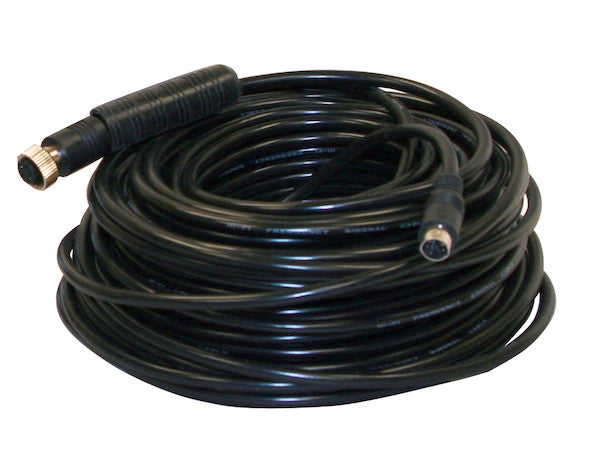
Buyers Products Camera Cable can be used to add extra camera feeds to an existing backup camera system. The cables are rated IP67 for dust and water resistance and feature water-resistant sealed four-pin plugs at both ends. Available in 16 ft, 32 ft, 65 ft, and 82 ft lengths.
Specifications
| Cable Length | 65 |
|---|
Advanced Technical Overview: 65-Foot IP67-Rated Extension Cable for Robust Backup Camera Systems
This document provides a comprehensive technical overview of the 65-foot extension cable specifically designed for integrating with and expanding existing backup camera systems. Engineered by Buyers Products, this cable is a critical component for applications demanding extended reach, superior signal integrity, and robust environmental protection. It facilitates the seamless integration of additional camera feeds, enhancing operational visibility and safety across a wide range of commercial and industrial vehicles.
Product Design and Core Functionality
The primary function of this 65-foot cable is to extend the connectivity between a backup camera and its display monitor or central processing unit (CPU) within a vehicle's existing camera system infrastructure. It is purpose-built to accommodate scenarios where the standard cable length supplied with a camera system is insufficient, such as on long trailers, articulated buses, large construction equipment, or extended utility vehicles. The design emphasizes signal preservation over extended distances, ensuring that video feeds remain clear, stable, and free from interference, which is paramount for safety-critical applications.
Each cable features precisely engineered four-pin connectors at both ends. This specific connector type is a widely adopted standard in the heavy-duty vehicle camera industry due to its inherent advantages. The four pins typically provide dedicated pathways for video signal (composite video, often CVBS), power supply (VCC), ground (GND), and potentially an audio channel or a control signal (e.g., reverse trigger). This standardized pinout ensures broad compatibility with a multitude of camera and monitor systems already prevalent in the market, simplifying installation and reducing the need for proprietary adapters.
Environmental Resilience: IP67 Rating Explained
A cornerstone feature of this cable is its IP67 rating for dust and water resistance. The Ingress Protection (IP) rating system, defined by international standard IEC 60529, quantifies the degree of protection provided by mechanical casings and electrical enclosures against intrusion from solid objects and liquids. The "IP67" designation carries significant implications for product durability and operational reliability in harsh environments:
- First Digit '6' (Dust Tight): This indicates the highest possible rating for protection against solid particles. A rating of '6' means the enclosure is completely protected against dust ingress. No dust is allowed to penetrate the enclosure, ensuring that internal conductors and signal pathways remain uncontaminated and functional even in extremely dusty conditions common to construction sites, agricultural fields, quarries, or unpaved roads. This prevents abrasive wear, short circuits, and signal degradation caused by particulate accumulation.
- Second Digit '7' (Protected Against Immersion): This rating signifies protection against the effects of temporary immersion in water. Specifically, the device is protected against immersion in water up to 1 meter (approximately 3.3 feet) for 30 minutes. This level of protection is crucial for vehicle applications where the cable may be exposed to heavy rain, snow, road spray, pressure washing, or even temporary submersion during shallow water crossings. The sealed connectors and robust cable jacketing prevent water ingress into the electrical connections, mitigating the risk of corrosion, short circuits, and signal interruption.
The "water-resistant sealed four-pin plugs" are integral to achieving this IP67 rating. These connectors are not merely resistive to splashes but are designed with specific sealing mechanisms, such as O-rings or robust gaskets, that compress upon connection to form an impenetrable barrier against moisture and dust. The construction typically involves durable materials like high-grade plastics or metals with corrosion-resistant coatings, further enhancing their longevity in challenging outdoor conditions.
Technical Specifications and Performance Metrics
While the current description highlights the 65-foot length, a deeper technical analysis considers the implications of this length on signal integrity and power delivery:
Cable Construction and Materials:
- Conductor Material: High-purity copper is typically used for the conductors within such cables due to its excellent electrical conductivity. The gauge of the wire (AWG) is crucial; a sufficiently thick gauge minimizes resistance, thereby reducing voltage drop over the 65-foot length and ensuring adequate power delivery to the camera, as well as preserving signal amplitude.
- Insulation: Each conductor is individually insulated with a dielectric material, such as polyethylene (PE) or polyvinyl chloride (PVC), to prevent short circuits and maintain signal isolation. The quality of this insulation directly impacts capacitance and impedance, which are critical for high-frequency video signals.
- Shielding: For video cables, shielding is paramount to prevent electromagnetic interference (EMI) and radio frequency interference (RFI) from external sources (e.g., vehicle electronics, power lines, radio transmitters) and to prevent signal leakage. Common shielding methods include braided copper shields, foil shields (Mylar aluminum), or a combination of both. A dense braid provides effective low-frequency shielding, while foil is excellent for high-frequency noise. The effectiveness of the shielding directly correlates with the clarity and stability of the video signal over extended distances.
- Outer Jacket: The outermost layer is a robust jacket, often made from UV-resistant PVC, TPE (Thermoplastic Elastomer), or polyurethane (PUR). This jacket provides mechanical protection against abrasion, cuts, impacts, and exposure to oils, chemicals, and extreme temperatures. For automotive applications, resistance to ozone, road salts, and fuel derivatives is also a key consideration. The material selected contributes significantly to the cable's flexibility and durability over its operational lifespan.
Electrical Characteristics (Implicit for a 65-foot run):
- Impedance: Video signals, especially composite video, are typically transmitted over cables with a characteristic impedance of 75 Ohms. Maintaining this impedance consistently across the entire 65-foot length is crucial to prevent signal reflections, which manifest as ghosting or blurring on the display. High-quality cables are designed with precise geometric consistency to control impedance.
- Attenuation: Signal loss (attenuation) increases with cable length and frequency. Over 65 feet, some degree of attenuation is inevitable. The cable's design aims to minimize this loss, ensuring the video signal arrives at the monitor with sufficient strength and clarity. For professional-grade systems, the acceptable attenuation levels are carefully considered to maintain image quality.
- Capacitance: Excessive capacitance can cause high-frequency signal degradation, leading to a loss of detail in the video image. The insulation materials and conductor spacing are optimized to keep capacitance low.
- Voltage Drop: For the power lines within the cable, the resistance over 65 feet will cause a voltage drop. This needs to be calculated to ensure the camera receives its minimum required operating voltage. A camera rated for 12V might require a slightly higher input from the vehicle's power system if significant voltage drop occurs, or the cable must be designed with sufficiently low resistance power conductors.
Installation and Application Considerations
The 65-foot length of this cable opens up a broad spectrum of application possibilities across various vehicle types:
- Trucks and Trailers: Essential for tractor-trailer combinations, allowing a rear-view camera on the trailer to connect to a monitor in the truck cab. This is particularly vital for long-haul trucks, flatbeds, and specialized trailers (e.g., livestock, car carriers) where multiple articulation points and extended lengths necessitate robust, long cables.
- Buses and RVs: Facilitates the installation of multiple cameras (rear, side-view, door-view) on long passenger buses, school buses, and large recreational vehicles, ensuring comprehensive situational awareness for the driver.
- Construction and Agricultural Equipment: Crucial for heavy machinery such as excavators, bulldozers, combines, and sprayers, where blind spots are extensive and the operating environment is exceptionally harsh. The IP67 rating is especially beneficial here due to constant exposure to dirt, mud, and water.
- Utility and Municipal Vehicles: Used on refuse trucks, street sweepers, snowplows, and emergency vehicles, where enhanced visibility is critical for safety in urban and rural settings.
Best Practices for Installation:
- Routing: Cables should be routed away from sharp edges, moving parts, and extreme heat sources (e.g., exhaust systems). Use cable ties or clamps at regular intervals to secure the cable and prevent sagging, chafing, or entanglement.
- Protection: While the cable is robust, additional protection like conduit or split loom tubing can be considered in areas of high abrasion or impact risk, especially if routing through chassis frames or near rotating components.
- Connector Care: Even with sealed connectors, ensuring they are clean and free of debris before mating is important. Hand-tighten connectors firmly to engage the seal but avoid over-tightening which can damage the threads or internal pins.
- Strain Relief: Ensure that connectors are not subjected to undue pulling or bending strain. Use integrated strain relief features on the connectors or provide external strain relief near connection points.
- Grounding: Proper system grounding is essential for mitigating electrical noise. Ensure all components of the camera system, including the monitor and camera, are correctly grounded to the vehicle chassis.
Comparative Advantage and Economic Impact
The investment in a high-quality, IP67-rated 65-foot cable like this offers significant long-term advantages compared to inferior alternatives:
- Reliability and Longevity: The robust construction and IP67 rating significantly extend the operational life of the cable, reducing the frequency of replacements and associated downtime. This translates to lower total cost of ownership (TCO).
- Signal Integrity: Superior shielding and conductor quality ensure consistent, high-resolution video feeds, which directly contributes to enhanced operational safety and decision-making for vehicle operators. Blurred or intermittent signals compromise safety.
- Reduced Maintenance: The sealed connectors and durable jacket minimize the need for troubleshooting and repairs related to environmental ingress or mechanical damage.
- System Compatibility: The use of standard four-pin connectors ensures broad compatibility, allowing for flexible system expansion and component upgrades without proprietary lock-ins.
- Compliance and Safety: Reliable camera systems contribute to compliance with safety regulations and may help reduce accident rates, potentially leading to lower insurance premiums and fewer legal liabilities.
In conclusion, the 65-foot Buyers Products Camera Cable is not merely an extension cord; it is a critical, high-performance component engineered to meet the stringent demands of commercial and industrial vehicle environments. Its IP67 rating, combined with its robust construction and standardized connectivity, ensures reliable, high-fidelity video transmission over extended distances, directly contributing to enhanced operational safety, efficiency, and longevity of backup camera systems.