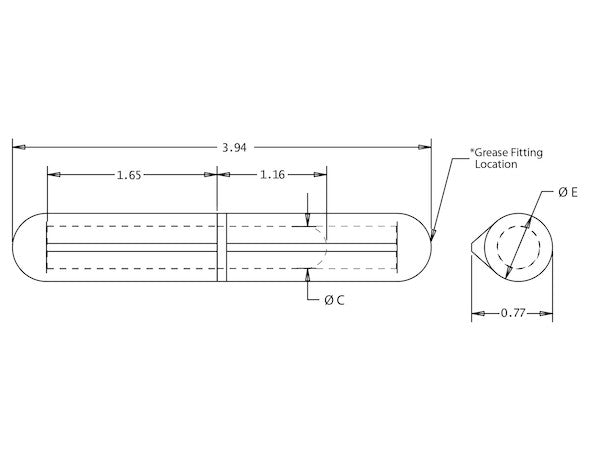
Buyers Products Aluminum Weld-On Bullet Hinge (also known as a lift-off hinge) is ideal for trailer doors/gates and tool cabinets. The hinge is constructed from aluminum with a stainless steel pin and bushing. They are available in multiple sizes to fit your application. Please contact Customer Service for further information.
Specifications
| Bushing Material | Stainless Steel |
|---|---|
| Diameter (in.) | 0.63 |
| Hinge Length (in.) | 3.94 |
| Pin Diameter (in.) | 0.39 |
| Pin Length A (in.) | 1.65 |
| Pin Length B (in.) | 1.16 |
| Pin Material | Stainless Steel |
| Thickness (in.) | 0.77 |
| With Grease Fitting (y/n) | No |
Advanced Technical Overview: Buyers Products Aluminum Weld-On Bullet Hinge with Stainless Pin and Bushing (0.77 x 3.94 Inch)
The Buyers Products Aluminum Weld-On Bullet Hinge represents a sophisticated engineering solution designed for demanding applications requiring robust articulation, superior corrosion resistance, and simplified maintenance. This specific model, characterized by its 0.77-inch thickness and 3.94-inch length, is meticulously crafted to deliver exceptional performance in environments where traditional hinge mechanisms may falter. Its unique construction, leveraging the synergistic properties of high-grade aluminum for the main body and premium stainless steel for the critical pin and bushing components, establishes it as an indispensable asset for a diverse array of industrial, commercial, and utility vehicle applications, prominently including trailer doors/gates and tool cabinets.
Material Science and Engineering Excellence
Aluminum Hinge Body: Optimized for Performance and Durability
The selection of aluminum for the primary hinge body is a deliberate engineering choice, providing a multitude of benefits over traditional ferrous metals. Aluminum, particularly in alloys suitable for structural applications such as 6061-T6, offers an unparalleled strength-to-weight ratio. This attribute is crucial in applications where weight reduction is paramount, contributing to improved fuel efficiency in mobile applications like trailers and reducing the overall structural load on cabinets and enclosures. The inherent lightness of aluminum also facilitates easier handling and installation.
Beyond its low density, aluminum exhibits exceptional resistance to corrosion, particularly atmospheric oxidation. When exposed to air, aluminum naturally forms a thin, dense, and passive oxide layer that effectively shields the underlying metal from further corrosive attack. This passive layer is self-repairing, ensuring long-term protection even in challenging outdoor environments. Compared to carbon steel, which requires extensive surface treatments (e.g., painting, galvanizing) to achieve comparable corrosion resistance, aluminum provides this attribute intrinsically, reducing long-term maintenance costs and extending the operational lifespan of the hinge.
Furthermore, the weld-on nature of this hinge capitalizes on aluminum's excellent weldability. When properly executed, aluminum welding (typically Gas Tungsten Arc Welding - GTAW or TIG welding) creates a monolithic bond between the hinge and the parent structure, offering superior structural integrity and load transfer capabilities compared to mechanical fasteners. This eliminates potential points of weakness, such as bolt holes, which can concentrate stress or allow moisture ingress, further enhancing the hinge's durability and resistance to dynamic loads and vibration commonly encountered in vehicle and industrial settings. The 0.77-inch thickness of the hinge body provides ample material for robust weld joints, ensuring a strong and reliable attachment.
Stainless Steel Pin and Bushing: The Core of Durability and Smooth Operation
The hinge's operational integrity is significantly bolstered by the utilization of stainless steel for both the articulating pin and the internal bushing. This combination is critical for minimizing wear, reducing friction, and ensuring consistent, reliable movement over extended periods, especially under repetitive loading and in abrasive or corrosive conditions.
Stainless steel, primarily austenitic grades like 304 or 316, is chosen for its superior mechanical properties and exceptional corrosion resistance. Grade 304 stainless steel offers excellent resistance to a wide range of atmospheric and chemical environments, exhibiting high tensile strength and ductility. For more aggressive environments, such as those involving salt spray (e.g., marine applications) or specific chemical exposures, Grade 316 stainless steel, with its added molybdenum content, provides enhanced resistance to pitting and crevice corrosion. Both grades are non-magnetic in their annealed state, which can be advantageous in certain specialized applications.
The stainless steel pin, with a diameter of 0.39 inches, serves as the central pivot for the hinge. Its high hardness and wear resistance ensure that it can withstand the torsional and shear forces generated during door or gate operation without significant deformation or abrasive wear. The precise manufacturing tolerances of the pin contribute to smooth articulation and minimal slop in the hinge mechanism.
Complementing the pin, the stainless steel bushing acts as a critical interface between the rotating pin and the stationary hinge leaves. Bushings are designed to reduce friction between moving parts, distribute loads evenly, and absorb wear, thereby protecting the more expensive hinge body components. A stainless steel bushing offers several key advantages: it has a low coefficient of friction against a stainless steel pin, especially when compared to dissimilar metals that could lead to galvanic corrosion or accelerated wear. Furthermore, the inherent corrosion resistance of the bushing material prevents degradation of the bearing surface due to environmental factors, maintaining smooth operation even after prolonged exposure to moisture, dust, or chemicals. The absence of a grease fitting, as indicated in the specifications, suggests a design engineered for minimal maintenance, relying on the intrinsic lubricity and wear characteristics of the stainless steel components, possibly augmented by tight tolerances or specialized internal surface finishes, to provide reliable, low-friction operation without the need for periodic lubrication in many common applications. This feature translates into reduced operational costs and simplifies maintenance schedules.
Functional Design and Mechanical Advantages
Bullet Hinge Geometry: Compact Strength
The "bullet hinge" nomenclature derives from its distinctive cylindrical form factor. This design offers several practical and aesthetic advantages. Its compact, streamlined profile makes it less obtrusive than traditional butt hinges, ideal for applications where space is at a premium or a clean visual aesthetic is desired. Mechanically, the cylindrical body distributes stresses efficiently, minimizing stress concentrations and enhancing the hinge's overall load-bearing capacity. The weld-on nature allows for a near-flush installation, presenting a smooth exterior surface that reduces snag points and enhances security.
Weld-On Installation: Permanent Structural Integration
The weld-on mounting method is a cornerstone of this hinge's design, offering superior strength and security. Unlike bolt-on or screw-on hinges, a properly welded hinge becomes an integral part of the structure it supports. This eliminates issues associated with fastener loosening due to vibration or fatigue, providing a permanent, high-strength connection. For applications like trailer gates and heavy equipment enclosures, where dynamic loads and extreme forces are common, the structural integrity of a weld is invaluable. The 0.77-inch thickness of the hinge body provides ample material for creating strong, full-penetration welds, ensuring maximum load transfer and resistance to shear forces. Weld-on hinges also offer greater resistance to tampering and theft compared to externally fastened alternatives, an important consideration for tool cabinets and secure enclosures.
Specialized welding techniques are essential for aluminum. Proper surface preparation, selection of appropriate filler metals (e.g., 4043 or 5356 series aluminum filler wire), precise heat management to prevent distortion, and the use of inert shielding gases (argon or helium mixtures) are critical for achieving high-quality, durable welds. The expertise required for aluminum welding ensures a professional, robust installation that maximizes the hinge's inherent strength.
Lift-Off Functionality: Enhanced Versatility and Access
A key distinguishing feature of this product, also known as a lift-off hinge, is its two-piece design that allows for the easy removal of the door or gate without requiring disassembly of the hinge components from the frame or panel. This capability is exceptionally valuable in numerous scenarios:
- Maintenance and Repair: Facilitates quick and easy access to the interior of a cabinet or trailer for servicing, repairs, or part replacement without needing to work around a permanently attached door.
- Temporary Removal: Enables the temporary removal of a gate or panel to accommodate oversized loads, improve maneuverability, or provide unrestricted access to an area.
- Space Optimization: In confined spaces, a door can be lifted off to maximize workspace or maneuver equipment.
- Component Replacement: If a door or panel needs to be replaced entirely, the lift-off feature simplifies the process, reducing downtime.
- Safety: In certain emergency situations, the ability to quickly remove an obstruction can be a critical safety advantage.
The design achieves this by having a non-integrated pin, often with one half of the hinge having a fixed post and the other a receiving barrel. When the door is lifted, the barrel disengages from the post, allowing for separation. Pin Length A (1.65 in.) and Pin Length B (1.16 in.) likely refer to specific dimensions of the pin's exposed or functional lengths, which are critical for ensuring adequate engagement and stability when the hinge is in use, while still allowing for the desired lift-off clearance. These dimensions are engineered to provide a secure pivot point while enabling simple removal.
Performance Specifications and Their Implications
The detailed specifications provided are crucial for engineers and fabricators to ascertain the hinge's suitability for specific applications. The overall Hinge Length of 3.94 inches (approximately 100mm) is a balanced dimension, offering sufficient leverage and load distribution for moderate to heavy-duty doors and gates without being excessively bulky. The Diameter (0.63 in.) refers to the overall cylindrical diameter of the hinge body, indicating its compact footprint.
The Pin Diameter (0.39 in.) is a critical parameter influencing the hinge's shear strength and load-bearing capacity. A robust pin diameter ensures the hinge can withstand significant forces without bending or breaking, directly impacting the maximum weight and dynamic loads it can support. Coupled with the specified Pin Lengths A and B, these dimensions define the operational envelope and mechanical stability of the hinge, ensuring optimal engagement and disengagement for its lift-off function.
The Thickness (0.77 in.) refers to the material thickness of the hinge body components, which directly correlates with the hinge's structural rigidity and the strength of the weld joint it can form. This robust thickness is indicative of the hinge's capability to manage significant loads and resist deformation under stress, making it well-suited for heavy-duty applications.
Environmental Resilience and Longevity
The material combination of aluminum and stainless steel endows this hinge with exceptional environmental resilience. It is highly resistant to a wide spectrum of corrosive agents, including fresh and saltwater, many industrial chemicals, and common atmospheric pollutants. This makes it ideal for:
- Outdoor Applications: Withstands rain, humidity, UV radiation, and temperature fluctuations without degradation.
- Marine Environments: Excellent choice for boat hatches, dock gates, and marine equipment where constant exposure to saltwater demands superior corrosion resistance.
- Agricultural Equipment: Resists exposure to fertilizers, pesticides, and harsh outdoor conditions.
- Food Processing/Sanitary Environments: Stainless steel's hygienic properties and ease of cleaning make it suitable for applications requiring strict sanitation, although the aluminum body would need consideration for direct food contact areas.
The inherent durability of these materials, coupled with a robust design and precise manufacturing, translates into an extended service life and reduced lifecycle costs. The absence of a grease fitting indicates a sealed or self-lubricating design, minimizing maintenance requirements and making it suitable for applications where regular lubrication is impractical or undesirable.
Versatile Applications and Industry Suitability
While ideally suited for trailer doors/gates and tool cabinets, the technical attributes of this Aluminum Weld-On Bullet Hinge extend its utility to numerous other demanding sectors:
- Utility and Service Vehicles: Access panels, compartment doors, and cargo enclosures on service trucks, emergency vehicles, and utility trailers.
- Industrial Enclosures: Control panel doors, machinery guards, and access hatches in factories and industrial facilities where corrosive environments or frequent access is required.
- Agricultural Machinery: Access gates, equipment covers, and implements exposed to harsh outdoor elements and demanding operational cycles.
- Custom Fabrication Projects: Its weld-on nature and robust construction make it a preferred component for custom-built structures, gates, and specialized equipment.
- Security Installations: Heavy-duty gates and access points where tamper resistance and robust operation are paramount.
The hinge's ability to be fully integrated into the structure through welding, combined with its lift-off functionality and superior material properties, positions it as a premium solution for engineers, fabricators, and manufacturers seeking components that offer both high performance and long-term reliability.
Installation Considerations and Best Practices
For optimal performance and longevity, professional installation by a qualified welder experienced in aluminum fabrication is highly recommended. Key considerations include:
- Surface Preparation: All surfaces to be welded must be meticulously cleaned to remove oxides, oils, grease, and other contaminants that can compromise weld quality. This often involves mechanical brushing and chemical cleaning.
- Fit-Up and Alignment: Precise alignment of the hinge components and the door/frame is critical to ensure smooth operation and proper weight distribution. Tack welding can be used for initial positioning.
- Welding Process: Gas Tungsten Arc Welding (GTAW or TIG) is generally preferred for aluminum hinges due to its precise heat control and ability to produce high-quality, aesthetically pleasing welds. Appropriate filler metals, typically 4043 or 5356 series aluminum alloys, must be selected based on the parent material and desired weld characteristics.
- Heat Management: Aluminum has a high thermal conductivity, requiring careful heat input control to prevent distortion of the hinge or the surrounding structure. Preheating may be necessary for thicker sections.
- Post-Weld Treatment: Depending on the application, post-weld cleaning, brushing, or passivation may be employed to enhance corrosion resistance and appearance.
By adhering to these best practices, the full benefits of the weld-on design and the robust material properties can be realized, ensuring a durable and reliable hinge solution.
Conclusion
The Buyers Products Aluminum Weld-On Bullet Hinge with Stainless Pin and Bushing (0.77 x 3.94 Inch) represents a pinnacle of engineering for heavy-duty articulation requirements. Its strategic combination of lightweight, corrosion-resistant aluminum for the main body and highly durable, low-friction stainless steel for the critical pin and bushing components ensures exceptional longevity and operational reliability. The weld-on installation method provides unmatched structural integrity, while the intrinsic lift-off functionality offers unparalleled convenience and versatility for maintenance and access. With its robust dimensions and meticulous material selection, this hinge is engineered to withstand the most challenging environmental and operational conditions, making it an ideal choice for discerning professionals seeking a high-performance, low-maintenance hinge solution for trailers, tool cabinets, and a broad spectrum of industrial and commercial applications. For specific application guidance and further technical details, our Customer Service team is readily available to provide expert assistance.