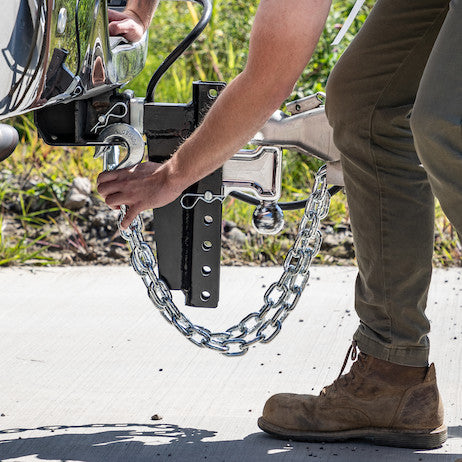
The Class 4 Safety Chain from Buyers Products is rated to 10,000 or 15,000 lb depending on the model. The chain is zinc-plated to withstand corrosion. Available in a range of sizes and lengths, the chains feature forged slip hook connectors. Use two safety chains with a total holding capacity of at least the total weight of the trailer and its contents. The chains are designed for towing only, not for lifting.
Specifications
| Chain Diameter (in.) | 3/8 |
|---|---|
| Chain Length (in.) | 22.00 |
| Coil | 30 Proof |
| Color | Silver |
| Finish | Zinc Plated |
| M.G.T.W. (lbs) | 10,000 |
| Material | Carbon Steel |
Advanced Technical Overview: 3/8" x 22" Class 4 Trailer Safety Chain with Forged Eye Slip Hook
The 3/8" x 22" Class 4 Trailer Safety Chain with a Forged Eye Slip Hook, designated as "30 Proof," represents a critical component in ensuring the secure and compliant operation of towed vehicles. Engineered with meticulous attention to material science, manufacturing precision, and adherence to industry standards, this safety chain is designed to provide an indispensable layer of redundancy in the event of a primary coupling failure. Its robust construction and specified attributes position it as a premium solution for trailer applications up to a Manufacturer's Gross Trailer Weight (M.G.T.W.) of 10,000 lbs.
Fundamental Role and Regulatory Compliance
Safety chains are not merely accessories but are legally mandated in most jurisdictions for any trailer exceeding a certain weight threshold. Their primary function is to maintain a connection between the tow vehicle and the trailer should the primary hitch connection (coupler) detach or fail during transit. This critical safety function prevents runaway trailers, minimizing the risk of severe accidents, property damage, and personal injury. The design and performance of safety chains are governed by a variety of standards, most notably SAE J684 for trailer hitches, balls, and safety chain installations, and relevant regulations from agencies like the Department of Transportation (DOT). This particular chain's classification as "Class 4" indicates its suitability for heavy-duty towing applications, specifically those with a Gross Trailer Weight (GTW) exceeding 5,000 lbs, aligning perfectly with its 10,000 lb M.G.T.W. rating.
Material Selection and Engineering: Carbon Steel for Uncompromising Strength
The foundation of this safety chain's structural integrity lies in its material composition: high-grade carbon steel. Carbon steel is a ferrous alloy primarily composed of iron and carbon, with carbon content typically ranging from 0.05% to 2.1% by weight. For chain applications requiring high tensile strength and durability, medium to high carbon steel grades are typically selected. The specific properties of carbon steel that make it ideal for safety chains include:
- High Tensile Strength: Carbon steel exhibits excellent resistance to breaking under tension, a paramount requirement for a component designed to arrest a moving trailer.
- Yield Strength: This refers to the stress at which a material begins to deform plastically. For safety chains, a high yield strength ensures that the chain can withstand significant loads without permanent deformation, preserving its structural integrity for subsequent use.
- Fatigue Resistance: Towed trailers subject safety chains to dynamic loading, vibrations, and cyclical stresses. Carbon steel’s inherent fatigue resistance ensures a longer service life under these challenging conditions.
- Weldability: The individual links of a chain are typically formed and then resistance welded. Carbon steel offers excellent weldability, creating strong, homogenous joints that maintain the overall integrity of the chain.
- Cost-Effectiveness: While offering superior mechanical properties, carbon steel remains a relatively economical material, allowing for the production of high-performance safety equipment at a justifiable cost.
The manufacturing process for such chains typically involves drawing steel wire, forming it into individual links, and then flash-butt welding the ends of each link to create a continuous, robust chain. Strict quality control measures during this process ensure uniformity of link dimensions, weld integrity, and freedom from defects that could compromise performance.
Corrosion Resistance: The Efficacy of Zinc Plating
Exposure to the elements—moisture, road salts, chemicals, and general abrasive debris—poses a significant threat to the longevity and structural integrity of steel components. To counteract these corrosive forces, this safety chain undergoes a zinc plating process. Zinc plating, a form of electroplating, applies a thin layer of zinc metal onto the carbon steel substrate. The mechanism of protection is twofold:
- Barrier Protection: The zinc layer acts as a physical barrier, preventing direct contact between the steel and corrosive agents.
- Sacrificial Protection (Galvanic Action): Zinc is a more electrochemically active metal than steel. In the presence of an electrolyte (e.g., moisture), the zinc corrodes preferentially, sacrificing itself to protect the underlying steel. This galvanic action continues even if the zinc coating is scratched or compromised in small areas, providing robust, long-lasting protection.
The silver finish resulting from zinc plating is not merely aesthetic; it is a visual indicator of this critical protective layer. This finish significantly extends the operational lifespan of the chain, ensuring that its load-bearing capacity remains uncompromised by rust and degradation over years of service in diverse environmental conditions. Regular inspection for any breaches in the zinc coating, which could indicate localized corrosion, is still recommended as part of a comprehensive maintenance routine.
Precision Sizing: 3/8-Inch Diameter and 22-Inch Length
The specific dimensions of this safety chain—3/8-inch diameter and 22-inch length—are critical parameters engineered to meet the demands of Class 4 towing applications.
- 3/8-Inch Chain Diameter: The nominal diameter of the chain stock (or the material used to form the links) directly correlates with its tensile strength and Working Load Limit (WLL). A 3/8-inch diameter chain, particularly when manufactured to "30 Proof" standards, possesses the necessary cross-sectional area and material volume to safely manage the forces associated with a 10,000 lb M.G.T.W. The diameter ensures that each link can withstand the anticipated static and dynamic loads without yielding or fracturing.
- 22-Inch Chain Length: The length of a safety chain is a crucial, yet often overlooked, specification. A 22-inch length is carefully calibrated to provide sufficient slack for the full range of articulation between the tow vehicle and the trailer during turns, while simultaneously being short enough to prevent the chain from dragging on the ground. Excessive length can lead to premature wear, entanglement, or even snagging on road obstacles, potentially compromising its effectiveness. Insufficient length, conversely, can restrict maneuverability, inducing undue stress on the chain during tight turns and potentially leading to premature failure. The optimal length ensures that the chain forms a protective cradle beneath the coupler, capable of supporting the coupler if it disconnects, without allowing the disconnected coupler to strike the ground. Best practice involves crossing the chains under the coupler to create this cradle and to reduce the likelihood of a disconnected coupler hitting the road surface.
The "30 Proof" Standard: A Mark of Quality and Performance
The designation "30 Proof" refers to the grade of chain, specifically "Proof Coil Chain Grade 30." This classification is derived from industry standards such as those set by the National Association of Chain Manufacturers (NACM) and ASTM International (e.g., ASTM A413 for chain used in towing and other applications). "Proof Coil" signifies that the chain has undergone a factory proof test, where each length of chain is subjected to a load equivalent to twice its Working Load Limit (WLL), without permanent deformation or failure. This process stress-tests every link, ensuring manufacturing consistency and material integrity.
Key implications of the "30 Proof" designation:
- Minimum Breaking Strength (MBS): Grade 30 chains have specified minimum breaking strengths that are significantly higher than their WLL, typically incorporating a design factor of 4:1 (MBS is four times the WLL). This provides a substantial safety margin for unexpected shock loads or dynamic stresses.
- Working Load Limit (WLL): While the M.G.T.W. for which this chain is rated is 10,000 lbs, the WLL of a single 3/8" Grade 30 chain is typically around 2,650 lbs (or 2,600 lbs depending on specific manufacturing tolerances and standards referenced). It is imperative, as stated in the product description, to use two safety chains whose *combined* holding capacity meets or exceeds the M.G.T.W. of the trailer and its contents. For a 10,000 lb trailer, two 3/8" Grade 30 chains provide a combined WLL of 5,300 lbs (2 x 2,650 lbs). This meets the legal minimum requirement, where the combined capacity is at least the total trailer weight. The M.G.T.W. rating on the product (10,000 lbs) therefore refers to the maximum trailer weight for which a pair of these chains is suitable, not the capacity of a single chain.
- Quality Assurance: Adherence to Grade 30 standards guarantees a certain level of metallurgical quality, consistent link geometry, and reliable welding processes. This ensures uniform strength throughout the chain's entire length.
Understanding the "30 Proof" rating is crucial for proper application and compliance with safety regulations, reinforcing the chain's suitability for heavy-duty towing by adhering to established performance benchmarks.
Connector System: Forged Eye Slip Hook
The terminal end of this safety chain features a single forged eye slip hook. This type of connector is specifically engineered for ease of attachment and robust security to the tow vehicle's safety chain loops.
- Forged Construction: Forging is a manufacturing process that involves shaping metal using localized compressive forces. This process enhances the material's grain structure, eliminating porosity and increasing density. The result is a hook with superior strength, impact resistance, and fatigue life compared to cast or stamped alternatives. Forged components are exceptionally durable and less prone to brittle fracture, which is paramount for a critical safety component.
- Eye Design: The "eye" refers to the closed loop section of the hook where it permanently attaches to the chain. This robust connection point ensures that the hook is securely integrated with the chain, preventing accidental detachment of the hook from the chain itself. The eye is often welded or mechanically fastened to the chain's end link, forming a secure assembly.
- Slip Hook Mechanism: A slip hook (also known as a grab hook or clevis hook, though this one is specifically "eye slip") is characterized by its wide throat opening, designed for quick and easy attachment to the safety chain loops or D-rings on the tow vehicle's hitch receiver. While simple in design, its strength lies in the forged construction and the secure engagement it provides when correctly inserted. Unlike some hooks with self-closing latches, a standard slip hook relies on proper installation and geometry to remain engaged under load. It's designed for rapid deployment and robust, albeit non-locking, connection.
The combination of forged material and an intelligent design ensures that this hook can withstand the same extreme forces as the chain itself, forming an integral and reliable part of the safety system.
Manufacturer's Gross Trailer Weight (M.G.T.W.) and Safety Factors
The M.G.T.W. of 10,000 lbs specified for this product indicates the maximum weight of the fully loaded trailer for which a pair of these safety chains is suitable. As previously discussed, the individual Working Load Limit (WLL) of a 3/8" Grade 30 chain is approximately 2,650 lbs. The industry standard, often mandated by regulations, requires the combined WLL of the safety chains to be at least equal to the Gross Trailer Weight (GTW). Therefore, two such chains provide a combined WLL of 5,300 lbs. While this exceeds the requirement for a 5,000 lb GTW, it is critical to note that the product is rated to *10,000 lbs M.G.T.W.*. This implies that the manufacturer considers a pair of these chains appropriate for trailers up to 10,000 lbs, likely incorporating an understanding of the difference between WLL and the actual breaking strength, and accounting for the dynamic nature of towing stresses. Many regulations permit chains whose combined breaking strength meets a multiple of the trailer's GVWR. It's crucial for the end-user to verify local and federal regulations regarding safety chain capacity relative to the trailer's Gross Vehicle Weight Rating (GVWR) or GTW.
The distinction between WLL, proof load, and ultimate breaking strength is fundamental in engineering safety. The WLL is the maximum mass or force that a product is certified to support. The proof load is typically twice the WLL, applied during manufacturing to test integrity. The ultimate breaking strength is the load at which the component is expected to fail, typically 3 to 5 times the WLL, providing a substantial safety factor to account for unforeseen circumstances, shock loads, and material variability.
Installation Best Practices and Maintenance Protocol
Proper installation and regular maintenance are paramount to the continued efficacy of this safety chain:
- Crossing the Chains: Always cross the safety chains under the trailer coupler. This creates a secure "cradle" that will prevent the trailer tongue from hitting the ground if the primary coupling fails, thereby minimizing damage and maintaining some steering control.
- Appropriate Slack: Ensure there is enough slack for full turns and articulation of the tow vehicle and trailer, but not so much that the chains drag on the ground. A good rule of thumb is that the chains should be taut but not overly stretched during a full lock turn.
- Secure Attachment: Attach the hooks securely to the designated safety chain loops on the tow vehicle's hitch receiver. Ensure full engagement of the hook.
- No Twisting or Kinking: Avoid twisting, kinking, or knotting the chains, as this can significantly reduce their effective strength and compromise their performance.
- Regular Inspection: Periodically inspect the entire chain assembly for signs of wear, corrosion, deformation (e.g., stretched links, bent hooks), cracks, or any other damage. Pay close attention to the welds on the links and the integrity of the forged hook. Any damaged chain should be immediately replaced.
- Cleaning: While zinc plating provides excellent protection, cleaning off accumulated dirt, salt, and debris can further extend its lifespan.
- No Lifting: As explicitly stated, these chains are designed exclusively for towing applications. They are not rated or designed for overhead lifting, where dynamic loading, specific rigging requirements, and vastly different safety factors apply. Using them for lifting operations is extremely dangerous and strictly prohibited.
Conclusion
The 3/8" x 22" Class 4 Trailer Safety Chain with 1 Forged Eye Slip Hook-30 Proof is a meticulously engineered and highly reliable product designed to meet the rigorous demands of heavy-duty towing. Its selection of high-grade carbon steel, advanced zinc plating for corrosion resistance, precise dimensional specifications, and adherence to "30 Proof" quality standards collectively ensure exceptional strength, durability, and safety. The robust forged eye slip hook provides a dependable connection point. By understanding its technical specifications, adhering to proper installation guidelines, and committing to routine maintenance, users can confidently rely on this safety chain to provide essential protection and peace of mind, fulfilling its critical role in preventing runaway trailer incidents and safeguarding all road users.