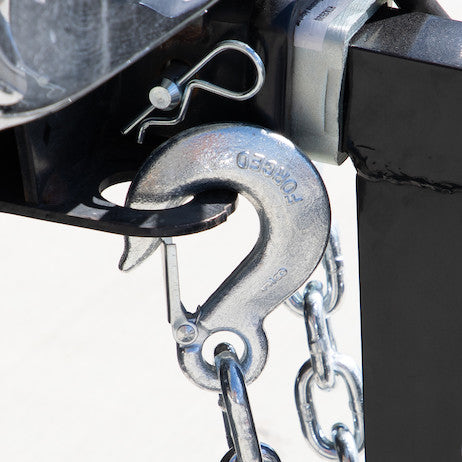
The Class 4 Safety Chain from Buyers Products is rated to 10,000 or 15,000 lb depending on the model. The chain is zinc-plated to withstand corrosion. Available in a range of sizes and lengths, the chains feature forged slip hook connectors. Use two safety chains with a total holding capacity of at least the total weight of the trailer and its contents. The chains are designed for towing only, not for lifting.
Specifications
| Chain Diameter (in.) | 3/8 |
|---|---|
| Chain Length (in.) | 35.00 |
| Coil | 30 Proof |
| Color | Silver |
| Finish | Zinc Plated |
| M.G.T.W. (lbs) | 10,000 |
| Material | Carbon Steel |
Advanced Technical Overview: 3/8x35 Inch Class 4 Trailer Safety Chain with Forged Eye Slip Hook
The 3/8x35 Inch Class 4 Trailer Safety Chain from Buyers Products represents a critical component in ensuring the secure and compliant operation of towed vehicles. Engineered to meet the rigorous demands of professional and serious recreational towing, this safety chain is specifically designed for applications requiring a robust and reliable connection between the tow vehicle and trailer. With a Maximum Gross Trailer Weight (M.G.T.W.) rating of 10,000 lbs, this chain is ideally suited for Class 4 towing scenarios, encompassing a wide range of utility, boat, equipment, and travel trailers within this substantial weight category. Its construction from high-grade carbon steel, enhanced with a durable zinc-plated finish, and featuring a robust forged eye slip hook, underscores its commitment to superior performance and longevity in challenging environmental conditions.
Understanding Class 4 Towing Capabilities and Safety Chain Requirements
Trailer hitches and their associated components are categorized into classes based on their towing capacity. A Class 4 rating signifies a heavy-duty towing capability, typically designed for trailers with a M.G.T.W. ranging from 5,001 lbs to 10,000 lbs, and sometimes up to 12,000 lbs, depending on the specific standard referenced. This particular 3/8x35 inch safety chain is rated for 10,000 lbs M.G.T.W., precisely aligning with the upper threshold of the Class 4 category, making it an indispensable safety device for such applications. The fundamental principle behind safety chains is to provide a secondary connection between the tow vehicle and the trailer in the event of a primary coupling failure. Federal regulations, alongside state and local statutes, mandate the use of safety chains for virtually all trailers, emphasizing their critical role in preventing runaway trailers and mitigating potential hazards on public roadways.
The operational directive for safety chains dictates that the combined capacity of all chains utilized must at least equal the gross trailer weight. For this specific product, where a single chain has a 10,000 lbs M.G.T.W. rating, using two such chains effectively provides a redundant safety system capable of securing trailers up to 20,000 lbs, assuming proper attachment and configuration. However, it is crucial to align the chain's individual M.G.T.W. rating with the specific requirements of the trailer it is intended to secure. In the context of a Class 4 trailer with a 10,000 lbs M.G.T.W., two chains, each rated for at least 5,000 lbs, would meet the minimum requirement. This 3/8-inch chain, with its individual 10,000 lbs rating, therefore offers a substantial safety margin for trailers at the upper limit of Class 4, ensuring enhanced security and compliance.
Material Science and Engineering: Carbon Steel and Zinc Plating
The choice of material for safety chains is paramount to their performance and durability. This 3/8-inch safety chain is fabricated from high-quality carbon steel. Carbon steel is a ferrous alloy primarily composed of iron and carbon, with carbon content typically ranging up to 2.1% by weight. This specific composition imparts excellent tensile strength, hardness, and wear resistance, making it an ideal material for applications requiring high load-bearing capabilities and resilience against mechanical stress. The inherent strength of carbon steel ensures that the chain can withstand the dynamic forces encountered during towing, including sudden jerks, braking forces, and potential shock loads during a coupling separation event.
To further enhance the chain's operational lifespan and resistance to environmental degradation, it undergoes a meticulous zinc-plating process. Zinc plating, also known as galvanization when applied to larger steel structures, involves coating the carbon steel with a thin layer of zinc. This metallic coating serves as a sacrificial anode, providing cathodic protection against corrosion. In the presence of moisture and oxygen, zinc corrodes preferentially to steel, thereby protecting the underlying carbon steel substrate from rust and oxidation. This is particularly crucial for trailer safety chains, which are constantly exposed to varying weather conditions, road salts, abrasive particles, and other corrosive elements. The silver color of the zinc-plated finish is indicative of this protective layer, ensuring that the chain maintains its structural integrity and aesthetic appeal over extended periods of outdoor exposure and rigorous use. The superior corrosion resistance offered by zinc plating significantly extends the service life of the chain, reducing the need for frequent replacements and upholding safety standards.
Grade 30 Proof Chain: An Assurance of Quality and Performance
The "30 Proof" designation for this chain refers to its grade, specifically Grade 30, often called proof coil chain. Chain grades are established standards that classify chains based on their material, heat treatment, and mechanical properties, primarily tensile strength and working load limit (WLL). Grade 30 is a general utility chain designed for applications such as tie-downs, towing, and light lifting (though this specific product is explicitly not for lifting). The "proof" aspect refers to a proof test, which is a non-destructive test applied to every link of the chain during manufacturing. During a proof test, each chain is subjected to a load equivalent to twice its Working Load Limit (WLL) but significantly less than its ultimate breaking strength. This process helps to detect any latent defects, such as cracks or weak welds, and ensures that the chain can withstand its rated capacity without permanent deformation. It essentially "proofs" the chain's ability to perform reliably under its specified load.
While Grade 30 chains offer good strength for their intended applications, it is essential to understand that they possess a lower strength-to-weight ratio compared to higher-grade chains (e.g., Grade 70 transport chain or Grade 80/100/120 alloy chains used for overhead lifting). For the purpose of trailer safety chains, Grade 30, with its robust carbon steel construction and proof testing, provides an appropriate balance of strength, durability, and cost-effectiveness. The 3/8-inch diameter, coupled with the Grade 30 proof coil specification, contributes directly to its 10,000 lbs M.G.T.W. rating, ensuring it meets the stringent safety requirements for Class 4 trailers.
Optimized Dimensions: 3/8-inch Diameter and 35-inch Length
The physical dimensions of a safety chain are critical for both its strength and its practical application. This safety chain features a 3/8-inch diameter, a standard robust size for medium to heavy-duty towing applications. The diameter directly correlates with the cross-sectional area of the chain links, which in turn dictates its ultimate tensile strength and Working Load Limit (WLL). A 3/8-inch chain provides ample strength for the stated 10,000 lbs M.G.T.W. rating, ensuring that it can withstand the forces experienced during routine towing and, more critically, in an emergency decoupling event.
With a length of 35 inches, this safety chain is engineered to offer an optimal balance between necessary slack for maneuvering and sufficient tension for safety. An ideal safety chain length permits full articulation of the tow vehicle and trailer during turns, preventing undue stress on the chain or its attachment points. Simultaneously, it must be short enough to prevent the drawbar or coupler from contacting the ground if it detaches, creating a "cradle" effect. This cradle effect is enhanced by crossing the safety chains underneath the trailer tongue when attaching them to the tow vehicle. This configuration ensures that if the primary coupling fails, the crossed chains will support the trailer tongue, keeping it elevated and preventing it from digging into the road surface, which could lead to a loss of control. The 35-inch length is typically sufficient to achieve this critical crossing for most standard trailer and tow vehicle configurations, providing a vital safety measure.
The Forged Eye Slip Hook: Secure and Reliable Connection
The connector on a safety chain is as crucial as the chain itself, as it is the primary point of attachment to the tow vehicle. This chain is equipped with a forged eye slip hook. The term "forged" refers to the manufacturing process where metal is shaped through localized compressive forces, typically by hammering or pressing. Forging aligns the grain structure of the metal, resulting in components with superior strength, toughness, and fatigue resistance compared to parts made by casting or machining. A forged hook is significantly more resilient to shock loads and repetitive stress, which are common in towing applications. This enhanced structural integrity is paramount for a component that must withstand potential emergency forces.
A "slip hook" (also known as a grab hook or clevis hook, depending on the specific design) is characterized by its wide throat opening, allowing for easy and quick attachment to the safety chain loops or anchor points on the tow vehicle. The "eye" in "forged eye slip hook" indicates the method of connection to the chain itself – typically, the end of the chain is secured directly into a closed loop or "eye" on the hook. This design ensures a permanent and secure connection between the chain and the hook, eliminating the possibility of the hook detaching from the chain under load. The ease of use of a slip hook, combined with the inherent strength of its forged construction, makes it a highly effective and reliable connector for trailer safety chains. It allows for rapid deployment and removal while providing a secure and robust link in the safety system.
Regulatory Compliance and Best Practices for Safety Chain Use
Adherence to regulatory guidelines and industry best practices is not merely a recommendation but a legal imperative for towing operations. Federal regulations, particularly those outlined by the Department of Transportation (DOT), mandate the use of safety chains that meet specific strength requirements. The 10,000 lbs M.G.T.W. rating of this Class 4 chain ensures compliance for a substantial range of trailers. Beyond federal mandates, individual states may have additional requirements regarding safety chain attachment, strength, and condition, making it essential for operators to be aware of local statutes.
Key best practices for safety chain deployment include:
- Crossing Chains: Always cross the safety chains underneath the trailer coupler. This creates a safety cradle that can support the trailer tongue if it detaches from the hitch, preventing it from striking the ground and potentially causing an accident.
- Appropriate Length: Ensure chains are long enough to permit full turning radius without becoming taut, but short enough to prevent dragging on the ground and to keep the trailer tongue elevated in a disconnect scenario. The 35-inch length of this chain is designed to facilitate this balance.
- Secure Attachment: Attach chains securely to dedicated safety chain loops or appropriately rated anchor points on the tow vehicle, not to the bumper unless explicitly rated for this purpose. The forged slip hook facilitates a reliable connection to these anchor points.
- No Twisting or Kinking: Avoid twisting, kinking, or wrapping the chains around the trailer tongue, as this can weaken them and compromise their effectiveness.
- Regular Inspection: Prior to each tow, visually inspect the chains for signs of wear, corrosion, nicks, bends, cracks, or deformation in the links or hooks. Any damaged chains must be replaced immediately. Zinc plating helps to resist corrosion, but vigilance is still required.
- Dedicated Use: Reiterate that safety chains are designed exclusively for towing. They are not intended for lifting, pulling, or securing cargo, as their design and safety factors are different for those applications. The WLL for towing is calculated with a different safety margin than WLL for lifting.
Long-Term Durability and Maintenance
The longevity and continued reliability of a safety chain are directly linked to its initial material quality, protective finishes, and ongoing maintenance. The carbon steel construction provides a strong foundation, while the zinc plating offers significant protection against environmental degradation, extending the chain's operational life even in harsh conditions involving moisture, road salt, and dirt. However, no protective coating is entirely impervious to damage from severe abrasion or prolonged exposure. Regular cleaning, especially after exposure to corrosive agents, helps to maintain the integrity of the zinc finish. Storing the chains in a clean, dry environment when not in use can also contribute to their lifespan. Periodic checks of the hooks for spring tension (if applicable to the specific hook design, though slip hooks typically do not have springs) and any signs of distortion are also recommended. Any observed damage, such as stretched links, cracked welds, deep gouges, or severely rusted areas, necessitates immediate replacement to ensure the integrity of the safety system.
Conclusion: An Essential Component for Secure Towing Operations
The 3/8x35 Inch Class 4 Trailer Safety Chain with 1 Forged Eye Slip Hook from Buyers Products is more than just an accessory; it is a vital safety component engineered to provide robust secondary security for trailers up to 10,000 lbs M.G.T.W. Its construction from durable zinc-plated carbon steel, adherence to Grade 30 proof coil standards, precise dimensions, and the inclusion of a high-strength forged eye slip hook all contribute to its superior performance and reliability. By understanding the technical specifications and adhering to best practices for installation and maintenance, users can ensure maximum safety and compliance during all towing operations. This chain exemplifies a commitment to quality and safety, providing peace of mind for professional haulers and recreational users alike, knowing that their valuable cargo and the public are protected by a meticulously engineered safety system.