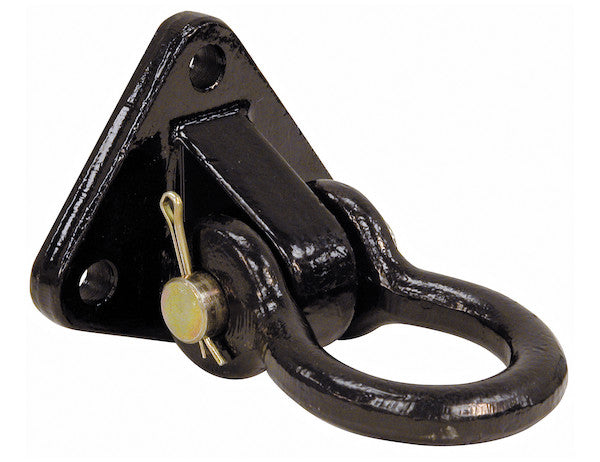
The Heavy Duty Towing Shackle from Buyers Products is made from rugged drop-forged steel to handle straight-line towing jobs up to 18,000 lb. It's ideal for recovery towing of dump trucks. The assembly bolts on to the truck chassis and features a pin to lock the shackle in position. It is black powder-coated for maximum corrosion resistance.
Specifications
| Capacity (lbs) | 18000 |
|---|---|
| Color | Black |
| Finish | Powder-Coat |
| Material | Forged Steel |
| Mount Type | Bolt-On |
| Mounting Hole Diameter (in.) | 0.656 |
| Mounting Holes Center to Center (in.) | 2.880 vertical / 4.380 horizontal |
The Black Drop Forged Heavy-Duty Towing Shackle from Buyers Products represents an pinnacle of engineering for severe-duty towing and recovery operations. Designed with meticulous attention to material science, structural integrity, and long-term durability, this shackle provides an indispensable component for professional fleets, heavy equipment operators, and commercial vehicle maintenance teams. Its robust construction and purposeful design address the most challenging demands encountered in recovering high-mass vehicles such as fully loaded dump trucks, rendering it a critical asset for operational continuity and safety.
Advanced Material Science: The Superiority of Drop-Forged Steel
At the core of this towing shackle's exceptional performance lies its construction from rugged drop-forged steel. The forging process, specifically drop-forging, is a critical manufacturing technique employed to produce components requiring maximum strength, impact resistance, and fatigue life. Unlike casting, which involves pouring molten metal into a mold and allowing it to solidify, or welding, which joins multiple pieces, forging works the metal in its solid state under immense pressure.
During drop-forging, a heated steel billet is placed between dies and subjected to successive blows from a power hammer or press. This process rearranges the internal grain structure of the steel, elongating the grains in the direction of the metal flow. This aligns the inherent strength of the material along the lines of maximum stress anticipated in application. The resulting continuous grain flow throughout the shackle, particularly around critical stress points such as the eyes and the U-bend, imparts significantly enhanced mechanical properties:
- Increased Tensile Strength: Forged steel exhibits superior resistance to pulling forces compared to cast or machined alternatives of the same material composition. This is paramount for towing applications where static and dynamic tensile loads are substantial.
- Enhanced Impact Resistance: The refined grain structure and absence of internal voids, which are common in castings, make forged steel highly resistant to sudden shocks and impacts. In recovery scenarios, sudden jerking motions or dynamic loads are commonplace, and the shackle's ability to withstand these without brittle fracture is crucial.
- Superior Fatigue Resistance: Components subjected to repetitive loading cycles, as is typical in towing and recovery, can fail due to fatigue. Drop-forging minimizes stress concentrations and micro-defects, significantly extending the shackle's service life under cyclical stress.
- Improved Ductility: While immensely strong, forged steel retains a degree of ductility, allowing it to deform plastically before catastrophic failure, providing a margin of safety that alerts operators to potential overload through visible deformation rather than sudden fracture.
The specific grade of steel employed in this shackle is meticulously selected to optimize the balance between hardness, strength, and toughness, ensuring it can withstand the extreme stresses of an 18,000 lb capacity application without compromising structural integrity.
Precision Engineering for Uncompromising Performance
Every aspect of this Heavy-Duty Towing Shackle has been engineered for maximum efficiency, safety, and longevity under demanding conditions.
Rated Capacity: 18,000 lbs (8,165 kg)
The specified capacity of 18,000 lbs represents the Working Load Limit (WLL) for this shackle. The WLL is the maximum mass or force that a piece of lifting or pulling equipment can safely support when used in a specific configuration. It is determined by the manufacturer and typically incorporates a substantial safety factor, often 4:1 or 5:1, relative to the ultimate breaking strength. This means the shackle is engineered to withstand forces far exceeding its rated WLL before failure, providing a critical safety margin for operators. Adhering strictly to the 18,000 lb WLL is paramount to prevent equipment failure, potential injury, and property damage during towing or recovery operations. For tasks involving dynamic loads, such as kinetic recoveries, it is standard practice to select rigging with a WLL significantly higher than the static weight of the vehicle to account for the additional forces generated.
Optimized for Straight-Line Towing Jobs
This shackle is specifically designed and rated for straight-line towing applications. In these scenarios, the primary force vector is directly axial, minimizing bending moments or lateral stresses that could prematurely fatigue or damage alternative rigging solutions. The geometry of the shackle ensures that the load is distributed evenly across the curved body and through the secure pin mechanism, channeling the forces efficiently to the mounting point on the truck chassis. This design focus makes it exceptionally reliable for pulling heavy vehicles out of immobilization points where a direct, powerful pull is required.
Secure Locking Pin Mechanism
A fundamental feature of safe towing is the securement of the connection point. This shackle incorporates a robust pin mechanism designed to lock the shackle securely in position. The pin, typically manufactured from a high-strength alloy steel to resist shear forces, passes through the eyes of the shackle and is then secured. This locking mechanism prevents accidental disengagement under load, which could occur from vibrations, sudden stops, or changes in tension. The integrity of this pin and its locking feature is non-negotiable for operator safety and the prevention of catastrophic disconnections during active towing operations.
Advanced Corrosion Protection: Black Powder-Coat Finish
Durability in challenging outdoor and industrial environments is not solely dependent on the base material but also on its surface treatment. This towing shackle features a black powder-coat finish, offering superior protection against environmental degradation compared to conventional liquid paint systems.
The powder coating process involves electrostatically applying a dry powder made of finely ground polymer resins, pigments, and curing agents to the shackle. The shackle is then heated, causing the powder to melt, flow, and chemically cross-link into a smooth, uniform, and extremely durable coating. The benefits of this finish are manifold:
- Exceptional Corrosion Resistance: The continuous, non-porous layer of the powder coat acts as a formidable barrier against moisture, road salts, chemicals, and other corrosive agents prevalent in trucking and recovery environments. This significantly extends the operational lifespan of the shackle, maintaining its structural integrity and aesthetic appearance.
- Superior Abrasion and Impact Resistance: Powder coating forms a thicker and more resilient layer than liquid paint, providing enhanced resistance to chipping, scratching, and general wear and tear from friction, impacts with other equipment, or debris.
- UV Stability: The black powder coat is formulated to resist fading and degradation from ultraviolet (UV) radiation, ensuring the finish remains intact and protective even under prolonged sun exposure.
- Environmental Advantages: Powder coating is an environmentally responsible choice, as it contains no volatile organic compounds (VOCs) and produces minimal hazardous waste during application.
The black color of the finish not only provides a professional, discreet aesthetic but also offers practical benefits in terms of heat absorption and camouflaging minor scuffs, contributing to the shackle's overall rugged persona.
Integrated Mounting System: Secure Bolt-On Design
The interface between the towing shackle and the vehicle chassis is a critical point for safety and load transfer. This shackle features a robust bolt-on mount type, engineered for secure and reliable attachment to heavy-duty truck frames.
Advantages of Bolt-On Mounting
A bolt-on system is preferred in many heavy-duty applications over weld-on or integrated receiver mounts due to several key advantages:
- Structural Integrity Preservation: Welding directly to a vehicle's chassis can alter the metallurgical properties of the frame material, potentially introducing stress concentrators or weakening heat-affected zones if not performed by certified professionals with precise control. A bolt-on solution avoids these risks, preserving the original engineering and integrity of the chassis.
- Even Load Distribution: The multi-hole bolt pattern ensures that the immense forces generated during towing are distributed over a larger surface area of the chassis, minimizing localized stress points and reducing the likelihood of frame deformation or failure.
- Serviceability and Replaceability: Bolt-on components are inherently easier to inspect, maintain, and replace if damaged or worn, simplifying fleet management and reducing downtime.
- Compatibility and Customization: The standardized mounting hole dimensions allow for integration with a wide range of heavy-duty chassis designs, or for fabrication of custom mounting plates that can be securely bolted to the frame.
Precise Mounting Hole Specifications
The specific mounting hole dimensions are critical for proper installation and ensure optimal load transfer:
- Mounting Hole Diameter: 0.656 inches (16.66 mm): This precise diameter is engineered to accommodate high-strength fasteners, typically Grade 8 or equivalent, which are essential for securing components under such extreme loads. The snug fit minimizes play, preventing shear forces on the bolts and ensuring direct load transmission to the chassis.
- Mounting Holes Center to Center: 2.880 inches vertical / 4.380 inches horizontal: These center-to-center dimensions define the bolt pattern, crucial for aligning with existing frame structures or for designing new mounting points. The vertical and horizontal spacing allows for a robust, multi-bolt attachment that can effectively resist both tensile and shear forces during towing. Proper alignment and the use of all designated mounting points are essential to achieve the shackle's rated capacity and maintain the structural integrity of both the shackle and the vehicle chassis.
Professional installation is highly recommended, adhering to all manufacturer guidelines and utilizing appropriate high-strength hardware (e.g., Grade 8 bolts, lock washers, and self-locking nuts) torqued to specifications. Chassis reinforcement may be necessary depending on the vehicle type and intended use to ensure the frame can adequately support the forces generated by a 18,000 lb tow.
Targeted Application: Recovery Towing of Dump Trucks and Heavy Equipment
The design and capacity of this shackle make it exceptionally well-suited for the demanding task of recovering dump trucks. These vehicles, often operating in challenging environments like construction sites, quarries, landfills, or off-road conditions, are prone to getting stuck in mud, soft soil, or ditches. A fully loaded dump truck can easily weigh 60,000 lbs (30 tons) or more, requiring recovery equipment with substantial WLLs and uncompromising reliability.
Beyond dump trucks, this heavy-duty shackle is an ideal solution for the recovery of other large commercial vehicles and heavy equipment, including:
- Tractor-Trailers: For situations where an articulation point or specialized recovery point is needed on the tractor unit itself.
- Refuse Trucks: Operating in urban and suburban environments, these vehicles can also become mired or require assistance after mechanical failure.
- Buses and Coaches: For recovery from roadside incidents or off-road excursions.
- Agricultural Machinery: Tractors, combines, and other large farm equipment frequently operate on soft terrain and can require robust recovery solutions.
- Construction Equipment: Loaders, excavators, and graders, while often capable of self-recovery, may occasionally require external assistance.
The "straight-line towing" capability is particularly advantageous in these scenarios, as it allows for direct pulls to extract immobilized vehicles efficiently and safely, minimizing complex rigging setups. The shackle serves as a critical, high-strength connection point between the recovery vehicle's winch line or tow strap and the stranded vehicle's chassis, ensuring a secure and reliable link in the recovery chain.
Safety, Compliance, and Maintenance Protocols
Operating heavy-duty towing and recovery equipment demands an unwavering commitment to safety and adherence to best practices. This shackle is engineered with these principles in mind.
Understanding Working Load Limit (WLL) and Breaking Strength (BS)
As previously noted, the 18,000 lb capacity is the Working Load Limit. It is imperative that operators never exceed this WLL. The Breaking Strength (or Ultimate Tensile Strength) is the point at which the equipment will fail, typically 4 to 5 times the WLL. Operating within the WLL provides the necessary safety margin to account for dynamic loads, shock loads, and potential unforeseen circumstances during recovery operations. Miscalculating loads or exceeding the WLL is a primary cause of equipment failure and can lead to severe accidents.
Pre-Operational Inspection and Routine Maintenance
To ensure continued safe operation and maximize service life, rigorous inspection and maintenance protocols must be followed:
- Visual Inspection Before Each Use: Examine the shackle for any signs of deformation, bends, twists, cracks, nicks, gouges, or excessive wear. Pay close attention to the eyes, the shackle body, and the pin.
- Pin Integrity: Ensure the locking pin is straight, undamaged, and functions correctly to secure the shackle. Check for wear on the pin and its corresponding holes.
- Coating Condition: While the powder coat offers excellent protection, inspect for any significant chips or areas where the base metal is exposed, which could indicate localized impact damage or potential for corrosion.
- Mounting Point Verification: Regularly check the bolts securing the shackle to the chassis for proper torque and ensure the chassis mounting points show no signs of fatigue or deformation.
- Replacement Criteria: Any shackle exhibiting signs of deformation, cracking, excessive wear, or a damaged locking pin mechanism must be immediately removed from service and replaced. Attempting to repair or use compromised rigging equipment is extremely dangerous.
Adherence to industry standards, such as those promulgated by organizations like ASME (e.g., ASME B30.26 for Rigging Hardware), provides comprehensive guidance for the safe use, inspection, and maintenance of rigging components. Fleet operators and individual users are strongly advised to familiarize themselves with and implement such standards.
Conclusion: The Definitive Choice for Heavy-Duty Towing and Recovery
The Black Drop Forged Heavy-Duty Towing Shackle from Buyers Products is more than just an accessory; it is a critical investment in operational efficiency, safety, and longevity for any commercial fleet engaged in heavy-duty towing and recovery. Its construction from rugged drop-forged steel, precisely engineered 18,000 lb capacity, secure bolt-on mounting, and robust black powder-coat finish collectively define a product built for the most demanding applications.
By leveraging advanced metallurgical techniques and a meticulous design philosophy, this shackle provides an uncompromising solution for challenging recovery scenarios, particularly involving high-mass vehicles like dump trucks. It stands as a testament to durability, reliability, and safety, ensuring that commercial operations can proceed with confidence, knowing their critical towing connections are secured by equipment designed to perform flawlessly under extreme stress. For professionals who cannot afford compromise when it comes to vehicle recovery, this towing shackle represents the definitive choice, delivering performance and peace of mind in every heavy pull.