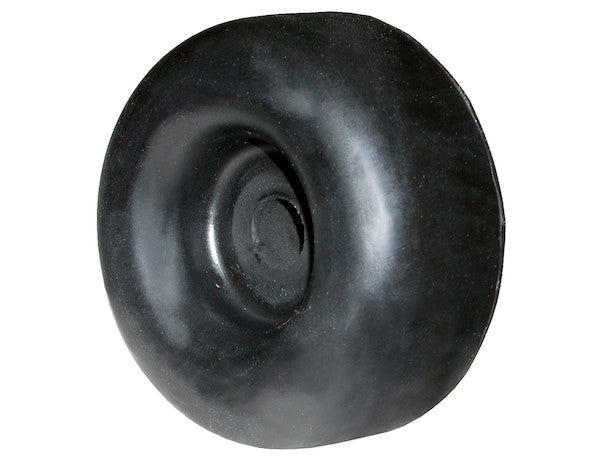
Buyers Products Full Round Rubber Bumpers are an easy way to help protect surfaces from accidental damage from nearby door handles, latches, or cam locks. It can also be used as a cushion for loading ramps or lift gates to prevent damage when closing or opening.
Specifications
| Color | Black |
|---|---|
| Height (in.) | 1.00 |
| Hole Dia. | 4/10 |
| Material | Rubber |
| Number of Mounting holes | 1 |
| Sold in Pairs (y/n) | No |
| Width (in.) | 2-1/2 |
The Buyers Products Round Rubber Bumper, with its precise dimensions of 2-1/2 inches in diameter and 1 inch in height, represents a critical component in engineered solutions requiring effective impact absorption, vibration damping, and surface protection. Crafted from robust rubber material and presented in a utilitarian black finish, this bumper is designed for a broad spectrum of industrial, commercial, and vehicular applications where durability and functional integrity are paramount. Its fundamental purpose is to mitigate kinetic energy transference, thereby safeguarding adjacent surfaces, reducing operational noise, and extending the service life of equipment and infrastructure. The specified dimensions and material properties are crucial for its performance characteristics, enabling it to serve as an indispensable buffer against mechanical stresses and incidental contact.
The physical geometry of the bumper, a full round profile, is strategically engineered to distribute impact forces radially, minimizing stress concentration at any single point of contact. A diameter of 2-1/2 inches provides a substantial contact area, which is vital for effective energy dissipation, while the 1-inch height offers adequate deflection distance to absorb shocks without bottoming out under typical load conditions. This volumetric configuration ensures optimal performance across various loading scenarios, from incidental bumps to sustained compression. The single mounting hole, precisely drilled to 4/10 inch (0.40 inches) in diameter, facilitates secure and straightforward installation using standard fasteners, ensuring the bumper remains firmly in place even under repetitive stress. The black coloration is not merely aesthetic; it often indicates the incorporation of carbon black, a common additive in rubber compounds that significantly enhances UV resistance, weatherability, and overall mechanical strength, making the bumper suitable for both indoor and demanding outdoor environments.
Advanced Material Science: Understanding Rubber in Bumper Applications
The selection of rubber as the primary material for this bumper is foundational to its functionality. Rubber, a class of elastomers, possesses unique viscoelastic properties that enable it to deform significantly under stress and subsequently return to its original shape, making it ideal for absorbing impact energy and damping vibrations. While the specific type of rubber is not detailed, common elastomers used in such applications include Styrene-Butadiene Rubber (SBR), Ethylene Propylene Diene Monomer (EPDM), Natural Rubber (NR), and Neoprene (Polychloroprene). Each type offers a distinct profile of mechanical and environmental resistances, tailoring performance to specific operational demands.
- Durometer Hardness: The hardness of a rubber compound, measured on the Shore A scale, directly influences the bumper's compression characteristics. A softer durometer (e.g., Shore A 40-60) provides greater shock absorption and deflection, ideal for delicate surfaces or lighter impacts. A harder durometer (e.g., Shore A 70-90) offers higher load-bearing capacity and increased resistance to deformation, suitable for heavy-duty applications or where minimal deflection is desired. The precise durometer for this 2-1/2" x 1" bumper would be optimized to balance energy absorption with structural integrity under expected loads.
- Tensile Strength and Elongation: These properties quantify the rubber's resistance to breaking under tension and its ability to stretch before fracturing. High tensile strength ensures the bumper can withstand significant pulling forces without tearing, which is important for mounting integrity and overall durability. Elongation, or the percentage increase in length before failure, indicates the material's flexibility and resilience.
- Compression Set Resistance: This critical property describes the rubber's ability to resist permanent deformation after being subjected to a constant compressive force over time. A low compression set is vital for bumpers, ensuring they retain their original shape and protective capabilities through countless cycles of compression and relaxation, thereby preventing premature failure and maintaining consistent performance.
- Abrasion Resistance: For applications involving frequent contact or sliding forces, such as loading ramps or material handling equipment, high abrasion resistance is essential. Rubber compounds can be formulated to withstand significant wear and tear, prolonging the bumper's service life in challenging environments.
- Environmental Resistance: The performance of rubber bumpers can be significantly affected by environmental factors.
- Temperature Range: Rubber compounds are engineered to maintain their mechanical properties across specific temperature ranges. Extremely low temperatures can cause brittleness and loss of elasticity, while high temperatures can lead to softening, accelerated aging, and permanent deformation. A robust rubber bumper like this one would typically operate effectively within a broad service temperature range to accommodate diverse climates and industrial heat exposures.
- UV and Ozone Resistance: For outdoor applications, exposure to ultraviolet (UV) radiation and ozone can cause surface cracking, hardening, and degradation of rubber. The use of carbon black in black rubber compounds significantly enhances resistance to these environmental aggressors, ensuring the bumper's long-term integrity in sun-exposed or ozone-rich environments.
- Chemical Resistance: Depending on the application, bumpers may be exposed to oils, greases, fuels, acids, or alkalis. Specialized rubber compounds (e.g., Nitrile for oil resistance, EPDM for acid/alkali resistance) are chosen to resist specific chemical degradation, preventing swelling, dissolution, or loss of mechanical properties.
- Water and Moisture Resistance: While rubber generally exhibits good water resistance, prolonged immersion or exposure to certain aqueous solutions can still affect some compounds. Resistance to hydrolysis and water absorption ensures stability in wet or humid conditions, crucial for marine or washdown applications.
Engineering for Impact Absorption and Vibration Damping
The fundamental role of this round rubber bumper is to manage mechanical energy. When an impact occurs, the bumper material compresses, absorbing kinetic energy and converting it into potential energy (stored within the deformed rubber) and heat. This process significantly reduces the peak force transmitted to the protected surface, preventing damage. The viscoelastic nature of rubber also allows it to dissipate this energy, preventing rebound and oscillation. In vibration damping applications, the bumper isolates components from oscillating forces, reducing noise and preventing fatigue in structural elements and fasteners.
The specific dimensions of 2-1/2 inches diameter and 1 inch height are engineered to provide an optimal force-deflection curve for a variety of common industrial and vehicular loads. The larger diameter ensures a stable base and efficient load distribution across the mounting point, minimizing localized stress on the attachment surface. The 1-inch height provides sufficient volume of material to undergo controlled deformation, absorbing substantial impact energy without reaching its compression limit too rapidly, thereby preventing a 'hard stop' which could still damage components.
Versatile Application Scenarios
The technical specifications and material properties of the Buyers Products Round Rubber Bumper lend themselves to an extensive array of applications:
- Vehicle & Transportation Industry: Integral for trucks, trailers, recreational vehicles (RVs), and utility vehicles. Used as docking bumpers on loading docks, rear bumpers on commercial vehicles to prevent damage during backing, or as stoppers for hydraulic lift gates and cargo ramp systems. The robust construction and environmental resistance make it ideal for exterior vehicular use.
- Industrial Machinery & Equipment: Serves as a protective buffer on automated machinery, conveyor systems, robotics, and assembly lines. Prevents metal-on-metal contact, dampens operational vibrations from motors or reciprocating parts, and protects delicate sensors or actuators from accidental impacts within industrial settings.
- Material Handling: Essential for protecting mobile equipment such as forklifts, pallet jacks, utility carts, and dollies from impact damage when maneuvering in warehouses or manufacturing facilities. Also used on racks, shelves, and storage systems to prevent damage to goods or infrastructure during loading and unloading.
- Marine Applications: Functions effectively as a boat fender or dock bumper, protecting hulls from abrasive contact with piers or other vessels. The inherent water and weather resistance of high-quality rubber compounds is particularly beneficial in these demanding environments.
- Facility Protection: Can be mounted on walls, columns, and corners in commercial buildings, parking garages, and industrial plants to protect structures from impact by vehicles, equipment, or foot traffic. Reduces maintenance costs associated with structural damage.
- HVAC and Electrical Enclosures: Utilized as vibration isolators for compressors, generators, and large electrical panels, reducing noise transmission and preventing fatigue failure of components caused by continuous operational vibrations.
- OEM Integration: As a standard yet robust component, this bumper is frequently integrated into original equipment designs across various sectors, providing built-in protection and enhancing product longevity and safety.
Installation and Maintenance Considerations
Proper installation is crucial to realizing the full protective potential of the 2-1/2" diameter x 1" high round rubber bumper. The single 4/10-inch diameter mounting hole is designed for compatibility with standard bolts, screws, or rivets. When selecting fasteners, consideration must be given to the material of the mounting surface, the expected shear and pull-out forces, and environmental conditions. For instance, stainless steel fasteners are recommended for outdoor or corrosive environments to prevent galvanic corrosion and ensure long-term stability. The installation torque should be sufficient to firmly secure the bumper without over-compressing the rubber and causing premature degradation around the mounting point. Regular inspection for signs of wear, cracking, or loss of elasticity is recommended, particularly in high-impact or harsh environmental applications. Prompt replacement of degraded bumpers ensures continuous protection and operational safety.
Conclusion
The Buyers Products Round Rubber Bumper, characterized by its 2-1/2 inch diameter, 1 inch height, and robust rubber construction, is more than a simple accessory; it is an engineered solution designed to perform critical functions in diverse operational contexts. Its precise dimensions, coupled with the inherent viscoelastic properties of its material, provide superior impact absorption, vibration damping, and surface protection capabilities. From safeguarding valuable equipment and infrastructure to enhancing operational safety and reducing maintenance costs, this bumper delivers reliable, long-lasting performance. Its single-hole mounting design ensures ease of installation, making it a highly practical and cost-effective component for professionals seeking to implement durable protective measures across a wide array of industrial, commercial, and vehicular applications. Investing in this technically sound protective element translates directly into improved longevity of assets and enhanced operational efficiency.