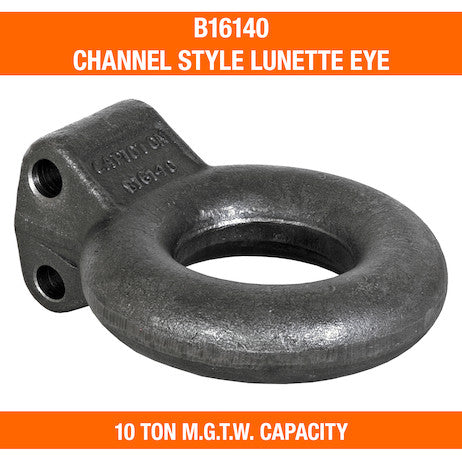
The Forged Steel Tow Eyes from Buyers Products are designed to be bolted into an adjustable channel bracket. This allows you to position the tow eye or lunette for level towing. Simply bolt the eye into the channel bracket at the position that fits your needs, and connect to the pintle hook on your truck. The eye has an interior diameter of 3 in. and is made of rugged forged steel to handle a maximum gross towing weight of 25,000 lb. Available in a corrosion-resistant zinc-plated finish or with no finish.
Specifications
| Drawbar Section (in.) | 1.625 |
|---|---|
| Eye Inner Diameter (in.) | 3.00 |
| Eye Outer Diameter (in.) | 6.25 |
| Finish | Plain |
| M.G.T.W. (lbs.) | 20,000 |
| M.V.L. (lbs.) | 2,000 |
| Material | Forged Steel |
| Mounting Hole Diameter (in.) | 0.656 |
| Vertical Hole Spacing (in.) | 2.00 |
Technical Overview: Plain 10-Ton Forged Steel Tow Eye 3 Inch I.D.
The Plain 10-Ton Forged Steel Tow Eye with a 3-inch Inner Diameter represents a critical component in heavy-duty towing systems, engineered for uncompromising strength, durability, and reliability. Designed to seamlessly integrate with adjustable channel brackets and standard pintle hooks, this tow eye facilitates secure and stable connections for a wide range of commercial, industrial, and agricultural trailers. Its robust construction from forged steel ensures superior performance under extreme loads and harsh operating conditions, making it an indispensable asset for professional towing applications requiring a maximum gross towing weight (MGTW) of 20,000 lbs and a maximum vertical load (MVL) of 2,000 lbs.
Advanced Material Science: The Superiority of Forged Steel
The foundation of this tow eye's exceptional performance lies in its material: forged steel. Unlike cast steel or fabricated alternatives, forging is a manufacturing process that involves shaping metal while it is solid, typically through localized compressive forces. This process fundamentally alters the microstructure of the steel, imparting distinct advantages critical for high-stress applications:
- Optimized Grain Structure: During forging, the metal's grain structure is refined and elongated, following the contours of the part. This "grain flow" aligns with the stress patterns that the tow eye will experience in operation, significantly enhancing its strength, toughness, and resistance to fatigue. In contrast, cast materials have a random grain structure, which can lead to localized weak points.
- Increased Tensile Strength and Yield Strength: The mechanical working involved in forging densifies the steel, eliminating internal voids, porosity, and other defects commonly found in cast components. This results in substantially higher tensile strength (resistance to breaking under tension) and yield strength (resistance to permanent deformation) compared to non-forged equivalents. For a component subjected to constant pulling and dynamic stresses, these properties are paramount for safety and longevity.
- Superior Impact and Shock Resistance: Towing operations frequently expose components to sudden impacts, jolts, and dynamic loading. Forged steel exhibits exceptional impact resistance due to its refined grain structure and absence of internal flaws, making it far less susceptible to brittle fracture under shock loads. This is crucial for maintaining structural integrity during trailer articulation, sudden stops, or traversing uneven terrain.
- Enhanced Fatigue Life: Fatigue failure, caused by repeated stress cycles below the material's yield strength, is a common concern in towing equipment. The controlled grain flow and refined microstructure of forged steel significantly improve its resistance to crack initiation and propagation, thereby extending the component's service life and reducing the risk of catastrophic failure over thousands of towing cycles.
- Consistent Quality: The forging process allows for precise control over the material's properties, resulting in a highly uniform and predictable product. This consistency is vital for ensuring that each tow eye meets rigorous performance standards and maintains its integrity throughout its operational lifespan.
The selection of forged steel for this 10-ton tow eye is not merely a choice of material but a deliberate engineering decision to deliver a product capable of withstanding the most demanding towing challenges with an unparalleled margin of safety and durability.
Load Capacity and Dynamic Performance: Understanding 10-Ton Rating
The designation of a "10-Ton" capacity for this tow eye translates directly to a Maximum Gross Towing Weight (MGTW) of 20,000 lbs (9,071 kg) and a Maximum Vertical Load (MVL) of 2,000 lbs (907 kg), as detailed in the specifications. These ratings are critical for ensuring proper and safe towing operations:
- Maximum Gross Towing Weight (MGTW): This refers to the maximum total weight of the trailer, including its cargo, that the tow eye is engineered to safely pull. The 20,000 lb rating positions this component firmly within the heavy-duty segment, suitable for large utility trailers, construction equipment carriers, agricultural implements, and industrial platforms. It is imperative that the combined weight of the trailer and its load never exceeds this MGTW to prevent overstressing the tow eye and compromising towing safety.
- Maximum Vertical Load (MVL): Also known as tongue weight, the MVL represents the maximum downward force exerted by the trailer tongue on the tow eye and, consequently, on the towing vehicle's hitch system. A proper tongue weight, typically 10-15% of the MGTW for conventional trailers, is essential for maintaining stability and control during towing. The 2,000 lb MVL rating for this tow eye accommodates substantial vertical forces, indicating its robust design for balanced load distribution and reduced oscillation.
The engineering behind these capacities involves sophisticated stress analysis, finite element modeling, and rigorous physical testing. Safety factors are incorporated into the design to account for dynamic loads, sudden braking, accelerations, road irregularities, and potential shock loads, ensuring that the tow eye maintains structural integrity far beyond its stated working limits under normal operating conditions. It is crucial for operators to always match the tow eye's capacity to the requirements of the trailer and the towing vehicle's pintle hook system.
Precision Engineering: Dimensional Specifications and Interoperability
The precise dimensions of the Plain 10-Ton Forged Steel Tow Eye are meticulously engineered to ensure optimal performance, secure mounting, and universal compatibility with industry-standard towing components. Key dimensional specifications include:
- Eye Inner Diameter (3.00 in.): The 3-inch interior diameter is a standard dimension designed for seamless compatibility with most heavy-duty pintle hooks. This precise fit minimizes play between the tow eye and the pintle hook, reducing wear on both components and mitigating harsh shock loads transmitted during acceleration and deceleration. A snug fit also contributes to quieter towing and improved trailer handling characteristics.
- Eye Outer Diameter (6.25 in.): This dimension speaks to the substantial amount of forged steel surrounding the inner bore, indicating the material thickness and structural mass dedicated to bearing the immense forces of heavy-duty towing. The robust outer diameter provides the necessary strength to prevent deformation and ensure the integrity of the inner diameter under maximum load conditions.
- Drawbar Section (1.625 in.): The drawbar section refers to the thickness and profile of the material where the tow eye interfaces with the adjustable channel bracket. A 1.625-inch drawbar section provides ample strength for bolting securely into the channel, distributing the towing forces effectively across the mounting points. This dimension is crucial for preventing localized stress concentrations and ensuring the long-term integrity of the connection to the adjustable mount.
- Mounting Hole Diameter (0.656 in.) and Vertical Hole Spacing (2.00 in.): These specifications dictate the precise fitment with standard adjustable channel brackets. The 0.656-inch hole diameter accommodates high-strength bolts, typically Grade 8, which are essential for securing the tow eye to the bracket. The 2.00-inch vertical hole spacing is an industry-standard dimension, ensuring broad compatibility with a variety of adjustable channel brackets, facilitating quick and secure installation. The precision of these mounting points is paramount for maintaining alignment and preventing movement that could lead to wear or structural fatigue.
These precisely defined dimensions underscore the product's design for interoperability, ease of installation, and structural integrity, guaranteeing a reliable connection within a comprehensive towing system.
Versatile Mounting and Level Towing Capability
A significant advantage of this tow eye's design is its integration with an adjustable channel bracket. This boltable design offers unparalleled versatility and critical functional benefits:
- Adjustable Height for Level Towing: Trailers, tow vehicles, and load distributions vary widely. The ability to bolt the tow eye into different positions within an adjustable channel bracket allows operators to precisely match the height of the tow eye to the pintle hook on the towing vehicle. Achieving a level trailer orientation is not merely an aesthetic preference; it is crucial for optimal trailer stability, even tire wear, efficient braking, and proper weight distribution across the trailer's axles. This adjustability prevents "nose-high" or "nose-low" trailer attitudes, which can negatively impact handling, increase aerodynamic drag, and create unsafe towing conditions.
- Simplified Installation and Replacement: The bolt-on design facilitates straightforward installation and, when necessary, replacement. This eliminates the need for welding or specialized fabrication, streamlining maintenance procedures and reducing downtime. Utilizing high-strength fasteners (e.g., Grade 8 bolts, lock washers, and self-locking nuts) torqued to manufacturer specifications is essential for a secure and long-lasting connection.
- Adaptability Across Fleets: For fleet operators managing diverse towing vehicles and trailer types, the adjustable channel bracket system provides a standardized, flexible solution. A single tow eye model can be adapted to various setups by simply repositioning it within the channel, enhancing operational efficiency and reducing inventory complexity.
This intelligent design ensures that the tow eye is not only inherently strong but also functionally versatile, catering to the dynamic requirements of professional towing.
Finish Options: Durability and Corrosion Protection
The Plain 10-Ton Forged Steel Tow Eye is available in two finish options, catering to different operational environments and user preferences:
- Plain Finish: This option refers to the natural, untreated forged steel surface. While robust in its inherent material strength, a plain finish is typically chosen for applications where the component will be subsequently painted by the end-user to match specific equipment aesthetics or for installations in protected environments where corrosion is not a primary concern. It also presents a cost-effective option for scenarios where additional surface treatment is not deemed critical or will be applied post-purchase. Users opting for the plain finish should be aware of the steel's susceptibility to surface oxidation (rust) when exposed to moisture and air without protective coatings.
-
Corrosion-Resistant Zinc-Plated Finish: The zinc-plated option provides an enhanced layer of protection against environmental degradation. Zinc plating is a process where a thin layer of zinc is applied to the steel surface, typically through electroplating. This coating offers dual-action corrosion resistance:
- Barrier Protection: The zinc layer acts as a physical barrier, preventing moisture and corrosive agents from reaching the underlying steel.
- Sacrificial Protection (Galvanic Action): Zinc is more electrochemically active than steel. If the coating is scratched or compromised, the zinc will corrode preferentially, sacrificing itself to protect the steel from rusting. This galvanic action significantly extends the life of the tow eye, especially in challenging outdoor environments, exposed to road salts, chemicals, and varying weather conditions.
The zinc-plated finish is highly recommended for applications where the tow eye will be continuously exposed to moisture, road spray, or other corrosive elements, ensuring long-term aesthetic integrity and structural reliability.
The availability of these finish options allows purchasers to select the most appropriate configuration based on their specific operational context and desired level of corrosion protection.
Applications Across Industries
The robust design and high capacity of the Plain 10-Ton Forged Steel Tow Eye make it suitable for a diverse array of heavy-duty towing applications across multiple industries:
- Commercial Hauling: Essential for flatbed trailers, enclosed cargo trailers, and specialized transport trailers used in logistics and freight.
- Construction: Integral for moving construction equipment such as mini excavators, skid steers, scissor lifts, and material handling trailers on job sites and between locations.
- Agriculture: Used on large farm implements, hay wagons, fertilizer spreaders, and other agricultural trailers that require robust connections for field operations and transport.
- Municipal Fleets: Employed by public works departments for utility trailers, chipper trailers, and equipment haulers.
- Industrial Operations: Suitable for heavy-duty dollies, yard spotters, and specialized industrial trailers within manufacturing plants, warehouses, or port facilities.
- Utility Services: Critical for power companies, telecommunications providers, and other utility services for hauling generators, cable reels, and specialized equipment.
Its reliability and strength ensure that critical operations remain uninterrupted and safe, regardless of the challenging environments these industries often present.
Safety, Maintenance, and Longevity
The tow eye is a primary safety component in any towing system. Adherence to best practices in installation, operation, and maintenance is paramount for ensuring the longevity of the component and the safety of personnel and equipment:
- Proper Installation: Always use high-grade fasteners (e.g., Grade 8 bolts) and torque them to the manufacturer's specified values. Ensure lock washers or other locking mechanisms are employed to prevent loosening under vibration.
- Regular Inspections: A comprehensive pre-trip inspection should include the tow eye. Check for any signs of wear, deformation, cracks, excessive corrosion, or looseness in the mounting bolts. Pay particular attention to the contact surfaces where the pintle hook engages the eye, as this area experiences the most wear.
- Wear Limits: Adhere to established wear limits for the inner diameter of the tow eye. Excessive ovaling or thinning of the material indicates a compromised component that requires immediate replacement.
- Matching Components: Always ensure the tow eye capacity (MGTW and MVL) meets or exceeds the requirements of the trailer being towed. Similarly, ensure the pintle hook on the towing vehicle has a compatible capacity and is in good condition.
- Lubrication: While not always necessary for pintle hook systems, maintaining clean and functional contact surfaces can contribute to reduced wear. Consult pintle hook manufacturer recommendations.
- Dynamic Loading Awareness: Understand that dynamic forces during towing (e.g., sudden braking, sharp turns, rough roads) can momentarily exert loads far greater than static weights. The forged steel construction is designed to mitigate these, but operating within rated capacities and driving responsibly are key.
By diligently adhering to these safety and maintenance protocols, operators can maximize the service life of their Plain 10-Ton Forged Steel Tow Eye and uphold the highest standards of towing safety and operational efficiency.
Conclusion: An Unwavering Commitment to Performance
The Plain 10-Ton Forged Steel Tow Eye with a 3-inch I.D. represents a professional-grade solution for demanding towing scenarios. Its construction from premium forged steel delivers superior mechanical properties, including enhanced strength, fatigue resistance, and impact toughness, surpassing the capabilities of lesser materials. Coupled with its precise dimensional engineering for compatibility with standard pintle hooks and adjustable channel brackets, and the option for a corrosion-resistant finish, this tow eye offers an optimal blend of durability, versatility, and safety. For operators and fleet managers who prioritize reliability and require a component that can consistently perform under heavy loads and challenging conditions, this tow eye stands as an exemplary choice, ensuring secure connections and operational continuity for years to come.