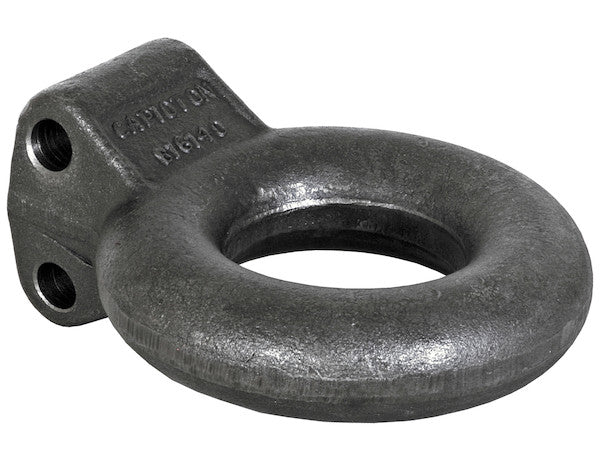
The Forged Steel Tow Eyes from Buyers Products are designed to be bolted into an adjustable channel bracket. This allows you to position the tow eye or lunette for level towing. Simply bolt the eye into the channel bracket at the position that fits your needs, and connect to the pintle hook on your truck. The eye has an interior diameter of 3 in. and is made of rugged forged steel to handle a maximum gross towing weight of 25,000 lb. Available in a corrosion-resistant zinc-plated finish or with no finish.
Specifications
| Drawbar Section (in.) | 1.625 |
|---|---|
| Eye Inner Diameter (in.) | 3.00 |
| Eye Outer Diameter (in.) | 6.25 |
| Finish | Plain |
| M.G.T.W. (lbs.) | 25,000 |
| M.V.L. (lbs.) | 3,000 |
| Material | Forged Steel |
| Mounting Hole Diameter (in.) | 0.656 |
| Vertical Hole Spacing (in.) | 2.0 |
The Plain 12.5 Ton Forged Steel Tow Eye with a 3 Inch I.D. represents a critical component in heavy-duty towing applications, meticulously engineered to ensure robust performance, enhanced safety, and extended operational longevity. This detailed exposition delves into the material science, design principles, performance specifications, installation considerations, and operational benefits of this indispensable towing accessory, aiming to provide a comprehensive understanding for professionals in the transportation, construction, agricultural, and industrial sectors.
Engineering Excellence: The Forged Steel Advantage
At the core of this tow eye's superior performance is its construction from forged steel. Forging is a metal forming process that involves shaping metal using localized compressive forces, typically applied by hammers or presses. Unlike casting, which involves pouring molten metal into a mold, forging mechanically works the metal, yielding a product with distinct metallurgical advantages. This process refines the grain structure of the steel, aligning the grains in the direction of the metal's primary stress, creating a "grain flow" that enhances the material's strength, ductility, and resistance to fatigue. The result is a component free from internal voids, porosity, or inclusions often associated with casting, leading to a significantly higher strength-to-weight ratio and improved impact resistance.
The selection of forged steel for a component like a tow eye, which is subjected to immense tensile, shear, and dynamic shock loads during towing operations, is paramount. This material inherently offers superior tensile strength, ensuring that the eye can withstand the pulling forces exerted by heavy trailers without permanent deformation or failure. Furthermore, its enhanced fatigue resistance means the tow eye can endure countless cycles of loading and unloading, a common occurrence in dynamic towing environments, without developing microscopic cracks that could propagate into catastrophic failures over time. The material's ability to absorb and distribute sudden impacts, such as those experienced during acceleration, braking, or traversing uneven terrain, is also a direct benefit of its refined microstructure, providing an additional layer of safety and reliability.
The manufacturing process itself adheres to stringent quality control standards, ensuring that each forged steel tow eye consistently meets the specified material properties and structural integrity. This commitment to engineering excellence translates directly into a product that professionals can trust in demanding operational scenarios, minimizing downtime and maximizing the safety of their towing operations.
Precision in Design: The 3-Inch I.D. and Structural Geometry
The precise dimensions of the tow eye are not arbitrary but are a result of industry standards and careful engineering to ensure optimal compatibility and performance. The 3-inch Inner Diameter (I.D.) is a critical specification, as it defines the interface with the pintle hook on the towing vehicle. This standardized dimension ensures a secure and precise fit with a wide range of heavy-duty pintle hooks, minimizing slack and play between the two components. A snug fit is crucial for reducing wear on both the tow eye and the pintle hook, mitigating shock loads, and preventing excessive movement that could lead to premature material fatigue or even disconnection. The outer diameter of the eye, measuring 6.25 inches, provides the necessary material thickness to support the forces concentrated around the inner circumference, ensuring the integrity of the 3-inch opening under maximum load conditions.
The design also incorporates a robust drawbar section measuring 1.625 inches. This section is the structural backbone of the tow eye, providing the mass and strength required to transfer the immense towing forces from the eye to the mounting bracket. Its dimensions are engineered to seamlessly integrate with standard adjustable channel brackets, ensuring a broad range of application compatibility. The integration of mounting holes with a 0.656-inch diameter and a vertical spacing of 2.0 inches further reinforces this compatibility. These precise hole specifications are vital for ensuring proper bolt engagement, facilitating secure attachment to the adjustable channel bracket. Correct hole alignment minimizes stress concentrations around the fasteners, distributing the load efficiently across the entire mounting surface and preventing elongation or deformation of the mounting holes over time, which could compromise the security of the connection.
Every aspect of the tow eye's geometry, from its precise diameters to its mounting hole configurations, is meticulously designed to create a unified, high-performance towing connection. This holistic engineering approach ensures that the component not only performs its primary function but also contributes to the overall stability, safety, and longevity of the entire towing system.
Load Bearing Capabilities: M.G.T.W. and M.V.L. Explained
The performance capabilities of the Plain 12.5 Ton Forged Steel Tow Eye are quantified by two critical ratings: Maximum Gross Towing Weight (M.G.T.W.) and Maximum Vertical Load (M.V.L.), also known as tongue weight. Understanding these specifications is fundamental for safe and efficient towing operations.
The M.G.T.W. of 25,000 lbs (equivalent to 12.5 tons) indicates the maximum total weight of the trailer, including its cargo, that the tow eye is engineered to safely pull. This rating is not merely a number but a reflection of the tow eye's structural integrity, material strength, and design robustness under continuous pulling forces. Exceeding this rating can lead to critical material fatigue, permanent deformation, or catastrophic failure of the tow eye, posing severe safety risks. Adhering strictly to the M.G.T.W. ensures that the component operates within its engineered limits, providing a substantial safety factor to account for dynamic loads, sudden impacts, and varying road conditions.
The M.V.L. of 3,000 lbs specifies the maximum downward force that the trailer's tongue can exert on the tow eye. This "tongue weight" is a crucial parameter for maintaining trailer stability. Insufficient tongue weight can lead to trailer sway, a dangerous condition where the trailer oscillates uncontrollably, while excessive tongue weight can overload the towing vehicle's rear axle, affecting steering, braking, and tire wear. For pintle hook connections, the tongue weight should ideally be between 10% and 15% of the M.G.T.W. to ensure optimal stability. A 3,000 lb M.V.L. for a 25,000 lb M.G.T.W. product is well within this optimal range, demonstrating that this tow eye is designed to support a properly balanced trailer effectively.
These ratings are established through rigorous testing protocols, often including static load tests, dynamic fatigue tests, and destructive tests, to validate the product's performance under simulated and real-world conditions. When selecting a tow eye, it is imperative to match its M.G.T.W. and M.V.L. capabilities to the specific requirements of the trailer and the nature of the cargo, always erring on the side of caution. This commitment to appropriate load matching is a cornerstone of safe heavy-duty towing practices.
Strategic Integration: Bolting into Adjustable Channel Brackets
The design of this forged steel tow eye emphasizes its integration into an adjustable channel bracket system, a highly advantageous feature for optimizing towing dynamics. The ability to bolt the tow eye into a channel bracket allows for precise vertical positioning of the lunette relative to the towing vehicle's pintle hook. This adjustability is critical for achieving "level towing," where the trailer's frame remains parallel to the ground. Level towing is not merely an aesthetic preference; it is a fundamental principle of safe and efficient heavy-duty hauling. When a trailer is towed level, the load is distributed evenly across all of its axles, preventing overloading on any single axle and minimizing premature tire wear, brake imbalance, and suspension strain. Furthermore, a level trailer improves aerodynamic efficiency, reduces sway tendencies, and ensures proper operation of trailer brakes.
The mechanical fastening mechanism, involving bolting the tow eye into the channel, provides a secure and robust connection. The specified mounting hole diameter of 0.656 inches and vertical hole spacing of 2.0 inches are engineered for compatibility with standard heavy-duty channel brackets, ensuring a precise fit for high-strength fasteners. It is strongly recommended to use hardened bolts, such as Grade 8 bolts, along with appropriate washers and lock nuts, to secure the tow eye. These components are designed to withstand the high shear and tensile forces generated during towing, resisting loosening due to vibration and shock. Proper torque application for the bolts, as specified by the fastener manufacturer, is paramount to achieving the necessary clamping force and preventing joint slip, which could lead to accelerated wear or failure.
The adjustability afforded by the channel bracket system provides unparalleled versatility. It allows operators to compensate for varying trailer tongue heights, different towing vehicle hitch heights, and even changes in vehicle suspension dynamics when under load. This adaptability ensures that the optimal towing geometry can be maintained across a diverse fleet of equipment and a multitude of operational scenarios, thereby enhancing safety, improving operational efficiency, and extending the service life of both the tow eye and the trailer components.
Durability and Environmental Considerations: The Plain Finish
The "Plain" finish of this forged steel tow eye signifies an uncoated, bare steel surface. While the product is also available with a corrosion-resistant zinc-plated finish, the plain option caters to specific operational and aesthetic preferences. A plain finish offers several distinct advantages, particularly in environments where direct welding, custom painting, or specific surface treatments are desired by the end-user. The absence of a factory coating simplifies welding processes, eliminating the need for pre-grinding or removal of a plated layer that could interfere with weld integrity or produce hazardous fumes. This makes the plain tow eye an ideal choice for custom fabrication projects or for integration into existing systems where welding is a necessary part of the assembly.
For users who wish to apply a custom paint scheme that matches their fleet's aesthetics or specific environmental protection requirements, the plain surface provides an excellent substrate. After proper surface preparation, such as degreasing and priming, the bare steel readily accepts various industrial coatings, allowing for a tailored corrosion protection strategy. This flexibility is invaluable for companies with specific coating protocols or those operating in unique climatic conditions that may require specialized paints or anti-corrosive treatments beyond standard plating.
However, it is important to acknowledge that a plain steel finish, by its nature, is susceptible to rust and corrosion when exposed to moisture, road salts, and harsh environmental elements. For maximum longevity and to maintain aesthetic appeal, regular inspection and protective measures are recommended. This may include periodic cleaning, application of rust-inhibiting primers, or protective waxes, especially if the tow eye is not immediately painted or integrated into a sealed system. Despite this, the inherent strength and durability of the forged steel itself mean that superficial surface corrosion typically does not compromise the structural integrity or load-bearing capacity of the tow eye, particularly with consistent maintenance and proper application of protective coatings as needed by the end-user.
Applications and Operational Context
The Plain 12.5 Ton Forged Steel Tow Eye with a 3-inch I.D. is engineered for a broad spectrum of heavy-duty towing applications, making it an indispensable component across various industries. Its robust construction and high load ratings render it suitable for situations where reliability and safety are paramount.
- Construction Industry: This tow eye is extensively used on construction trailers designed to transport heavy machinery such as excavators, bulldozers, skid steers, and material handlers. The demanding nature of construction sites, with uneven terrain and constant heavy loads, necessitates a towing component that can withstand significant shock and continuous stress.
- Agricultural Sector: Farmers rely on durable towing equipment to move large agricultural implements, wagons, and livestock trailers. The tow eye’s capacity to handle substantial gross towing weights makes it ideal for the robust trailers commonly found in agricultural operations, ensuring safe transport across diverse farm landscapes.
- Commercial Hauling: For commercial transport companies specializing in heavy equipment, modular homes, or specialized freight, this tow eye provides the reliable connection needed for large-capacity trailers. Its compatibility with standard pintle hooks ensures seamless integration into existing fleets of heavy-duty trucks.
- Government and Municipal Fleets: Public works departments, utility companies, and military operations utilize similar tow eyes for their heavy-duty utility trailers, equipment haulers, and specialized mobile units. The demand for resilience and long service life in these critical applications is met by the forged steel construction.
- Logging and Mining Operations: In extreme environments characterized by rough terrain and very heavy, often uneven loads, this tow eye offers the necessary strength and durability for logging trailers, mining equipment transport, and other heavy industrial applications where equipment reliability is essential to productivity and safety.
The operational context for this tow eye often involves exposure to abrasive materials, extreme temperatures, and corrosive elements. The selection of forged steel ensures that the core structural integrity is maintained even when subjected to such harsh conditions, provided appropriate protective measures are taken for the plain finish based on the specific environment.
Installation Protocols and Best Practices
Proper installation of the tow eye into an adjustable channel bracket is crucial for maximizing its performance and ensuring towing safety. While the process is straightforward, adherence to best practices is essential:
- Select Appropriate Channel Bracket: Ensure the channel bracket is rated for the tow eye's M.G.T.W. and M.V.L. and has compatible hole spacing (2.0 inches vertical spacing) and sufficient material thickness to support the forces.
- Positioning for Level Towing: Attach the tow eye to the channel bracket at the height that achieves a level orientation for the trailer when coupled to the towing vehicle. This may require trial and error, adjusting the tow eye's vertical position until the trailer frame is parallel to the ground.
- Use Grade 8 Hardware: Always use high-strength, Grade 8 bolts, nuts, and hardened flat washers for securing the tow eye. The 0.656-inch mounting hole diameter is designed for common heavy-duty fasteners. Grade 8 hardware provides the necessary tensile and shear strength to resist the dynamic forces encountered during towing.
- Correct Torque Application: Tighten all bolts to the torque specifications recommended by the fastener manufacturer. Under-torqued bolts can loosen under vibration, leading to joint failure, while over-torqued bolts can stretch or damage the fasteners and the tow eye's mounting holes. Use a calibrated torque wrench for accuracy.
- Regular Inspection: After initial installation and periodically thereafter, inspect all bolts for tightness and the tow eye for any signs of wear, cracks, or deformation. Pay close attention to the area around the pintle hook interface and the mounting holes. Any signs of stress or damage warrant immediate attention and potential replacement.
- Surface Protection (Plain Finish): If the plain finish is not immediately painted, consider applying a rust-inhibiting coating or primer to prevent surface corrosion, especially in humid or corrosive environments.
By following these protocols, operators can ensure that the tow eye functions optimally, provides a secure connection, and contributes positively to the overall safety and reliability of their heavy-duty towing operations.
Safety, Compliance, and Longevity
The design and construction of this Forged Steel Tow Eye are rooted in a commitment to safety and adherence to industry best practices. While specific certifications vary by region and application, the inherent strength of forged steel, combined with precise dimensional control and high load ratings, positions this product as a reliable component for critical towing tasks. Users should always ensure their entire towing system—including the towing vehicle, hitch, channel bracket, tow eye, pintle hook, and trailer—is compliant with all applicable local, state, and federal regulations regarding towing capacity, safety chains, lighting, and braking.
The longevity of the tow eye is a direct function of its material quality, design integrity, and diligent maintenance. The robust nature of forged steel ensures a long service life, even under demanding conditions. However, regular inspection for signs of wear, such as excessive ovaling of the eye, significant surface abrasion, or any indications of cracks, is paramount. Any component exhibiting such wear should be promptly replaced to prevent potential failures. Proactive maintenance, including lubrication of the pintle hook mechanism and protective measures for the plain steel finish, will significantly extend the operational life of the tow eye and safeguard the investment in towing equipment.
Conclusion
The Plain 12.5 Ton Forged Steel Tow Eye with a 3 Inch I.D. is more than just a metal ring; it is a precisely engineered, high-strength component designed to be the nexus of safe and efficient heavy-duty towing. Its construction from premium forged steel ensures unparalleled strength, durability, and resistance to fatigue and impact, critical attributes for challenging operational environments. The meticulous design, including its standardized 3-inch inner diameter and precise mounting hole specifications, guarantees seamless integration with industry-standard pintle hooks and adjustable channel brackets, facilitating optimal towing geometry and load distribution. With impressive M.G.T.W. and M.V.L. ratings, this tow eye confidently handles substantial loads, backed by rigorous engineering principles. Whether deployed in construction, agriculture, commercial hauling, or municipal services, this forged steel tow eye stands as a testament to reliability, performance, and unwavering safety, making it the preferred choice for professionals who demand the utmost from their towing equipment.