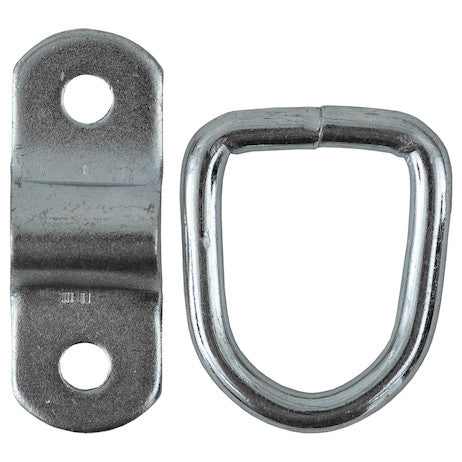
Buyers Products Rope Ring with Two Hole Bracket is made of zinc-plated steel with a formed steel clamp and carries a working load limit of 800 lb. Rope rings are not approved for lifting.
Specifications
| Min. Breaking Strength (lbs) | 2,400 |
|---|---|
| Mount Type | Surface |
| W.L.L. (lbs) | 800 |
Technical Overview: 1/4 Inch Rope Ring with 2-Hole Mounting Bracket, Zinc Plated
The 1/4 Inch Rope Ring with 2-Hole Mounting Bracket, zinc plated, represents a critical component in robust cargo securement systems across a diverse array of industrial, commercial, and recreational applications. Engineered for durability and reliable performance, this fixture provides a secure anchor point for ropes, straps, and other tie-down accessories, ensuring the safe transit and storage of goods. Its design prioritizes ease of installation, long-term resilience, and adherence to specified load-bearing capacities, making it an indispensable asset for effective load management.
Material Science and Fabrication: Zinc-Plated Steel Construction
The fundamental integrity of this rope ring system is derived from its premium material composition: zinc-plated steel. This selection is not arbitrary but is the result of careful engineering consideration for environments demanding high strength, wear resistance, and protection against corrosive elements. The core material, steel, provides the foundational mechanical strength necessary to withstand significant tensile forces. While the specific alloy may vary, it is typically a high-grade carbon steel, chosen for its excellent balance of hardness, toughness, and ductility. This allows the component to absorb and distribute loads effectively without premature deformation or catastrophic failure under its rated capacities.
The Role of Zinc Plating
The exterior finish—zinc plating—is a critical enhancement that extends the operational lifespan and maintains the aesthetic integrity of the rope ring. Zinc plating, a process involving the electrolytic deposition of a thin layer of zinc onto the steel substrate, serves primarily as a sacrificial coating. In the presence of moisture and oxygen, zinc corrodes preferentially to steel, forming a protective barrier that shields the underlying ferrous metal from rust and oxidation. This galvanic protection is highly effective in preventing common forms of corrosion that can compromise the structural integrity and appearance of untreated steel components over time. The zinc layer also provides a degree of abrasion resistance, guarding against minor scratches and impacts that might otherwise expose the bare steel to corrosive agents. The typical thickness of this zinc layer is carefully controlled during manufacturing to ensure optimal protection without compromising the dimensional tolerances or the functionality of the rope ring.
Furthermore, the zinc-plating process contributes to a smoother, more uniform surface finish, which can reduce friction during the engagement of ropes or straps and minimize wear on both the securement device and the cargo being restrained. The bright, metallic appearance of zinc-plated hardware also offers a visual indication of quality and can contribute to a more professional look in various applications.
Formed Steel Clamp and 2-Hole Mounting Bracket
Central to the rope ring’s functionality is the formed steel clamp, which meticulously integrates the movable ring with the fixed mounting bracket. The "formed" aspect of the steel clamp indicates that the component has undergone a cold or hot forming process, such as stamping, bending, or rolling. This manufacturing technique ensures precise dimensional accuracy, excellent material grain structure for enhanced strength, and a consistent profile that facilitates reliable attachment. Forming steel, as opposed to casting or welding multiple pieces, often results in a more homogeneous structure with fewer internal stresses, contributing to superior fatigue resistance and overall durability.
The mounting bracket is specifically designed with a two-hole configuration. This dual-point attachment system is engineered to provide superior stability and optimized load distribution when the rope ring is subjected to tensile forces. Unlike single-point mounts, a two-hole bracket effectively dissipates stresses across a broader surface area of the mounting substrate, significantly reducing the likelihood of localized stress concentrations that could lead to fastener pull-out or substrate damage. The spacing between the two holes is optimized to balance ease of installation with maximum securement effectiveness, allowing for the use of robust fasteners that can withstand the specified working load limit.
Performance Specifications and Engineering Principles
The reliability and safety of any cargo securement device are quantified by its performance specifications. For this 1/4 Inch Rope Ring, the key metrics are the Working Load Limit (WLL) and the Minimum Breaking Strength (MBS), along with the designated mount type.
Working Load Limit (WLL): 800 lb
The Working Load Limit (WLL) is a critical parameter that defines the maximum static load that a piece of lifting equipment or cargo securement hardware can safely support when properly applied. For this rope ring, the WLL is specified at 800 lb (approximately 363 kg). This value is not merely a measure of the product's ultimate strength but is a carefully calculated figure that incorporates a substantial safety factor. The WLL is always significantly less than the Minimum Breaking Strength to account for various unpredictable factors that can influence real-world performance. These factors include: dynamic loading (shocks, vibrations, sudden accelerations or decelerations), potential material fatigue over time, variations in environmental conditions (temperature extremes, moisture), improper installation techniques, minor material imperfections, and potential wear and tear during normal operation. Adhering strictly to the WLL is paramount to ensuring operational safety and preventing equipment failure, cargo damage, and potential injury to personnel.
Minimum Breaking Strength (MBS): 2,400 lb
The Minimum Breaking Strength (MBS), also often referred to as Ultimate Tensile Strength (UTS), represents the minimum force at which a new and undamaged component is expected to fail or break when subjected to a direct, steady pull under controlled laboratory conditions. For this rope ring, the MBS is 2,400 lb (approximately 1089 kg). The relationship between MBS and WLL is fundamental to engineering safety. In this instance, the MBS of 2,400 lb and a WLL of 800 lb indicates a safety factor of 3:1 (2400 lb / 800 lb = 3). A safety factor of 3:1 is a common and robust standard for many cargo securement applications, providing a significant margin of safety above the intended operational loads. This margin accounts for the aforementioned real-world variables, ensuring that even under conditions exceeding typical static loads, the component maintains a reserve of strength before catastrophic failure. It is crucial to understand that exceeding the WLL, even if still below the MBS, progressively erodes this safety margin, dramatically increasing the risk of failure.
Mount Type: Surface
The "Surface Mount" designation signifies that the bracket is designed for direct attachment to the external surface of a structural component, such as a truck bed, trailer wall, floor, or chassis. This mounting method offers versatility and ease of installation compared to recessed or through-hole designs that might require more complex structural modifications. The two-hole bracket design ensures that when properly installed with appropriate fasteners, the load is distributed effectively across the mounting surface. The success of a surface-mount installation heavily relies on the integrity of the substrate and the correct selection and application of fasteners. For optimal performance, the mounting surface must be flat, rigid, and capable of withstanding the forces exerted by the secured cargo.
Critical Safety Precaution: Not Approved for Lifting
It is imperative to emphasize the explicit warning that these rope rings are not approved for lifting. This restriction is not a minor guideline but a critical safety mandate rooted in fundamental engineering principles and regulatory compliance. Lifting operations, by their very nature, introduce complex dynamic forces, shock loads, and potential for catastrophic failure with severe consequences for personnel and property. Devices designed for lifting (e.g., shackles, eye bolts, hoist rings) are manufactured to far more stringent specifications, typically incorporating significantly higher safety factors (often 4:1 or 5:1 for static loads, and even higher for dynamic scenarios), more robust material traceability, and often undergoing individual proof testing and certification. The design of this rope ring, while exceptionally strong for cargo securement, lacks the specific geometry, material properties, and safety factors required to safely manage the multi-directional stresses, pendulum effects, and potential shock loads inherent in lifting operations. Utilizing this product for lifting tasks constitutes a severe misuse, will void any manufacturer's warranty, and carries an unacceptably high risk of catastrophic failure, leading to serious injury or fatality.
Applications and Versatility
The 1/4 Inch Rope Ring with 2-Hole Mounting Bracket, Zinc Plated, offers a highly versatile and essential securement solution across a broad spectrum of industries and recreational pursuits. Its robust design and effective load capacity make it suitable for numerous applications where reliable anchor points are needed to restrain cargo from shifting during transit or storage.
- Commercial and Utility Trailers: Indispensable for securing equipment, tools, and materials within enclosed or open utility trailers.
- Truck Beds and Vans: Provides additional tie-down points in pick-up truck beds, service vehicles, and cargo vans, enhancing the safety of transported goods.
- Marine Applications (Non-Lifting): Suitable for securing gear, covers, or equipment on boats, docks, or marine craft, provided it is not used for critical lifting or mooring. The zinc plating offers reasonable protection in marine environments.
- Agricultural Equipment: Useful for restraining implements, supplies, or produce on farm trailers, ATV racks, or utility vehicles.
- Industrial and Workshop Settings: Can be installed on workbenches, shelving units, or storage areas to secure tools, equipment, or components, preventing movement during assembly or transport within a facility.
- Recreational Vehicles (RVs) and Campers: Ideal for securing camping gear, bicycles, coolers, or other items both inside and outside RVs, contributing to a safer travel experience.
- ATV and Powersports: Provides reliable anchor points for securing ATVs, motorcycles, or snowmobiles onto trailers for transport.
- Custom Fabrication and OEM: Its standardized design and robust construction make it an excellent choice for original equipment manufacturers (OEMs) and custom fabricators looking to integrate reliable tie-down points into their products or specialized vehicles.
In all these applications, the primary function remains consistent: to create a steadfast anchor for various types of securement devices, including bungee cords, rope, cam buckle straps, and ratchet straps, thereby preventing cargo movement caused by acceleration, deceleration, turns, or road irregularities.
Installation Guide and Best Practices
Proper installation is paramount to achieving the rated Working Load Limit and ensuring the long-term reliability of the 1/4 Inch Rope Ring. Failure to adhere to correct installation procedures can significantly compromise the component's integrity and lead to premature failure or unsafe conditions.
1. Substrate Selection and Preparation:
The mounting surface must be capable of supporting the anticipated loads. Ideal substrates include structural steel, thick aluminum, or robust wood framing. Ensure the surface is clean, flat, and free from obstructions or corrosion that could impede a secure fit. If mounting to wood, ensure it is solid and free of rot or damage. If mounting to thin sheet metal, reinforcement plates should be considered on the opposite side to distribute the load and prevent fastener pull-through.
2. Fastener Selection:
The strength of the rope ring system is only as good as its weakest link, which often includes the fasteners. For optimal performance, use high-grade fasteners appropriate for the substrate and application. Typically, grade 5 or grade 8 bolts (SAE) or class 8.8 or 10.9 bolts (Metric) are recommended for metal substrates, paired with corresponding lock washers and nuts to prevent loosening due to vibration. For wood, robust lag screws or carriage bolts with large washers are suitable. Fasteners should be sized to fit the mounting holes without excessive play and long enough to provide adequate thread engagement, preferably extending through the substrate with a nut on the opposite side for maximum security.
3. Drilling and Alignment:
Accurately mark the drilling locations using the bracket as a template. Use a drill bit sized appropriately for your chosen fasteners. Drill perpendicular to the mounting surface to ensure straight holes and proper fastener alignment. Deburr any sharp edges around the drilled holes to prevent future damage to the substrate or components. Proper alignment of the bracket is crucial to ensure that the rope ring can pivot freely and that the load is applied correctly.
4. Securement and Torque:
Position the bracket flush against the mounting surface. Insert the chosen fasteners through the bracket holes and the substrate. If using through-bolts, apply washers (flat and lock washers) and nuts on the opposite side. Hand-tighten all fasteners first to ensure proper alignment, then progressively tighten them using appropriate tools. For metal fasteners, follow recommended torque specifications provided by the fastener manufacturer or general engineering guidelines for the chosen bolt size and grade. Over-tightening can strip threads or deform the bracket/substrate, while under-tightening can lead to loosening under vibration or load. Ensure fasteners are uniformly tightened to distribute stress evenly.
5. Post-Installation Inspection:
After installation, perform a visual inspection. Verify that the bracket is firmly seated against the surface, that all fasteners are securely tightened, and that the rope ring pivots smoothly without binding. There should be no visible gaps or wobbling. A periodic check of fastener tightness is recommended, especially after initial use or exposure to heavy loads and vibration.
Maintenance and Longevity
While the zinc-plated steel construction offers inherent durability, routine maintenance and inspection are vital to ensure the continued safe and effective operation of the 1/4 Inch Rope Ring over its lifespan.
- Regular Visual Inspection: Before each use, or at least periodically, inspect the rope ring and mounting bracket for any signs of wear, damage, or corrosion. Look for cracks, bends, distortions, significant rust formation (especially if the zinc plating has been breached), or excessive wear on the ring itself.
- Fastener Integrity: Check that all mounting fasteners remain tight. Vibration and dynamic loading can gradually loosen bolts. Re-tighten any loose fasteners to their specified torque.
- Corrosion Management: Although zinc-plated, severe scratches or prolonged exposure to harsh environments can compromise the coating. If significant rust appears, the component's structural integrity may be compromised, warranting replacement. Minor surface rust may be treated, but if it penetrates the material, replacement is the safest option.
- Deformation: Any visible deformation of the ring, bracket, or mounting holes indicates that the component has been subjected to loads exceeding its design limits. Such components must be immediately removed from service and replaced.
- Environmental Considerations: While robust, extreme temperatures, continuous exposure to saltwater, or corrosive chemicals can accelerate degradation. Consider these factors during inspection and adjust replacement schedules accordingly.
Adhering to these maintenance practices ensures that the rope ring continues to provide a reliable and safe securement point, prolonging its service life and preventing potential failures.
Compliance and Industry Standards (General Considerations)
While this specific product adheres to its stated WLL and MBS, its application often falls within broader regulatory frameworks for cargo securement. In North America, for instance, the Federal Motor Carrier Safety Administration (FMCSA) in the United States and similar bodies in Canada (e.g., Canadian Council of Motor Transport Administrators - CCMTA) publish detailed regulations and best practices for securing cargo on commercial vehicles. These regulations often specify requirements for the strength and number of tie-downs based on cargo weight, dimensions, and type. While individual rope rings are components, their selection and installation must align with these overarching standards to ensure full compliance and maximize safety. Users are encouraged to consult relevant local, national, and industry-specific regulations pertaining to cargo securement for their particular application.
The Value Proposition: Durability, Reliability, and Safety
The 1/4 Inch Rope Ring with 2-Hole Mounting Bracket, Zinc Plated, stands as a testament to thoughtful engineering and material selection for demanding applications. Its zinc-plated steel construction offers superior corrosion resistance and inherent strength, ensuring a long operational life even in challenging environments. The formed steel clamp and two-hole bracket design provide a stable and robust anchor point, distributing loads effectively and simplifying installation. With a clearly defined Working Load Limit of 800 lb and a generous safety factor derived from its 2,400 lb Minimum Breaking Strength, users can rely on this component for dependable cargo securement. The explicit caution against using it for lifting underscores a commitment to safety and proper application, guiding users toward safe and effective utilization. This product is an essential investment for anyone requiring a dependable, durable, and easily installable tie-down solution, providing peace of mind by ensuring that valuable cargo remains securely in place.