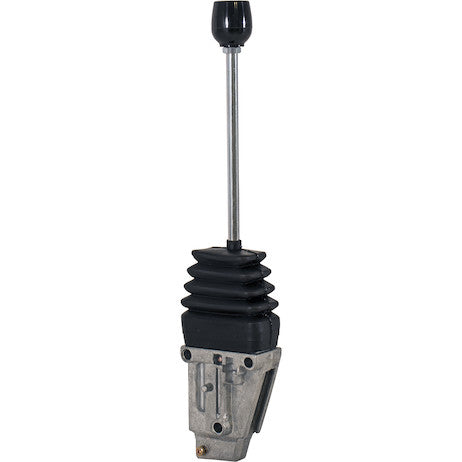
Buyers Products Single Axis Locking Remote Control System is designed for flexibility in use and installation. The sturdy, weatherproof control can be mounted on the interior or exterior of your vehicle and can be used singly or stacked for multi-spool valves. Each valve lever has a momentary spring-to-center action and a 5/8 in. stroke each way from center neutral position.
Specifications
| Mounting Hole Pattern | 3 Hole | ||
| Handle Material | Carbon Steel | ||
| Description | Single Axis Remote Valve Control | ||
| Can be stacked (y/n) | Yes | ||
| Mounting Plate Width | 3.19 " | ||
| Handle Length | 11.5 " | ||
| Number of Axis | Single | ||
| Boot Height | 3.50 " | ||
| Mounting Hole Diameter | 0.33 " | ||
| Mounting Plate Height | 3.82 " | Thickness | 1.65 " |
Advanced Technical Overview: Buyers Products Single Axis Remote Valve Control System
The Buyers Products Single Axis Locking Remote Control System represents a robust and versatile solution for precision hydraulic valve actuation across a wide spectrum of mobile and stationary industrial applications. Engineered for durability and operational efficiency, this system is a critical component for operators requiring reliable, repeatable, and ergonomically optimized control over single-axis hydraulic functions. This comprehensive technical overview delves into the design principles, operational characteristics, material science, installation considerations, and functional advantages that distinguish this product in the competitive landscape of industrial controls.
Design Philosophy and Core Functionality
At its core, the Single Axis Remote Valve Control System is designed to provide a mechanical interface between an operator and a hydraulic control valve. This interface translates manual input into precise linear displacement, which, in turn, actuates the spool of a hydraulic valve. The fundamental design emphasizes user-centric ergonomics combined with exceptional mechanical resilience. The "Single Axis" designation indicates that the control manipulates a single degree of freedom, typically corresponding to a single hydraulic function such as raising/lowering, extending/retracting, or rotating in one plane. The "Locking" feature, though not explicitly detailed in the initial description, often implies a mechanism to maintain a specific output position, preventing accidental displacement once set, which is critical for tasks requiring sustained valve engagement. If not a literal "lock," the robust spring-to-center action itself provides a strong neutral detent, which is a form of inherent positional stability.
Momentary Spring-to-Center Action
A key operational characteristic is the "momentary spring-to-center action." This mechanism ensures that the valve lever automatically returns to a neutral (center) position upon release by the operator. This is a crucial safety and operational feature for several reasons:
- Safety: In the event of operator distraction or emergency, the hydraulic function immediately ceases, preventing unintended movement of equipment.
- Precision: It facilitates precise, short bursts of hydraulic power, ideal for fine adjustments or inching operations.
- Efficiency: Reduces wear on the hydraulic pump and associated components by disengaging flow when not actively commanded.
- Ergonomics: Minimizes operator fatigue by eliminating the need to actively return the lever to neutral.
The spring mechanism is engineered for consistent tension and durability, utilizing high-cycle life springs made from materials resistant to fatigue and corrosion.
Lever Stroke and Control Fidelity
The specified "5/8 in. stroke each way from center neutral position" defines the maximum linear travel of the control lever in both directions from its quiescent state. This stroke length is meticulously chosen to offer an optimal balance between granular control resolution and the full actuation range required for typical hydraulic valve spools. A longer stroke can offer finer control but may require greater operator effort, while a shorter stroke might be less precise. The 5/8-inch displacement provides sufficient mechanical advantage to fully engage the spool without excessive lever travel, contributing to both operational comfort and precise modulation of hydraulic flow.
Material Science and Construction
The choice of materials and construction methods are paramount to the longevity and performance of a control system exposed to harsh industrial environments.
Handle Material: Carbon Steel
The selection of "Carbon Steel" for the handle material is a deliberate engineering decision based on its mechanical properties:
- High Tensile Strength: Carbon steel exhibits excellent resistance to bending, torsion, and impact, ensuring the handle can withstand significant operational forces without deformation or fracture.
- Durability: It is inherently robust, capable of enduring repetitive motions and accidental impacts common in demanding work settings.
- Wear Resistance: With appropriate surface treatments (e.g., plating or coating), carbon steel offers good resistance to abrasive wear, prolonging the handle's functional life.
- Cost-Effectiveness: Carbon steel is a relatively economical material, allowing for a high-performance component without prohibitive manufacturing costs.
To further enhance its suitability for outdoor or corrosive environments, the carbon steel components are typically treated with industrial-grade coatings (e.g., powder coating, zinc plating, or other anti-corrosion finishes) that provide a barrier against moisture, chemicals, and UV radiation, preventing rust and degradation.
Weatherproof Design and Environmental Resistance
The description highlights a "sturdy, weatherproof control." This implies a comprehensive approach to sealing and material selection to protect internal mechanisms from environmental ingress. Key aspects of weatherproof design include:
-
Boot Material: The "Boot Height" specification of 3.50 inches suggests a substantial protective boot. This component is typically made from high-performance elastomers (e.g., Neoprene, EPDM, or high-grade polyurethane) chosen for their resilience to:
- UV Radiation: Prevents cracking and degradation from sunlight exposure.
- Ozone: Protects against atmospheric ozone, a common cause of rubber deterioration.
- Chemical Resistance: Withstands exposure to common industrial fluids such as hydraulic oil, fuels, solvents, and cleaning agents.
- Temperature Extremes: Maintains flexibility and sealing integrity across a wide operating temperature range, from sub-zero to elevated industrial temperatures.
- Water and Dust Ingress: Forms an effective seal around the moving lever mechanism, preventing the entry of water, dust, dirt, and other particulate matter that could contaminate or seize internal components.
- Housing Construction: The main housing, likely constructed from durable engineering plastics or cast metal, is designed with tight tolerances and integrated gaskets or seals to prevent moisture penetration.
- Corrosion Protection: All external metal components, including fasteners and the handle base, are treated to resist corrosion.
Versatility and Installation Flexibility
The design emphasizes flexibility in both use and installation, a critical consideration for equipment manufacturers (OEMs) and fleet operators.
Mounting Options: Interior or Exterior
The ability to mount the control "on the interior or exterior of your vehicle" significantly broadens its applicability. This flexibility is supported by:
- Robust Housing: The weatherproof design ensures reliable operation regardless of environmental exposure.
- Compact Footprint: The dimensions (Mounting Plate Width: 3.19", Mounting Plate Height: 3.82", Thickness: 1.65") indicate a relatively compact unit, allowing for installation in confined spaces within a cab or on an external panel.
- Secure Mounting Pattern: The "3 Hole" mounting pattern with a "Mounting Hole Diameter" of 0.33 inches ensures a secure and stable attachment to various surfaces. This standard pattern facilitates integration with existing equipment designs.
Stackability for Multi-Spool Valves
The explicit statement "Can be stacked (y/n) Yes" highlights a significant advantage for complex hydraulic systems. Stacking multiple single-axis controls allows for the creation of multi-functional control stations, each lever independently managing a specific spool within a multi-spool hydraulic valve bank. This modularity offers several benefits:
- Customization: Operators can tailor the control layout to match their specific application requirements, placing frequently used controls in optimal ergonomic positions.
- Space Efficiency: Stackable designs allow multiple controls to occupy a smaller overall footprint compared to separate, non-stackable units, which is crucial in vehicles with limited dashboard or console space.
- Ease of Installation: Standardized mounting interfaces simplify the integration of multiple units.
- Scalability: Systems can be easily expanded or reconfigured by adding or removing control modules as operational needs evolve.
The design likely incorporates interlocking features or a common mounting bracket system that facilitates secure and aesthetically pleasing stacking, ensuring consistent lever spacing and operational ergonomics across multiple stacked units.
Detailed Specifications and Engineering Implications
The provided specifications offer critical insights into the physical attributes and design considerations.
- Mounting Hole Pattern: 3 Hole – A common and secure pattern for mechanical controls, offering stability against rotational forces and vibration.
- Mounting Hole Diameter: 0.33" – Suitable for standard imperial fasteners (e.g., 5/16" or M8 bolts), ensuring compatibility with readily available hardware.
- Mounting Plate Width: 3.19", Mounting Plate Height: 3.82" – These dimensions define the footprint of the control unit at its base. They are crucial for panel cutout design and ensuring adequate space for installation.
- Thickness: 1.65" – Refers to the depth of the unit, important for clearance behind the mounting panel.
- Handle Length: 11.5" – A significant dimension that influences operator leverage, ergonomic reach, and the overall profile of the control. A longer handle can provide greater mechanical advantage and a more comfortable grip, reducing operator strain during prolonged use. It also positions the grip away from the pivot point, offering more precise control over the 5/8" spool travel.
- Number of Axis: Single – Confirms the control's dedicated function for one hydraulic operation.
- Boot Height: 3.50" – As discussed, this is a key indicator of the environmental protection offered, ensuring ample coverage over the internal mechanism and dynamic seal around the handle.
Applications and Target Markets
Given its robust design and technical specifications, the Buyers Products Single Axis Remote Valve Control System is ideally suited for a broad array of demanding applications across various industries:
- Construction Equipment: Control of excavators, loaders, backhoes, graders, and other heavy machinery for functions like bucket tilt, auxiliary attachments, or outrigger deployment.
- Agricultural Machinery: Operation of tractor implements, plows, cultivators, sprayers, and material handling attachments.
- Utility Vehicles: Control of aerial lifts, boom trucks, service cranes, and municipal equipment for functions such as lift extension, rotation, or tool actuation.
- Waste Management: Compactor controls, refuse body functions, and lift gate operations.
- Forestry Equipment: Log grapples, chippers, and harvesting machinery.
- Material Handling: Forklifts, telehandlers, and specialized conveyors requiring precise hydraulic control.
- Marine Applications: Control of winches, davits, and steering mechanisms on workboats or commercial vessels, where weatherproof design is paramount.
- Specialized Industrial Machinery: Any stationary or mobile equipment utilizing hydraulic power for linear or rotational actuation where a reliable, single-axis mechanical control is required.
Maintenance and Longevity
While designed for minimal maintenance, understanding factors contributing to longevity is important:
- Sealing Integrity: Regular inspection of the protective boot for tears or deterioration is crucial, especially in high-UV or abrasive environments. Replacing a damaged boot promptly prevents internal contamination.
- Lubrication: Although generally factory-lubricated for life, in extremely dusty or wet conditions, periodic inspection of the internal pivot points for smooth operation may be beneficial. Use of appropriate, non-gumming lubricants is recommended if necessary.
- Mounting Security: Periodically check the mounting fasteners for tightness to ensure the control remains securely affixed and to prevent premature wear due to vibration.
- Cable Linkage Inspection: If used with mechanical push-pull cables, regular inspection of the cable, clevis pins, and connection points for wear or corrosion is vital to maintain control fidelity.
Conclusion
The Buyers Products Single Axis Locking Remote Control System is a meticulously engineered component designed to deliver superior performance and durability in challenging operational environments. Its combination of robust materials, weatherproof construction, ergonomic design, and versatile mounting options makes it an indispensable control solution for a vast array of hydraulic applications. The momentary spring-to-center action ensures safety and precision, while the stackable design offers unparalleled flexibility for integrating into complex multi-functional systems. By understanding the technical depth and design rationale behind each feature, users and system integrators can fully appreciate the value and long-term reliability this control system brings to their equipment.