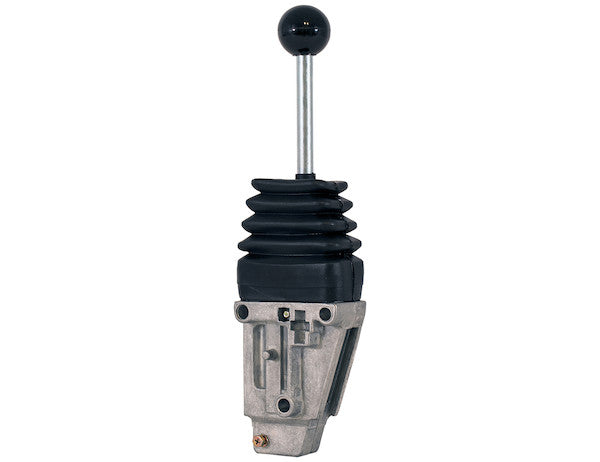
Buyers Products Single Axis Remote Valve Control with Detent is designed for flexibility--both in use and in installation. The sturdy, weatherproof control can be mounted on either the interior or exterior of your vehicle, and can be used singly or stacked for multi-spool valves. Each valve lever has a detent feature to hold the lever in place during use and a 5/8 in. stroke each way from center neutral position.
Specifications
| Mounting Plate Width | 3.19 " |
| Detent Type | Center |
| Handle Material | Carbon Steel |
| Mounting Hole Pattern | 3 Hole |
| Boot Height | 3.50 " |
| Thickness | 1.65 " |
| Handle Length | 8.0 " |
| Description | Single Axis Remote Valve Control with Center Detent |
| Mounting Hole Diameter | 0.33 " |
| Mounting Plate Height | 3.82 " |
| Number of Axis | Single |
Advanced Engineering and Application of the Single Axis Remote Valve Control with Center Detent
The Buyers Products Single Axis Remote Valve Control with Center Detent represents a pinnacle of mechanical control engineering, designed for robust performance, precise operation, and exceptional durability across a spectrum of demanding applications. This comprehensive description delves into the technical intricacies, operational benefits, and broad applicability of this critical component, emphasizing its role in optimizing hydraulic and pneumatic systems in mobile and industrial environments.
Core Functionality and Design Philosophy
At its heart, this control unit is engineered to provide precise, single-axis manipulation of hydraulic or pneumatic valves, facilitating the execution of specific functions such as lift, lower, extend, retract, open, or close. The term "single axis" denotes its capacity to control movement in one primary direction or along one plane, translating operator input into a linear mechanical action that typically actuates a valve spool. This simplicity is a deliberate design choice, enhancing reliability and ease of integration into existing systems.
Remote Operation and Ergonomics
The "remote" aspect of this control system is paramount for modern machinery. It decouples the operator's position from the hydraulic valve's physical location, offering significant advantages in terms of safety, operator comfort, and situational awareness. Operators can position themselves in a secure, climate-controlled cabin with optimal visibility, away from moving parts, high-pressure lines, or hazardous environments. The 8.0-inch handle length is ergonomically designed to provide ample leverage, reducing operator fatigue during prolonged use while ensuring a comfortable grip and precise tactile feedback. This extended handle facilitates a wide range of motion, translating into nuanced control over the attached valve.
The Significance of the Center Detent Mechanism
The "Center Detent" is a defining feature of this control unit, critical for both operational precision and safety. A detent mechanism provides a positive, tactile lock that holds the control lever firmly in a neutral or specified position without continuous operator input. In this case, the detent is strategically placed at the center, signifying the neutral or standby position of the valve. When the lever is moved from this center detent, it engages the valve's spool to perform a function (e.g., extend a cylinder). Upon releasing the lever, the detent ensures it snaps back and locks into the neutral position, preventing accidental activation and maintaining system stability when no function is required.
Technically, the detent mechanism often involves a spring-loaded ball or roller engaging with a precisely machined groove or notch. This provides a distinct "click" or tactile resistance as the lever enters or exits the detent, offering immediate feedback to the operator. The benefits are manifold:
- Precision and Stability: The detent ensures that the valve remains in a defined neutral state, preventing creep or unintentional activation, which is vital for safety-critical applications.
- Reduced Operator Fatigue: Operators do not need to continuously hold the lever in the neutral position, allowing them to focus on other tasks or monitor the operation.
- Enhanced Safety: By preventing inadvertent valve actuation, the detent significantly reduces the risk of accidents caused by unexpected movement of equipment or loads.
- Energy Efficiency: When the valve is held in neutral, the hydraulic system often operates in an open-center configuration or a standby mode, minimizing unnecessary fluid flow and parasitic power losses.
Precise Stroke Control
The specified 5/8 inch stroke each way from the center neutral position is a critical parameter. This finite and symmetrical stroke ensures that the attached valve spool can be fully actuated in both directions (e.g., fully open and fully closed, or fully extend and fully retract) with a consistent and predictable lever movement. This precise stroke length is engineered to match the typical throw requirements of most standard hydraulic and pneumatic control valves, ensuring optimal engagement without over-travel or insufficient actuation. The consistent stroke contributes directly to the repeatability and reliability of the controlled function.
Robust Construction and Environmental Resilience
The design ethos of the Buyers Products control unit places a strong emphasis on durability and resistance to harsh operating environments. This is evident in its material selection and construction features.
Premium Material Selection
- Handle Material: Carbon Steel: The choice of carbon steel for the handle is deliberate. Carbon steel offers exceptional tensile strength, yield strength, and hardness, making it highly resistant to bending, breaking, and wear. This is crucial for a component that experiences frequent manual manipulation and potential impacts. Its inherent toughness ensures longevity even in heavy-duty applications.
- Weatherproof Casing: The description highlights a "sturdy, weatherproof control." This implies the housing is constructed from materials and sealed using methods that protect internal components from environmental ingress. While specific IP (Ingress Protection) ratings are not provided, the "weatherproof" designation typically signifies protection against moisture (rain, snow, wash-downs), dust, and debris. This could involve high-impact polymers, powder-coated metals, or a combination, coupled with robust gaskets and seals around moving parts and mounting interfaces. The boot height of 3.50 inches further protects the internal mechanism from dirt and moisture, extending the operational life of the unit.
Designed for Extreme Conditions
Equipment operating in municipal, agricultural, construction, or utility sectors often faces extreme conditions including:
- Temperature Fluctuations: From sub-zero winters to scorching summers.
- Vibration and Shock: Constant exposure to engine vibration, rough terrain, and operational impacts.
- Corrosive Agents: Road salt, chemicals, fertilizers, and other corrosive substances.
- UV Radiation: Prolonged exposure to sunlight.
The robust construction and weatherproof characteristics ensure that the control unit maintains its functional integrity and tactile performance under these challenging conditions, minimizing downtime and maintenance requirements. The 1.65-inch thickness indicates a solid and substantial build, further contributing to its resistance to deformation and impact.
Installation Flexibility and System Integration
One of the key advantages cited is the unit's flexibility in installation and use. This adaptability makes it a versatile solution for diverse mobile and industrial machinery.
Versatile Mounting Options
The control unit can be mounted on either the interior or exterior of a vehicle or machine. This flexibility is supported by the unit's weatherproof design. Exterior mounting is common for applications where the operator needs to be outside the cabin (e.g., operating a boom on a utility truck, controlling a plow from the truck bed). Interior mounting provides protection from the elements for the control unit itself and is common in enclosed cabs. The precise mounting plate dimensions (3.19" width, 3.82" height) and the 3-hole mounting pattern with 0.33" diameter holes provide standardized parameters for easy integration into custom or pre-existing control panels.
Stackability for Multi-Spool Valves
The ability to use the control "singly or stacked for multi-spool valves" is a significant design advantage. Multi-spool valves are common in hydraulic systems that manage several independent functions from a single valve bank (e.g., controlling multiple cylinders or motors). By designing the single-axis controls to be stackable, manufacturers can create a custom control console with multiple levers arranged side-by-side. This not only saves valuable panel space but also allows for a compact and organized operator interface, where each lever corresponds to a specific hydraulic function. This modularity ensures scalability and simplifies future expansion or modification of the control system.
Interfacing with Hydraulic/Pneumatic Valves
This remote control unit typically interfaces with hydraulic or pneumatic valves via mechanical push-pull control cables. These cables, also known as mechanical control cables, consist of a flexible inner member (often stainless steel wire rope) that slides within a rigid yet flexible outer conduit. When the control lever is actuated, it pushes or pulls the inner member, which in turn actuates the spool of the remote valve. The design of the control unit includes appropriate attachment points and linkage mechanisms to securely connect to the cable's end fittings, ensuring efficient and low-friction transmission of force.
The selection and routing of these push-pull cables are crucial for system performance. Factors such as cable length, bend radii, and resistance to environmental factors must be considered to maintain smooth operation and minimize hysteresis. The robust design of the control unit ensures it can withstand the forces transmitted through these cables over extensive operational cycles.
Operational Advantages and User Experience
Beyond its technical specifications, the Single Axis Remote Valve Control significantly enhances the overall operational experience and system reliability.
- Intuitive Operation: The simplicity of a single-axis lever with a defined neutral detent makes operation highly intuitive, reducing the learning curve for new operators and minimizing errors.
- Enhanced Productivity: With precise control and reduced fatigue, operators can perform tasks more efficiently and accurately, leading to increased productivity and throughput. The positive detent feedback allows for confident and swift engagement of functions.
- Reduced Maintenance: The durable construction, weatherproof sealing, and high-quality materials contribute to a long service life and minimal maintenance requirements, leading to lower total cost of ownership.
- Versatility Across Industries: Its adaptability makes it suitable for a vast array of applications, ensuring that equipment across different sectors can benefit from its reliable performance.
Diverse Applications
The utility of the Single Axis Remote Valve Control with Center Detent extends across numerous sectors, where robust, reliable, and precise mechanical control is paramount:
- Municipal Vehicles: Essential for snowplows (angle, lift, lower functions), salt spreaders (control of gate opening), refuse trucks, and street sweepers. The weatherproof design is particularly critical here due to constant exposure to harsh elements.
- Construction Equipment: Used in mini excavators, skid steers, backhoes, and other heavy machinery for functions like blade angle, bucket tilt, or auxiliary attachment control.
- Agricultural Machinery: Integral to controlling various implements such as loaders, tillers, sprayers, and specialized harvesting equipment, where precise adjustments are often needed.
- Utility Vehicles: For controlling booms, winches, outriggers, and tool circuits on service trucks, aerial lifts, and other specialized utility vehicles.
- Material Handling: Employed in forklifts, lift tables, and conveyor systems for controlling specific movements like lifting, lowering, or engaging stops.
- Forestry Equipment: In logging machinery for controlling grapple functions, sawhead movements, or other hydraulic attachments.
In each of these applications, the control unit provides the critical interface between the operator's intent and the machine's hydraulic or pneumatic actions, ensuring safety, efficiency, and reliable performance.
Technical Deep Dive and Engineering Considerations
For engineers and system integrators, several additional technical aspects are noteworthy:
- Detent Holding Force: The detent mechanism is engineered to provide an optimal balance between holding force (to prevent accidental disengagement) and actuation force (to allow smooth, intentional movement). This force profile is critical for operator comfort and safety.
- Durability of Internal Components: Beyond the carbon steel handle and robust casing, the internal pivots, linkages, and springs are designed for high cycle counts, using wear-resistant materials and corrosion-resistant coatings.
- Cable Compatibility: While specific cable types are not listed, the control unit is designed to be compatible with industry-standard push-pull cables, typically those featuring bulk-head mounts and threaded rod end connections or ball joint ends, allowing for easy selection of appropriate cables for specific installations.
- Vibration Damping: The overall construction and choice of materials contribute to the unit's ability to resist vibration-induced wear and maintain stable operation, preventing false actuations in dynamic environments.
- Serviceability: While designed for longevity, considerations for potential servicing or replacement are often integrated, ensuring that field maintenance, if required, is straightforward.
Conclusion
The Buyers Products Single Axis Remote Valve Control with Center Detent is more than just a lever; it is a meticulously engineered component designed to deliver superior control, reliability, and durability in the most demanding operational contexts. Its thoughtful combination of a sturdy, weatherproof construction, a positive center detent, precise stroke, and flexible mounting options makes it an indispensable element in modern hydraulic and pneumatic control systems. By prioritizing operator safety, comfort, and precision, this control unit significantly enhances the functionality and efficiency of mobile equipment and industrial machinery across a wide array of applications, underscoring Buyers Products' commitment to quality and performance in mechanical control solutions.