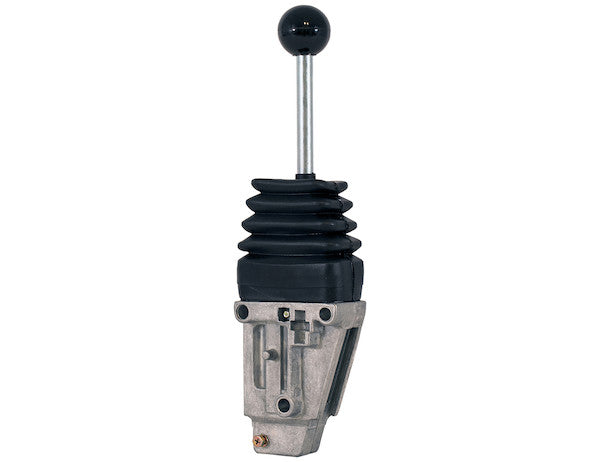
Buyers Products Single Axis Remote Valve Control with Detent is designed for flexibility--both in use and in installation. The sturdy, weatherproof control can be mounted on either the interior or exterior of your vehicle, and can be used singly or stacked for multi-spool valves. Each valve lever has a detent feature to hold the lever in place during use and a 5/8 in. stroke each way from center neutral position.
Specifications
| Description | Single Axis Remote Valve with End Detents |
| Thickness | 1.65 " |
| Mounting Plate Height | 3.82 " |
| Number of Axis | Single |
| Handle Material | Carbon Steel |
| Detent Type | End |
| Can be stacked (y/n) | Yes |
| Boot Height | 3.50 " |
| Mounting Plate Width | 3.19 " |
| Mounting Hole Diameter | 0.33 " |
| Mounting Hole Pattern | 3 Hole |
| Handle Length | 8.0 " |
Advanced Technical Overview: Single Axis Remote Valve Control with End Detents
The Buyers Products Single Axis Remote Valve Control with End Detents represents a critical component in the sophisticated orchestration of hydraulic and pneumatic systems across a myriad of mobile and stationary industrial applications. Engineered for unparalleled reliability, ergonomic efficiency, and robust performance, this control unit is meticulously designed to provide precise, tactile command over single-function valves, enhancing operational safety and productivity in demanding environments.
Foundational Principles: Single Axis Control
At its core, the designation "Single Axis" signifies that the control unit is dedicated to modulating a singular mechanical or fluid power function. Unlike multi-axis controllers that simultaneously manage multiple degrees of freedom, a single-axis system provides unambiguous, dedicated input for one specific operation – for instance, extending a hydraulic cylinder, initiating a motor rotation, or opening/closing a gate valve. This design philosophy is intentionally implemented to simplify operator interaction, reduce potential for error, and provide granular control over a critical singular function. In applications where individual, distinct actions are paramount, the single-axis architecture excels by offering direct, intuitive, and highly responsive feedback to the operator. This direct correlation between a single lever movement and a specific machine action is crucial for tasks requiring high precision or where sequential operations are common.
The Imperative of Remote Valve Control in Modern Operations
The integration of remote valve control systems has revolutionized operational methodologies across various industrial sectors. The Buyers Products unit exemplifies this by facilitating the actuation of valves from a distance, thereby decoupling the operator from the immediate vicinity of the active machinery or the valve itself. This separation yields multiple profound benefits. Firstly, it significantly augments operator safety by removing personnel from potentially hazardous zones involving high pressures, extreme temperatures, moving parts, or confined spaces. Operators can maintain a safe vantage point, optimizing visibility and situational awareness while manipulating equipment. Secondly, remote control enhances ergonomic comfort and reduces operator fatigue, particularly during prolonged shifts. The ability to position the control in an optimal, accessible location, irrespective of the valve's physical mounting, minimizes awkward postures and repetitive strain injuries. Thirdly, it drastically improves operational efficiency; operators can manage complex sequences of actions with greater speed and accuracy, directly contributing to increased throughput and reduced cycle times. The strategic placement of controls translates into a more intuitive and responsive operational experience, which is indispensable in fast-paced work environments.
Precision and Stability: The Mechanism of End Detents
A defining feature of this control unit is the inclusion of "End Detents." A detent mechanism serves to momentarily or permanently hold a mechanical component in a specific position, resisting unintended movement without requiring continuous operator force. In the context of this single-axis control, end detents are strategically positioned at the full travel extremes of the lever's stroke – a 5/8 inch displacement each way from the center neutral position. When the lever is moved to its maximum extent in either direction, the detent engages, positively latching the lever in that actuated position. This robust retention mechanism ensures that the valve remains fully engaged or disengaged, maintaining the desired operational state until intentionally released by the operator. The benefits are manifold:
- Consistent Operation: For functions requiring continuous engagement (e.g., maintaining a constant hydraulic flow, keeping a plow raised), the detent eliminates the need for the operator to continuously hold the lever, thereby reducing physical strain and allowing attention to be focused on other tasks.
- Prevention of Accidental Disengagement: In environments prone to vibration, shock, or incidental contact, the detent prevents the lever from inadvertently returning to the neutral position, ensuring operational continuity and preventing potential hazards or loss of control.
- Enhanced Precision: The positive engagement of the detent provides clear, tactile feedback to the operator, confirming that the valve has reached its full actuation point. This reduces ambiguity and contributes to precise control over fluid power circuits.
- Reduced Operator Fatigue: By mechanically holding the lever, the detent significantly alleviates operator strain, particularly in applications where control functions are engaged for extended periods. This contributes to a safer and more comfortable work environment over long shifts.
The 5/8 inch stroke length each way from center neutral is a meticulously chosen parameter, offering a precise balance between fine control and rapid full actuation. This specific travel distance ensures that the operator has sufficient range for nuanced adjustments while allowing for quick and definitive engagement of the end detents when full activation is required.
Robustness and Environmental Resilience: Engineering for Durability
The construction of the Buyers Products Single Axis Remote Valve Control is underpinned by a commitment to durability and long-term reliability in adverse conditions. The unit is explicitly designed to be "sturdy" and "weatherproof," attributes achieved through careful material selection and design principles.
- Handle Material: Carbon Steel: The choice of carbon steel for the handle is deliberate. Carbon steel is renowned for its high tensile strength, excellent resistance to impact, and wear characteristics. This material ensures that the primary operator interface can withstand the rigors of frequent use, accidental impacts, and the mechanical stresses associated with lever manipulation. Furthermore, carbon steel can be treated or coated to enhance its corrosion resistance, contributing to its longevity in exposed environments.
- Weatherproofing: The designation "weatherproof" implies a sophisticated defense against environmental ingress. This typically involves precision-engineered seals, such as elastomeric boots (with a specified height of 3.50 inches), gaskets, and tight tolerances in the housing design. These elements work synergistically to prevent the penetration of moisture (rain, snow, wash-downs), dust, debris, and other contaminants into the internal mechanism. Such protection is paramount for maintaining the integrity and functionality of the control unit when mounted externally on vehicles or industrial equipment, ensuring reliable operation through extreme weather cycles and abrasive operating conditions. The robust sealing not only protects the mechanical components but also any electrical connections if they were present in a more complex variant, safeguarding against short circuits and operational failures.
- Overall Structural Integrity: The compact yet solid physical dimensions, including a thickness of 1.65 inches, a mounting plate height of 3.82 inches, and a mounting plate width of 3.19 inches, suggest a construction designed to resist deformation and maintain alignment even under significant vibrational loads or minor impacts inherent in mobile equipment operation. The design prioritizes structural rigidity to ensure the consistent and accurate functioning of the internal detent mechanism and lever articulation.
Installation Versatility and Modularity: Adapting to System Needs
A key differentiator for the Buyers Products Single Axis Remote Valve Control is its inherent flexibility in installation and system integration:
- Interior or Exterior Mounting: The weatherproof design enables installation either within the protective confines of a vehicle cab or operator station, or externally on the chassis, frame, or bodywork. This versatility allows system integrators and end-users to optimize control placement based on operational requirements, available space, and specific environmental exposures. External mounting is particularly advantageous for machinery where internal cab space is limited or where quick, accessible control is needed from outside the primary operator station.
-
Stackability for Multi-Spool Valves: The ability to stack multiple control units is a significant design advantage, transforming individual single-axis controls into a modular system capable of managing multi-spool hydraulic or pneumatic valves. For equipment requiring simultaneous or sequential control over several hydraulic functions (e.g., a dump truck with controls for dump body, plow lift, and spreader engagement), stacking multiple single-axis units provides a compact and organized control bank. This modular approach offers several benefits:
- Space Efficiency: Stacked controls occupy a smaller footprint compared to separate, bulkier multi-lever controllers, making them ideal for installations with limited panel space.
- Customization: System designers can configure the exact number of control levers needed for a specific application, avoiding the unnecessary expense or complexity of over-specified multi-function controllers.
- Ease of Maintenance/Replacement: If one control unit fails or requires servicing, it can be individually replaced without affecting the entire control bank, simplifying maintenance procedures and reducing downtime.
- Ergonomic Grouping: Operators can benefit from a custom-arranged array of controls, tailored to the specific logical grouping of machine functions, enhancing intuitive operation.
- Mounting Specifications: The detailed mounting specifications (Mounting Hole Diameter: 0.33 inches, Mounting Hole Pattern: 3 Hole) provide precise guidelines for secure installation. The three-hole pattern ensures robust anchoring to a mounting surface, distributing forces effectively and preventing rotation or loosening under operational stress. This level of detail is crucial for integrators to plan and execute reliable mechanical integration into diverse equipment platforms.
Operational Ergonomics: The Role of Handle Length
With an 8.0-inch handle length, the control unit is designed with optimal ergonomics in mind. A longer handle provides increased leverage, reducing the physical effort required by the operator to move the lever, especially when overcoming the resistance of valve spool friction or the detent mechanism. This enhanced leverage translates directly into reduced hand and arm fatigue over extended operating periods. Furthermore, the length allows for comfortable gripping and precise modulation, even when operators are wearing heavy work gloves, which is common in many industrial and outdoor applications. The balance between control precision, ease of actuation, and ergonomic comfort is carefully calibrated to ensure that the operator can maintain fine control with minimal strain.
Application Scenarios and Industry Impact
The Buyers Products Single Axis Remote Valve Control with End Detents finds indispensable utility across a broad spectrum of heavy-duty and industrial applications:
- Municipal and Fleet Vehicles: Essential for dump trucks (tailgate, dump body lift), salt and sand spreaders (spreader engagement, auger control), snowplows (blade lift/angle), and utility vehicles (auxiliary equipment).
- Construction Equipment: Used in mini excavators, compact loaders, or specialized attachments for functions like auxiliary hydraulic tool activation, bucket curl, or boom articulation where a single, dedicated control is beneficial.
- Agricultural Machinery: Ideal for controlling various implements such as hydraulic cylinders for tillage equipment, planter markers, or spray boom section controls.
- Material Handling: Forklifts (auxiliary functions), conveyor systems (start/stop), or other industrial lifting equipment requiring robust, positive control.
- Marine Applications: For controlling winches, steering mechanisms (as a secondary input), or other auxiliary deck equipment where weather resistance is critical.
In each of these contexts, the controller's combination of precision, durability, weather resistance, and detent functionality ensures reliable and safe operation, directly contributing to increased productivity and reduced operational costs.
Maintenance, Longevity, and Total Cost of Ownership
The engineering philosophy behind this control unit emphasizes minimal maintenance and extended operational lifespan. The robust construction materials, particularly the carbon steel handle and comprehensive weatherproofing, minimize wear and tear from environmental exposure and continuous use. The inherent simplicity of a mechanical single-axis control system means fewer complex components that could fail, contributing to a longer Mean Time Between Failures (MTBF). Regular inspection of the boot for tears and ensuring the mounting fasteners remain tight are typically the primary maintenance requirements. This focus on durability and ease of upkeep translates into a lower Total Cost of Ownership (TCO) over the product's lifecycle, as it reduces expenses related to frequent replacements, repairs, and associated operational downtime. Investing in a high-quality, durable control like this ensures consistent performance and maximizes the return on equipment investment.
Conclusion
The Buyers Products Single Axis Remote Valve Control with End Detents is a meticulously engineered solution that stands as a testament to functional design and robust construction. Its capacity to deliver precise, stable, and ergonomic control over critical single-axis functions, coupled with its unparalleled adaptability for both interior and exterior mounting and its stackable modularity, positions it as an indispensable component in a vast array of industrial and mobile hydraulic/pneumatic systems. By prioritizing safety, efficiency, and long-term reliability through features like end detents, weatherproof construction, and durable materials, this control unit not only meets but exceeds the rigorous demands of contemporary operational environments, empowering operators and optimizing machine performance across diverse applications.