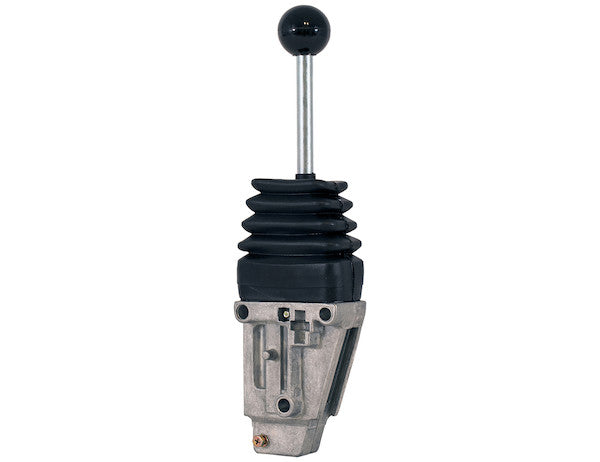
Buyers Products Single Axis Remote Valve Control with Detent is designed for flexibility--both in use and in installation. The sturdy, weatherproof control can be mounted on either the interior or exterior of your vehicle, and can be used singly or stacked for multi-spool valves. Each valve lever has a detent feature to hold the lever in place during use and a 5/8 in. stroke each way from center neutral position.
Specifications
| Description | Single Axis Remote Valve with End Detents |
| Can be stacked (y/n) | Yes |
| Detent Type | Center and End |
| Boot Height | 3.50 " |
| Thickness | 1.65 " |
| Mounting Hole Pattern | 3 Hole |
| Number of Axis | Single |
| Mounting Hole Diameter | 0.33 " |
| Handle Material | Carbon Steel |
| Mounting Plate Height | 3.82 " |
| Mounting Plate Width | 3.19 " |
| Handle Length | 8.0 " |
Advanced Technical Overview: Buyers Products Single Axis Remote Valve Control with Center and End Detents
The Buyers Products Single Axis Remote Valve Control with Center and End Detents represents a robust and versatile solution for precision hydraulic system management in a diverse range of mobile and industrial applications. Engineered for optimal performance and durability, this control unit is designed to interface seamlessly with various hydraulic valve configurations, particularly multi-spool systems where precise, repeatable operations are paramount. This detailed technical overview will delve into the design philosophy, operational mechanics, material specifications, and installation considerations that underscore the superiority of this product.
Design Philosophy and Core Functionality
At its core, this single-axis remote valve control is meticulously engineered to provide reliable and ergonomic control over hydraulic circuits. The "single-axis" designation implies control over one specific hydraulic function, typically a cylinder extension/retraction or motor direction/speed. The inclusion of both "center and end detents" is a critical functional enhancement. A center detent ensures that the control lever will mechanically lock into a neutral position, providing a clear haptic feedback to the operator and preventing unintended actuation when the system is idle or requires a specific hold state. End detents, conversely, allow the lever to lock into fully actuated positions (e.g., fully extended or fully retracted for a cylinder, or continuous rotation for a motor), maintaining the hydraulic flow without requiring constant operator input. This feature is particularly valuable for applications requiring sustained operation, enhancing both safety and operational efficiency by reducing operator fatigue and ensuring consistent performance.
The design prioritizes flexibility in both application and installation. Its weatherproof construction is not merely a superficial attribute but a fundamental design choice, enabling deployment in harsh environmental conditions typical of outdoor mobile equipment. This inherent robustness expands its utility across sectors such as construction, agriculture, municipal services, and material handling, where exposure to elements like moisture, dust, and temperature extremes is commonplace.
Mechanical and Operational Characteristics
The control mechanism is centered around a durable lever, manufactured from carbon steel, ensuring high tensile strength and resistance to wear and fatigue. The 8.0-inch handle length is ergonomically designed to provide ample leverage and comfortable gripping, facilitating precise control with minimal effort. The operational stroke of 5/8 inch each way from the center neutral position is finely tuned to provide adequate throw for proportional or discrete valve actuation, offering a balance between fine control and rapid response.
The detent mechanism is a precision-engineered component designed for consistent locking and release. The detents are typically spring-loaded ball or roller mechanisms that engage with profiled notches or grooves on the control shaft. The force required to overcome the detent (breakaway force) is carefully calibrated to prevent accidental disengagement while allowing for smooth, deliberate operation. This tactile feedback is invaluable, providing the operator with clear confirmation of the control's position without requiring visual confirmation.
For applications involving multi-spool hydraulic valves, the "stackable" feature is a significant advantage. This allows multiple single-axis control units to be physically coupled, creating a consolidated control station for complex hydraulic systems. Stacking not only optimizes space utilization but also streamlines the control layout, enhancing operator ergonomics and reducing the learning curve for multi-function machinery. The modular design ensures that each stacked unit operates independently, maintaining the integrity and precision of individual hydraulic circuits.
Material Specifications and Durability
The choice of materials is critical for the long-term reliability of a control unit subjected to demanding environments. The carbon steel handle, as noted, offers excellent mechanical properties. Complementing this, the control unit likely incorporates corrosion-resistant coatings or finishes on metallic components to withstand moisture and chemical exposure. Internal components, such as springs and pivots, are typically made from hardened steel alloys to resist wear and maintain detent integrity over thousands of cycles.
The 3.50-inch boot height specification indicates the presence of a protective boot, usually made from high-grade rubber or synthetic elastomers. This boot serves multiple critical functions: it seals the internal mechanism against ingress of dirt, dust, and moisture, thereby preventing premature wear and corrosion; it provides flexibility for lever movement; and it contributes to the overall weatherproof rating of the unit. The material selected for the boot must exhibit excellent ozone resistance, UV stability, and broad temperature range performance to prevent cracking or degradation in varying environmental conditions.
The overall thickness of 1.65 inches and the robust mounting plate dimensions (3.82 inches height, 3.19 inches width) suggest a sturdy construction capable of withstanding operational vibrations and impacts without compromising structural integrity or mounting stability. The 3-hole mounting pattern with 0.33-inch diameter holes provides a secure attachment point to vehicle dashboards, control consoles, or equipment chassis, ensuring the control remains firmly in place during aggressive use.
Installation and Integration Considerations
The flexibility in mounting—both interior and exterior—is a testament to the unit's robust design and sealing capabilities. For interior installations, the compact footprint and ergonomic design blend well with cabin aesthetics, while for exterior mounting, the weatherproof construction ensures reliable operation regardless of exposure. Proper installation involves securing the unit using the specified mounting hole pattern and diameter, ensuring a stable foundation for operation.
When integrating this control with hydraulic valves, careful consideration must be given to the linkage system. Remote valve controls typically connect to the valve spool via mechanical linkages, such as push-pull cables, rods, or flexible cables. The 5/8-inch stroke of the control lever must be compatible with the required spool travel of the hydraulic valve to ensure full range of motion and precise actuation. Selecting appropriate linkage components that are durable, low-friction, and correctly sized for the application is paramount to achieving optimal system performance and minimizing hysteresis.
For stacked configurations, the modular design necessitates straightforward mechanical coupling between units. This typically involves interlocking features or common mounting points that ensure alignment and stability when multiple controls are ganged together. Electrical interlocks or safety switches may also be integrated, particularly in complex systems, to prevent simultaneous or unsafe operations, further enhancing the overall safety profile.
Applications and Industry Relevance
The Buyers Products Single Axis Remote Valve Control with Center and End Detents finds widespread application across numerous industries due to its versatility and ruggedness:
- Construction Equipment: Operating auxiliary functions on excavators, loaders, backhoes, such as grapple rotation, attachment tilt, or blade angle. The detents are particularly useful for maintaining consistent operation of an attachment.
- Agricultural Machinery: Controlling implements like plows, cultivators, sprayers, or bale handlers. The ability to hold a position via detent is valuable for tasks requiring sustained hydraulic pressure or flow.
- Truck and Trailer Systems: Actuating functions on dump trucks (hoist control), snowplows (blade lift/angle), salt spreaders, or refuse compactors. Its weatherproof design makes it ideal for external mounting on municipal vehicles.
- Material Handling: Controlling functions on forklifts, telehandlers, or conveyor systems, such as clamp actuation, boom extension, or platform lift.
- Forestry Equipment: Managing log grapples, chippers, or felling heads, where precise and sustained control of hydraulic functions is crucial.
- Marine Applications: Operating steering systems, winches, or other hydraulic components on vessels, requiring a control that can withstand corrosive marine environments.
The technical specifications—including the number of axis (single), detent type (center and end), stackability (yes), and robust physical dimensions—collectively define a product engineered for high reliability and adaptability. The carbon steel handle, precise stroke, and weatherproof boot all contribute to a control unit that not only meets but often exceeds the demanding requirements of professional industrial and mobile hydraulic applications. Its ability to be installed internally or externally, coupled with the option for stacking, positions it as a highly flexible and cost-effective solution for both new equipment designs and aftermarket upgrades, ultimately contributing to enhanced operational control, safety, and longevity of the hydraulic systems it governs.
In summary, the Buyers Products Single Axis Remote Valve Control with Center and End Detents is not merely a lever; it is a precisely engineered interface designed to bridge the gap between human intent and hydraulic power with unwavering reliability and ergonomic excellence. Its robust construction, thoughtful features, and adaptable design make it an indispensable component in sophisticated hydraulic control systems across a multitude of heavy-duty applications.