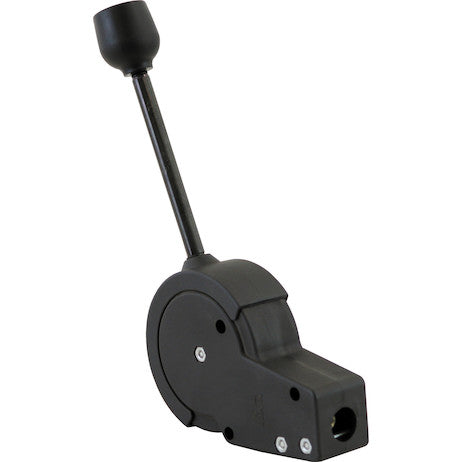
The Buyers Products Single Axis Remote Valve Control with Offset Handle is designed for versatility in installation and in use. The control can be mounted on either the interior or exterior of the vehicle and can be used singly or stacked for multi-spool valves. Its rear cable connection eliminates the need to bend cables. The composite pivot handle with a 70?? neutral position offers better control. Choose either a locking or non-locking handle. Mounting Brackets sold separately.
Specifications
| Handle Material | Carbon Steel |
| Description | Single Axis Remote Valve Control, Center-locking, Composite, 70?? Offset Handle |
| Detent Type | Center |
| Can be stacked (y/n) | Yes |
| Number of Axis | Single |
Advanced Technical Overview: Buyers Products Single Axis Remote Valve Control with 70° Offset Handle
The Buyers Products Single Axis Remote Valve Control, featuring a 70° offset handle and a center-locking mechanism, represents a meticulously engineered solution for precision hydraulic system management in demanding mobile and stationary applications. This control unit is designed to provide robust, reliable, and ergonomic operation of single-spool or multi-spool hydraulic valves, offering significant advantages in installation flexibility, operational efficiency, and long-term durability. This comprehensive technical overview delves into the design philosophy, material science, operational mechanics, installation considerations, and application benefits of this advanced control system.
Design Philosophy and Core Principles
The fundamental design objective for the Buyers Products Single Axis Remote Valve Control was to address common challenges encountered in hydraulic control systems: limited installation space, cable routing complexities, operator fatigue, and the need for modularity. By focusing on these critical areas, the design integrates several innovative features:
- Versatility in Installation: The unit's compact footprint and adaptable mounting options allow for integration into a wide range of vehicle types and industrial machinery, whether in cab interiors or exposed exterior environments.
- Optimized Cable Management: The rear-facing cable connection port is a critical design choice, eliminating the need for acute cable bends that often lead to premature cable wear, increased friction, and compromised control response. This design promotes a smoother, more direct cable path, extending cable service life and improving system responsiveness.
- Ergonomic Operator Interface: The 70° offset composite pivot handle is engineered to reduce operator strain and improve control precision. This specific angle is ergonomically optimized to align with natural wrist and arm postures, enhancing comfort during prolonged operation and minimizing the risk of repetitive strain injuries.
- Modularity and Scalability: The ability to stack multiple control units is a testament to its modular design. This feature simplifies the management of multi-spool hydraulic valves, allowing operators to control complex systems from a consolidated interface without requiring custom fabrication or extensive modifications.
- Durability and Reliability: Constructed with high-grade carbon steel for critical structural components and a robust composite for the handle, the control is built to withstand harsh operational environments, including exposure to vibration, shock, temperature fluctuations, and contaminants.
Material Science and Construction
The selection of materials for the Single Axis Remote Valve Control is paramount to its performance and longevity:
- Handle Material - Carbon Steel (Internal Structure) / Composite (Ergonomic Grip): The internal structure of the handle, particularly the pivot mechanism and lever arm connecting to the cable, is fabricated from carbon steel. Carbon steel offers excellent tensile strength, yield strength, and fatigue resistance, essential for enduring repeated actuation cycles and resisting bending forces. This ensures the structural integrity and precise transmission of input forces to the control cable. The outer grip section of the handle is made from a durable composite material. Composites are chosen for their superior ergonomic properties, including tactile feel, thermal insulation (preventing discomfort in extreme temperatures), and chemical resistance. Furthermore, composites can be molded into complex shapes, allowing for the optimized 70° offset geometry and comfortable grip. The combination leverages the mechanical strength of steel with the ergonomic and environmental benefits of advanced composites.
- Housing and Enclosure: While not explicitly detailed, typical Buyers Products control units utilize robust metallic (e.g., powder-coated steel or aluminum alloy) or high-strength polymer enclosures. These materials provide protection against mechanical impact, dust, moisture, and UV radiation, crucial for both interior and exterior mounting applications. Powder coating, if applied, provides an additional layer of corrosion resistance.
- Internal Mechanisms: Precision-machined components within the control unit, such as bushings, pivots, and detent mechanisms, are manufactured from wear-resistant materials. These might include hardened steels, brass, or engineered polymers, selected to minimize friction, ensure smooth operation, and maintain positional accuracy over the product's lifespan.
Operational Mechanics: Center-Locking and Detent System
The "Center-locking" and "Detent Type: Center" specifications highlight a key aspect of the control's functionality. This refers to a mechanism that positively holds the handle in a neutral (center) position until an intentional force is applied to move it. Once moved, the locking feature, if selected, can be engaged to hold the handle in a specific actuated position, preventing unintended movement due to vibration or external forces. This is particularly critical in applications where precise, sustained valve activation is required, or where safety dictates that a control position remains fixed until manually released.
- Center Detent: The detent mechanism provides tactile feedback to the operator, indicating when the handle is precisely in the neutral position. This improves operational confidence and helps prevent accidental partial engagement of hydraulic functions. It typically involves a spring-loaded ball or roller engaging with a predefined recess in the pivot mechanism.
- Locking Mechanism: For the locking variant, an additional mechanism (e.g., a thumb lever, push-button, or friction clamp) allows the operator to mechanically lock the handle in any desired position along its travel path. This is invaluable for maintaining a constant flow or pressure from a hydraulic valve without continuous operator input, reducing fatigue and freeing the operator for other tasks. The release mechanism is designed for intuitive and rapid disengagement, ensuring quick response times when adjustments are necessary.
Cable Connection and Interface
The control unit is designed to interface with standard mechanical push-pull control cables. The rear cable connection port is a significant ergonomic and engineering advantage. Traditional side or bottom-entry cable connections often necessitate sharp bends in the cable, which can:
- Increase friction within the cable conduit, leading to higher operator effort and reduced control sensitivity.
- Accelerate wear of the cable's inner wire and outer jacket due to repeated bending stress, shortening its operational life.
- Create installation challenges, requiring more space and careful routing to avoid kinks.
By routing the cable directly out the rear, the Buyers Products control unit minimizes these issues, promoting a more linear cable path. This results in:
- Smoother Operation: Reduced friction translates to less effort required by the operator, enhancing comfort and precision.
- Extended Cable Life: Less bending stress significantly prolongs the life of the control cable, reducing maintenance frequency and costs.
- Easier Installation: Simplifies cable routing, especially in confined spaces, and reduces the likelihood of installation errors.
Installation Considerations and Mounting
The "Mounting Brackets sold separately" note indicates a modular approach to installation, allowing users to select application-specific mounting hardware. This offers:
- Flexibility: Different brackets can accommodate various mounting surfaces, thicknesses, and orientations (e.g., flush mount, pedestal mount, surface mount).
- Customization: Users can choose brackets optimized for vibration isolation, specific aesthetic requirements, or multi-unit stacking configurations.
Key considerations for installation include:
- Location: Whether interior or exterior, the chosen location must allow for unrestricted handle movement and provide a clear, as-straight-as-possible path for the control cable to the hydraulic valve.
- Environmental Protection: For exterior mounting, ensure the chosen bracket and installation method maintain the control unit's environmental sealing (if applicable) and protect the cable connection point from direct water ingress or excessive debris accumulation.
- Ergonomics: Position the control unit such that the operator can comfortably reach and manipulate the handle without straining, maintaining visibility of other controls or work areas.
- Stacking (for multi-spool valves): When stacking multiple units, ensure adequate clearance between handles and that the combined assembly is securely mounted to withstand operational forces. The design for stacking implies robust attachment points and precise dimensional tolerances to ensure stable, aligned assemblies.
Applications and Benefits
This Single Axis Remote Valve Control is ideally suited for a broad spectrum of mobile and industrial hydraulic applications, including:
- Snow and Ice Control Equipment: Operating plows, spreaders, and other attachments.
- Refuse Collection Vehicles: Controlling compactor functions, lifters, and dump mechanisms.
- Construction Machinery: Actuating auxiliary functions on backhoes, excavators, and loaders (e.g., grapple rotation, tilt buckets).
- Agricultural Equipment: Managing implements, loaders, and various hydraulic functions.
- Utility Vehicles: Controlling booms, winches, and auxiliary tools.
- Marine Applications: Operating steering, thrusters, or deck machinery.
The primary benefits derived from its use include:
- Enhanced Operator Comfort and Reduced Fatigue: The ergonomic 70° offset handle and smooth operation minimize physical strain, especially during long shifts.
- Improved Control Precision: The detent and optional locking mechanism, combined with reduced cable friction, allow for finer control over hydraulic functions.
- Increased System Reliability and Lifespan: Robust construction, quality materials, and optimized cable routing contribute to longer service intervals for both the control unit and the associated cables.
- Versatility and Adaptability: Suitable for a wide array of applications and easily configurable for single or multi-spool valve control.
- Simplified Maintenance: The design facilitates easier inspection and replacement of cables, if necessary, due to the direct rear connection.
- Cost-Effectiveness: By reducing wear on cables and minimizing operator errors, the total cost of ownership is lowered through decreased maintenance and improved operational efficiency.
Technical Specifications in Detail
- Handle Material: Carbon Steel (internal structure), Composite (grip): This dual-material approach ensures both mechanical strength and ergonomic superiority. Carbon steel provides the necessary rigidity and durability for the actuating lever, while the composite offers a comfortable, non-slip, and temperature-stable grip.
- Description: Single Axis Remote Valve Control, Center-locking, Composite, 70° Offset Handle: Clearly defines the product's core features: single-axis movement for precise control of one hydraulic function, the option for a center-locking mechanism for sustained positioning, a composite ergonomic handle, and the distinctive 70° offset angle.
- Detent Type: Center: Reinforces the presence of a tactile feedback mechanism that positively identifies the neutral position, crucial for preventing unintentional activation and ensuring a default "off" state.
- Can be stacked (y/n): Yes: This confirms the modular design, allowing for the creation of multi-control banks for managing complex hydraulic systems without custom fabrication. Stacking capabilities imply standardized mounting interfaces and inter-unit rigidity.
- Number of Axis: Single: Specifies that each unit controls one degree of freedom (e.g., extending/retracting a cylinder, rotating a motor in one direction). For multi-directional control, multiple units (or a multi-axis joystick) would be required, but this single-axis unit is optimized for linear, proportional control.
Conclusion
The Buyers Products Single Axis Remote Valve Control with 70° Offset Handle is more than just a lever; it is a precisely engineered component designed to integrate seamlessly into sophisticated hydraulic systems. Its meticulous attention to detail in material selection, ergonomic design, and operational mechanics translates directly into tangible benefits for operators and system integrators alike. By offering unparalleled installation flexibility, superior cable management, enhanced operator comfort, and robust reliability, this control unit sets a high standard for remote hydraulic valve actuation. It stands as a testament to Buyers Products' commitment to delivering high-performance, durable, and user-centric solutions for demanding applications across various industries.