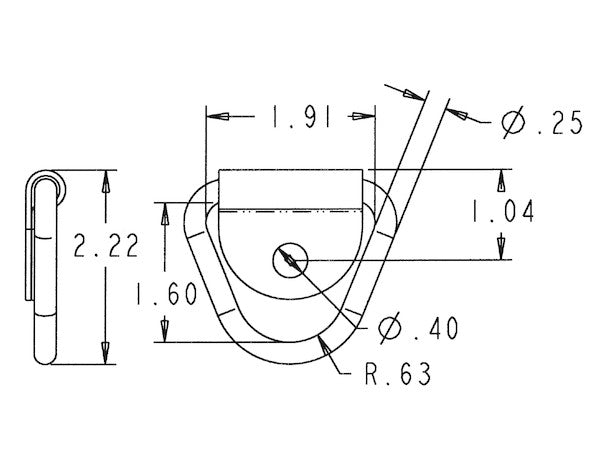
The Rope Ring with One Hole Clip from Buyers Products carries a working load limit of 800 lb. It features a black zinc-plated finish for corrosion resistance. Ideal for use with a zinc-plated support plate (sold separately), the rope ring provides sturdy holding power for your tools and equipment. Rope rings are not approved for lifting.
Specifications
| Min. Breaking Strength (lbs) | 2,400 |
|---|---|
| Mount Type | Surface |
| W.L.L. (lbs) | 800 |
The 1/4 Inch Forged Rope Ring with 1-Hole Integral Mounting Bracket, finished with a robust black zinc plating, represents a meticulously engineered solution for securement applications demanding exceptional strength, durability, and corrosion resistance. Designed to provide steadfast holding power for a diverse range of equipment, tools, and cargo, this component is a testament to precision manufacturing and material science, ensuring reliable performance in demanding environments. While its design inherently suggests substantial strength, it is critically important to reiterate that this rope ring is purpose-built for tie-down and securement tasks and is unequivocally not approved for lifting operations, a distinction rooted in fundamental safety and engineering principles.
Forged Construction: Engineering for Superior Strength and Durability
At the core of this rope ring's superior performance is its forged construction. Unlike cast or stamped components, forging involves the application of compressive forces to raw metal, typically high-grade steel, to plastically deform it into the desired shape. This process refines the metal's grain structure, aligning the grain flow with the contour of the part. The result is a non-uniform, directional grain pattern that significantly enhances the component's mechanical properties, including tensile strength, impact resistance, and fatigue life. Forging eliminates internal voids, porosity, and structural weaknesses often found in castings, leading to a much denser, more homogenous material. The 1/4 inch thickness of the material, when forged, ensures that the structural integrity is maximized across the entire component, particularly in critical stress areas such as the ring circumference and the junction with the mounting bracket. This enhanced material integrity translates directly into the impressive Minimum Breaking Strength (M.B.S.) of 2,400 lbs, providing a substantial safety margin for its intended applications.
Integrated Mounting Bracket: Design for Durability and Installation Efficiency
The integral 1-hole mounting bracket is a key design feature that contributes significantly to both the strength and ease of installation of this rope ring. By being forged as a single, contiguous piece with the ring, the bracket eliminates welded or bolted connections that could otherwise become potential points of failure under load or through repeated stress cycles. This monolithic construction ensures seamless load transfer from the ring through the bracket to the mounting surface. The single-hole design simplifies installation, requiring only one fastener to secure the unit. This design is particularly advantageous when mounting to structural elements where drilling multiple holes might compromise integrity or when space is limited. The bracket's geometry is optimized to distribute the fastening forces effectively, minimizing stress concentrations around the bolt hole and enhancing the overall stability of the securement point. For optimal performance, the use of a high-strength fastener, appropriate for the substrate material, is crucial, often complemented by a zinc-plated support plate (sold separately) to further distribute loads over a larger surface area, mitigating localized stress on the mounting surface.
Performance Metrics: Understanding W.L.L. and M.B.S. for Safe Operation
Understanding the specified performance metrics—Working Load Limit (W.L.L.) and Minimum Breaking Strength (M.B.S.)—is paramount for the safe and effective utilization of this rope ring. The W.L.L. of 800 lbs represents the maximum load that should be applied to the rope ring in service under specified conditions. This figure incorporates a safety factor and is the recommended maximum operational load. Exceeding the W.L.L. can compromise the integrity of the component and lead to failure. The M.B.S. of 2,400 lbs denotes the minimum static load at which a new, undamaged component is expected to fail. The ratio of M.B.S. to W.L.L. for this product is 3:1 (2,400 lbs / 800 lbs = 3), which is an industry-standard safety factor for tie-down and cargo securement hardware. This 3:1 safety factor accounts for dynamic loads, shocks, and potential minor wear and tear, ensuring a robust margin of safety in real-world applications. It is imperative that users rigorously adhere to the W.L.L. to prevent catastrophic failure, especially considering the dynamic nature of loads in transportation and industrial settings. These ratings are established under controlled testing conditions and assume proper installation and use in static tie-down applications, not dynamic lifting scenarios.
Corrosion Resistance: The Science of Black Zinc Plating
The application of a black zinc-plated finish is a critical feature that significantly enhances the longevity and reliability of the 1/4 Inch Forged Rope Ring, especially in environments prone to moisture, chemicals, and other corrosive agents. Zinc plating is an electrochemical process where a thin layer of zinc is deposited onto the surface of the steel. Zinc acts as a sacrificial coating; being more electrochemically active than steel, it corrodes preferentially when exposed to corrosive elements, thereby protecting the underlying steel substrate. This galvanic protection prevents the formation of rust and extends the service life of the component considerably. The black finish is typically achieved through a chromate conversion coating applied over the zinc layer, which not only provides additional corrosion resistance but also offers an aesthetically pleasing, low-sheen appearance. This black finish is often preferred for its resistance to fingerprints and its ability to blend seamlessly with dark vehicle or equipment components, reducing glare. For a component subjected to external environmental factors, such as those encountered on trailers, trucks, and outdoor equipment, this level of corrosion protection is indispensable for maintaining structural integrity and appearance over time.
Surface Mount Design and Installation Considerations
The "Surface Mount" type of this rope ring implies direct attachment to a flat surface. Proper installation is critical to achieving the stated W.L.L. and ensuring safe operation. When selecting fasteners, it is recommended to use hardware that matches or exceeds the strength of the mounting bracket, such as Grade 8 bolts for high-strength applications, with an appropriate diameter to fit the single mounting hole. The bolt should be securely fastened with a lock washer and nut, or into a tapped hole in the substrate, to prevent loosening under vibration or dynamic loads. The mounting surface itself must be structurally sound and capable of withstanding the anticipated loads. For thinner gauge materials or softer substrates, the use of a zinc-plated support plate (sold separately) on the opposite side of the mounting surface is highly recommended. This support plate serves to distribute the load from the fastener over a broader area, preventing deformation of the mounting surface and ensuring that the full strength of the rope ring can be utilized without compromising the integrity of the base material. Attention to proper torque specifications for fasteners is also essential to prevent over-tightening, which can damage the bracket or substrate, or under-tightening, which can lead to premature loosening and failure. Regular inspection of the mounting hardware and the surrounding surface is advised to identify any signs of wear, deformation, or corrosion that might compromise securement.
Operational Scope and Application Spectrum
The 1/4 Inch Forged Rope Ring with 1-Hole Integral Mounting Bracket is an exceptionally versatile securement device, finding extensive utility across numerous industries and applications. In the transportation sector, it is invaluable for securing cargo on flatbed trailers, enclosed trailers, utility trailers, and commercial trucks, ensuring that goods remain stable during transit. For utility vehicles and service trucks, these rings provide crucial anchor points for tools, equipment, and spare parts, preventing movement and potential damage or injury. The construction industry utilizes these rings on heavy equipment, scaffolding, and temporary structures for securing various components, cables, hoses, and light machinery. Agricultural machinery also benefits from these robust tie-down points for attaching tarps, chains, and implements. In industrial settings, they can be employed on workbenches, mobile carts, and machinery to secure items during operation or transport within a facility. Even in non-critical marine applications (excluding saltwater submersion without additional protective measures), they can serve as reliable tie-down points on recreational boats or docks for securing covers, fenders, or small gear. Its robust design and material strength make it suitable for environments where exposure to moderate abrasion, vibration, and environmental elements is common, reinforcing its role as a reliable anchor point for a multitude of securement needs.
Safety Protocols and Critical Limitations: "Not Approved for Lifting"
The explicit disclaimer that "Rope rings are not approved for lifting" is a critical safety instruction that cannot be overstated. This distinction is fundamental to understanding the engineering intent and safety parameters of the product. Lifting hardware, such as lifting eyes, hoist rings, or shackles designed for overhead lifting, are engineered and manufactured to far more stringent standards and often with a higher safety factor (typically 5:1 or greater) to account for dynamic loads, shock loads, fatigue, and the catastrophic consequences of failure in overhead applications. They are also subject to specific regulatory certifications (e.g., ASME B30.26 for Rigging Hardware). This forged rope ring, while exceptionally strong for its designated purpose, is designed for static or semi-static securement and tie-down applications where the primary forces are tension and shear along a relatively fixed axis. It is not designed to withstand the complex, multi-directional, dynamic, and often unpredictable forces encountered in overhead lifting, nor is it subject to the same regulatory oversight for such applications. Attempting to use this rope ring for lifting could lead to premature failure, resulting in severe property damage, injury, or even loss of life. Users must always select lifting hardware specifically designed, rated, and certified for lifting operations when such tasks are required, and never substitute tie-down hardware for lifting hardware, irrespective of its apparent strength.
Material Science and Quality Control Precision
The selection of raw materials and the rigorous quality control processes during manufacturing are pivotal to the consistent high performance of this 1/4 Inch Forged Rope Ring. Typically, such components are manufactured from high-grade carbon steel alloys, chosen for their excellent balance of strength, ductility, and forgeability. The specific alloy composition is carefully controlled to achieve the desired mechanical properties post-forging and heat treatment. Throughout the forging process, strict controls are maintained over heating temperatures, deformation rates, and cooling cycles to ensure the optimal grain structure and freedom from defects. Post-forging, components undergo cleaning, and potentially stress-relieving heat treatments, before the zinc plating process. The black zinc plating itself is applied under tightly controlled electrochemical conditions to ensure uniform thickness, excellent adhesion, and consistent corrosion protection across all surfaces. Each stage, from raw material inspection to final coating thickness verification, is subject to stringent quality checks, often including visual inspection, dimensional measurement, and destructive/non-destructive testing of samples, to ensure that every unit meets the specified M.B.S., W.L.L., and corrosion resistance standards, guaranteeing a product of consistent reliability and long-term performance.
Long-Term Durability and Maintenance
Designed for longevity, the 1/4 Inch Forged Rope Ring requires minimal maintenance but benefits from periodic inspection to ensure continued safe and effective operation. Regular visual checks should be performed to identify any signs of wear, such as abrasion or thinning of the material, especially on the inner circumference of the ring where ropes or straps may rub. Inspection for deformation, cracks, or bending of the ring or mounting bracket is also crucial, as these indicate potential overload or material fatigue and necessitate immediate replacement. The black zinc plating should be checked for signs of significant chipping, peeling, or widespread rust formation, which could compromise the corrosion resistance. If surface rust begins to appear, especially in highly corrosive environments, the component's protective layer may be compromised, warranting either replacement or re-coating if feasible and approved. Maintaining clean mounting surfaces and ensuring fasteners remain tight will also contribute to the overall durability and reliability of the securement system. Adherence to these simple inspection and maintenance guidelines will significantly extend the service life of the rope ring, protecting both your equipment and operational safety.
Conclusion
The 1/4 Inch Forged Rope Ring with 1-Hole Integral Mounting Bracket, featuring a durable black zinc-plated finish, stands as a premium choice for robust and reliable securement. Its forged construction, meticulous design, and comprehensive corrosion protection ensure it delivers superior holding power with a substantial 800 lb Working Load Limit. Engineered for efficient surface mounting and backed by a 2,400 lb Minimum Breaking Strength, it embodies both strength and safety for a wide array of tie-down applications. While its capabilities are extensive for cargo securement, it is critically important to remember its singular focus: tie-down. This product is not designed or approved for lifting, a distinction that underscores its specialized role and the importance of appropriate hardware selection for specific tasks. For professionals and enthusiasts alike seeking an uncompromising solution for securing valuable equipment and cargo, this forged rope ring offers an optimal blend of performance, durability, and secure installation.