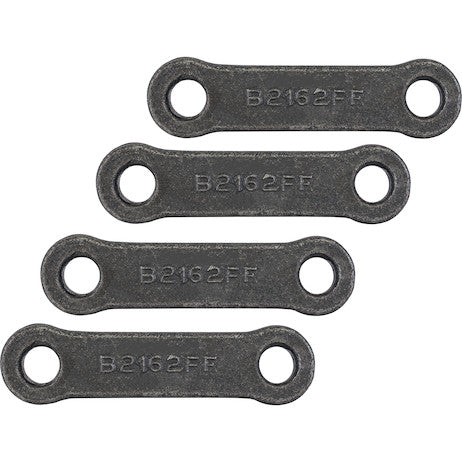
Forged Tie Bar for 3-1/2 Inch Frame - 4-1/4 Inch Center to Center Holes - 4-Pack Buyers Products Forged Tie Bar for 3-1/2 Inch Frame is ideal for use with tie down rods or U-bolts. Each tie bar is forged from 1/2 in. thick steel and has 4-1/4 in. center-to-center mounting holes. Ideal for mounting truck equipment to the chassis. Comes as a 4-pack.
Specifications
| Finish | Plain |
|---|---|
| Length (in.) | 5.75 |
| Material | Forged Steel |
| Mounting Holes Ctr to Ctr (in.) | 4.25 |
| Number of Mounting Holes | 2 |
| Thickness | .50 |
| Width (in.) | 1.25 |
The Forged Tie Bar for 3-1/2 Inch Frame, featuring 4-1/4 Inch Center to Center Holes and supplied as a 4-Pack by Buyers Products, represents a critical component in robust fastening applications for various commercial, industrial, and heavy-duty vehicle chassis. This meticulously engineered tie bar is designed to provide superior clamping force distribution and structural integrity when securing auxiliary equipment, bodies, or specialized systems to vehicle frames, particularly those with a 3-1/2 inch flange width. Its construction from forged steel ensures unparalleled durability and resistance to the severe operational stresses encountered in demanding environments.
At the core of this product's exceptional performance is its material specification: forged steel. The forging process, a manufacturing method involving the shaping of metal through localized compressive forces, inherently enhances the material's grain structure. Unlike casting, where molten metal solidifies, or machining from rolled bar stock, forging refines the internal grain, aligning it with the component's contours. This metallurgical refinement eliminates internal voids, porosity, and shrinks, which are common weaknesses in cast parts, and produces a directional grain flow that maximizes the steel's strength, toughness, and fatigue resistance. Consequently, a forged steel tie bar exhibits significantly higher tensile strength, yield strength, and impact resistance compared to its non-forged counterparts. This enhanced material integrity is paramount for applications where components are subjected to dynamic loads, vibrations, torque, and potential impact forces, ensuring a longer service life and superior reliability under adverse conditions. The 1/2 inch thickness further contributes to this strength profile, providing substantial cross-sectional area to withstand bending moments and shear stresses without deformation.
The dimensional precision of this tie bar is critical for its intended application. Designed specifically for 3-1/2 inch frames, it provides an optimal bearing surface for secure attachment. Vehicle frames, particularly those in medium to heavy-duty trucks and trailers, typically feature standardized flange widths. A 3-1/2 inch frame width is common, and this tie bar is precisely dimensioned to span across the frame's flange, distributing the clamping force from U-bolts or tie-down rods uniformly. This uniform pressure distribution is vital in preventing localized stress concentrations on the frame, which could lead to material fatigue, cracking, or premature failure of either the frame or the mounted equipment. The length of 5.75 inches and a width of 1.25 inches are engineered to maximize this load distribution while maintaining a compact profile that does not interfere with other chassis components.
The 4-1/4 inch center-to-center mounting holes are a key specification, directly correlating with standard U-bolt and tie-down rod dimensions commonly utilized in the industry. This standardized spacing facilitates straightforward integration with a wide array of existing fastening hardware, reducing the need for custom fabrication or modification during installation. The holes are precisely drilled to accommodate the shanks of U-bolts or tie rods, ensuring a snug fit that minimizes play and maximizes the clamping efficiency of the entire assembly. The presence of two mounting holes per tie bar ensures that the clamping force is applied symmetrically, further enhancing the stability and security of the mounted equipment. This meticulous design detail underpins the tie bar's effectiveness in creating a robust and stable connection between equipment and chassis.
The primary application for these forged tie bars is the secure mounting of diverse truck equipment to the vehicle chassis. This encompasses a broad spectrum of installations, including but not limited to: utility bodies, service bodies, dump bodies, flatbeds, auxiliary fuel tanks, hydraulic reservoirs, toolboxes, air tanks, liftgate power units, snowplow mounts, salt and sand spreaders, and various specialized vocational equipment. In each of these scenarios, the tie bar acts as an essential intermediary, distributing the clamping forces exerted by U-bolts or tie-down rods evenly across the frame rails. Without such a component, direct clamping of U-bolts onto the frame could lead to localized deformation, scoring, or eventual fatigue failure of the frame material, especially under dynamic loads, vibrations, and road shock. The tie bar mitigates these risks by presenting a rigid, high-strength surface that effectively broadens the contact area, thereby significantly enhancing the overall integrity and longevity of the mounting system.
Beyond traditional truck equipment, the versatility of these forged tie bars extends to a multitude of other heavy-duty and industrial applications. They are indispensable in trailer manufacturing and repair, providing secure attachment points for decking, crossmembers, or suspension components. In agricultural machinery, they can be utilized for securing implements or auxiliary structures to tractor frames or equipment chassis. Custom fabrication shops often rely on such robust components for building specialized carts, equipment stands, or structural reinforcements where high strength and reliability are paramount. The plain finish, while offering no inherent corrosion protection, provides a clean surface ready for welding, priming, painting, or galvanizing by the end-user, allowing for customization based on specific environmental exposure requirements and aesthetic preferences. This flexibility is particularly valuable in bespoke applications where specialized coatings might be necessary.
From an engineering perspective, the design of this forged tie bar addresses several critical considerations for effective load transfer and structural integrity. Firstly, it effectively manages stress concentration. When a U-bolt clamps directly onto a frame, the stress is concentrated along the narrow contact points of the U-bolt legs. The tie bar, with its broader surface area, disperses this stress over a larger region, reducing the likelihood of fatigue cracks propagating from these stress points. Secondly, it enhances vibration resistance. In dynamic operational environments, vibrations can lead to loosening of fasteners over time. By providing a rigid and stable platform, the tie bar helps to maintain the initial clamping force, thereby increasing the overall resistance to fastener back-off and ensuring the long-term security of the mounted components. Thirdly, the consistent 1/2 inch thickness across the component ensures uniform load bearing capacity and prevents differential deflection under load, which could compromise the stability of the mounted equipment.
Installation best practices dictate that when utilizing these tie bars, appropriate torque specifications for the U-bolts or tie-down rods must be strictly adhered to. Overtightening can overstress the fasteners and potentially deform the frame or tie bar, while undertightening can lead to insufficient clamping force and eventual loosening. Professional installation involves ensuring proper alignment of the tie bars with the frame and equipment, confirming that all fasteners are correctly seated, and employing appropriate locking mechanisms (e.g., lock washers, prevailing torque nuts) where applicable to prevent loosening under vibration. The use of a 4-pack is particularly advantageous for common installations where multiple tie-down points are required, such as securing a flatbed or a large utility body, ensuring uniformity in components and simplifying procurement.
Buyers Products is renowned for its commitment to producing high-quality, durable components for the work truck and trailer industries. This forged tie bar exemplifies that commitment through its robust construction and precise engineering. Each tie bar undergoes stringent quality control processes to ensure dimensional accuracy, material integrity, and adherence to performance specifications. This dedication to quality assurance guarantees that the product will perform reliably in demanding applications, contributing to the safety and operational efficiency of commercial vehicles and industrial equipment.
In conclusion, the Forged Tie Bar for 3-1/2 Inch Frame with 4-1/4 Inch Center to Center Holes from Buyers Products is an indispensable, high-performance fastening accessory. Its forged steel construction provides superior strength and fatigue resistance, making it suitable for the most arduous applications. The precise dimensions, particularly the 3-1/2 inch frame compatibility and 4-1/4 inch center-to-center holes, ensure seamless integration with standard heavy-duty fastening hardware and optimal load distribution across vehicle frames. Whether for mounting essential truck equipment, reinforcing trailer structures, or securing specialized industrial machinery, this tie bar offers a professional, reliable, and durable solution. The convenience of a 4-pack further enhances its value, providing a cost-effective and readily available solution for multiple attachment points, ensuring that critical equipment remains securely fastened, minimizing downtime, and maximizing operational safety and efficiency for fleet operators, mechanics, and fabricators alike.