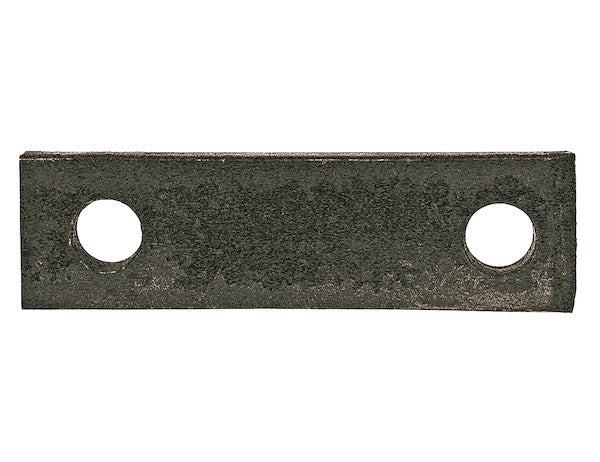
Buyers Products Tie Bars work in conjunction with tie down rods or U-bolts to mount truck equipment to a chassis. The tie bars are square-ended and have a plain finish which can be painted if needed. They are available in multiple lengths and are a standard 1-1/2 in. wide, thus compatible with Buyers Products U-bolts and tie down rods. Additional lengths are available by special order. Please contact Customer Service for further information.
Specifications
| Finish | Plain |
|---|---|
| Length (in.) | 6.50 |
| Material | Carbon Steel |
| Mounting Holes Ctr to Ctr (in.) | 4.50 |
| Number of Mounting Holes | 2 |
| Thickness | .50 |
| Width (in.) | 1.50 |
Advanced Technical Overview: Tie Bar for 3-3/4 Inch Frame with 4-1/2 Inch Center-to-Center Holes
The Tie Bar, specifically engineered for 3-3/4 inch truck frames and featuring a 4-1/2 inch center-to-center hole spacing, represents a critical component in the secure and stable mounting of auxiliary equipment onto commercial vehicle chassis. This precision-manufactured tie bar serves as an essential interface, facilitating a robust connection between diverse truck equipment – ranging from toolboxes and service bodies to hydraulic power units and specialized attachments – and the underlying structural framework of the vehicle. Its design is predicated on the principles of mechanical integrity, load distribution, and compatibility within established industry standards for heavy-duty vehicle upfitting.
Constructed from high-grade carbon steel, this tie bar is optimized for environments demanding superior tensile strength, yield strength, and resistance to fatigue. Carbon steel is selected for its advantageous mechanical properties, including its inherent hardness and durability, which are paramount in applications subjected to dynamic loads, constant vibration, and varying environmental stresses characteristic of commercial vehicle operation. The material's metallurgical composition ensures that the tie bar can withstand significant shear, tensile, and compressive forces without plastic deformation or structural compromise, thereby maintaining the integrity of the mounted equipment over its operational lifespan. Furthermore, carbon steel offers excellent weldability, which, while not directly relevant to its immediate function as a bolt-on component, highlights its versatility in overall fabrication and repair scenarios within a broader heavy-duty context.
The physical dimensions of this tie bar are meticulously calibrated to ensure optimal performance and universal compatibility within its specified application range. With a nominal length of 6.50 inches, a width of 1.50 inches, and a substantial thickness of 0.50 inches, the tie bar provides a generous surface area for load distribution while maintaining a compact profile. The 1.50-inch width is a common industry standard, ensuring seamless integration with a vast array of U-bolts and tie down rods, particularly those manufactured by Buyers Products, thus simplifying procurement and installation processes for upfitters and fleet maintenance personnel. The 0.50-inch thickness is particularly significant, as it imparts substantial rigidity and resistance to bending and torsion, critical for securely holding heavy equipment under dynamic driving conditions and off-road applications. This robust thickness contributes directly to the component's ability to resist deformation from localized stresses exerted by tightening fasteners, thereby preventing loosening over time.
A defining characteristic of this particular tie bar is its precise adaptation for 3-3/4 inch truck frames. Commercial truck frames are typically specified by their rail height and web thickness, with 3-3/4 inches referring to a common frame rail dimension. The tie bar's geometry is specifically engineered to bridge the space across these frame rails, creating a secure attachment point that distributes clamping force evenly. This precise fit minimizes the potential for stress concentrations on the frame or the mounted equipment, which could otherwise lead to premature wear or structural failure. The square-ended design further enhances this secure fit, allowing for a flush contact against mating surfaces and preventing rotational movement, which is essential for maintaining the stability of mounted equipment, especially under braking, acceleration, or cornering maneuvers. The inherent stability offered by the square ends also simplifies installation, reducing the need for intricate adjustments or shimming.
Central to the functionality of this tie bar is its 4-1/2 inch center-to-center hole spacing for the two mounting holes. This dimension is crucial for achieving proper alignment with standard U-bolts and tie down rods designed to straddle a 3-3/4 inch frame rail. The precision drilling of these holes, maintained within tight manufacturing tolerances, guarantees that the tie bar can be quickly and accurately assembled with corresponding fasteners, eliminating misalignment issues that could compromise the integrity of the connection. The presence of two mounting holes provides a balanced two-point attachment, essential for distributing clamping loads uniformly and preventing rotational forces from impacting the securement of equipment. This dual-hole configuration enhances the overall stability and shear resistance of the mounted assembly, ensuring that the equipment remains firmly attached even under extreme operating conditions, such as sudden impacts or significant terrain variations.
The tie bar features a plain finish, which offers several practical advantages. From a manufacturing perspective, a plain finish allows for cost-effective production, as it bypasses the additional processes associated with coating or plating. For the end-user, this plain carbon steel surface provides maximum flexibility. While it requires post-installation treatment for optimal corrosion resistance in harsh environments, it allows for custom painting to match the vehicle's aesthetic or to integrate seamlessly with a specific coating system already in use. This flexibility is particularly valuable for upfitters who may apply specialized protective coatings, such as zinc-rich primers, epoxy paints, or undercoating, tailored to the specific operational environment of the truck (e.g., coastal regions, agricultural settings, or areas with heavy road salt usage). The un-coated surface also facilitates any field modifications, such as welding, that might be required during custom installations without the need to strip away existing coatings.
In practical application, this tie bar is integral to mounting a wide array of truck equipment. For instance, in the installation of utility service bodies, the tie bar secures the body to the chassis frame rails, distributing the weight and dynamic forces generated during vehicle operation. Similarly, when mounting auxiliary fuel tanks, toolboxes, fifth-wheel hitches, or crane pedestals, the tie bar works in conjunction with U-bolts or tie down rods to create a non-intrusive yet incredibly strong clamping mechanism. This method of attachment is preferred for many applications as it avoids drilling into the main frame rails, which can compromise the structural integrity and warranty of the chassis. By clamping around the frame, the tie bar system allows for a secure, semi-permanent attachment that can be adjusted or removed with relative ease, making it highly adaptable for various upfitting needs and future modifications.
The engineering considerations extend beyond mere fitment to encompass the overall system's resistance to environmental factors and operational stresses. The carbon steel material, while having a plain finish, possesses a certain level of inherent robustness against mechanical wear and impact. When properly coated post-installation, it forms a formidable barrier against rust, chemical exposure, and abrasive elements like road grit or gravel. The integrity of the connection, achieved through precise hole spacing and robust material thickness, ensures that vibrations transmitted from the road or engine are effectively damped and distributed across the mounting area, reducing the likelihood of fastener loosening or fatigue cracking in the equipment or chassis over time. This holistic approach to design and material selection underscores the component's role not just as a fastener, but as an integral part of the vehicle's long-term operational reliability and safety.
The compatibility with Buyers Products U-bolts and tie down rods highlights an important aspect of system engineering. Utilizing components designed to work in conjunction optimizes performance and simplifies the selection process. Buyers Products maintains rigorous manufacturing standards, ensuring that their U-bolts and tie down rods feature corresponding dimensions, thread specifications, and material properties that are perfectly matched to this tie bar. This synergy guarantees maximum clamping force, thread engagement, and overall structural cohesion of the mounted assembly, preventing issues such as cross-threading, insufficient torque, or premature wear that can arise from mismatched components. This comprehensive approach provides peace of mind for both installers and end-users, knowing that the entire mounting system is engineered for peak performance and longevity.
In conclusion, the Tie Bar for 3-3/4 Inch Frame with 4-1/2 Inch Center-to-Center Holes is a testament to precision engineering for heavy-duty applications. Its selection of high-grade carbon steel, meticulously calculated dimensions (6.50-inch length, 1.50-inch width, 0.50-inch thickness), and precise hole spacing (4.50 inches center-to-center for two holes) ensure unparalleled structural integrity and compatibility. Designed for secure equipment mounting on 3-3/4 inch truck frames, its square-ended, plain finish offers installation flexibility and durability. This component serves not merely as a fastening device but as a foundational element in achieving safe, stable, and compliant integration of auxiliary equipment onto commercial vehicle chassis, ensuring robust performance and reliability under the most demanding operational conditions. Its strategic design and material specification affirm its status as an indispensable component for professional truck upfitters and fleet operators prioritizing long-term durability and safety.