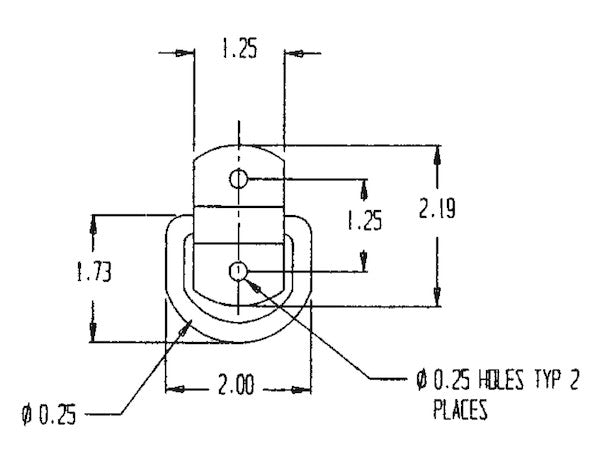
The Light Duty Rope Ring from Buyers Products carries a working load limit of 400 lb. It features a welded D-ring and a 14 Ga steel clip. Choose zinc-plated steel or stainless steel construction. Ideal for use with a zinc-plated support plate (sold separately), the rope ring provides sturdy holding power for your tools and equipment. Rope rings are not approved for lifting.
Specifications
| Finish | Zinc |
|---|---|
| Material | Steel |
| Min. Breaking Strength (lbs) | 1,200 |
| Mount Type | Surface |
| W.L.L. (lbs) | 400 |
Technical Overview: 1/4 Inch Forged Light Duty Rope Ring with 2-Hole Mounting Bracket, Zinc Plated
The 1/4 Inch Forged Light Duty Rope Ring with 2-Hole Mounting Bracket, Zinc Plated, represents a robust and meticulously engineered solution for securing tools and equipment in a wide array of industrial, commercial, and recreational applications. Designed and manufactured to exacting standards by Buyers Products, this component is a testament to functional design, material science, and precision manufacturing. Its primary function is to provide a reliable anchor point for various tie-down applications, ensuring the stability and safety of cargo within its specified operational parameters.
Component Analysis: The Forged Rope Ring (D-Ring)
At the core of this assembly is the 1/4 inch forged steel D-ring. The term "forged" signifies a manufacturing process where metal is shaped through compressive forces, utilizing localized, intense pressure. This method stands in stark contrast to casting or machining processes, offering distinct advantages in terms of material integrity and mechanical properties. During forging, the metal's internal grain structure is refined and aligned, eliminating internal voids and improving overall density. This results in a finished product with superior tensile strength, impact resistance, and fatigue life compared to components produced by other methods. Forging enhances the steel's inherent toughness, making the D-ring exceptionally resilient to the stresses and strains encountered during cargo securement. The 1/4 inch dimension refers to the nominal diameter of the steel bar from which the D-ring is formed, indicating a substantial cross-section capable of withstanding significant loads. Furthermore, the D-ring is welded, a critical design feature that ensures full structural integrity. A welded joint, when executed correctly, creates a monolithic connection between the two ends of the D-ring, preventing separation under load and distributing stress evenly throughout the ring's circumference. This integral welding process is paramount for achieving the specified strength ratings and contributes significantly to the rope ring's reliability as a securement point.
The 2-Hole Mounting Bracket: Structural Integration and Securement
Complementing the forged D-ring is a meticulously designed 2-hole mounting bracket, fabricated from 14-gauge steel. The gauge designation, 14 Ga, translates to a specific material thickness, which is approximately 0.0747 inches or 1.905 mm. This thickness provides an optimal balance between material rigidity and ease of fabrication, ensuring that the bracket can withstand the forces transmitted from the D-ring without deformation while remaining amenable to standard mounting procedures. The bracket's design incorporates two pre-drilled holes, strategically positioned to facilitate a secure surface mount. This two-hole configuration is critical for load distribution and stability. When fasteners are properly installed through both holes, the bracket is firmly anchored to the mounting surface, mitigating the risk of rotation or displacement under dynamic loads. The surface mount type implies that the bracket sits flush against the substrate, providing a low-profile installation that minimizes protrusion and potential snagging. While mounting hardware is sold separately, the design inherently assumes the use of appropriate bolts, screws, or rivets that correspond to the hole diameters and the structural integrity of the intended mounting surface. The ability to integrate with an optional zinc-plated support plate (also sold separately) further enhances the mounting system's versatility and strength. A support plate, typically installed on the opposite side of a thin-walled substrate, effectively increases the bearing surface area, distributing the applied load over a larger region and preventing pull-through or localized deformation of the mounting material. This optional augmentation is highly recommended for applications involving lighter gauge sheet metal or composite panels where localized stress concentrations could otherwise compromise the integrity of the securement point.
Corrosion Protection: Zinc Plating Technology
The entire assembly, encompassing both the forged D-ring and the 2-hole mounting bracket, benefits from a comprehensive zinc-plated finish. Zinc plating is a widely adopted electrodeposition process that provides an effective sacrificial coating for steel components. In this process, a thin layer of zinc metal is electrically bonded to the steel substrate. Zinc is less noble than steel in the galvanic series, meaning that in the presence of an electrolyte (such as moisture), the zinc will preferentially corrode, thereby protecting the underlying steel from oxidation and rust formation. This sacrificial protection mechanism is particularly effective in environments characterized by humidity, intermittent moisture exposure, or the presence of corrosive agents. Beyond its primary role in corrosion resistance, zinc plating imparts a clean, bright, and aesthetically pleasing finish, contributing to the product's professional appearance and facilitating easy inspection for wear or damage. The durability of zinc plating in light-duty applications ensures an extended service life for the rope ring, reducing maintenance requirements and preserving the structural integrity of the securement point over time. While stainless steel construction offers inherent corrosion resistance throughout the material, zinc-plated steel provides a cost-effective alternative that delivers robust protection suitable for a vast majority of non-marine or non-highly corrosive industrial environments.
Performance Specifications: WLL, MBS, and Safety Factors
Understanding the performance specifications is paramount for the safe and effective deployment of this rope ring. The product is rated with a Working Load Limit (WLL) of 400 lbs (approximately 181.4 kg). The WLL represents the maximum static load that a component is designed to safely support under specific conditions. It is not an arbitrary figure but is derived from rigorous testing and engineering calculations, incorporating a significant safety factor. In the case of this rope ring, the Minimum Breaking Strength (MBS) is specified at 1,200 lbs (approximately 544.3 kg). The MBS is the load at which the component is expected to fail or fracture under controlled testing conditions. The relationship between WLL and MBS is critical: WLL = MBS / Safety Factor. For this rope ring, the implied safety factor is MBS (1,200 lbs) / WLL (400 lbs) = 3:1. This safety factor of 3:1 is standard for many static load applications and provides a reasonable margin against unexpected overloads, material imperfections, or minor damage. However, it is imperative to note that this safety factor pertains to static loads. Dynamic loads, which involve sudden movements, impacts, or vibrations, can generate forces significantly higher than the nominal weight of the secured object. Therefore, users must exercise caution and ensure that the aggregate forces generated during transit or operation do not exceed the WLL. The "Light Duty" classification aligns with this WLL, indicating suitability for securing smaller tools, light equipment, organizational components, or ancillary gear, rather than heavy machinery or critical structural elements.
Applications and Intended Use Cases
This 1/4 Inch Forged Light Duty Rope Ring is engineered to provide sturdy holding power for a diverse range of items across various sectors. Its primary utility lies in cargo management and organization within vehicles, trailers, and fixed installations. Common applications include:
- Utility and Service Vehicles: Securing hand tools, small power tools, spare parts, safety equipment, and inventory within truck beds, service van interiors, and toolboxes.
- Recreational Vehicles (RVs) and Trailers: Tying down camping gear, luggage, bicycles, coolers, and other recreational equipment to prevent shifting during travel.
- Enclosed Trailers: Providing multiple anchor points for securing merchandise, furniture, or equipment during transport, ensuring items remain stationary and protected from damage.
- Workshops and Garages: Creating permanent or semi-permanent tie-down points on workbenches, walls, or floors for securing items during maintenance, assembly, or storage.
- Marine Applications (Limited): While zinc plating offers good protection in many outdoor environments, continuous saltwater exposure might eventually compromise the finish. However, for interior boat storage or occasional outdoor use, it offers reliable securement for fishing gear, safety equipment, or personal belongings.
- General Industrial Use: As a versatile anchor point in facilities for securing covers, tarps, hoses, cables, or non-critical equipment.
Critical Safety Advisory: Not Approved for Lifting
A fundamental and non-negotiable directive associated with this product is that it is explicitly "Not approved for lifting." This limitation is critically important and must be strictly adhered to to prevent serious injury, property damage, or catastrophic failure. The design, material specifications, and particularly the safety factor (3:1) of this rope ring are engineered for tie-down and static securement applications, where loads are primarily constrained against movement rather than actively suspended or elevated. Lifting operations inherently involve significantly higher dynamic forces, greater risks, and require components with much larger safety factors (typically 4:1, 5:1, or even 8:1, depending on the lifting standard and application) and specialized design considerations to account for potential shock loading, sling angles, and the severe consequences of failure. Misusing this rope ring for lifting purposes would place it under stresses far exceeding its design parameters, leading to an extremely high probability of failure. Lifting components undergo distinct certifications and testing protocols that differ substantially from those for tie-down hardware. Users must understand this distinction and utilize only certified lifting hardware for any overhead lifting or material handling applications. The rope ring's purpose is strictly limited to securing items against lateral, longitudinal, or vertical movement on a supporting surface.
Installation and Maintenance Guidelines
Proper installation is paramount to achieving the full specified performance of the 1/4 Inch Forged Light Duty Rope Ring. Users must select an appropriate mounting surface that possesses sufficient structural integrity to support the anticipated loads. The surface should be clean, flat, and free of obstructions. Fastener selection is also critical; although not included, fasteners should be of a suitable grade (e.g., Grade 5 or 8 bolts for high-strength applications), appropriate material (e.g., zinc-plated or stainless steel to match corrosion resistance), and sufficient length to penetrate the mounting substrate securely without protruding excessively. Torque specifications for fasteners should be observed to ensure a tight, secure connection without overtightening, which could strip threads or damage the substrate. The optional zinc-plated support plate, when utilized, should be correctly positioned to maximize load distribution. Regular inspection of installed rope rings is highly recommended. This includes checking for signs of corrosion, deformation, cracking, or excessive wear on the D-ring, the bracket, and the mounting points. Fasteners should be periodically checked for tightness, and retorqued if necessary. Any rope ring exhibiting signs of damage or compromise should be immediately removed from service and replaced to maintain the safety and integrity of the securement system.
Conclusion
The 1/4 Inch Forged Light Duty Rope Ring with 2-Hole Mounting Bracket, Zinc Plated, from Buyers Products, stands as a testament to engineering excellence in light-duty securement. Its forged steel D-ring, precision-welded for maximum strength, coupled with a robust 14-gauge steel mounting bracket, provides a reliable and durable anchor point. The zinc-plated finish ensures significant resistance against environmental corrosion, prolonging its service life and maintaining functional integrity. With a clearly defined Working Load Limit of 400 lbs and a safety factor derived from its 1,200 lbs Minimum Breaking Strength, this component is ideally suited for securing tools, equipment, and cargo across a broad spectrum of applications where lightweight, dependable tie-down points are required. Adherence to the critical directive that it is not approved for lifting applications is essential for user safety and product performance. When properly installed and maintained, this rope ring offers an invaluable solution for enhancing organization, stability, and safety in both mobile and stationary environments, reflecting Buyers Products' commitment to delivering high-quality, purpose-built hardware solutions.