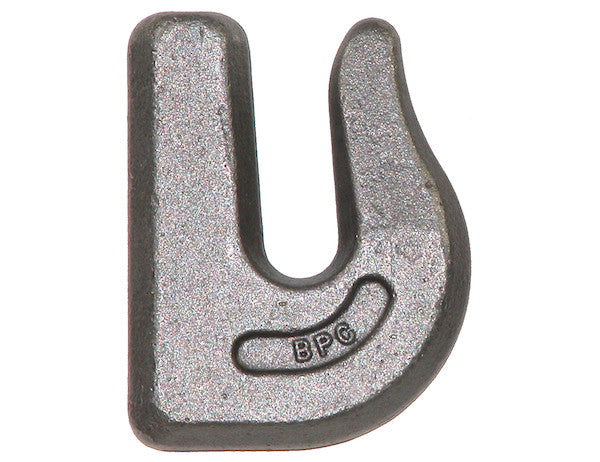
Weld-On Heavy Duty Tow/Recovery Hooks from Buyers Products are made of drop-forged steel for grade 43 chain attachment. The hooks are designed so a chain will catch and not slide through them. They are available in three sizes to fit different chain link diameters, for working load limits of 3900, 5400 or 9200 lb each.
Specifications
| Capacity (lbs) | 5,400 |
|---|---|
| Chain Size (in.) | 3/8 |
| Material | Forged Steel |
The 3/8 Inch Drop Forged Weld-On Heavy-Duty Towing Hook, specifically engineered for Grade 43 chain, represents a critical component in demanding towing and recovery operations. This product is meticulously designed and manufactured to provide a secure, robust, and permanent attachment point on various types of equipment, including commercial trucks, utility vehicles, agricultural machinery, and heavy construction equipment. Its integration into a vehicle's frame or structural component ensures a direct and reliable load transfer, which is paramount for safety and efficiency in high-stress applications.
At the core of this hook's exceptional performance lies its material and manufacturing process: drop-forged steel. Forging is a metalworking process that involves shaping metal using localized compressive forces. Drop forging, a specific type of forging, utilizes an impact or a combination of impact and pressing to deform the metal. This process refines the grain structure of the steel, aligning it with the contours of the hook. This optimized grain flow results in significantly enhanced strength, ductility, and impact resistance compared to cast or machined components. Unlike casting, which can introduce internal voids, porosity, or segregation, forging produces a homogenous, defect-free structure, making the resulting product inherently stronger and more reliable under dynamic and static loads. The chosen steel alloy for this hook is selected for its superior mechanical properties, capable of withstanding the rigorous demands of heavy-duty towing and recovery without yielding, fracturing, or experiencing premature fatigue.
The classification as "Grade 43" is a crucial technical specification, indicating the hook's compatibility with Grade 43 high-test chain. In the context of lifting and towing hardware, chain grades are standardized metrics that denote the minimum tensile strength and working load limit (WLL) of a chain. Grade 43, also known as "High Test Chain," is a medium carbon-manganese steel chain that has been heat-treated to achieve superior strength-to-weight ratio compared to lower grades like Grade 30 (Proof Coil). A Grade 43 chain, when matched with this hook, offers a significantly higher WLL for a given chain diameter, making it an ideal choice for applications where robustness and reliability are paramount. The 3/8-inch designation refers to the nominal diameter of the chain links that this hook is designed to accommodate seamlessly, ensuring proper fitment and preventing improper loading or accelerated wear. The stated Working Load Limit (WLL) of 5,400 lbs for this particular hook is not merely an arbitrary number; it is a carefully calculated value that incorporates a substantial safety factor, typically 4:1 or 5:1, relative to the ultimate breaking strength. This safety margin is critical in preventing catastrophic failures and ensuring operational safety under predictable conditions, as well as accounting for minor variations in load dynamics.
The design of the hook specifically addresses the critical requirement of secure chain attachment. The geometry is meticulously engineered to ensure that a chain, once engaged, will "catch and not slide through." This design feature is paramount for preventing accidental disengagement during recovery operations, which could lead to severe injury, equipment damage, or further operational complications. The specific curvature and throat opening are optimized to cradle the chain link effectively, providing a positive lock that resists forces attempting to dislodge it. This is particularly vital in dynamic recovery situations where sudden jerks or changes in tension are common. The tip of the hook is often tapered or shaped to facilitate easy engagement with chain links while maintaining its integrity under load. This thoughtful engineering contributes directly to operational efficiency and, more importantly, to the safety of personnel involved in towing and recovery tasks.
The "weld-on" attachment method offers distinct advantages over bolt-on alternatives in many heavy-duty applications. A properly executed weld creates a monolithic bond between the hook and the host structure, effectively making them a single, continuous component. This eliminates potential points of failure such as bolt shear or loosening due to vibration, which can be prevalent in high-stress environments. Weld-on hooks provide unparalleled strength and durability, transferring loads directly into the vehicle's frame or chassis, thereby maximizing the overall structural integrity of the recovery point. This method also allows for greater flexibility in positioning the hook, enabling customization to specific vehicle designs or operational requirements, ensuring optimal leverage and access. However, the integrity of a weld-on installation is highly dependent on the quality of the welding process. It necessitates professional welding by a certified technician, using appropriate welding procedures, filler materials, and pre/post-weld treatments to ensure a full-penetration, defect-free joint. The base material of the chassis must also be suitable for welding, taking into account its metallurgical properties and thickness to prevent weakening or distortion from heat input.
Applications for the 3/8 Inch Drop Forged Weld-On Heavy-Duty Towing Hook are extensive and varied across numerous industries. In the commercial trucking sector, these hooks are indispensable for emergency vehicle recovery, enabling operators to extract disabled or overturned heavy trucks from challenging terrains or roadside incidents. For utility companies, they provide reliable attachment points for pulling cables, setting poles, or recovering specialized equipment. In agriculture, these hooks are critical for hitching heavy implements, pulling bogged-down tractors, or performing various field operations requiring significant tractive effort. Construction sites leverage these hooks on excavators, loaders, and dozers for moving heavy materials, pulling stuck machinery, or securing loads. Even in specialized fields like off-road recreation or forestry, where vehicles frequently encounter difficult terrain, these hooks serve as crucial recovery points. Their heavy-duty classification ensures they can withstand the extreme forces and abrasive environments characteristic of these demanding uses, providing a durable and long-lasting solution.
Safety is a paramount concern with any towing and recovery product, and this hook is designed with inherent safety features. However, proper usage and adherence to safety protocols are indispensable. Understanding the Working Load Limit (WLL) is fundamental; under no circumstances should the total load being exerted on the hook exceed its rated WLL. Overloading can lead to plastic deformation, structural fatigue, or sudden catastrophic failure. It is also critical to understand the difference between WLL and ultimate breaking strength; the latter is significantly higher but represents the point of failure, not safe operational capacity. Shock loading, which occurs when a sudden, dynamic force is applied (e.g., snatching a stuck vehicle), can momentarily exceed the WLL and even the ultimate breaking strength, potentially causing failure. Users should always strive for smooth, controlled pulls. The angle of pull also affects the effective WLL; pulling at an angle significantly reduces the hook's capacity, distributing force non-axially and introducing bending moments. Always aim for a straight-line pull whenever possible. Regular pre-use inspection of the hook is essential. This includes checking for signs of deformation, cracks, nicks, excessive wear, corrosion, or any other damage that might compromise its integrity. If any such damage is observed, the hook should be immediately taken out of service and replaced. The weld joint itself should also be inspected for any signs of cracking or fatigue. Furthermore, it is imperative to use this hook in conjunction with chains and other rigging components (shackles, straps) that have a WLL equal to or greater than that of the hook, ensuring that the weakest link in the recovery system is not inadvertently the hook itself.
Compliance with industry standards is a cornerstone of professional-grade towing and recovery equipment. Products like this 3/8 Inch Drop Forged Weld-On Heavy-Duty Towing Hook are manufactured to meet or exceed relevant industry specifications, such as those established by the American Society for Testing and Materials (ASTM) or the National Association of Chain Manufacturers (NACM) for chain and rigging hardware. These standards dictate material composition, manufacturing processes, testing protocols (including proof load testing), and marking requirements. Adherence to these standards ensures that the product performs predictably under its rated capacity and provides a reliable measure of quality and safety for the end-user. Buyers Products, as a reputable manufacturer, likely employs stringent quality control measures throughout the manufacturing process, from raw material selection to final product inspection, to ensure that each hook consistently meets these high benchmarks. This commitment to quality translates into a product that professionals can trust in critical applications, reducing the risk of failure and improving overall operational safety and efficiency.
Proper installation, as highlighted earlier, is critical for the performance and safety of this weld-on hook. Before welding, the mounting surface on the vehicle's frame or structure must be thoroughly cleaned of paint, rust, grease, and any other contaminants to ensure a strong, metallurgical bond. The choice of welding process (e.g., SMAW, GMAW) and filler material should be appropriate for the base metal of the chassis and the hook material, ensuring compatible strength and ductility. Pre-heating the base material may be necessary for thicker sections or certain steel alloys to prevent cracking in the heat-affected zone (HAZ). A full penetration fillet weld, or a combination of fillet and groove welds, providing adequate weld leg length and throat thickness, is typically recommended to achieve the maximum load-bearing capacity. Post-weld inspection, including visual examination for defects and potentially non-destructive testing (NDT) methods like magnetic particle inspection, can further assure the integrity of the welded joint. It is a critical recommendation that only qualified and certified welders perform the installation to guarantee structural integrity.
Maintenance and longevity are also key considerations for maximizing the return on investment for such a durable product. While made from robust forged steel, regular inspections are crucial to identify any wear or damage before it becomes critical. Any hook exhibiting signs of stretching, opening of the throat, cracks, deep gouges, or severe corrosion should be removed from service immediately. Abrasive environments, exposure to harsh chemicals, or continuous outdoor storage without protection can accelerate wear and corrosion. Cleaning the hook periodically and storing it in a dry, protected environment when not in use can significantly extend its service life. The intrinsic quality of drop-forged steel and professional manufacturing ensures that with proper care and adherence to operational guidelines, this 3/8 Inch Drop Forged Weld-On Heavy-Duty Towing Hook will provide years of reliable service in the most demanding recovery and towing scenarios, serving as a testament to its robust design and superior engineering.