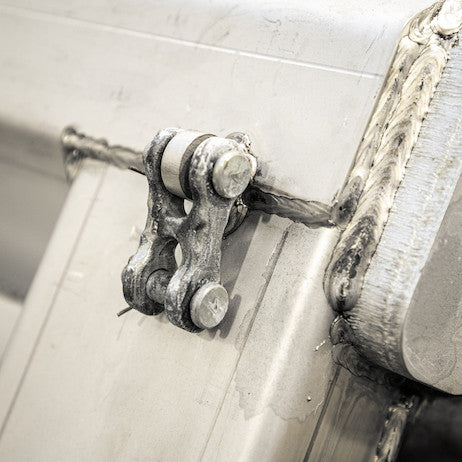
The Double Clevis Link from Buyers Products allows you to quickly and easily make a repair to a chain. It's made of drop-forged, heat-treated steel with clear zinc plating for corrosion resistance. The link can handle a working load limit of 5,400 lb.
Specifications
| Chain Diameter (in.) | 3/8 |
|---|---|
| Chain Length (in.) | - |
| Color | Silver |
| Finish | Zinc Plated |
| M.G.T.W. (lbs) | - |
| Material | Carbon Steel |
| W.L.L. (lbs) | 5,400 |
The Double Clevis Link, precisely engineered for 3/8 inch chain systems, represents a critical component in the lexicon of chain repair, assembly, and securement hardware. Designed and manufactured by Buyers Products, this link embodies a confluence of material science, advanced metallurgy, and functional engineering, delivering a robust solution for a myriad of industrial, agricultural, transportation, and construction applications. Its core utility lies in its capacity to facilitate rapid and secure connections, particularly in situations demanding the repair of damaged chain sections or the creation of customized chain assemblies, thereby minimizing operational downtime and enhancing system integrity.
Central to the superior performance of this Double Clevis Link is its meticulously chosen material and manufacturing process. Fabricated from high-grade carbon steel, the component undergoes a stringent drop-forging process. Drop forging is a metalworking technique where the material is shaped by compressive forces applied through dies. This method imparts several significant metallurgical advantages over alternative manufacturing processes such as casting or machining from plate. The primary benefit of drop forging is the creation of a continuous grain flow within the steel. This grain flow aligns with the contours of the component, enhancing its directional strength and resistance to impact and fatigue stresses. In contrast, cast components often possess a random grain structure, which can lead to areas of weakness, while machined components may disrupt the natural grain flow, potentially creating stress risers. The coherent grain structure achieved through drop forging significantly augments the link's overall tensile strength and ductility, rendering it exceptionally resilient under the specified working load limits and dynamic loading conditions often encountered in demanding applications. Furthermore, the compressive forces involved in drop forging refine the grain structure, reducing porosity and internal voids, thereby ensuring a higher degree of material homogeneity and integrity. This process is instrumental in producing a link that not only meets but often exceeds the rigorous performance expectations for chain connecting hardware.
Following the drop-forging process, the carbon steel material undergoes a precise heat treatment regimen. Heat treatment is a series of controlled heating and cooling operations applied to metals to alter their microstructure and, consequently, their mechanical properties. For a component like a clevis link, typically subjected to significant tensile and shear forces, heat treatment is crucial for optimizing its strength-to-weight ratio and enhancing its durability. The specific heat treatment applied to this carbon steel likely involves a combination of processes such as quenching and tempering. Quenching involves rapidly cooling the steel from an elevated temperature, typically within the austenitic phase, to achieve a harder, but more brittle, martensitic microstructure. Subsequent tempering involves reheating the quenched steel to an intermediate temperature, followed by controlled cooling. This tempering process reduces the brittleness induced by quenching while maintaining a high level of hardness and significantly improving the steel's toughness and ductility. The precise control over the heat treatment parameters ensures that the Double Clevis Link achieves an optimal balance of hardness, strength, and resistance to brittle fracture, a critical characteristic for safety-critical components in load-bearing applications. This advanced metallurgical conditioning ensures that the link can withstand the specified 5,400 lb Working Load Limit (WLL) with a substantial safety factor, providing reliable performance over its operational lifespan.
Corrosion resistance is another paramount consideration for hardware deployed in outdoor, marine, or otherwise harsh industrial environments. The Double Clevis Link addresses this through the application of clear zinc plating. Zinc plating is an electroplating process where a thin layer of zinc is deposited onto the surface of the steel. This coating serves a dual protective function. Firstly, it acts as a sacrificial layer (galvanic protection). If the coating is scratched or compromised, the zinc, being more electrochemically active than steel, will preferentially corrode, thereby protecting the underlying steel substrate from rust. Secondly, the zinc layer forms a physical barrier that isolates the steel from corrosive elements such as moisture, oxygen, and various atmospheric pollutants. The "clear" aspect refers to the chromate conversion coating applied over the zinc, which enhances the zinc's inherent corrosion resistance and provides a bright, aesthetically pleasing finish. This clear chromate treatment typically contains trivalent chromium, adhering to modern environmental regulations (RoHS compliance) by avoiding hexavalent chromium. The combination of zinc plating and chromate passivation significantly extends the service life of the clevis link, preventing premature degradation due to rust and maintaining the mechanical integrity of the component even when exposed to challenging environmental conditions, reducing the need for frequent replacement and contributing to lower lifecycle costs. The adherence to industry standards for plating thickness and quality ensures consistent performance across all units.
The design of the Double Clevis Link is inherently optimized for seamless integration with 3/8 inch chain systems. The "double clevis" nomenclature indicates that the link features two distinct clevis ends, each designed to accommodate a link of a chain. A clevis mechanism consists of a U-shaped shackle with holes at the ends through which a pin can be inserted to secure a connecting component. In this double configuration, each end of the clevis link can engage with an existing chain link, effectively creating a strong and secure connection without the need for specialized tools beyond a hammer to seat the pin and a pair of pliers for the cotter pin. This design facilitates a robust, mechanical connection that is highly resistant to unintentional disengagement under tension. The precise internal dimensions of the clevis ends are engineered to perfectly mate with the standard dimensions of a 3/8 inch chain link, ensuring a snug fit that minimizes play and wear, thereby maximizing the efficiency and safety of the connection. The common securing mechanism involves a removable clevis pin, often retained by a cotter pin or a spring clip. This design provides both security and the convenience of quick assembly and disassembly, an invaluable attribute for field repairs or dynamic rigging configurations.
Performance specifications are critical for safety and operational efficacy. This Double Clevis Link is rated with a Working Load Limit (WLL) of 5,400 lb. The WLL is defined as the maximum static load that can be safely applied to a piece of lifting or rigging equipment when the load is evenly distributed. It is a fundamental safety parameter, ensuring that the component can perform its intended function without permanent deformation or failure under normal operating conditions. It is imperative that users never exceed the stated WLL, as doing so can lead to structural compromise, catastrophic failure, and severe injury or property damage. The WLL is typically determined by dividing the Minimum Breaking Load (MBL) by a safety factor. While the MBL is not explicitly stated, common industry practice for such hardware often employs a safety factor of 4:1 or 5:1. Assuming a conservative safety factor of 4:1, the Minimum Breaking Load for this link would be approximately 21,600 lb (5,400 lb WLL * 4). This substantial margin between the WLL and the MBL provides a robust buffer against unforeseen peak loads, dynamic forces, and minor material imperfections, ensuring a high degree of operational safety. The determination of WLL and MBL is usually achieved through rigorous destructive and non-destructive testing, adhering to recognized industry standards such as those promulgated by the National Association of Chain Manufacturers (NACM) or the American Society of Mechanical Engineers (ASME B30.26), which govern the design, manufacturing, and testing of rigging hardware. For a 3/8 inch chain, a 5,400 lb WLL is typically commensurate with Grade 70 transport chain, indicating its suitability for heavy-duty applications requiring high strength and reliability.
The applications for the 3/8 Inch Double Clevis Link are extensive and diverse. Foremost is its indispensable role in chain repair and maintenance. When a section of chain becomes damaged due to excessive wear, deformation, or fracture, this link provides an efficient and economical alternative to replacing the entire chain. By removing the compromised link(s) and inserting the double clevis link, the chain can be restored to full functionality with minimal downtime. This is particularly valuable in sectors like transportation, where Grade 70 chains are routinely used for securing heavy equipment and cargo, and rapid repairs are essential to maintain delivery schedules. In agricultural settings, where chains are integral to machinery operation, the ability to quickly mend a broken chain in the field can prevent costly delays. Beyond repairs, the link is also highly effective for chain assembly and fabrication. It allows for the creation of custom chain lengths, the attachment of various end fittings (hooks, rings, shackles), or the connection of multiple chain segments to form complex rigging configurations. Its ease of installation makes it suitable for both temporary setups and more permanent installations where occasional disassembly for inspection or modification might be required. Construction sites, towing and recovery operations, industrial lifting, and material handling all benefit from the versatility and reliability offered by this specific component.
Proper installation and adherence to safety guidelines are paramount to maximizing the performance and longevity of the Double Clevis Link and ensuring operational safety. Prior to installation, both the clevis link and the chain links it will connect should be thoroughly inspected for any signs of wear, deformation, cracks, nicks, gouges, or corrosion that might compromise their structural integrity. The clevis pin must be correctly aligned and fully seated through the clevis body and the chain link eyes. The retaining mechanism, typically a cotter pin or spring clip, must be securely installed to prevent the clevis pin from inadvertently disengaging under load or vibration. It is crucial to use cotter pins of the correct size and material, ensuring their ends are properly splayed or bent to lock them in place. Users must consistently operate within the specified Working Load Limit (WLL) of 5,400 lb, avoiding any shock loading or dynamic loads that could momentarily exceed this limit. Shock loading, defined as a sudden or rapidly applied load, can generate forces significantly higher than the static weight, potentially leading to catastrophic failure even if the static load is below the WLL. Environmental factors such as extreme temperatures, exposure to corrosive chemicals, or abrasive materials can also degrade the performance of the link and the chain. Regular, documented inspections by qualified personnel are essential to identify any signs of wear, fatigue, or damage that may necessitate replacement. Any clevis link exhibiting permanent deformation, cracks, excessive pitting from corrosion, or signs of heat damage should be immediately removed from service and replaced to maintain system safety. Furthermore, it is critical to ensure that the WLL of the clevis link is compatible with, and ideally exceeds, the WLL of the chain it is connecting, to prevent the link from becoming the weakest point in the assembly. Adequate training for personnel involved in rigging and chain handling is indispensable for safe operation.
In summary, the Buyers Products Double Clevis Link for 3/8 inch chain is not merely a repair part; it is a precisely engineered safety-critical component. Its fabrication from drop-forged, heat-treated carbon steel ensures exceptional strength, durability, and resistance to fatigue and impact. The clear zinc plating provides superior corrosion resistance, extending its operational life in harsh environments. With a meticulously determined Working Load Limit of 5,400 lb, backed by robust safety factors, it provides a reliable connection for Grade 70 and lower-grade 3/8 inch chains. The double clevis design facilitates swift, secure, and tool-efficient repairs and assemblies, significantly enhancing operational efficiency and minimizing downtime across a broad spectrum of heavy-duty applications. By adhering to rigorous manufacturing standards and metallurgical processes, this clevis link represents an investment in safety, efficiency, and long-term reliability for any professional requiring steadfast chain connectivity. Its technical specifications and robust construction make it an indispensable asset for maintaining the integrity and performance of critical chain systems in demanding industrial and commercial operations.