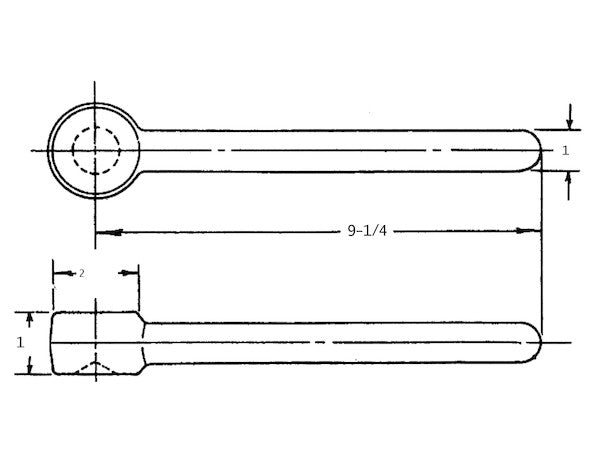
The Forged Rod End from Buyers Products is machined with NC thread and is ideal for all connecting and linkage needs.
Specifications
| Outer Eye Diameter (in.) | 2.000 " |
| Eye Opening (in.) | 1.000 " |
| Thread Stocked | 1-8 |
| Bolt Shaft Length (in.) | 9.250 " |
| Bolt Shaft Diameter (in.) | 1.000 " |
Advanced Technical Overview: 1 x 9-1/4 Inch Forged Rod End with 1-8 NC Thread, Zinc Plated
This document provides an in-depth technical analysis of the 1 x 9-1/4 Inch Forged Rod End, precision-machined with a 1-8 NC thread and finished with a robust zinc plating. Designed and manufactured by Buyers Products, this component is engineered to meet rigorous demands in a wide array of industrial, agricultural, automotive, and heavy-duty applications where secure and reliable mechanical connections are paramount. The rod end serves as a crucial interface for transmitting motion, accommodating angular misalignment, and facilitating tensile or compressive forces within linkage systems.
I. Product Description and Core Functionality
The Forged Rod End, as highlighted, is a fundamental mechanical component specifically designed for comprehensive connecting and linkage requirements. Its primary function is to provide a swivel-style connection point between two parts, typically a shaft or rod and a fixed or rotating component. This design allows for a degree of angular movement, mitigating stress concentrations that can arise from misaligned or dynamically loaded systems. The integration of a precision-machined National Coarse (NC) thread facilitates direct attachment to corresponding threaded rods or shafts, ensuring a strong, adjustable, and reliable connection. The zinc-plated finish enhances the component's durability and longevity in challenging operational environments.
II. Material Science and Forging Process
The designation "Forged Rod End" signifies a critical aspect of its manufacturing process and subsequent mechanical properties. Forging is a manufacturing process that involves shaping metal using localized compressive forces. Unlike casting or machining from bar stock, forging inherently improves the mechanical properties of the material. The forging process for this rod end likely involves heating a suitable steel alloy (e.g., medium carbon steel or alloy steel, selected for its balance of strength, ductility, and machinability) to a specific temperature and then subjecting it to controlled deformation using dies. This process refines the grain structure of the metal, aligning the grain flow with the shape of the component. This refined grain structure results in several key advantages:
- Increased Tensile Strength: The material becomes stronger under tension.
- Enhanced Fatigue Resistance: The ability to withstand repeated cyclic loading without failure is significantly improved.
- Superior Impact Toughness: The component can absorb more energy before fracturing.
- Reduced Porosity and Internal Defects: Forging virtually eliminates internal voids and imperfections commonly found in castings.
The selection of the base material is crucial. Typical steels used for such high-stress components include SAE 1045, 4140, or similar medium to high carbon steels, which offer excellent forgeability and respond well to heat treatment if additional hardness or strength is required. The specific grade would be chosen based on the desired balance of strength, ductility, and cost-effectiveness for the intended applications.
III. Precision Machining and Thread Specifications
Following the forging process, the rod end undergoes precision machining to achieve the specified dimensions and surface finishes, particularly for the threaded section and the eye bore. The detailed specifications are as follows:
- Bolt Shaft Length: 9.250 inches (9-1/4 inches): This dimension refers to the overall length of the solid shaft portion of the rod end, extending from the base of the eye to the end of the threaded section. This substantial length indicates suitability for applications requiring significant reach or adjustment capability within linkage systems.
- Bolt Shaft Diameter: 1.000 inch (1 inch): A 1-inch diameter shaft provides a robust cross-section, conferring high resistance to bending, shear, and torsional stresses. This dimension is critical for determining the load-bearing capacity and overall structural integrity of the component.
-
Thread Stocked: 1-8 NC: This specifies a National Coarse (NC) thread with a nominal diameter of 1 inch and 8 threads per inch.
- Nominal Diameter (1 inch): Corresponds directly to the bolt shaft diameter, ensuring compatibility.
-
Threads Per Inch (8 TPI): The relatively coarse pitch of 8 threads per inch provides several advantages:
- Faster Engagement: Fewer turns are required to achieve full engagement.
- Increased Tolerance to Damage: Coarser threads are less susceptible to stripping or damage from minor impacts or cross-threading during assembly compared to fine threads.
- Greater Strength: In many materials, coarse threads can offer slightly higher shear strength than fine threads of the same diameter due to a larger thread root area.
- Ease of Manufacturing: Coarse threads are generally easier to machine, contributing to cost-effectiveness.
- NC (National Coarse) Profile: The NC thread series is standardized for general-purpose applications where strength, ease of assembly, and resistance to stripping are primary considerations. It adheres to specific thread form angles (typically 60 degrees), pitch diameters, and root/crest configurations to ensure interchangeability and robust performance.
IV. Eye Dimensions and Articulation
The eye of the rod end is the critical articulation point, designed to accommodate a pin, bolt, or clevis, allowing for rotational and angular movement. The specified dimensions are:
- Outer Eye Diameter: 2.000 inches: This measurement defines the external dimension of the eye, providing insight into the overall size and potential strength around the bore. A larger outer diameter suggests a robust design capable of handling significant loads.
- Eye Opening: 1.000 inch: This is the bore diameter of the eye, which is designed to precisely fit a 1-inch diameter pin or bolt. The precision of this bore is paramount for minimizing play and wear in the joint, ensuring efficient transfer of forces and preventing premature failure due to looseness or excessive friction. The fit tolerance for this opening would typically be H7 or similar, ensuring a smooth, yet snug, fit with a corresponding ground pin.
The combination of these eye dimensions with the forged construction ensures a high load-bearing capacity and excellent resistance to deformation under shear and radial loads applied through the connecting pin.
V. Zinc Plating: Corrosion Protection and Aesthetic
The final finish of zinc plating is a critical feature contributing significantly to the product's longevity and performance, particularly in exposed environments. Zinc plating involves applying a thin coating of zinc to the steel surface through an electroplating process. This coating provides sacrificial corrosion protection, meaning the zinc corrodes preferentially to the underlying steel when exposed to moisture and oxygen. Key benefits include:
- Corrosion Resistance: Excellent protection against rust and other forms of atmospheric corrosion, extending the service life of the component. This is particularly vital in outdoor applications, marine environments (with appropriate chromate conversion), or industrial settings where moisture, chemicals, or abrasive elements are present.
- Sacrificial Protection: Even if the zinc coating is scratched, it continues to protect the steel substrate in the immediate vicinity, preventing localized rust formation.
- Durability: The zinc layer provides a degree of abrasion resistance, protecting the underlying steel from minor mechanical damage.
- Aesthetic Appeal: Zinc plating typically results in a bright, clean metallic finish, which is often preferred for visibility and cleanliness in many applications.
- Cost-Effectiveness: Zinc plating is a widely used and relatively economical method for providing effective corrosion protection for steel components.
For enhanced corrosion resistance, especially in harsh conditions, the zinc plating may be further treated with a chromate conversion coating (e.g., clear, yellow, or black chromate). While not explicitly stated, this is a common practice for zinc-plated components to provide an additional barrier and improve resistance to white rust (zinc corrosion products).
VI. Applications and Target Industries
Given its robust construction, precise dimensions, and corrosion-resistant finish, this forged rod end is suitable for a diverse range of demanding applications across various industries:
- Heavy Equipment and Construction: Used in linkages for excavators, loaders, bulldozers, cranes, and other construction machinery for hydraulic cylinder connections, steering linkages, and control arms.
- Agricultural Machinery: Employed in tractors, plows, cultivators, and harvesters for three-point hitches, implement linkages, steering systems, and hydraulic cylinder connections.
- Truck and Trailer Industry: Critical for suspension linkages, steering components, braking systems, fifth-wheel mechanisms, and cargo securement systems in commercial vehicles.
- Industrial Machinery: Found in various manufacturing and processing equipment, conveyors, material handling systems, and robotics where robust and adjustable linkages are required.
- Marine Applications: Suitable for boat steering systems, rudder linkages, throttle controls, and other mechanical connections, particularly with the added protection of zinc plating (though marine-specific coatings might be considered for direct saltwater exposure).
- Automotive (Heavy-Duty/Off-Road): Used in custom suspension systems, steering components, and control linkages for off-road vehicles and specialized automotive applications.
- Fluid Power Systems: Ideal for connecting hydraulic and pneumatic cylinders to their loads, enabling efficient force transmission and accommodating angular motion.
VII. Installation and Maintenance Considerations
Proper installation and periodic maintenance are crucial for maximizing the service life and performance of the rod end:
- Thread Engagement: Ensure adequate thread engagement (typically at least 1.5 times the nominal diameter for steel components) to achieve full load-carrying capacity and prevent stripping.
- Torque Specifications: Adhere to manufacturer-recommended torque values for mating fasteners to prevent over-tightening (which can damage threads or distort components) or under-tightening (which can lead to loosening and premature wear).
- Alignment: While rod ends accommodate some angular misalignment, minimizing initial misalignment during assembly will reduce stress and wear on the joint.
- Lubrication: Although not explicitly stated, the eye opening may benefit from periodic lubrication if designed for high-cycle dynamic motion, especially if no self-lubricating bushing is present. Regular inspection for wear in the bore is recommended.
- Corrosion Inspection: Regularly inspect the zinc plating for signs of damage or significant corrosion. While zinc offers excellent protection, severe abrasion or prolonged exposure to harsh chemicals can compromise the coating.
- Wear Monitoring: Periodically check for excessive play or looseness in the eye opening, which indicates wear and potential need for replacement to maintain system integrity.
VIII. Quality Assurance and Standards Compliance
Buyers Products is known for manufacturing components designed to meet industry standards. This forged rod end would likely adhere to relevant manufacturing tolerances, material specifications (ASTM, SAE), and potentially performance standards for specific applications. The combination of forging, precision machining, and protective plating reflects a commitment to producing durable and reliable components for demanding operational environments. The uniform dimensions and specified thread type ensure interchangeability and compliance with common mechanical design practices.
Conclusion
The 1 x 9-1/4 Inch Forged Rod End, machined with a 1-8 NC thread and protected by zinc plating, represents a high-performance mechanical component engineered for strength, durability, and reliability. Its forged construction imparts superior mechanical properties, making it resilient to high stresses, fatigue, and impact. The precision-machined 1-8 NC thread ensures robust and adjustable connectivity, while the 1.000-inch eye opening provides a sturdy articulation point. The zinc plating offers vital corrosion resistance, extending its operational life in diverse and challenging environments. This rod end is an indispensable component for critical linkage and connection requirements across a multitude of industrial and heavy-duty sectors, providing a dependable solution for transmitting motion and managing forces within complex mechanical systems.