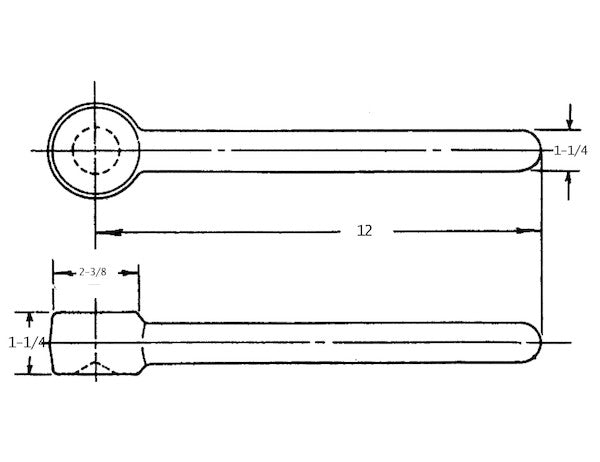
The Forged Rod End from Buyers Products is machined with NC thread and is ideal for all connecting and linkage needs.
Specifications
| Eye Opening (in.) | 1.250 " |
| Thread Stocked | 1 1/4-7 |
| Bolt Shaft Diameter (in.) | 1.250 " |
| Bolt Shaft Length (in.) | 12.000 " |
| Outer Eye Diameter (in.) | 2.50 " |
Advanced Technical Overview: 1-1/4 x 12 Inch Forged Rod End with 1-1/4-7 NC Thread
This document provides a comprehensive technical analysis of the 1-1/4 x 12 Inch Forged Rod End, precision-machined with a 1-1/4-7 NC (National Coarse) thread. Manufactured by Buyers Products, this component is engineered to serve critical functions in a multitude of mechanical systems, providing robust and reliable linkage for various connecting applications. Its design prioritizes durability, strength, and precise fitment, making it an indispensable element in demanding industrial, agricultural, and heavy-duty mobile equipment contexts.
Material and Forging Process
The foundation of this rod end's exceptional performance lies in its forged construction. Forging is a manufacturing process that involves shaping metal using localized compressive forces. Unlike casting or machining from bar stock, forging refines the grain structure of the metal, aligning it with the component's shape. This critical metallurgical advantage results in a significantly stronger, tougher, and more fatigue-resistant part. The material likely consists of a high-strength carbon steel or alloy steel, selected for its excellent mechanical properties and ability to withstand the forging process without cracking. Common candidates include AISI 1045, 4140, or similar grades, which offer a superior balance of tensile strength, yield strength, and ductility. The forging process enhances the material's resistance to impact, vibration, and cyclical loading, factors frequently encountered in dynamic mechanical assemblies. The absence of internal voids, porosity, or inclusions, which can be present in cast parts, further contributes to the rod end's structural integrity and reliability over its operational lifespan. The precise control over the forging temperature and deformation rates during manufacturing ensures consistent material properties throughout the entire component.
Precision Machining and Thread Specification
Following the forging process, the rod end undergoes precision machining. This critical secondary operation transforms the rough forging into a finished component with exact dimensional tolerances and surface finishes. The most defining feature of this rod end is the 1-1/4-7 NC thread. This designation specifies a nominal diameter of 1.25 inches (1-1/4") and a thread pitch of 7 threads per inch (TPI). The "NC" suffix denotes a National Coarse thread series, which is characterized by a larger thread root, making it less susceptible to stripping, easier to engage, and generally more forgiving in environments where contaminants or minor damage might be present. NC threads also offer superior strength against shear forces compared to fine threads of the same diameter. The machining process for the thread involves highly accurate lathes or CNC machining centers, utilizing appropriate cutting tools and coolants to achieve precise thread geometry, pitch diameter, and lead accuracy. The thread must conform to established ANSI/ASME standards (e.g., B1.1) for screw threads, ensuring interchangeability and proper engagement with corresponding threaded components. The surface finish within the thread flanks is also critical to minimize friction during assembly and to prevent galling under load. Quality control measures, such as thread gauging, are employed to verify compliance with thread class specifications, typically 2A for external threads, ensuring a suitable fit with internal threads.
Geometric Specifications and Dimensional Analysis
The provided specifications detail key dimensions crucial for proper application and integration:
- Eye Opening (in.): 1.250" (1-1/4"): This dimension refers to the internal diameter of the rod end's eye. It is designed to accommodate a pin, bolt, or shaft with a corresponding diameter of 1-1/4 inches. This precise clearance ensures proper articulation while minimizing slop or excessive play, which could lead to accelerated wear or stress concentrations. The surface of the eye opening is typically machined to a smooth finish to reduce friction and facilitate the insertion and rotation of the mating pin.
- Thread Stocked: 1 1/4-7: This reiterates the thread specification, confirming the male threaded portion of the rod end. The length of the threaded section is critical for providing adequate engagement and load distribution when assembled.
- Bolt Shaft Diameter (in.): 1.250" (1-1/4"): This refers to the main shank diameter of the rod end, which transitions into the threaded section. It provides the necessary cross-sectional area to withstand tensile and compressive forces without yielding or buckling. The consistency of this diameter along its length is important for alignment and stability within the assembly.
- Bolt Shaft Length (in.): 12.000": This dimension represents the overall length of the bolt shaft portion, from the shoulder of the eye to the end of the threaded section. A 12-inch length offers significant adjustability and reach for various linkage applications, allowing for precise positioning and tensioning within a system. This extended length can be particularly advantageous in applications requiring substantial extension or the ability to span considerable distances between pivot points.
- Outer Eye Diameter (in.): 2.50": This is the external diameter of the rod end's eye. This dimension is crucial for determining the necessary clearance around the pivot point within an assembly. It also provides an indication of the material thickness around the eye, which directly contributes to its strength and resistance to radial loading and deformation. A larger outer diameter generally implies a more robust eye capable of handling higher loads.
These dimensions are critical for engineers and designers to ensure proper fit, function, and load-bearing capacity within the intended mechanical system. Deviations from these specified tolerances could lead to misalignment, premature wear, or catastrophic failure.
Functional Application and Performance Characteristics
The 1-1/4 x 12 Inch Forged Rod End is engineered for dynamic loading conditions, typically found in:
- Heavy-Duty Vehicle Steering and Suspension Systems: Linkages in trucks, construction equipment, and agricultural machinery where robust connections are paramount.
- Industrial Machinery: Actuation arms, control linkages, and tensioning rods in manufacturing equipment, presses, and conveyors.
- Agricultural Equipment: Implement attachments, lift arms, and adjustment mechanisms in tractors and farm machinery.
- Specialized Equipment: Custom fabrication projects requiring strong, adjustable, and reliable pivot points.
Its primary function is to provide a flexible connection point that can articulate, accommodating angular misalignment while transmitting axial loads (tension or compression). The robust forging process ensures high tensile and compressive strength, preventing deformation or fracture under typical operational loads. The precise machining of the eye opening allows for smooth rotation around a mating pin, minimizing friction and wear when properly lubricated or paired with a suitable bushing. The 12-inch shaft length offers a broad range of adjustability, facilitating accurate system setup and maintenance of critical distances within a linkage mechanism.
Key performance attributes include:
- High Load-Bearing Capacity: The forged construction and generous dimensions contribute to exceptional strength, allowing the component to withstand significant static and dynamic loads without plastic deformation or fracture.
- Durability and Longevity: The refined grain structure of forged steel, coupled with appropriate material selection, provides superior resistance to fatigue, impact, and wear, extending the operational life of the component even in harsh environments.
- Corrosion Resistance (Optional/Treatment Dependent): While not explicitly stated, such components are often supplied with a protective coating (e.g., zinc plating, black oxide, or paint) to enhance corrosion resistance, especially in outdoor or corrosive industrial applications. If untreated, appropriate anti-corrosion measures by the end-user are recommended.
- Ease of Integration: The standard 1-1/4-7 NC thread ensures compatibility with a wide range of commercially available nuts, threaded couplings, and other components, simplifying assembly and replacement.
- Articulative Freedom: The rod end design allows for pivotal movement, crucial for converting linear motion into angular motion or accommodating misalignment between connected components, thereby reducing stress on the overall system.
Installation and Maintenance Considerations
Proper installation is paramount to achieving the designed performance and longevity of the rod end. When installing, it is critical to ensure:
- Correct Torque Application: Mating nuts must be torqued to the manufacturer's specified values to prevent loosening under vibration and to ensure adequate clamping force without overstressing the threads.
- Thread Engagement: Sufficient thread engagement (typically 1 to 1.5 times the nominal diameter) is required to distribute loads evenly across the threads and prevent stripping.
- Alignment: While rod ends accommodate some misalignment, excessive angularity beyond their design limits can induce bending stresses on the pin and eye, leading to premature wear or failure. Proper system alignment should always be strived for.
- Lubrication: Depending on the application and the presence of bushings, periodic lubrication of the eye opening and pin interface may be necessary to reduce friction, prevent galling, and extend service life.
- Inspection: Regular inspection for signs of wear, deformation, cracking, or corrosion is recommended, especially in high-stress or critical applications. Any damage should prompt immediate replacement.
Quality Assurance and Compliance
Buyers Products, as a reputable manufacturer, typically adheres to stringent quality control protocols throughout the manufacturing process. This includes:
- Material Certification: Verification of raw material composition and mechanical properties against industry standards.
- Dimensional Inspection: Use of precision measurement tools (calipers, micrometers, CMMs, thread gauges) to ensure all specified dimensions and tolerances are met.
- Non-Destructive Testing (NDT): Depending on criticality, methods like magnetic particle inspection or ultrasonic testing may be employed on a sample basis to detect internal or surface flaws in forged components.
- Mechanical Testing: Tensile strength, yield strength, and hardness tests may be performed on representative samples to confirm the mechanical integrity of the finished product.
Compliance with relevant industry standards (e.g., SAE, ASTM for materials, ASME for threads) is generally expected, ensuring the product's reliability and suitability for its intended applications across various sectors.
Conclusion
The 1-1/4 x 12 Inch Forged Rod End with 1-1/4-7 NC Thread from Buyers Products represents a high-integrity, robust, and precision-engineered mechanical component. Its forged construction provides superior strength and durability, making it ideally suited for demanding linkage and connecting applications where reliability is paramount. The meticulous machining ensures dimensional accuracy and thread integrity, facilitating seamless integration into complex mechanical systems. Its generous length and standard thread form offer versatility and ease of use, making it a critical asset for engineers and maintenance professionals seeking dependable performance in heavy-duty environments. Understanding its material properties, manufacturing process, and detailed specifications is crucial for maximizing its operational effectiveness and ensuring long-term system integrity.