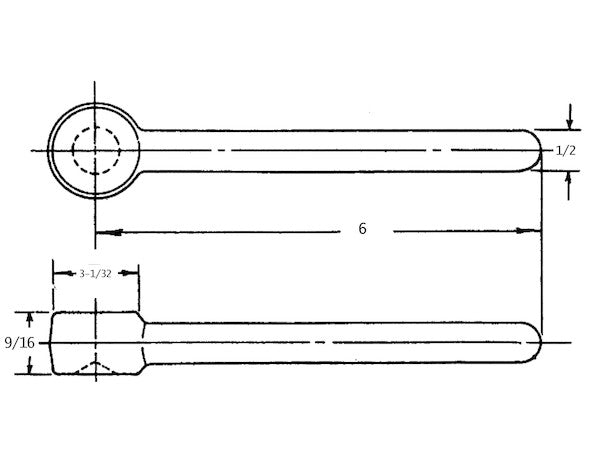
The Forged Rod End from Buyers Products is machined with NC thread and is ideal for all connecting and linkage needs.
Specifications
| Thread Stocked | 1/2-13 |
| Outer Eye Diameter (in.) | 0.97 " |
| Eye Opening (in.) | 0.500 " |
| Bolt Shaft Diameter (in.) | .500 " |
| Bolt Shaft Length (in.) | 6.000 " |
Technical Overview: Forged Rod End with 1/2-13 NC Thread
This document provides a comprehensive technical overview of the 1/2 x 6 Inch Forged Rod End Machined With 1/2-13 NC Thread, a precision component engineered by Buyers Products. Designed for a diverse range of mechanical applications requiring robust and reliable connections, this rod end exemplifies superior manufacturing processes and material science. Its specific design parameters, including a 0.500-inch eye opening, a 0.500-inch bolt shaft diameter, and a 6.000-inch bolt shaft length, coupled with the standardized 1/2-13 NC thread, ensure versatility and compatibility across numerous industrial and automotive systems.
Manufacturing Process: Forging and Precision Machining
The foundation of this rod end's exceptional strength and durability lies in its manufacturing process, specifically forging. Forging is a metal forming process that involves applying compressive forces to shape metal, typically through hammering, pressing, or rolling. This process refines the grain structure of the material, eliminating internal voids and improving its mechanical properties, such as tensile strength, yield strength, and fatigue resistance, far exceeding those of cast or machined-from-bar components. The material used for this forging is carefully selected to meet stringent performance requirements, often high-strength alloy steels, which are then heat-treated to achieve optimal hardness and toughness.
Following the forging process, the component undergoes precision machining. This critical stage involves the use of computer numerical control (CNC) machinery to achieve the exact dimensions and tolerances specified. The machining process focuses on several key areas: the eye opening, the bolt shaft diameter, and crucially, the 1/2-13 NC thread. CNC machining ensures consistent quality, dimensional accuracy, and surface finish, all of which are paramount for the rod end's functional integrity and its ability to integrate seamlessly into complex mechanical assemblies. The thread, in particular, requires meticulous attention to detail to ensure proper engagement with mating components, preventing premature wear or failure.
Material Science and Heat Treatment
The selection of raw material for the forging process is a critical engineering decision. Typically, high-grade alloy steels, such as AISI 4140, 4340, or similar high-strength low-alloy steels, are employed. These materials are chosen for their excellent balance of strength, toughness, and machinability. The chemical composition, including elements like chromium, molybdenum, manganese, and carbon, is carefully controlled to impart specific mechanical properties. Chromium enhances hardenability and corrosion resistance, molybdenum improves high-temperature strength and creep resistance, while manganese contributes to strength and ductility. Carbon content is crucial for the steel's overall hardness and response to heat treatment.
Heat treatment is an indispensable step in optimizing the performance of the forged rod end. This process involves controlled heating and cooling cycles designed to alter the microstructure of the steel, thereby enhancing its mechanical properties. Common heat treatment processes include:
- Hardening: Involves heating the steel to an austenitizing temperature, followed by rapid quenching (e.g., in oil or water). This transforms the microstructure into martensite, a very hard and brittle phase.
- Tempering: After hardening, the steel is reheated to a lower temperature and held for a specific duration, then cooled. Tempering reduces the brittleness of martensite while improving its toughness and ductility, achieving a desirable balance of strength and impact resistance. The specific tempering temperature dictates the final hardness and toughness of the component.
- Stress Relieving: A process that reduces internal stresses induced during manufacturing processes like forging and machining, thereby preventing distortion and improving dimensional stability.
The precise control over these heat treatment parameters is essential to ensure the rod end achieves its specified strength, fatigue life, and wear resistance, allowing it to withstand dynamic loads and harsh operating environments.
Thread Specification: 1/2-13 NC
The 1/2-13 NC thread is a standard unified national coarse (NC) thread series specification, indicating a nominal diameter of 0.500 inches and 13 threads per inch. This coarse thread series is widely preferred in applications where strength, ease of assembly, and resistance to stripping are critical. Key characteristics of the NC thread include:
- Increased Thread Depth: Coarse threads have a larger pitch (distance between threads) and thus deeper thread profiles compared to fine threads. This larger depth provides greater engagement and shear area, contributing to higher tensile strength and pull-out resistance.
- Reduced Likelihood of Stripping: Due to their robust profile, NC threads are less susceptible to stripping during assembly, especially in softer materials or when repeated assembly/disassembly is required.
- Tolerance to Minor Damage: Coarse threads are more forgiving of minor nicks, burrs, or surface imperfections that might render a fine thread unusable.
- Ease of Assembly: The larger lead of coarse threads allows for quicker engagement and faster assembly, a significant advantage in production environments.
- Vibration Resistance: While often considered less resistant to self-loosening under vibration than fine threads without locking mechanisms, the inherent strength and deeper engagement of NC threads can still provide a robust connection, particularly when augmented with appropriate locking hardware.
The precision with which the 1/2-13 NC thread is machined is critical for proper fit, load distribution, and longevity of the connection. Adherence to ASME B1.1 standards for unified inch screw threads ensures interchangeability and compatibility with a wide array of fasteners and mating components.
Dimensional Analysis and Tolerances
The specified dimensions of the rod end are critical for its function and integration:
- Outer Eye Diameter (0.97 in.): This dimension defines the overall external profile of the eye, influencing clearance requirements within its operational environment.
- Eye Opening (0.500 in.): This precisely machined internal diameter is designed to accommodate a 0.500-inch diameter pin, bolt, or shaft. The tight tolerance on this dimension ensures a snug fit, minimizing play and rotational slop, which is crucial for precise linkage operation and load transfer. Any excessive clearance here can lead to premature wear, increased noise, and reduced system accuracy.
- Bolt Shaft Diameter (0.500 in.): This refers to the diameter of the cylindrical portion of the rod end that extends from the threaded section. Its consistent diameter ensures proper alignment and fit within supporting structures or mounting points.
- Bolt Shaft Length (6.000 in.): This defines the total length of the non-threaded shank section of the rod end. This length is critical for providing adequate reach, clearance, and often, for accommodating specific mounting requirements, such as passing through multiple components or providing a sufficient lever arm for linkage action.
Manufacturers adhere to strict geometric dimensioning and tolerancing (GD&T) principles during production. These tolerances ensure that variations in manufacturing do not compromise the fit, form, or function of the component. For a critical part like a rod end, tolerances on perpendicularity, concentricity, and parallelism are as important as the linear dimensions themselves, influencing the component's performance under dynamic loads and its overall lifespan.
Applications and Operational Considerations
The 1/2 x 6 Inch Forged Rod End with 1/2-13 NC Thread is engineered for a broad spectrum of demanding applications across various industries, including:
- Automotive and Heavy Equipment: Used extensively in steering linkages, suspension systems, throttle controls, shift linkages, and hydraulic cylinder connections in trucks, buses, construction equipment, agricultural machinery, and specialized vehicles. Its forged construction provides the necessary strength to withstand the high dynamic loads and harsh environmental conditions common in these sectors.
- Industrial Machinery: Integral in conveying systems, packaging machinery, automation equipment, and various articulated mechanisms where reliable, high-strength connections are paramount for operational efficiency and safety.
- Marine Applications: Suitable for certain marine control systems and linkages where its robust construction offers durability, although specific corrosion resistance treatments may be necessary depending on the exposure level to saltwater.
- General Mechanical Linkages: Provides a versatile solution for general-purpose connecting and articulation needs across a multitude of engineering designs.
When integrating this rod end into a system, several operational considerations are essential:
- Load Capacity: Engineers must verify that the rod end's static and dynamic load ratings are sufficient for the intended application. Factors like tensile strength, compressive strength, shear strength, and fatigue life are critical.
- Alignment and Misalignment: While rod ends generally allow for some degree of angular misalignment, exceeding these limits can induce bending stresses and lead to premature failure. Proper design of the connecting linkage should minimize excessive misalignment.
- Environmental Factors: Temperature extremes, exposure to corrosive agents, dust, and moisture can affect the performance and lifespan of the rod end. Appropriate material selection, coatings, or seals may be required for challenging environments.
- Lubrication: Depending on the application, the eye opening may require lubrication for smooth operation and reduced wear, particularly in high-frequency or high-load rotational applications. Maintenance schedules should account for this.
- Fastener Compatibility: Ensure that the mating bolt or pin for the eye opening and the threaded fastener for the 1/2-13 NC thread are of appropriate grade and material to match the strength of the rod end, preventing the weakest link syndrome in the assembly.
- Torque Specifications: Adherence to proper torque specifications for the threaded connection is crucial to prevent loosening under vibration and to ensure adequate clamping force without overstressing the thread.
Quality Control and Standards Compliance
Buyers Products maintains rigorous quality control processes throughout the manufacturing lifecycle of the forged rod end. These processes include:
- Raw Material Inspection: Verification of chemical composition and mechanical properties of incoming steel billets.
- In-Process Inspections: Monitoring of forging temperatures, die conditions, and dimensional checks at various stages of machining.
- Final Dimensional Inspection: Comprehensive measurement of all critical dimensions, including eye opening, bolt shaft diameter and length, and thread specifications, using calibrated gauges and optical inspection equipment.
- Mechanical Testing: Sample testing for tensile strength, yield strength, hardness, and fatigue characteristics to confirm the integrity of the heat treatment and material properties.
- Non-Destructive Testing (NDT): Techniques such as magnetic particle inspection or eddy current testing may be employed on critical batches to detect surface or subsurface flaws.
Compliance with industry standards, such as those set by ASME, SAE, and ASTM, further assures the quality, reliability, and interchangeability of the product. The robust design and manufacturing adherence to these standards ensure that the 1/2 x 6 Inch Forged Rod End Machined With 1/2-13 NC Thread delivers consistent, high-performance service in demanding mechanical applications.
In conclusion, this forged rod end is not merely a simple connecting piece but a meticulously engineered component. Its design leverages advanced material science, precision forging, and state-of-the-art machining techniques to deliver a product of superior strength, durability, and reliability. Its specific dimensions and the standardized 1/2-13 NC thread make it a versatile and indispensable component for a wide array of industrial and vehicular applications, offering engineers and manufacturers a trusted solution for their critical linkage requirements.