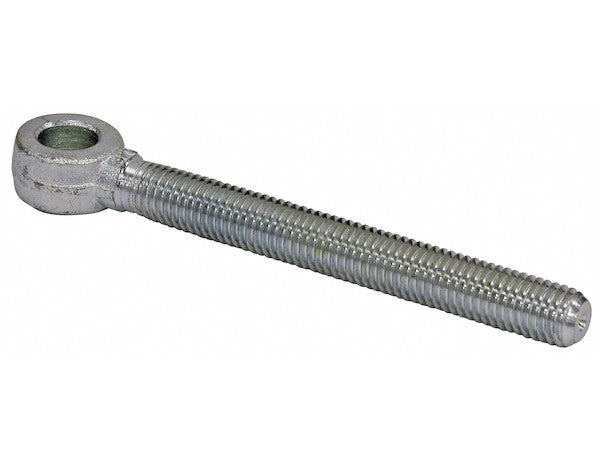
Buyers Products Forged Rod End is built to last from sturdy PH hardened steel, and is zinc-plated for corrosion resistance. The 5/8-11 by 6 in. forged male rod end has 4-1/2 in. of thread for secure fastening.
Specifications
| Bolt Shaft Diameter (in.) | .625 |
|---|---|
| Bolt Shaft Length (in.) | 6.000 |
| Eye Opening (in.) | 0.688 |
| Outer Eye Diameter (in.) | 1.250 |
| Thread Stocked | 5/8-11 |
The Zinc Plated Forged Rod End with 5/8-11 Full Thread represents a critical component engineered for robust performance and exceptional durability in a diverse array of mechanical and industrial applications. This meticulously designed rod end, often referred to as a heim joint or spherical rod end bearing, is a testament to precision manufacturing, advanced material science, and superior corrosion protection. Its primary function is to facilitate the transmission of dynamic loads and accommodate angular misalignment between two moving parts, making it indispensable in systems requiring flexible yet strong linkage.
At the core of this product's inherent strength and reliability lies its forged construction. Forging is a metalworking process that involves shaping metal using localized compressive forces. Unlike casting, which involves melting and pouring metal into a mold, or machining from bar stock, forging reorganizes the material’s grain structure, aligning it with the component's shape. This metallurgical realignment eliminates internal voids and defects, resulting in a significantly denser, more uniform, and ultimately stronger component. The benefits of forging are manifold: enhanced tensile strength, superior yield strength, remarkable impact resistance, and an extended fatigue life. For critical load-bearing applications, the ability of forged components to withstand repeated stress cycles without failure is paramount. The grain flow created during the forging process ensures that the material's strength is maximized along the lines of stress, providing unparalleled robustness compared to alternatives that lack this inherent structural integrity. This makes forged rod ends ideal for applications subjected to high shock loads, vibrations, and continuous operational demands where component integrity is non-negotiable.
The selection of PH hardened steel as the base material further elevates the performance profile of this rod end. PH stands for Precipitation Hardening, a heat treatment process applied to certain steel alloys to increase their strength and hardness. This class of stainless steels, such as 17-4 PH or 15-5 PH (common examples, though the specific alloy may vary), offers a unique combination of properties: very high strength, good corrosion resistance (even before plating), excellent toughness, and good weldability. The hardening process typically involves a solution annealing treatment followed by an aging treatment at an elevated temperature. During the aging phase, microscopic precipitates form within the steel's microstructure, impeding dislocation movement and thereby increasing the material's hardness and strength. This results in a material that not only possesses high ultimate tensile strength and yield strength but also maintains commendable ductility, preventing brittle failure under extreme conditions. The inherent corrosion resistance of PH hardened steels, combined with their superior mechanical properties, makes them an optimal choice for components operating in harsh industrial environments where exposure to moisture, chemicals, or abrasive elements is common. The PH hardened steel ensures that the rod end can endure significant operational stresses while resisting deformation and wear over its service life.
To further augment its resistance to environmental degradation, the forged rod end undergoes a zinc plating process. Zinc plating is a widely adopted electroplating technique that deposits a thin layer of zinc onto the steel substrate. This layer acts as a sacrificial coating, providing galvanic corrosion protection. In the presence of an electrolyte (such as moisture), the zinc preferentially corrodes instead of the underlying steel, thereby protecting the steel base metal from rust and oxidation. The zinc layer effectively creates a barrier that shields the steel from corrosive elements, while also offering cathodic protection should the coating be scratched or damaged. The specific type of zinc plating typically includes a chromate conversion coating, which enhances the corrosion resistance of the zinc layer itself and can give the part a clear, yellow, or black appearance. This multi-layered defense mechanism ensures that the rod end maintains its structural integrity and aesthetic appeal even when exposed to challenging outdoor conditions, humidity, and various industrial fluids. The meticulous application of zinc plating extends the operational lifespan of the component, reduces maintenance requirements, and contributes significantly to the overall reliability of the system in which it is integrated. Adherence to standards such as ASTM B633 for zinc plating further assures the quality and consistency of this protective finish, guaranteeing specified thickness and corrosion performance.
The design of this specific rod end features a 5/8-11 thread, indicating a major diameter of 5/8 inch and 11 threads per inch. This standardized Unified National Coarse (UNC) thread specification is prevalent in industrial applications due to its robust nature, ease of manufacture, and excellent resistance to stripping and loosening under dynamic loads. The coarse thread profile provides greater strength and faster assembly compared to fine threads, making it suitable for heavy-duty fastening where vibrational loosening could be a concern. The designation "Full Thread" in the product title, corroborated by the specification of "4-1/2 in. of thread for secure fastening" on a 6-inch bolt shaft length, signifies that a substantial portion of the shaft is threaded. This extensive thread engagement is critical for achieving maximum clamping force and ensuring a highly secure connection. A longer thread engagement surface distributes the load more evenly across the mating threads, reducing stress concentrations and preventing premature wear or failure of the fastener. This is particularly important in applications where precise adjustment and robust locking are required, as it allows for ample thread interaction with a mating nut or threaded bore, thereby maximizing the joint's integrity and resistance to pull-out forces.
Precision dimensions are paramount for the proper function and interchangeability of mechanical components. This rod end features a Bolt Shaft Diameter of 0.625 inches (5/8 inch), a Bolt Shaft Length of 6.000 inches, an Eye Opening of 0.688 inches, and an Outer Eye Diameter of 1.250 inches. These dimensions are not arbitrary; they are engineered to meet specific functional requirements and ensure compatibility with standard mating components. The bolt shaft diameter dictates the size of the pin or bolt that will pass through the rod end's eye. The Eye Opening, often referred to as the bore diameter of the spherical bearing, is critical for accommodating the connecting pin with appropriate clearance, allowing for smooth articulation without excessive play. The Outer Eye Diameter defines the overall footprint of the spherical head, influencing its fit within constrained spaces and its ability to withstand radial loads. The overall bolt shaft length is crucial for applications requiring specific reach or adjustability. The meticulous control over these dimensions during manufacturing, typically adhering to tight tolerances (e.g., +/- 0.005 inches or tighter for critical features), ensures a precise fit, minimizes backlash, and guarantees optimal performance when integrated into complex assemblies. Such dimensional accuracy is achieved through advanced machining processes following forging, ensuring that the finished product meets stringent engineering specifications for form, fit, and function.
The performance characteristics of this zinc plated forged rod end make it exceptionally versatile across numerous demanding industries. Its high load-bearing capacity, a direct consequence of the forged PH hardened steel construction, enables it to withstand significant tensile, compressive, and shear forces. This makes it suitable for heavy machinery, agricultural equipment, construction vehicles, and material handling systems where robust linkages are essential. The inherent toughness and fatigue resistance mean it can endure repetitive operational cycles and sudden impact loads without compromising its structural integrity. Furthermore, the ability of the rod end to accommodate angular misalignment, facilitated by its spherical eye, is crucial in systems where perfect alignment between connecting components is difficult to maintain or where dynamic motion requires flexibility. This angular compensation prevents binding and reduces stress on other system components, thereby prolonging the overall lifespan of the machinery. The zinc plating ensures consistent performance even in environments characterized by high humidity, temperature fluctuations, or exposure to corrosive agents, maintaining smooth operation and preventing premature wear or seizure due to rust. From steering linkages in off-road vehicles to hydraulic cylinder attachments in industrial presses, the rod end provides a reliable and long-lasting connection.
Quality assurance and manufacturing excellence are integral to the production of such a critical component. Each forged rod end undergoes a rigorous series of quality control checks, starting from the inspection of raw materials, through the forging process, heat treatment, machining, and finally, the zinc plating application. Non-destructive testing methods, dimensional inspections, and material property verification are standard procedures to ensure that every unit conforms to the specified design and performance criteria. Adherence to industry standards such as ISO 9001 for quality management systems, and specific ASTM or SAE material and plating specifications, reinforces the commitment to producing components of the highest caliber. Traceability protocols ensure that the manufacturing history of each rod end can be meticulously tracked, providing accountability and facilitating continuous improvement. This comprehensive approach to quality control guarantees that the Zinc Plated Forged Rod End with 5/8-11 Full Thread not only meets but often exceeds the demanding expectations of modern industrial and mechanical applications.
In conclusion, the Zinc Plated Forged Rod End with 5/8-11 Full Thread is an expertly engineered component designed for superior performance and longevity in challenging environments. Its foundation in advanced forging techniques provides unparalleled metallurgical strength and fatigue resistance. The utilization of PH hardened steel contributes exceptional tensile strength and toughness, while the zinc plating offers a robust defense against corrosion, ensuring extended service life. The precise 5/8-11 thread with substantial engagement length guarantees secure fastening and optimal load distribution. Furthermore, its meticulously controlled dimensions ensure perfect fit and functional compatibility within diverse mechanical systems. This rod end is not merely a component; it is a critical investment in the reliability, safety, and efficiency of your equipment, poised to deliver consistent, high-performance operation across a broad spectrum of industrial, automotive, agricultural, and marine applications. Its combination of material integrity, precision engineering, and protective finishing makes it an indispensable choice for engineers and manufacturers seeking a dependable solution for dynamic linkage requirements.