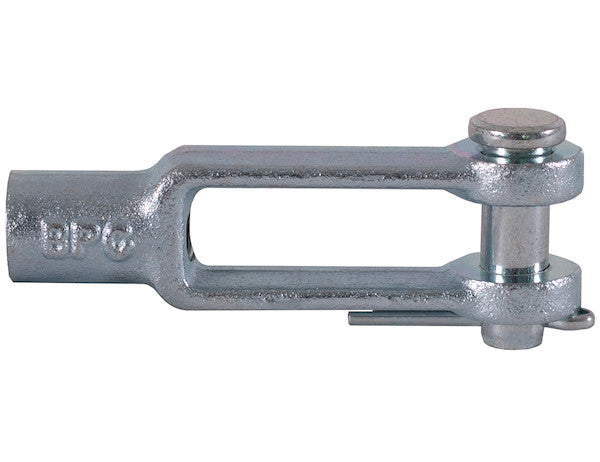
Buyers Products Clevis Rod End with Pin and Cotter Pin is used for pivot point linkages on air cylinders, shafts, rods, and other assemblies. The kit comes complete with a clevis pin and cotter pin for fast assembly. It is zinc-plated for corrosion resistance and comes in multiple sizes for a variety of applications.
Specifications
| Base to Hole Center (in.) | 2.250 |
|---|---|
| Bottom of Clevis Pin Head to Bottom of Pin (Maximum Usable Length) | .969 |
| Center Hole to Neck (in.) | 1.438 |
| Chamfer Angle | 15 |
| Chamfer Length | .078 |
| Clevis Pin Diameter | .313 |
| Clevis Pin Head Bevel Length | .094 |
| Clevis Pin Head Diameter | .438 |
| Clevis Pin Hole Dia. (in.) | 0.594 |
| Clevis Pin Hole Drill Number | 38 |
| Clevis Pin Incl. (y/n) | Yes |
| Color | Zinc |
| Finish | Zinc Plated |
| Height of Yoke Arm (in.) | 0.500 |
| Hole Dia. (in.) | 0.313 |
| Inner Arm to Arm (in.) | 0.344 |
| Material | Forged Steel |
| Neck Dia. (in.) | 0.500 |
| Neck Length (in.) | 0.813 |
| NOTUSED | .813 |
| Overall Pin Length | 1.063 |
| Thread Size (in.) | 5/16-24 |
| Type | Standard |
| Width (in.) | 0.750 |
The B27083AZ 5/16 Inch Clevis with Pin and Cotter Pin Kit represents a meticulously engineered solution for establishing robust and reliable pivot point linkages across a diverse array of industrial and mechanical applications. Designed to facilitate rotational motion while securely transmitting forces, this kit is an essential component in the construction and maintenance of machinery, hydraulic systems, and control mechanisms where precise and durable connections are paramount. Its comprehensive design, inclusive of the clevis rod end, a precisely sized clevis pin, and a dependable cotter pin, ensures not only rapid assembly but also long-term operational integrity.
Advanced Technical Overview: The B27083AZ Clevis System
Fundamental Role in Mechanical Linkages
Clevis assemblies are foundational elements in mechanical engineering, serving as critical interfaces for connecting various components that require angular articulation. The B27083AZ kit is specifically designed for applications demanding a 5/16 inch nominal pin diameter, providing a strong, flexible connection point for linear actuators such as air cylinders, hydraulic cylinders, shafts, rods, and other pivotal assemblies. This type of linkage is indispensable in scenarios where a push-pull motion needs to be translated into rotational movement, or where components need to pivot freely under load. Examples span from agricultural machinery and construction equipment to automotive systems, material handling devices, and custom automation projects. The inherent design of a clevis joint allows for a certain degree of misalignment, accommodating minor angular discrepancies without inducing excessive stress, thus enhancing system resilience and reducing premature wear on connected components.
Detailed Component Analysis and Material Science
The Forged Steel Clevis Rod End
The core of the B27083AZ kit is its clevis rod end, manufactured from high-quality forged steel. Forging is a manufacturing process that involves shaping metal through localized compressive forces. This process significantly enhances the material's strength, toughness, and fatigue resistance by refining its grain structure and eliminating internal defects such as porosity and voids commonly found in cast parts. The directional grain flow achieved through forging aligns with the shape of the part, optimizing its load-bearing capabilities and making it exceptionally resilient to shock, impact, and repetitive stress cycles inherent in dynamic mechanical systems. This metallurgical advantage ensures that the clevis can withstand the rigorous demands of industrial environments, providing a dependable connection point throughout its operational lifespan.
The specific geometry of the clevis rod end is defined by several critical dimensions. The "Inner Arm to Arm" dimension of 0.344 inches dictates the maximum width of the mating component that can be accommodated within the clevis yoke. Precise control over this tolerance is crucial for minimizing play while ensuring free movement. The "Height of Yoke Arm" (0.500 inches) and "Width" (0.750 inches) contribute to the structural integrity and shear strength of the clevis arms, which bear the primary load when the pin is subjected to shear forces. The "Neck Dia." (0.500 inches) and "Neck Length" (0.813 inches) characterize the connection point where the clevis attaches to a rod or shaft, typically via the specified "Thread Size" of 5/16-24. This fine-pitch thread (24 threads per inch for a 5/16-inch diameter) provides a secure, vibration-resistant attachment, crucial for maintaining linkage rigidity and preventing loosening under dynamic conditions. The "Base to Hole Center" (2.250 inches) and "Center Hole to Neck" (1.438 inches) dimensions are vital for design engineers, providing the necessary data for calculating linkage geometry, lever arm lengths, and overall system kinematics.
The 5/16 Inch Clevis Pin
The clevis pin is the central element that facilitates the pivot action and transmits loads between the clevis body and the connected component. With a "Clevis Pin Diameter" of 0.313 inches, precisely matching the "Hole Dia." of 0.313 inches in the clevis arms, a snug fit is achieved, minimizing wear and ensuring consistent load distribution. The pin's robust construction is essential, as it primarily operates under shear stress. Its "Overall Pin Length" of 1.063 inches and a "Bottom of Clevis Pin Head to Bottom of Pin (Maximum Usable Length)" of 0.969 inches are engineered to provide sufficient engagement through the clevis arms and the mating component, while allowing for adequate space for the cotter pin. The "Clevis Pin Head Diameter" of 0.438 inches and a "Clevis Pin Head Bevel Length" of 0.094 inches provide a stable bearing surface against one arm of the clevis, distributing axial forces and preventing the pin from passing through the hole. The pin is designed with a transverse hole, indicated by "Clevis Pin Hole Drill Number 38" (approximately 0.1015 inches in diameter), through which the cotter pin is inserted to prevent accidental dislodgement of the clevis pin, thereby ensuring the integrity of the pivot joint under operational stresses and vibrations.
The Cotter Pin: The Security Mechanism
Although seemingly minor, the cotter pin plays a pivotal role in the B27083AZ kit, acting as the primary safeguard against the inadvertent withdrawal of the clevis pin. Once the clevis pin is inserted through the clevis arms and the connected component, the cotter pin is threaded through the designated hole in the clevis pin. Its tines are then bent, typically in opposite directions, to create a mechanical interference fit that locks the clevis pin securely in place. This simple yet effective mechanism prevents axial movement of the clevis pin, even under severe vibration or dynamic loading, thus maintaining the structural integrity and safety of the entire linkage. The inclusion of the cotter pin as part of the complete kit underscores a commitment to providing a ready-to-assemble, secure, and reliable connection solution.
Corrosion Resistance: The Zinc Plated Finish
The B27083AZ kit features a "Zinc Plated" finish, signifying a critical enhancement for durability and longevity, especially in demanding environments. Zinc plating is an electrochemical process where a thin layer of zinc is deposited onto the surface of the steel components. This metallic coating serves as a sacrificial layer; in the presence of moisture and corrosive agents, the zinc preferentially corrodes before the underlying steel, thereby protecting the base material from rust and oxidation. This galvanic protection is highly effective in extending the service life of the components, particularly in outdoor applications, marine environments, or areas exposed to humidity, chemicals, or road salts.
Beyond its primary function of corrosion protection, the zinc plating also imparts an aesthetically pleasing, bright metallic finish, contributing to the overall professional appearance of the assembled machinery. This surface treatment reduces the need for frequent maintenance, such as painting or greasing for rust prevention, thereby decreasing operational downtime and overall ownership costs. The "Color" specification of "Zinc" confirms this protective and visually appealing finish, ensuring that the components maintain their structural integrity and functional performance over extended periods, even when subjected to challenging operational conditions.
Engineering Specifications and Their Implications for Performance
The comprehensive specifications provided for the B27083AZ kit are not merely descriptive figures but are crucial engineering parameters that define its performance, interoperability, and application suitability. Each dimension and characteristic has a direct impact on how the clevis performs within a larger mechanical system.
- Base to Hole Center (2.250 in.): This measurement is fundamental for kinematic design, determining the effective length of the clevis as a lever arm or part of a linkage system. Precision in this dimension ensures accurate replication of intended motion paths and force transmission.
- Bottom of Clevis Pin Head to Bottom of Pin (Maximum Usable Length) (.969 in.): This critical dimension defines the effective gripping length of the pin, indicating the maximum combined thickness of the clevis arms and the component being linked that the pin can securely span before the cotter pin is inserted.
- Center Hole to Neck (1.438 in.): This dimension, along with the Base to Hole Center, helps define the overall geometry and balance of the clevis, influencing its fit within constrained spaces and its interaction with other components of the linkage.
- Chamfer Angle (15) and Chamfer Length (.078): These small but significant details on the clevis pin aid in smooth insertion into mating holes, reducing the risk of binding or damage during assembly. Chamfers also help distribute stress concentrations, improving fatigue life.
- Clevis Pin Diameter (.313 in.) and Hole Dia. (.313 in.): The exact match between the pin diameter and the clevis hole diameter is paramount. A precise fit minimizes radial play, reducing impact wear, noise, and potential for fatigue failure at the pivot point. Too tight a fit would impede movement, while too loose a fit would introduce excessive slop.
- Clevis Pin Head Bevel Length (.094 in.) and Head Diameter (.438 in.): The design of the pin head ensures secure seating against the outer surface of the clevis arm, preventing the pin from sliding inward while providing a robust contact area for load distribution.
- Clevis Pin Hole Drill Number (38): This indicates the precise drilling specification for the cotter pin hole. Drill number 38 corresponds to a diameter of 0.1015 inches, ensuring compatibility with standard cotter pins and a secure fit to prevent the main clevis pin from dislodging.
- Height of Yoke Arm (0.500 in.) and Width (0.750 in.): These dimensions are directly related to the structural integrity and load-bearing capacity of the clevis arms. Sufficient material thickness is critical to resist bending and shear forces exerted on the pivot point.
- Inner Arm to Arm (0.344 in.): This specifies the internal clearance within the clevis yoke, ensuring that the component being attached (e.g., an eye end of a cylinder rod) can fit freely and articulate correctly without binding.
- Neck Dia. (0.500 in.) and Neck Length (0.813 in.): These dimensions are essential for the male threaded end of the clevis that connects to an external rod or shaft, dictating the strength of the threaded connection and the amount of thread engagement possible.
- Overall Pin Length (1.063 in.): This is the total length of the clevis pin, from the tip to the top of the head, ensuring it can adequately pass through the linkage components and allow for cotter pin insertion.
- Thread Size (5/16-24): This specifies a 5/16-inch nominal diameter with 24 threads per inch (UNF - Unified National Fine). Fine threads offer greater resistance to vibration loosening, finer adjustment capabilities, and typically have higher shear strength in tension compared to coarse threads of the same diameter, making them ideal for dynamic applications where secure attachment is crucial.
Assembly, Installation, and Maintenance Protocols
The design of the B27083AZ kit emphasizes "fast assembly," which is crucial for efficiency in manufacturing and field service. Installation involves aligning the threaded neck of the clevis with the mating rod or shaft, screwing it into place to the desired depth, and securing it if necessary with a lock nut (not included, but commonly used for clevis rod ends). Subsequently, the clevis pin is inserted through the aligned holes of the clevis arms and the attached component. Finally, the cotter pin is passed through the transversal hole in the clevis pin and its ends are bent outward to firmly lock the pin in position. This sequence ensures a secure, articulated joint ready for operation.
The zinc-plated finish significantly contributes to reduced maintenance requirements. Unlike untreated steel, which demands regular inspection and protective coatings to ward off rust, the B27083AZ kit’s components are inherently protected. This reduces labor and material costs associated with corrosion prevention, while also enhancing the operational lifespan of the assembly. Routine inspection should still be conducted to check for any signs of wear on the pin, clevis holes, or cotter pin, and to ensure that the cotter pin remains securely bent. This proactive approach ensures continued reliability and safety of the linkage system.
Quality and Manufacturing Excellence
Buyers Products is committed to producing components that meet stringent quality standards. The selection of forged steel for the clevis rod end is a testament to this commitment, ensuring superior mechanical properties compared to less robust manufacturing methods. The precise machining of all critical dimensions – from the 5/16-inch pin diameter to the 5/16-24 thread size – guarantees consistency and interoperability. Adherence to these specifications minimizes variability, facilitates seamless integration into diverse systems, and ensures predictable performance under specified load conditions. This level of manufacturing precision and material selection provides engineers and users with confidence in the reliability and safety of the B27083AZ clevis kit.
Strategic Sizing and Application Versatility
While the B27083AZ specifically caters to a 5/16-inch pin requirement, its existence within a product line offering "multiple sizes for a variety of applications" highlights the strategic importance of clevis kits in general. This specific size is commonly found in medium-duty applications where moderate loads and precision articulation are required. From small agricultural implements and general utility trailers to intricate industrial automation mechanisms and hydraulic controls, the 5/16-inch clevis provides a standardized, dependable connection point. The availability of a complete kit streamlines procurement and ensures compatibility of all components, eliminating the guesswork often associated with sourcing individual parts.
Conclusion: The B27083AZ Kit as an Engineered Solution
In summary, the B27083AZ 5/16 Inch Clevis with Pin and Cotter Pin Kit is an expertly crafted, high-performance mechanical component designed for critical pivot point linkages. Its foundation in forged steel construction provides exceptional strength and durability, while the zinc-plated finish offers superior corrosion resistance, extending operational life and reducing maintenance overhead. The precise engineering of each dimension, from the 0.313-inch clevis pin diameter to the 5/16-24 thread size and the comprehensive design of the clevis arms, ensures optimal functional performance, ease of assembly, and reliable force transmission. This kit embodies a complete and ready-to-deploy solution for engineers and technicians requiring a dependable, robust, and corrosion-resistant articulation point for air cylinders, shafts, rods, and other essential mechanical assemblies, thereby contributing significantly to the integrity and efficiency of a wide range of industrial applications.