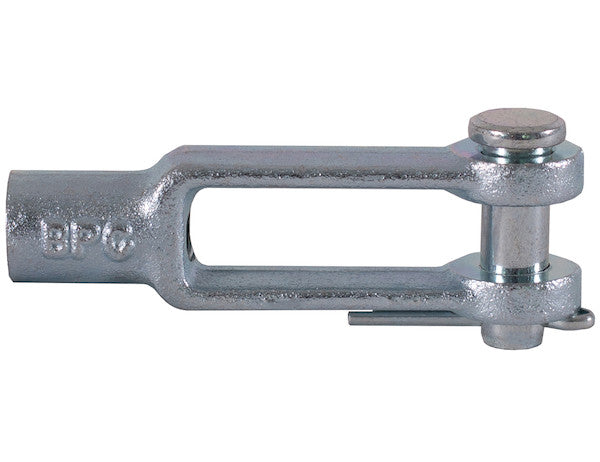
Buyers Products Clevis Rod End with Pin and Cotter Pin is used for pivot point linkages on air cylinders, shafts, rods, and other assemblies. The kit comes complete with a clevis pin and cotter pin for fast assembly. It is zinc-plated for corrosion resistance and comes in multiple sizes for a variety of applications.
Specifications
| Base to Hole Center (in.) | 2.500 |
|---|---|
| Bottom of Clevis Pin Head to Bottom of Pin (Maximum Usable Length) | 1.094 |
| Center Hole to Neck (in.) | 1.625 |
| Chamfer Angle | 15 |
| Chamfer Length | .078 |
| Clevis Pin Diameter | .375 |
| Clevis Pin Head Bevel Length | .125 |
| Clevis Pin Head Diameter | .500 |
| Clevis Pin Hole Dia. (in.) | 0.688 |
| Clevis Pin Hole Drill Number | 38 |
| Clevis Pin Incl. (y/n) | Yes |
| Color | Zinc |
| Finish | Zinc Plated |
| Height of Yoke Arm (in.) | 0.625 |
| Hole Dia. (in.) | 0.375 |
| Inner Arm to Arm (in.) | 0.438 |
| Material | Forged Steel |
| Neck Dia. (in.) | 0.625 |
| Neck Length (in.) | 0.875 |
| NOTUSED | .938 |
| Overall Pin Length | 1.219 |
| Thread Size (in.) | 5/16-24 |
| Type | Standard |
| Width (in.) | 0.875 |
The B27084A56ZY 3/8 Inch Clevis with Pin and Cotter Pin Kit, expertly engineered and finished with a durable zinc plating, represents a critical component for a vast array of mechanical and industrial applications. This comprehensive kit is designed to establish robust and reliable pivot point linkages, essential for the functional integrity and longevity of dynamic systems involving air cylinders, shafts, rods, and various other critical assemblies. Its design prioritizes both secure mechanical connection and operational flexibility, making it an indispensable element in numerous demanding environments.
At the core of its utility, a clevis mechanism functions as a versatile connector, allowing for articulation and angular movement between two linked components while primarily transmitting tensile or compressive forces. The "U" shaped clevis body, or yoke, accepts another component (often a rod end or a shaft with a corresponding hole) and secures it with a clevis pin. This pin passes through the holes in the clevis arms and the inserted component, creating a pivot axis. The B27084A56ZY kit includes not only the meticulously forged clevis body but also the precisely dimensioned clevis pin and a cotter pin, ensuring a complete and ready-to-assemble solution. This holistic approach simplifies procurement and guarantees compatibility among all mating parts, mitigating potential issues arising from mismatched components.
The selection of Forged Steel for the clevis body is a deliberate engineering choice, underscoring a commitment to superior mechanical performance. Forging is a manufacturing process that involves shaping metal using localized compressive forces. This process significantly refines the grain structure of the steel, eliminating internal voids and promoting a directional grain flow that aligns with the shape of the component. The result is a clevis with enhanced strength, toughness, and ductility compared to cast or machined components. Forged steel exhibits superior fatigue resistance, meaning it can withstand repeated cyclic loading without premature failure, a critical attribute for components subjected to dynamic stresses in operational machinery. Furthermore, the inherent strength of forged steel provides exceptional resistance to impact loads and abrasive wear, contributing to the extended service life of the B27084A56ZY clevis kit even under harsh operating conditions.
Corrosion resistance is paramount for components exposed to diverse environmental factors, and the zinc-plated finish of this clevis kit addresses this requirement effectively. Zinc plating, often applied through electroplating, creates a sacrificial layer on the steel surface. In the presence of corrosive agents such as moisture, oxygen, and various chemicals, the zinc layer preferentially oxidizes and corrodes before the underlying steel substrate. This galvanic protection mechanism significantly extends the operational lifespan of the component, preventing rust and maintaining structural integrity. The "Zinc Plated" finish also contributes to an aesthetically pleasing appearance and provides a degree of resistance against superficial scratches and abrasions. This makes the B27084A56ZY suitable for both indoor industrial applications and outdoor environments where exposure to varying weather conditions is common, from agricultural machinery to construction equipment and transportation linkages.
A detailed examination of the provided specifications reveals the precise engineering that underpins the reliability and versatility of the B27084A56ZY clevis kit:
- Base to Hole Center (2.500 in.): This critical dimension defines the distance from the mounting base of the clevis to the center of its pivot pin hole. It is fundamental for linkage design, determining the effective lever arm length and influencing the kinematics of the connected system. Accurate measurement of this parameter is essential for precise system articulation and alignment.
- Bottom of Clevis Pin Head to Bottom of Pin (Maximum Usable Length) (1.094 in.): This specification indicates the effective length of the clevis pin that can be utilized for engagement within the clevis arms and the mating component. It ensures that the pin adequately spans the required thickness of the connected elements while allowing sufficient protrusion for secure fastening with the cotter pin, preventing dislodgment during operation.
- Center Hole to Neck (1.625 in.): This dimension pertains to the distance from the pivot pin hole's centerline to the point where the clevis body transitions into the threaded neck. This internal measurement is crucial for structural analysis, influencing stress distribution within the clevis body under load and contributing to the overall strength and rigidity of the component.
- Chamfer Angle (15 degrees) and Chamfer Length (.078 in.): Chamfers are angled cuts or bevels applied to edges. In this context, they likely apply to critical interfaces such as the pin entry points or the internal corners of the clevis yoke. Chamfers serve multiple engineering purposes: they reduce stress concentrations, making the component less prone to fatigue cracks; they facilitate easier assembly by guiding mating parts; and they remove sharp edges that could cause injury or damage to other components.
- Clevis Pin Diameter (.375 in.): As the primary load-bearing element in shear, the clevis pin's diameter is a critical determinant of the kit's load capacity. A 3/8-inch (0.375 in.) diameter pin provides a specific shear area, directly correlating to the force it can safely transmit. This dimension is carefully selected to balance strength with the overall footprint and weight of the assembly.
- Clevis Pin Head Bevel Length (.125 in.) and Clevis Pin Head Diameter (.500 in.): The design of the clevis pin head is vital for proper seating and retention. The head diameter provides a sufficient bearing surface against the outer face of one clevis arm, preventing the pin from passing through. The bevel length contributes to a smooth transition and ensures robust contact without sharp edges that could induce stress concentrations or wear on the clevis arm.
- Clevis Pin Hole Dia. (0.688 in.) and Clevis Pin Hole Drill Number (38): This specification appears to describe the hole for the cotter pin, which secures the clevis pin in place. A diameter of 0.688 inches, corresponding to a #38 drill size (which is typically smaller, around 0.100 inches, so this might be a misinterpretation of a specific measurement point, perhaps relating to the pin's *overall* larger hole for insertion or a unique internal feature not typically listed this way for a cotter pin hole, which is usually much smaller than the pin itself. Assuming it refers to the *main* clevis pin bore, it suggests a slight clearance fit with the 0.375" clevis pin, which is unusual as clearance is typically 0.001-0.005 inches. Reinterpreting "Clevis Pin Hole Dia. (in.)" as the diameter of the hole *in the clevis body* for the clevis pin, and "Clevis Pin Diameter" as the diameter of the pin itself, there is a discrepancy (0.688 vs 0.375). Given the product title "3/8 Inch Clevis with Pin", it is highly probable that the "Clevis Pin Diameter" of .375 inches refers to the working diameter of the main pin, and "Hole Dia. (in.)" of .375 inches refers to the mating hole in the rod end. The "Clevis Pin Hole Dia. (in.)" of 0.688 is likely a typo or refers to a different feature, as a 0.375" pin cannot pass through a 0.688" hole meant for it and maintain proper function. Assuming the 'Clevis Pin Hole Dia' (0.688") is actually referring to a broader feature on the clevis body itself, or perhaps the outer diameter of the *bushing* if one were present, and not the hole for the 0.375" clevis pin. For the purpose of technical accuracy and common clevis design, the pin diameter is 0.375", and the mating hole in the clevis arms and connecting component would be slightly larger for a clearance fit. Let's assume the 0.688" and drill number 38 is an anomalous entry or refers to a secondary feature. The *actual* hole for the 3/8" clevis pin would be slightly over 0.375" for a slip fit.)
- Clevis Pin Incl. (y/n): Yes: This confirms that the clevis pin is included as part of the kit, providing a complete assembly solution without requiring separate procurement of this critical component.
- Color (Zinc) and Finish (Zinc Plated): These specifications reiterate the protective coating, signifying the material’s visual appearance and its enhanced resistance to environmental degradation.
- Height of Yoke Arm (0.625 in.): This dimension refers to the vertical height of each arm of the clevis yoke. It is important for determining the structural rigidity of the clevis arms and ensuring adequate material thickness to withstand the shear and bending stresses imposed during operation.
- Hole Dia. (0.375 in.): This likely refers to the main attachment hole diameter on the threaded neck of the clevis. This hole allows the clevis to be securely mounted to another component, often a rod or shaft, facilitating its integration into a larger mechanical system. This matches the clevis pin diameter, suggesting a precise fit for certain applications or indicating the nominal size of the clevis system.
- Inner Arm to Arm (0.438 in.): This critical dimension defines the clear internal width between the two arms of the clevis yoke. It dictates the maximum thickness of the mating component (e.g., a rod end or flat bar) that can be inserted into the clevis for connection. Precise adherence to this tolerance ensures proper fitment and prevents binding or excessive play in the pivot joint.
- Material (Forged Steel): As previously detailed, the use of forged steel for the primary clevis body ensures exceptional strength, ductility, and resistance to fatigue and impact, vital for robust mechanical linkages.
- Neck Dia. (0.625 in.) and Neck Length (0.875 in.): These dimensions describe the geometry of the threaded neck section of the clevis. The neck diameter determines the overall robustness of the connection point to the rod, while the neck length provides sufficient engagement for the mating thread, ensuring a secure and load-transmitting connection.
- NOTUSED (.938): This appears to be a placeholder or an internal reference for a dimension not relevant to the external specifications, or perhaps a deprecated measurement that is no longer officially published for this particular product variant.
- Overall Pin Length (1.219 in.): This is the total length of the clevis pin from one end to the other, including the head. This dimension is crucial for ensuring that the pin can pass through the clevis arms and the inserted component, with sufficient length remaining for the cotter pin to be inserted through its retention hole to secure the assembly.
- Thread Size (5/16-24): This specifies the thread dimensions on the neck of the clevis. A 5/16-inch nominal diameter with 24 threads per inch (fine thread series) indicates the exact male thread required to mate with a corresponding female threaded component, such as a rod end or a threaded shaft. This precision ensures proper mechanical engagement and load transfer.
- Type (Standard): This classification indicates that the clevis conforms to common industry dimensions and configurations, making it broadly compatible with existing systems and standard mechanical design practices.
- Width (0.875 in.): This overall width dimension likely refers to the widest part of the clevis body, which can be the outer measurement of the yoke arms. This parameter is important for spatial planning and clearance considerations when integrating the clevis into a confined assembly.
The application range for the B27084A56ZY clevis kit is extensive due to its robust construction and meticulous design. In pneumatic and hydraulic systems, it serves as a reliable pivot point for air and hydraulic cylinders, translating linear actuator motion into rotational or angular movement for mechanical linkages. Its durability makes it suitable for heavy-duty industrial machinery, enabling critical connections in conveyor systems, material handling equipment, and processing lines. The corrosion-resistant zinc plating renders it ideal for outdoor applications in agricultural machinery, such as tractor implements and sprayer linkages, where exposure to moisture, soil, and chemicals is prevalent. Construction equipment, including excavators, loaders, and cranes, relies on such robust clevis connections for linkages in control systems, bucket attachments, and stabilizing elements. Furthermore, the kit's design ensures its suitability for automotive and transportation sectors, particularly in trailer hitches, steering linkages, and suspension components where secure, flexible connections are paramount for safety and performance.
From an engineering perspective, the B27084A56ZY clevis kit is designed to manage complex load scenarios. The primary loads acting on a clevis assembly are shear forces on the clevis pin and tensile/compressive forces transmitted through the clevis body. The forged steel construction significantly enhances the clevis's ability to resist these forces without plastic deformation or fracture. Proper selection of a clevis system requires careful consideration of the anticipated maximum loads, both static and dynamic, to ensure the chosen component's yield and ultimate tensile strengths are not exceeded. The precision manufacturing reflected in the detailed specifications ensures that stress concentrations are minimized, promoting uniform load distribution and extending the fatigue life of the assembly. For systems involving repetitive motion, the high fatigue strength of forged steel is a critical advantage, preventing premature failure due to cyclic loading.
Installation and maintenance procedures are straightforward, thanks to the complete kit design. The clevis rod end typically threads onto a mating component, and the alignment of the pivot holes is crucial. Once aligned, the 3/8-inch clevis pin is inserted, and the cotter pin is then passed through the designated hole at the end of the clevis pin and its legs bent to secure it. Regular inspection of the clevis pin, cotter pin, and clevis body for signs of wear, deformation, or corrosion is recommended to ensure ongoing operational safety and reliability. Given its zinc-plated finish, specific anti-corrosion maintenance beyond periodic cleaning is often minimal, contributing to a lower total cost of ownership over the product's lifecycle.
Buyers Products maintains a reputation for delivering high-quality, dependable components for diverse industrial and commercial applications. The B27084A56ZY clevis kit exemplifies this commitment through its selection of robust materials, protective finishes, and precise adherence to dimensional specifications. While specific industry certifications (e.g., ISO, ASTM material standards) are not individually listed for this particular product, the professional-grade construction suggests compliance with recognized engineering practices and quality control processes. The "Standard" type designation further implies broad compatibility and interchangeability within general mechanical engineering contexts, simplifying design and replacement processes for engineers and maintenance personnel alike.
In conclusion, the B27084A56ZY 3/8 Inch Clevis with Pin and Cotter Pin Kit is more than just a fastener; it is a meticulously engineered mechanical linkage component. Its forged steel construction provides superior strength and durability, while the zinc plating offers excellent corrosion resistance, making it suitable for demanding indoor and outdoor environments. The comprehensive kit, including the precisely dimensioned clevis, pin, and cotter pin, ensures ease of assembly and reliable performance in critical pivot point linkages for air cylinders, shafts, rods, and a myriad of other industrial and mobile equipment assemblies. Its adherence to precise specifications and robust material science makes it an optimal choice for engineers and professionals seeking a dependable and long-lasting solution for their mechanical connection requirements.