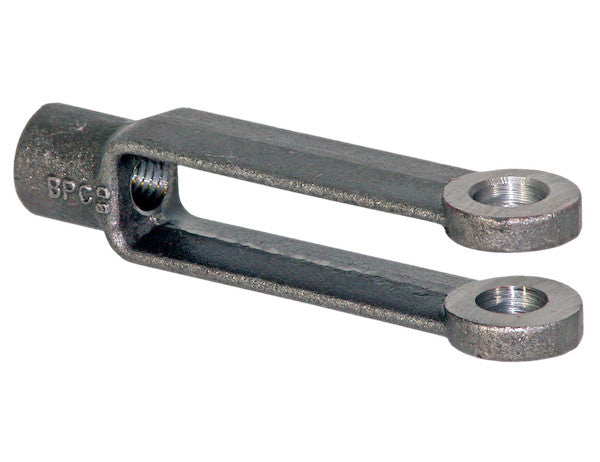
Adjustable Yoke Ends from Buyers Products are machine forged and meet SAE standards. Custom sizes and finishes are available.
Specifications
| Neck Dia. (in.) | 0.625 " |
| Type | Standard |
| Hole Dia. (in.) | 0.375 " |
| Center Hole to Neck (in.) | 1.625 " |
| Thread Size (in.) | 3/8-24 |
| Width (in.) | 0.875 " |
| Inner Arm to Arm (in.) | 0.438 " |
| Base to Hole Center (in.) | 2.500 " |
| Neck Length (in.) | 0.438 " |
| Clevis Pin Incl. (y/n) | No |
| Material | Forged Steel |
| Height of Yoke Arm (in.) | .625 |
| Finish | Zinc Plated |
Advanced Technical Overview: Precision-Engineered Adjustable Yoke End for Demanding Mechanical Linkages
The Adjustable Yoke End, specifically configured with a 3/8-24 NF thread and a 3/8-inch diameter thru-hole, featuring a durable zinc-plated finish, represents a critical component in a multitude of mechanical and industrial systems. Designed and manufactured by Buyers Products, this component exemplifies engineering precision, material integrity, and adherence to rigorous industry standards. Its primary function is to serve as a robust, adjustable termination point for push-pull rods, linkage assemblies, and control mechanisms, facilitating the transmission of linear and limited angular motion with exceptional reliability and minimal backlash.
Fundamental Design and Functional Principle
A yoke end, often referred to as a clevis end, is an essential element in converting linear motion from a threaded rod into a pivotal connection, typically with a clevis pin. This specific adjustable variant is engineered to provide precise control over the effective length of a linkage system. The adjustability is conferred by the integrated 3/8-24 National Fine (NF) thread. This thread pitch, characterized by its finer spacing compared to National Coarse (NC) threads, offers several distinct advantages in applications requiring high precision and resistance to loosening under vibration. The finer pitch allows for smaller incremental adjustments, enabling operators or technicians to dial in the exact length required for optimal system performance, whether in hydraulic cylinder linkages, steering mechanisms, throttle controls, or various industrial machinery applications. Furthermore, the increased number of threads per inch provides a greater shear area, contributing to enhanced strength and resistance to stripping, which is crucial in dynamic mechanical systems where integrity is paramount.
Material Science and Manufacturing Excellence: Forged Steel Construction
The selection of forged steel as the base material for this adjustable yoke end is a deliberate choice driven by superior mechanical properties essential for demanding applications. Forging is a manufacturing process that involves shaping metal by localized compressive forces using hammers or presses. Unlike casting, which involves pouring molten metal into a mold, or machining from bar stock, forging strategically aligns the internal grain structure of the steel. This optimized grain flow follows the contour of the part, resulting in significantly enhanced tensile strength, yield strength, fatigue resistance, and impact toughness. Specifically, forged components exhibit superior resistance to shock loads and cyclic stresses, making them ideal for applications subject to vibration and repetitive motion. The absence of internal voids, porosity, and other material defects commonly associated with casting ensures a homogenous and structurally sound component. The "machine forged" designation further indicates that the forging process is carried out under controlled conditions using advanced machinery, ensuring consistency in dimensions, material properties, and surface finish across all manufactured units. This commitment to superior material and manufacturing processes directly translates into a component with an extended service life and unwavering reliability in critical applications.
Precision Engineering: Dimensional Specifications and Their Significance
Understanding the detailed specifications of the Adjustable Yoke End is crucial for proper integration and optimal performance within an assembly. Each dimension plays a vital role in ensuring compatibility, load distribution, and functional efficacy:
- Neck Dia. (0.625"): The neck diameter refers to the cylindrical portion of the yoke end where the threaded rod would typically engage or where the component is supported. A robust neck diameter of 0.625 inches (5/8 inch) provides substantial material cross-section, ensuring high strength and rigidity at the crucial transition point between the threaded section and the yoke arms. This dimension is critical for resisting bending moments and shear stresses at the interface.
- Hole Dia. (0.375"): The thru-hole, with a diameter of 0.375 inches (3/8 inch), is precision-machined to accommodate a standard 3/8-inch clevis pin. This tight tolerance ensures minimal play between the yoke end and the mating component, reducing wear and contributing to precise motion transfer. The smooth finish within the hole minimizes friction and facilitates ease of assembly and disassembly.
- Center Hole to Neck (1.625"): This dimension defines the leverage arm and the effective operating length of the yoke end. A distance of 1.625 inches from the center of the clevis pin hole to the base of the threaded neck influences the stroke length capabilities and the geometric relationship with other linkage components. It is a critical parameter for kinematic analysis and ensuring correct motion profiles in articulated systems.
- Thread Size (3/8-24): As previously discussed, the 3/8-24 National Fine thread provides precise adjustability and robust engagement with mating threaded rods. The specification refers to a nominal diameter of 3/8 inch and 24 threads per inch.
- Width (0.875"): The overall width of the yoke end, at 0.875 inches (7/8 inch), indicates the external footprint of the component. This dimension is important for space claim considerations and ensuring clearance within confined mechanical enclosures.
- Inner Arm to Arm (0.438"): This crucial dimension, often referred to as the clevis width, specifies the maximum width of the mating component (e.g., another clevis, bracket, or rod end) that can be inserted between the yoke arms. At 0.438 inches (7/16 inch), it dictates compatibility with standard industrial components and ensures proper seating for the clevis pin, preventing side-to-side movement or binding.
- Base to Hole Center (2.500"): This dimension measures the vertical distance from the bottom-most point of the yoke end to the center of the clevis pin hole. It is essential for determining the overall height and mounting position of the component within an assembly, influencing ground clearance, interference with other parts, and the effective range of motion.
- Neck Length (0.438"): The neck length, measuring 0.438 inches, defines the length of the unthreaded portion of the neck where it transitions from the yoke arms. This dimension often plays a role in establishing bearing surfaces or providing clearance for wrenching flats, contributing to the overall structural integrity and ease of installation.
- Height of Yoke Arm (0.625"): The height of the individual yoke arm, at 0.625 inches, indicates the robust thickness of the material around the clevis pin hole. This dimension directly correlates with the shear strength of the arms and their ability to withstand the forces transmitted through the clevis pin, ensuring that the arms do not deform or fracture under load.
Protective Finish: Zinc Plating for Enhanced Durability
The zinc-plated finish applied to this adjustable yoke end is a critical feature contributing to its longevity and performance in various operational environments. Zinc plating is an electrodeposition process where a thin layer of zinc is applied to the steel surface. Zinc acts as a sacrificial coating, meaning it corrodes preferentially to the underlying steel when exposed to corrosive elements such as moisture, humidity, and certain chemicals. This galvanic protection effectively prevents rust and extends the service life of the component, particularly in outdoor, marine, or industrial settings where exposure to corrosive agents is common. Beyond corrosion resistance, zinc plating also offers a clean, aesthetically pleasing finish and improved abrasion resistance, contributing to both the functional and visual quality of the part. Adherence to a specified plating thickness and quality standard ensures uniform coverage and effective long-term protection against environmental degradation.
Adherence to SAE Standards: A Benchmark of Quality and Reliability
The statement that these adjustable yoke ends "meet SAE standards" is a testament to their superior design, manufacturing quality, and performance characteristics. The Society of Automotive Engineers (SAE) develops and publishes technical standards for a wide range of engineering applications, particularly within the automotive, aerospace, and commercial vehicle industries. For components like yoke ends, SAE standards (e.g., related to clevises, pins, or general mechanical linkages) would typically dictate critical parameters such as material composition, mechanical properties, dimensional tolerances, surface finish, thread specifications, and performance requirements (e.g., ultimate tensile strength, fatigue limits). Compliance with SAE standards ensures:
- Interchangeability: Components meeting SAE standards are often designed to be interchangeable with other standard parts, simplifying procurement and replacement.
- Performance Assurance: The component has been designed and tested to meet specific performance criteria under defined operating conditions.
- Quality Control: Manufacturing processes are subject to stringent quality control measures to ensure consistent product attributes.
- Safety: Adherence to established safety benchmarks helps prevent failures that could lead to operational hazards.
This commitment to SAE standards provides end-users with confidence in the product's reliability and suitability for demanding applications where component failure could have significant operational or safety implications.
Applications and Operational Context
The versatile design and robust construction of this adjustable yoke end make it indispensable across a broad spectrum of industries and mechanical applications. Its primary utility lies in creating adjustable linkages that transmit forces and motion between two points, often where one point pivots. Common applications include:
- Industrial Machinery: Used in conveyor systems, packaging machinery, textile equipment, and assembly lines for precise control of levers, gates, and actuating arms.
- Agricultural Equipment: Essential for control linkages in tractors, implements, and harvesting machinery, managing throttle controls, gear shifters, and various hydraulic connections.
- Commercial Vehicles: Found in steering linkages, suspension components, brake linkages, accelerator pedals, and door mechanisms for trucks, buses, and trailers.
- Material Handling: Integral to forklifts, cranes, and lifting devices for articulating various attachments and control systems.
- Hydraulic and Pneumatic Systems: Serves as a connection point for cylinder rods, converting the linear motion of a piston into pivotal motion for driven components.
- Automation and Robotics: Critical for creating precise, adjustable joints and linkages in robotic arms, automated assembly tools, and specialized motion control systems.
The ability to precisely adjust the linkage length is paramount in these applications for fine-tuning system performance, compensating for manufacturing tolerances, or setting specific operational parameters.
Engineering Considerations for Integration and Performance
When incorporating this adjustable yoke end into a larger mechanical system, several engineering considerations are paramount to optimize performance and ensure long-term reliability:
- Load Analysis: It is imperative to accurately assess the static and dynamic loads (tensile, compressive, shear, and fatigue) that the yoke end will experience. While forged steel offers superior strength, exceeding its rated capacity can lead to premature failure. Consideration should be given to peak loads, cyclic loads, and potential shock loads.
- Fatigue Life: For applications involving repetitive motion, fatigue analysis is critical. The robust forging process enhances fatigue resistance by optimizing grain structure and minimizing stress concentration points. However, proper design of the mating linkage and attachment points, along with correct torque application, is essential to maximize the fatigue life of the entire assembly.
- Environmental Factors: Although zinc plating provides excellent corrosion resistance, extreme environmental conditions (e.g., highly acidic or alkaline atmospheres, continuous saltwater immersion, or very high temperatures) may necessitate additional protective measures or alternative finishes. The operating temperature range should also be considered relative to the material properties of steel.
- Alignment and Misalignment: While yoke ends accommodate some degree of angular misalignment through the clevis pin, excessive misalignment can induce undue bending moments on the pin and concentrated stresses on the yoke arms, leading to accelerated wear or failure. Proper alignment of mating components during design and assembly is crucial.
- Fastener Selection: The choice of clevis pin and the method of securing it (e.g., cotter pin, retaining clip) must be appropriate for the application's loads and vibrational environment. The 3/8-inch thru-hole is designed for standard 3/8-inch clevis pins.
- Thread Engagement: When assembling the yoke end onto a threaded rod, it is vital to ensure adequate thread engagement. Insufficient thread engagement can lead to stripping or premature failure under load. The 3/8-24 NF thread provides excellent engagement characteristics, but proper installation practices are still necessary.
Customization and Flexibility for Specialized Needs
The availability of "Custom sizes and finishes" highlights Buyers Products' commitment to meeting diverse industrial requirements. While this standard adjustable yoke end serves a broad range of applications, specialized machinery or unique environmental conditions may necessitate bespoke solutions. Custom sizes could involve variations in clevis width, hole diameter, neck dimensions, or overall length to perfectly integrate into a specific design. Custom finishes might include alternative coatings like powder coating for enhanced chemical resistance, different types of zinc chromate (e.g., yellow chromate for enhanced salt spray protection), or even specialized treatments for extreme temperature or corrosive environments. This flexibility ensures that engineers and designers can procure components that precisely match their exacting specifications, thereby optimizing system performance, durability, and cost-efficiency for highly specialized applications.
Conclusion: A Reliable Component for Modern Engineering
The Adjustable Yoke End with a 3/8-24 NF thread and 3/8-inch diameter thru-hole, featuring a zinc-plated finish and manufactured from machine-forged steel, stands as a testament to robust engineering and manufacturing excellence. Its meticulously chosen material, precision manufacturing process, protective coating, and adherence to SAE standards collectively contribute to a component that offers unparalleled strength, durability, and reliability. The inherent adjustability of the design provides critical flexibility in linkage systems, allowing for precise setup and fine-tuning. From heavy industrial machinery and agricultural equipment to commercial vehicle systems and sophisticated automation, this yoke end provides a dependable and high-performance solution for transmitting forces and motion, ensuring the integrity and efficient operation of countless mechanical assemblies. Its design embodies a commitment to quality that ensures long-term service under the most demanding operational conditions, making it an indispensable part of modern mechanical engineering.