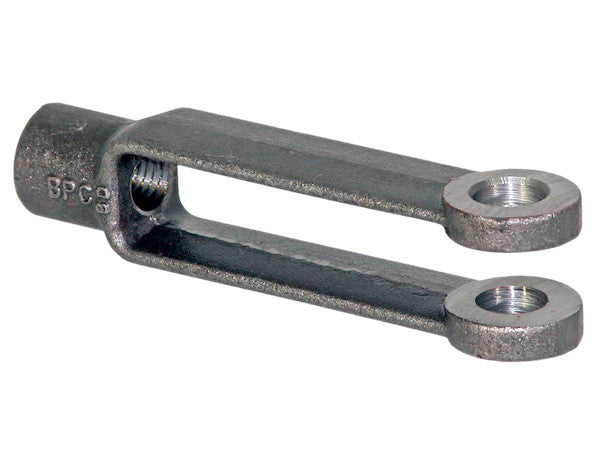
Adjustable Yoke Ends from Buyers Products are machine forged and meet SAE standards. Custom sizes and finishes are available.
Specifications
| Finish | Zinc Plated |
| Thread Size (in.) | 1/4-28 |
| Height of Yoke Arm (in.) | .813 |
| Inner Arm to Arm (in.) | 0.563 " |
| Neck Length (in.) | 1.125 " |
| Hole Dia. (in.) | 0.500 " |
| Width (in.) | 1.125 " |
| Center Hole to Neck (in.) | 1.875 " |
| Neck Dia. (in.) | 0.813 " |
| Clevis Pin Incl. (y/n) | No |
| Base to Hole Center (in.) | 3.000 " |
| Material | Forged Steel |
| Type | Standard |
The Adjustable Yoke End, featuring a 1/4-28 NF thread and a 1/2-inch diameter thru-hole with a zinc-plated finish, represents a critical component in a multitude of mechanical linkage and control systems. Engineered and manufactured by Buyers Products, this component is a testament to precision engineering, robust material selection, and adherence to rigorous industry standards. Its design facilitates not only mechanical connection but also precise adjustment within complex assemblies, offering unparalleled reliability and operational flexibility. This detailed description will delve into the technical specifications, material science, functional benefits, and diverse applications of this indispensable industrial component.
At its core, a yoke end, also commonly referred to as a clevis, serves as a pivotal connection point, translating linear or rotational motion within a mechanical system. The "adjustable" aspect of this particular yoke end is crucial, allowing for fine-tuning of linkage lengths, which is essential for accurate control, compensation for manufacturing tolerances, and field adjustments. This adjustability is typically achieved through a threaded connection at the neck of the yoke, enabling the component to be screwed into or out of a mating threaded rod or shaft, thereby shortening or lengthening the effective linkage assembly. Once the desired length is achieved, a jam nut is typically employed to secure the yoke end in place, preventing rotational movement and maintaining the precise setting.
The specified 1/4-28 NF thread is a critical technical detail. "1/4" indicates the nominal outside diameter of the male thread in inches, while "28" denotes 28 threads per inch. The "NF" suffix stands for National Fine thread series, a designation within the Unified Thread Standard (UTS). National Fine threads are characterized by a greater number of threads per inch compared to their National Coarse (UNC) counterparts for a given diameter. This finer pitch offers several distinct advantages in applications like yoke ends. Firstly, it provides a stronger connection due to a larger shear area for the engaged threads, which is vital in high-stress linkage applications. Secondly, the finer pitch allows for more precise adjustments, as each turn of the yoke end results in a smaller linear displacement, enabling extremely accurate length settings. Thirdly, NF threads are inherently more resistant to loosening under vibration, a common challenge in dynamic mechanical systems, due to their smaller helix angle. This makes the 1/4-28 NF thread an optimal choice for applications requiring both strength and precise, stable adjustability, from automotive control linkages to industrial machinery. The consistent quality of this thread form is paramount for smooth engagement and reliable performance over the operational lifespan of the component.
The thru-hole, with a diameter of 1/2 inch (0.500 inches), is designed to accommodate a clevis pin, bolt, or shaft of corresponding size. This hole is the primary point of articulation for the yoke end, forming a hinged connection with a mating component. The precision of this bore is crucial; it must be manufactured to tight tolerances to ensure a snug fit with the clevis pin, minimizing play and maximizing the efficiency and accuracy of motion transfer. Excessive clearance can lead to slop in the linkage, reducing control precision and accelerating wear. Conversely, insufficient clearance would impede pin insertion and free movement. The smooth finish within the thru-hole also contributes to reduced friction during articulation, enhancing component longevity and operational smoothness. Given that the clevis pin is explicitly noted as "not included," users have the flexibility to select a pin material and style (e.g., plain, grooved, with cotter pin hole) that best suits their specific application requirements, considering factors such as shear strength, corrosion resistance, and retention method.
Material selection and manufacturing process are fundamental to the performance of any mechanical component, and in the case of this Adjustable Yoke End, the use of "Forged Steel" is a significant indicator of its quality and durability. Forging is a manufacturing process that involves shaping metal using localized compressive forces, typically performed with hammers or dies. Unlike casting, which involves pouring molten metal into a mold, or machining from bar stock, forging reorganizes the metal's internal grain structure. This process aligns the grain flow with the contour of the part, significantly enhancing the material's mechanical properties, particularly its strength, toughness, and fatigue resistance. Forged steel components are renowned for their superior resistance to impact and shock loads, making them ideal for applications where sudden stresses or dynamic forces are present. The "machine forged" designation further implies that the forging process is highly controlled and automated, ensuring consistent quality, dimensional accuracy, and repeatable mechanical properties across all produced units. This robust material and manufacturing method ensure that the yoke end can withstand the demanding operational environments characteristic of industrial, agricultural, and automotive applications, providing a longer service life and greater reliability compared to components made from less robust methods.
The "Zinc Plated" finish provides a crucial layer of protection against environmental degradation. Zinc plating is a widely adopted electrochemical process where a thin coating of zinc is deposited onto the surface of the steel. This coating acts as a sacrificial layer, preferentially corroding before the underlying steel substrate when exposed to moisture, salts, or other corrosive agents. The process works by creating an electrochemical cell where zinc, being more anodic than steel, corrodes first, thereby protecting the cathodic steel. This significantly extends the service life of the component, particularly in outdoor, damp, or chemically aggressive environments. Beyond corrosion resistance, zinc plating also offers a clean, bright, and aesthetically pleasing finish, which can be important for components visible in an assembly. The plating process itself must be carefully controlled to ensure uniform coverage, adequate thickness, and proper adhesion to prevent flaking or blistering. The specification of a zinc-plated finish on this forged steel yoke end demonstrates a comprehensive approach to product design, balancing mechanical integrity with environmental resilience.
Compliance with "SAE standards" is a testament to the product's adherence to widely recognized and respected engineering criteria. SAE International (originally the Society of Automotive Engineers) develops and promulgates standards for engineering professionals in various industries, including aerospace, automotive, and commercial vehicles. When a component meets SAE standards, it signifies that it has been designed, manufactured, and tested to specific criteria regarding material composition, mechanical properties, dimensions, and performance benchmarks. This ensures interoperability with other SAE-compliant components, guarantees a certain level of quality and reliability, and provides confidence in the product's suitability for demanding applications. For an adjustable yoke end, SAE compliance might cover aspects such as thread quality, forging integrity, material strength, dimensional tolerances for the thru-hole and overall structure, and the efficacy of the protective coating. This commitment to industry standards underscores the professional-grade nature of the Buyers Products yoke end.
Let's consider the specific dimensions provided and their functional significance: * Height of Yoke Arm (0.813 in.): This dimension refers to the vertical extent of the arms of the yoke. It is critical for ensuring adequate material thickness around the thru-hole, contributing to the shear strength and bending resistance of the arms, and providing sufficient clearance for mating components. * Inner Arm to Arm (0.563 in.): This specifies the clear distance between the interior faces of the yoke arms. It dictates the maximum width of the mating component (e.g., a rod end, bracket, or lever) that can be accommodated within the clevis, ensuring proper fit and articulation without binding. * Neck Length (1.125 in.): The length of the threaded portion of the yoke. This dimension is crucial for achieving sufficient thread engagement with the mating rod or shaft, which is essential for maximizing the strength of the adjustable connection and preventing stripping under load. * Hole Dia. (0.500 in.): As previously discussed, this is the diameter of the thru-hole, precisely matching a 1/2-inch clevis pin or bolt for articulation. Its accuracy is paramount for proper function and wear characteristics. * Width (1.125 in.): This represents the overall maximum width of the yoke end, often measured across the widest point of the arms. It is important for determining the physical footprint of the component within an assembly and ensuring clearance from adjacent parts. * Center Hole to Neck (1.875 in.): This is a critical geometric dimension, measuring the distance from the center of the clevis pin hole to the shoulder or start of the threaded neck. It defines the effective working length of the yoke end itself and is essential for calculating overall linkage lengths and geometry in design. * Neck Dia. (0.813 in.): This refers to the diameter of the unthreaded portion of the neck, typically providing strength and a transition point from the main body of the yoke to the threaded section. It ensures the integrity of the connection point before the thread begins. * Base to Hole Center (3.000 in.): This dimension provides an overall reference from the theoretical "base" or end of the threaded neck to the center of the clevis pin hole. It is particularly useful for engineers in layout and spatial planning, helping to define the full extent of the component's operational envelope when installed. Each of these precise dimensions, when combined, ensures that the yoke end is geometrically sound, robust enough for its intended loads, and compatible with standardized mating components. The meticulous attention to these measurements is a hallmark of a professional-grade product designed for reliable integration into complex mechanical systems.
The versatility of this Adjustable Yoke End extends across a vast spectrum of industries and applications. In the agricultural sector, they are commonly found in control linkages for tractors, implements, and attachments, connecting hydraulic cylinders, steering mechanisms, and various operating levers. Their adjustability is invaluable for fine-tuning equipment performance and accommodating different setups. Within industrial machinery, these components are integral to conveyor systems, processing equipment, robotics, and automation lines, facilitating motion transfer and precise positioning. In the automotive and heavy-duty truck industry, yoke ends are frequently employed in throttle linkages, clutch linkages, brake systems, shift mechanisms, and steering components, where robust and adjustable connections are paramount for safety and performance. Marine applications, given the zinc-plated finish, also benefit from these yoke ends in steering systems, throttle controls, and engine linkages, albeit in less extreme saltwater environments without additional specialized coatings. Furthermore, general engineering and construction equipment, such as excavators, loaders, and cranes, rely on similar components for their various control and articulation points.
Installation and maintenance considerations for the Adjustable Yoke End are straightforward yet crucial for optimal performance and longevity. During installation, it is imperative to ensure that the mating threaded rod has sufficient thread engagement with the yoke end, typically at least 1.5 times the nominal thread diameter, to maximize the strength of the connection. The use of a jam nut, properly torqued against the yoke end, is critical to prevent loosening due to vibration or dynamic loads. The clevis pin should be correctly inserted and secured with a cotter pin, retaining clip, or other appropriate fastener to prevent dislodgement. While zinc plating provides substantial corrosion resistance, periodic inspection, especially in harsh environments, is recommended. Any signs of wear, deformation, or significant corrosion should prompt consideration for replacement to prevent potential system failure. Lubrication of the clevis pin and its bearing surfaces within the thru-hole can further reduce friction and extend the service life of both the yoke end and the pin.
The mention of "Custom sizes and finishes are available" highlights Buyers Products' commitment to meeting diverse customer needs beyond their standard offerings. While this specific yoke end is a standard, high-quality component, complex applications or unique design constraints may necessitate tailored solutions. Customization options could include: * Alternative Materials: For applications requiring even higher strength, extreme temperature resistance, or specific non-magnetic properties, materials like stainless steel (various grades), high-strength alloy steels, or even non-ferrous alloys could be specified. * Specialized Finishes: Beyond standard zinc plating, custom finishes might include hot-dip galvanizing for superior corrosion resistance in severe environments, nickel plating for enhanced wear resistance and brightness, black oxide for a subdued, non-reflective finish, or various powder coatings for specific aesthetic or protective properties. * Non-Standard Dimensions: While this product adheres to common standards, some legacy equipment or highly specialized designs might require different thread sizes, thru-hole diameters, or unique geometric configurations not covered by standard products. * Heat Treatment: For specific performance requirements, custom heat treatments such as hardening, tempering, or annealing could be applied to modify the steel's mechanical properties, enhancing characteristics like hardness, ductility, or impact resistance. * Integrated Components: In some cases, a custom order might involve the yoke end being pre-assembled with specific pins, bushings, or threaded rods to streamline the customer's assembly process.
These customization capabilities underscore the deep engineering expertise and manufacturing flexibility of Buyers Products, enabling them to serve a broad clientele from individual fabricators to large-scale OEM manufacturers with highly specific demands. This flexibility ensures that engineers and designers are not limited by off-the-shelf components but can procure parts that precisely fit their application's requirements, optimizing performance, cost-efficiency, and system longevity.
In summary, the Adjustable Yoke End with 1/4-28 NF thread and 1/2-inch diameter thru-hole, zinc-plated and manufactured from machine-forged steel by Buyers Products, is a meticulously engineered component. Its design integrates superior material properties, precise manufacturing tolerances, and industry-standard compliance to deliver a highly reliable, adjustable, and durable solution for critical mechanical linkages. From its robust forged steel construction and protective zinc plating to its fine-pitch thread for precise adjustments and SAE standards adherence, every aspect of this yoke end is optimized for performance in demanding industrial, agricultural, and automotive environments. As a fundamental building block in mechanical control and motion transfer systems, it stands as an exemplary product in its category, providing engineers and manufacturers with a dependable and versatile connection solution.