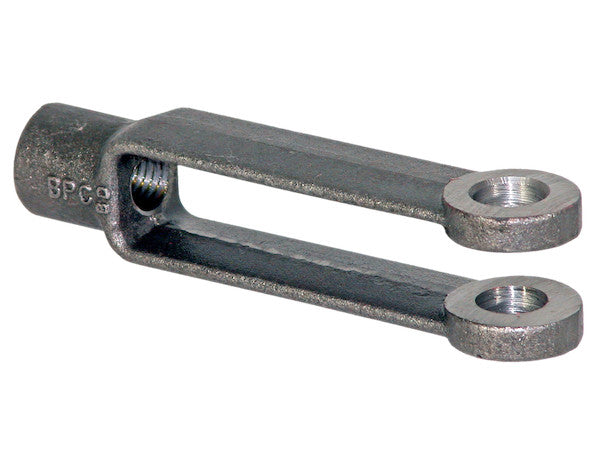
Adjustable Yoke Ends from Buyers Products are machine forged and meet SAE standards. Custom sizes and finishes are available.
Specifications
| Hole Dia. (in.) | 0.500 " | ||
| Neck Length (in.) | 1.125 " | ||
| Width (in.) | 1.125 " | ||
| Clevis Pin Incl. (y/n) | No | ||
| Height of Yoke Arm (in.) | .813 | ||
| Neck Dia. (in.) | 0.813 " | ||
| Material | Forged Steel | ||
| Finish | Zinc Plated Yellow | ||
| Base to Hole Center (in.) | 3.000 " | ||
| Thread Size (in.) | 3/8-24 | ||
| Center Hole to Neck (in.) | 1.875 " | Type | Standard |
| Inner Arm to Arm (in.) | 0.563 " |
Advanced Technical Overview: Precision-Engineered Adjustable Yoke End with 3/8-24 NF Thread and 1/2 Inch Thru-Hole
This document provides a comprehensive technical overview of the Adjustable Yoke End, a critical mechanical component designed for a wide range of industrial and commercial applications. Manufactured by Buyers Products, this yoke end is engineered with precision, utilizing machine forging techniques to ensure superior structural integrity and adherence to stringent industry standards, specifically SAE (Society of Automotive Engineers) specifications. This detailed description will delve into the material science, manufacturing processes, dimensional specifications, surface treatment, application considerations, and overall performance characteristics of this essential linkage component.
Material Science and Forging Process: The Foundation of Durability
The core strength and longevity of this adjustable yoke end stem from its selection of material and the meticulous manufacturing process. Crafted from high-quality forged steel, this component benefits immensely from the inherent advantages of forging over casting or machining from bar stock. Forging is a metal forming process that involves applying compressive forces to shape metal, resulting in several key metallurgical enhancements:
- Grain Flow Orientation: During forging, the metal's grain structure is refined and oriented to follow the component's contours. This continuous grain flow enhances the material's inherent strength, ductility, and resistance to fatigue and impact stresses. Unlike components machined from solid bar stock, where grain flow is often cut across, forged parts maintain uninterrupted grain patterns, leading to superior mechanical properties.
- Elimination of Internal Defects: The high pressures involved in forging effectively close internal voids, porosity, and shrinkage defects that can be present in cast components. This consolidation creates a denser, more homogeneous microstructure, significantly reducing the risk of catastrophic failure under load.
- Improved Mechanical Properties: Forged steel exhibits higher tensile strength, yield strength, and impact toughness compared to equivalent cast or even rolled steel. This makes the yoke end exceptionally resilient in demanding operational environments where dynamic loads and vibrations are common. The specific type of forged steel used is selected for its optimal balance of strength, machinability, and weldability, ensuring compatibility with various assembly methods and application requirements.
The "machine forged" designation implies the use of sophisticated forging equipment, such as hydraulic or mechanical presses, which allow for precise control over the forging parameters (temperature, pressure, die design). This level of control ensures consistency in product quality, dimensional accuracy, and optimal material properties across large production batches, thereby guaranteeing reliability for end-users.
Precision Dimensional Specifications: Engineered for Seamless Integration
The precise dimensions of this adjustable yoke end are critical for its correct function and compatibility within mechanical assemblies. Each dimension has been carefully engineered to facilitate reliable connections and proper articulation. Let's examine the key specifications:
- Hole Dia. (in.): 0.500" (1/2 Inch) - This through-hole diameter is designed to accommodate a standard 1/2-inch clevis pin, bolt, or shaft. The precision of this bore is crucial for minimizing play and ensuring smooth, controlled articulation within the linkage system. Tolerances are tightly controlled to prevent excessive wear or binding.
- Neck Length (in.): 1.125" - The neck length refers to the cylindrical section connecting the yoke arms to the threaded portion. This length is optimized to provide sufficient material for strength and stability, resisting bending moments and shear forces transmitted through the linkage.
- Width (in.): 1.125" - This dimension refers to the overall width of the yoke body. It is integral for structural integrity and for fitting within specified mounting spaces.
- Height of Yoke Arm (in.): 0.813" - This measurement defines the vertical dimension of the individual yoke arms. It is critical for determining the load-bearing capacity and rigidity of the arms, ensuring they can withstand the forces without deformation.
- Neck Dia. (in.): 0.813" - The diameter of the neck provides the cross-sectional area necessary to transfer tensile and compressive loads efficiently from the threaded rod to the clevis pin interface. Its robust design prevents stress concentrations in this critical transition zone.
- Base to Hole Center (in.): 3.000" - This is a crucial dimension for calculating the overall length of the linkage and for ensuring proper geometric alignment within a system. It represents the distance from the base of the threaded portion to the center of the clevis pin hole.
-
Thread Size (in.): 3/8-24 NF - This specification denotes a 3/8-inch nominal diameter thread with 24 threads per inch, utilizing the National Fine (NF) thread series. The fine thread offers several advantages:
- Increased Strength: Fine threads have a larger minor diameter and a larger stress area compared to coarse threads of the same nominal size, making them stronger in tension.
- Finer Adjustment: With more threads per inch, fine threads allow for more precise adjustments of the overall linkage length, which is paramount in applications requiring accurate positioning or tensioning.
- Reduced Loosening: The smaller helix angle of fine threads makes them less prone to loosening under vibration or dynamic loads, especially when combined with appropriate locking mechanisms.
- Compatibility: The 3/8-24 NF standard is widely recognized and ensures compatibility with a broad range of threaded rods, turnbuckles, and other connecting components.
- Center Hole to Neck (in.): 1.875" - This dimension specifies the distance from the center of the clevis pin hole to the beginning of the neck section. It influences the leverage and stress distribution within the yoke arms.
- Inner Arm to Arm (in.): 0.563" - This clearance dimension, also known as the throat width, dictates the maximum thickness of the mating component (e.g., a tab, lever, or bracket) that can be inserted between the yoke arms. A precise throat width minimizes lateral play and ensures secure engagement.
Surface Treatment: Zinc Plated Yellow for Enhanced Corrosion Resistance
The "Zinc Plated Yellow" finish is a critical attribute for the longevity and performance of the adjustable yoke end, especially in environments exposed to moisture, chemicals, or atmospheric pollutants. Zinc plating, specifically electrogalvanization, involves depositing a thin layer of zinc onto the steel surface. This process provides sacrificial corrosion protection, meaning the zinc corrodes preferentially to the underlying steel, thereby protecting the base metal even if the coating is scratched or compromised. The "yellow" designation typically refers to a chromate conversion coating applied over the zinc layer, which serves several important functions:
- Enhanced Corrosion Resistance: The chromate layer acts as a barrier and passivates the zinc, significantly increasing its resistance to white rust (zinc corrosion products) and extending the component's service life. Yellow chromates often contain hexavalent chromium, offering superior protection, though trivalent chromium alternatives are becoming more common due due to environmental regulations.
- Improved Adhesion for Subsequent Coatings: While not typically relevant for a finished zinc-plated part, the chromate layer can improve adhesion for paints or other coatings if ever required.
- Aesthetic Appeal: The yellow iridescence provides a distinct visual indicator of the protective finish.
This protective finish makes the yoke end suitable for outdoor applications, marine environments (non-submerged), agricultural machinery, construction equipment, and various industrial settings where rust prevention is paramount for maintaining operational safety and component lifespan.
Application and Functional Considerations: Versatility in Mechanical Linkages
Adjustable yoke ends are fundamental components in mechanical linkage systems, serving as clevis-type terminations for threaded rods or turnbuckles. Their primary function is to convert rotational motion (from adjusting the threaded rod) into linear adjustment or to provide a pivot point within a system. Common applications include:
- Control Linkages: In automotive, heavy equipment, and industrial machinery, yoke ends are used in throttle linkages, shift linkages, brake linkages, and steering mechanisms to transmit force and motion.
- Tensioning Systems: Coupled with threaded rods and nuts, they form turnbuckle assemblies for tensioning cables, structural bracing, and conveyor systems. The 3/8-24 NF thread allows for fine adjustment of tension.
- Hydraulic and Pneumatic Cylinder Rod Ends: They provide a flexible attachment point for cylinder rods, allowing the cylinder to connect to other components and accommodate slight misalignments during operation.
- Actuator Connections: Used to connect linear actuators to levers, valves, or other mechanical elements, facilitating precise positioning and movement.
- Agricultural Equipment: Found in various implements for adjusting angles, depths, or positions of machinery components.
- Construction Equipment: Integral in articulating joints and control systems for excavators, cranes, loaders, and other heavy machinery.
The "Adjustable" nature of this yoke end, facilitated by the precision 3/8-24 NF thread, allows for fine-tuning the effective length of a linkage. This adjustability is crucial for setting precise clearances, preloading components, or compensating for wear and manufacturing tolerances in complex mechanical systems. The 1/2-inch thru-hole accommodates standard clevis pins, which provide a low-friction pivot point, allowing for angular movement between connected components. The design ensures robust load transfer in both tension and compression, as well as resistance to shear forces at the clevis pin interface.
Compliance and Quality Assurance: Meeting SAE Standards
The statement "meet SAE standards" is a significant indicator of quality and reliability. The Society of Automotive Engineers (SAE) develops and publishes technical standards for engineering professionals in various industries, including aerospace, automotive, and commercial vehicles. Adherence to SAE standards means that this adjustable yoke end has been designed, manufactured, and tested to meet specific performance, material, and dimensional criteria established by industry experts. This compliance ensures:
- Interchangeability: Components meeting SAE standards are generally interchangeable with other compliant parts, simplifying design and maintenance.
- Performance Assurance: The yoke end is expected to perform reliably under specified operating conditions, having met or exceeded mechanical property requirements (e.g., tensile strength, fatigue life).
- Safety: Adherence to standards contributes to the overall safety of the systems in which these components are integrated, minimizing the risk of premature failure.
- Quality Consistency: Manufacturers adhering to SAE standards typically implement rigorous quality control processes throughout their production, ensuring consistent product quality.
Buyers Products' commitment to these standards underscores their dedication to providing high-quality, dependable components for demanding applications.
Customization Options: Tailored Solutions for Unique Requirements
The availability of "Custom sizes and finishes" highlights Buyers Products' flexibility in meeting specialized customer needs. While the standard product described offers robust features, certain applications may require deviations. Customization can include:
- Non-Standard Dimensions: Different hole diameters, neck lengths, thread sizes, or throat widths to interface with unique mating components or spatial constraints.
- Alternative Materials: For applications requiring higher strength, enhanced corrosion resistance (e.g., stainless steel), specific weight properties (e.g., aluminum alloys), or extreme temperature resistance.
- Specialized Finishes: Beyond yellow zinc plating, options might include black oxide for reduced reflectivity, specialized paints for chemical resistance, powder coating for enhanced durability and aesthetics, or hot-dip galvanizing for superior long-term corrosion protection in harsh outdoor environments.
- Inclusion of Clevis Pins: Although the standard product does not include a clevis pin, custom orders might bundle them, potentially with specific materials or locking mechanisms (e.g., cotter pins, retaining clips).
These customization capabilities allow engineers and product developers to procure yoke ends that are precisely tailored to their specific project requirements, optimizing performance and integration without compromise.
Maintenance and Longevity Considerations
Despite the robust design and protective finish, proper maintenance is crucial for maximizing the lifespan of the adjustable yoke end. Regular inspection for signs of wear, corrosion, or deformation is recommended, especially in high-cycle or high-load applications. The clevis pin and its corresponding thru-hole should be checked for wear, as excessive play can lead to increased stress and accelerated fatigue. The threaded connection should be clean and free of debris, and appropriate thread lubricants or anti-seize compounds can be used to ensure smooth adjustment and prevent galling. While the zinc plating offers significant corrosion resistance, severe abrasive environments or prolonged exposure to aggressive chemicals may necessitate more frequent inspection or the selection of alternative finishes/materials for custom orders. Proper torqueing of mating fasteners (if applicable) and adherence to system-specific maintenance schedules will ensure the adjustable yoke end performs reliably throughout its service life.
Conclusion
The Adjustable Yoke End with 3/8-24 NF Thread and 1/2 Inch Diameter Thru-Hole, manufactured by Buyers Products, represents a meticulously engineered and highly reliable component for a multitude of mechanical linkage applications. Its foundation in machine-forged steel, coupled with a precise zinc-plated yellow finish, ensures exceptional strength, durability, and corrosion resistance. Adherence to SAE standards guarantees performance and interchangeability, while the detailed dimensional specifications facilitate seamless integration into complex systems. The fine-thread adjustment capability offers precision, and the option for custom sizes and finishes underscores its versatility. This yoke end is more than just a component; it is a critical enabler of reliable and efficient mechanical operation across diverse industrial landscapes.