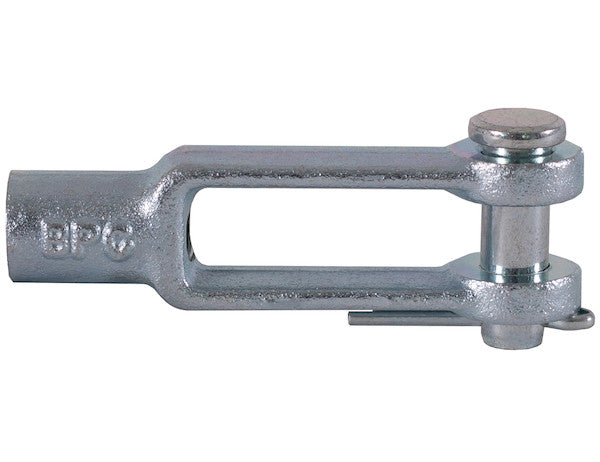
Buyers Products Clevis Rod End with Pin and Cotter Pin is used for pivot point linkages on air cylinders, shafts, rods, and other assemblies. The kit comes complete with a clevis pin and cotter pin for fast assembly. It is zinc-plated for corrosion resistance and comes in multiple sizes for a variety of applications.
Specifications
| Base to Hole Center (in.) | 3.000 |
|---|---|
| Bottom of Clevis Pin Head to Bottom of Pin (Maximum Usable Length) | 1.359 |
| Center Hole to Neck (in.) | 1.875 |
| Chamfer Angle | 15 |
| Chamfer Length | .109 |
| Clevis Pin Diameter | .500 |
| Clevis Pin Head Bevel Length | .156 |
| Clevis Pin Head Diameter | .625 |
| Clevis Pin Hole Dia. (in.) | 0.938 |
| Clevis Pin Hole Drill Number | 29 |
| Clevis Pin Incl. (y/n) | Yes |
| Color | Zinc |
| Finish | Zinc Plated |
| Height of Yoke Arm (in.) | 0.813 |
| Hole Dia. (in.) | 0.500 |
| Inner Arm to Arm (in.) | 0.563 |
| Material | Forged Steel |
| Neck Dia. (in.) | 0.813 |
| Neck Length (in.) | 1.125 |
| NOTUSED | 1.203 |
| Overall Pin Length | 1.540 |
| Thread Size (in.) | 5/16-24 |
| Type | Standard |
| Width (in.) | 1.125 |
Advanced Technical Overview: B27086A56ZY 1/2 Inch Clevis with Pin and Cotter Pin Kit - Zinc Plated
The B27086A56ZY Clevis Rod End with Pin and Cotter Pin kit represents a robust and precisely engineered solution for critical pivot point linkages across a diverse spectrum of industrial and mechanical applications. Designed to facilitate controlled angular motion and efficient force transmission, this component is indispensable in systems requiring reliable articulation between linear actuators, structural members, and other dynamic assemblies. This detailed technical exposition will delve into the fundamental design principles, material science, surface treatment, dimensional specifications, and application advantages that define the superior performance characteristics of this product.
Fundamental Design and Mechanical Principles
A clevis rod end, at its core, is a U-shaped or Y-shaped fastening device designed to accept a pin, which then passes through a corresponding hole in another component, typically a rod or shaft. This configuration creates a pivot point, enabling rotational freedom in a single plane while securely transmitting tensile or compressive loads. The B27086A56ZY clevis is engineered with a standard "yoke" configuration, featuring two parallel arms that define the clevis opening. This specific design allows for the secure housing of a mating component, ensuring proper alignment and load distribution when the clevis pin is inserted.
The mechanical function of this clevis assembly is paramount in converting linear motion into angular motion, or vice-versa, within a linkage system. For instance, in air cylinders, the clevis rod end attaches to the piston rod, allowing the linear extension or retraction of the cylinder to translate into controlled angular movement of an attached lever or linkage arm. The inherent strength of the clevis design lies in distributing shear forces across the clevis pin and the clevis arms, making it highly effective for applications involving significant cyclic loading and dynamic stresses.
Material Science: Forged Steel for Uncompromised Performance
The selection of forged steel as the primary material for the B27086A56ZY clevis is a critical engineering decision that significantly contributes to its durability and performance envelope. Forging is a manufacturing process that involves shaping metal using localized compressive forces, often performed at elevated temperatures. This process results in several key material advantages over alternatives such as casting or machining from plate stock:
- Superior Grain Structure: Forging refines the grain structure of the steel, aligning the grains with the shape of the component. This creates a continuous grain flow that enhances the material's strength, toughness, and resistance to fatigue, particularly at stress concentration points.
- Elimination of Internal Defects: The high compressive forces involved in forging help to eliminate internal voids, porosity, and other defects that can compromise the structural integrity of cast or welded components.
- Enhanced Mechanical Properties: Forged steel exhibits higher tensile strength, yield strength, and impact resistance compared to non-forged equivalents. This makes it ideally suited for high-stress applications where sudden loads or vibrations are common.
- Improved Fatigue Life: The refined grain structure and absence of defects translate into a significantly longer fatigue life, which is crucial for components subjected to repetitive loading cycles over extended operational periods.
For a pivot linkage such as this 1/2 inch clevis, where dynamic forces, vibrations, and potential shock loads are commonplace, the inherent strength and reliability of forged steel ensure prolonged operational integrity and reduced risk of premature failure, thereby minimizing downtime and maintenance costs.
Advanced Surface Treatment: Zinc Plating for Corrosion Resistance
Corrosion is a pervasive challenge in many industrial environments, capable of severely degrading the mechanical properties and aesthetic appeal of metallic components. To mitigate this, the B27086A56ZY clevis and its accompanying pin are finished with a zinc plating. Zinc plating is an electroplating process where a thin layer of zinc metal is deposited onto the surface of the steel substrate. This treatment provides several critical benefits:
- Sacrificial Protection (Galvanic Action): Zinc is more electrochemically active than steel. When exposed to corrosive agents (e.g., moisture, salt, industrial chemicals), the zinc coating preferentially corrodes, thereby protecting the underlying steel from rust and degradation. This sacrificial action ensures that even if the zinc layer is scratched or compromised in small areas, the adjacent zinc will continue to provide protection.
- Barrier Protection: The zinc layer acts as a physical barrier, preventing direct contact between the steel and corrosive elements. This is particularly effective in environments with moderate humidity or occasional exposure to aggressive chemicals.
- Enhanced Aesthetics: The bright, uniform finish of zinc plating provides a clean and professional appearance, which can be desirable for visible components in various applications. The "Zinc" color specified ensures a consistent visual standard.
- Cost-Effectiveness and Versatility: Zinc plating is a widely adopted and cost-effective method for corrosion protection, offering a good balance of performance and economic viability for a broad range of industrial applications.
The zinc plating ensures that the clevis kit maintains its structural integrity and functional performance even when operating in challenging environments, significantly extending its service life and reducing the need for frequent replacement.
Component Analysis: The Clevis, Pin, and Cotter Pin Kit
This product is supplied as a complete kit, emphasizing ease and speed of assembly. Each component plays a vital role in the overall functionality and reliability:
The Clevis Rod End
The clevis body itself is the primary structural component, designed to attach to a rod or shaft via a threaded connection. Its 'U' or 'Y' shape is engineered to house the mating component and the clevis pin. Key dimensional specifications of the clevis include:
- Base to Hole Center (3.000 in.): This dimension is crucial for accurate mechanical design, defining the effective length from the mounting base (e.g., the end of the threaded neck) to the pivot axis. It impacts lever ratios, linkage geometry, and overall system kinematics.
- Center Hole to Neck (1.875 in.): This specifies the distance from the centerline of the clevis pin hole to the beginning of the clevis neck. It is a vital structural dimension, influencing the moment arm and stress distribution within the clevis body.
- Height of Yoke Arm (0.813 in.): This dimension dictates the structural thickness and rigidity of the clevis arms. A robust arm height is essential for resisting bending and shear forces exerted during operation, ensuring the clevis maintains its form under load.
- Inner Arm to Arm (0.563 in.): This critical measurement defines the clearance between the two arms of the clevis. For a 1/2 inch clevis pin, an inner arm spacing of 0.563 inches provides sufficient clearance for the pin to pass through and accommodate a mating component (such as a flat bar or an eye-end) that is slightly less than this dimension, typically around 1/2 inch thick, allowing for necessary operational play without excessive looseness.
- Hole Dia. (in.) (0.500 in.): This is the precisely drilled bore through each clevis arm, designed to accommodate the 0.500 inch (1/2 inch) clevis pin. The tight tolerance between the pin and hole ensures efficient load transfer and minimizes play, which is crucial for precise linkage control.
- Neck Dia. (0.813 in.) & Neck Length (1.125 in.): These dimensions characterize the cylindrical section connecting the clevis yoke to its mounting interface. The neck diameter determines the load-bearing capacity in tension and compression, while the length provides sufficient material for the threaded section.
- Thread Size (5/16-24): This specifies the internal thread within the clevis neck, designed for attachment to a corresponding external thread on a rod, shaft, or other structural element. The 5/16-24 designation refers to a 5/16-inch nominal diameter with 24 threads per inch (fine thread series), indicating a strong and precise connection suitable for dynamic applications.
- Width (1.125 in.): This is the overall maximum width of the clevis, an important consideration for space constraints and component interference in congested mechanical systems.
The Clevis Pin
The clevis pin is the primary fastening element, responsible for securing the mating components within the clevis and forming the pivot point. The specifications for the clevis pin are:
- Clevis Pin Diameter (0.500 in.): This is the fundamental diameter of the pin, matching the "Hole Dia." of the clevis arms. This dimension is critical for determining the shear strength of the pin, which must be adequate to withstand the operational loads.
- Clevis Pin Incl. (y/n): Yes: Confirms that the clevis pin is included as part of the complete kit, simplifying procurement and ensuring compatibility.
- Overall Pin Length (1.540 in.): This length ensures that the pin can fully pass through both clevis arms and the intermediate component, with sufficient protrusion on the outer side for the cotter pin to be securely installed.
- Bottom of Clevis Pin Head to Bottom of Pin (Maximum Usable Length) (1.359 in.): This dimension indicates the effective grip length of the pin, representing the maximum thickness of components that can be securely joined by the pin. It ensures proper engagement and prevents axial movement of the pin within the assembly.
- Clevis Pin Head Diameter (0.625 in.) & Clevis Pin Head Bevel Length (0.156 in.): The head of the clevis pin is essential for retaining the pin on one side of the assembly. The diameter provides a sufficient bearing surface, while the bevel length contributes to ease of insertion and reduced stress concentration at the pin's head-to-shank transition.
- Clevis Pin Hole Dia. (in.) (0.938 in.) & Clevis Pin Hole Drill Number (29): *Note on data inconsistency:* While the `Clevis Pin Hole Dia. (in.)` is listed as 0.938 in., the `Clevis Pin Hole Drill Number` 29 typically corresponds to a drill size of approximately 0.136 in. for a cotter pin. Given this discrepancy, we interpret the "Clevis Pin Hole" in the context of the drill number as referring to the small transverse hole near the end of the clevis pin, designed for the insertion of a cotter pin. This hole, typically around 0.136 inches (Drill #29), is crucial for secondary retention. The 0.938 value likely refers to another feature or is a data entry anomaly, as a cotter pin hole of that diameter would be impractical. The function of this small hole is to secure the cotter pin.
- Chamfer Angle (15 deg) & Chamfer Length (.109 in.): These chamfers, applied to the pin ends, facilitate easy insertion into the clevis holes, reducing assembly effort and preventing damage to the mating bores during installation.
The Cotter Pin
The cotter pin, though seemingly small, plays a vital role as a secondary locking mechanism:
- Purpose: Once the clevis pin is inserted, the cotter pin is passed through the designated hole (typically Drill #29, approximately 0.136 inches) at the end of the clevis pin and its legs are splayed apart. This action mechanically locks the clevis pin in place, preventing it from dislodging due to vibration, shock, or other dynamic forces.
- Reliability: The simple yet effective design of the cotter pin provides a highly reliable retention method, ensuring continuous and safe operation of the linkage.
- Fast Assembly: The inclusion of the cotter pin in the kit ensures that users have all necessary components for a secure and complete installation without additional sourcing.
Application Versatility and Performance Advantages
The B27086A56ZY clevis kit is engineered for broad applicability across numerous industrial sectors, leveraging its robust design and material properties:
- Industrial Automation: Used in robotic arms, conveyor systems, and automated machinery for precise control of linkages and actuators.
- Agricultural Machinery: Ideal for attaching implements, hydraulic cylinders, and control rods on tractors, tillers, and other farm equipment, where ruggedness and corrosion resistance are critical.
- Construction Equipment: Essential in excavators, loaders, and cranes for hydraulic cylinder linkages, control arms, and other articulation points exposed to severe loads and environmental conditions.
- Material Handling: Employed in forklifts, hoists, and lifting equipment to connect forks, platforms, and safety mechanisms, requiring high load capacity and reliability.
- Transportation and Automotive: Suitable for specialized vehicle linkages, steering mechanisms, and suspension components where robust pivot points are necessary.
- Marine Applications: The zinc plating offers enhanced protection in saline environments, making it viable for marine steering linkages, engine controls, and deck hardware (though specific marine-grade coatings might be preferred for continuous immersion).
The "Standard" type designation signifies that this clevis adheres to widely recognized industrial dimensions and performance expectations, ensuring ease of integration into existing designs or new projects. Its ability to accommodate a 1/2-inch pin diameter, combined with the strength of forged steel and the protection of zinc plating, makes it a highly dependable component for transmitting substantial forces and enduring challenging operational cycles.
Engineering Considerations for Integration and Selection
When integrating the B27086A56ZY clevis into a mechanical system, several engineering factors should be considered:
- Load Capacity: The ultimate tensile, compressive, and shear strength of the clevis and pin are critical. The 1/2-inch pin diameter, combined with forged steel construction, indicates a substantial load-bearing capability. Designers should perform stress analyses to ensure the component is adequately sized for peak and fatigue loads.
- Alignment and Misalignment: While clevis linkages typically allow for planar rotation, careful consideration of alignment during assembly is important to prevent undue bending moments on the pin or concentrated stresses on the clevis arms. The slight clearance between the 0.500-inch pin and the 0.500-inch hole (often manufactured with a slight positive tolerance on the hole) provides minimal play, suitable for precision.
- Environmental Factors: Although zinc-plated for corrosion resistance, the severity of the operating environment (e.g., highly acidic, extreme humidity, constant salt spray) might necessitate more frequent inspection or the selection of alternative materials/coatings for exceptionally demanding conditions.
- Maintenance and Inspection: Regular inspection for wear, corrosion, and deformation of the clevis arms, pin, and cotter pin is recommended. The ease of disassembly and reassembly (thanks to the pin and cotter pin design) facilitates maintenance routines.
- Thread Compatibility: The 5/16-24 thread size requires careful matching with the mating rod or shaft to ensure a secure and durable connection. Proper thread engagement length is vital to prevent stripping or premature failure under tension.
Conclusion
The B27086A56ZY 1/2 Inch Clevis with Pin and Cotter Pin Kit stands as a testament to precision engineering, robust material selection, and effective surface treatment. Its forged steel construction provides unparalleled strength and fatigue resistance, while the zinc plating ensures extended operational life in corrosive environments. The comprehensive kit, including the precisely dimensioned clevis, clevis pin, and cotter pin, offers a ready-to-integrate solution for establishing reliable pivot point linkages in a wide array of industrial and mechanical systems. For engineers and designers seeking a high-performance, durable, and easily assembled rod end for critical applications, the B27086A56ZY presents an optimal choice, delivering consistent functionality and long-term value.