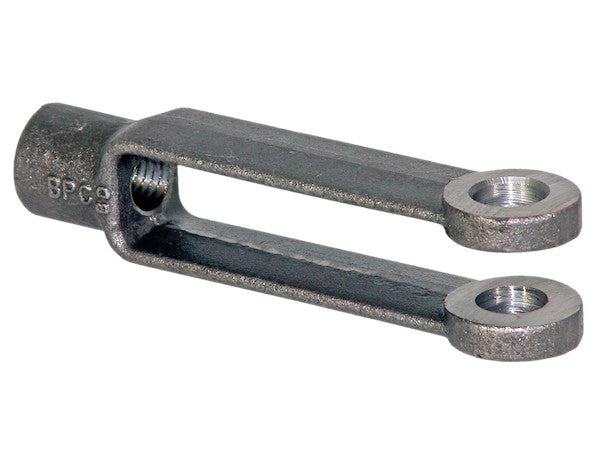
Adjustable Yoke Ends from Buyers Products are machine forged and meet SAE standards. Custom sizes and finishes are available.
Specifications
| Finish | Zinc Plated Yellow |
| Neck Length (in.) | 1.125 " |
| Clevis Pin Incl. (y/n) | No |
| Neck Dia. (in.) | 0.813 " |
| Type | Standard |
| Inner Arm to Arm (in.) | 0.563 " |
| Width (in.) | 1.125 " |
| Material | Forged Steel |
| Height of Yoke Arm (in.) | .813 |
| Center Hole to Neck (in.) | 1.875 " |
| Hole Dia. (in.) | 0.500 " |
| Base to Hole Center (in.) | 3.000 " |
| Thread Size (in.) | 5/16-24 |
Introduction to the Adjustable Yoke End
The Adjustable Yoke End, a cornerstone component in a vast array of mechanical linkage systems, is meticulously engineered for robust performance, precise adjustability, and enduring reliability. This specific variant, prominently featuring a 3/8-24 NF (National Fine) thread and a precisely dimensioned 1/2-inch (0.500") diameter thru-hole, is expertly crafted from high-strength machine-forged steel. To ensure exceptional longevity and resistance to environmental degradation, it is finished with a durable zinc-plated yellow chromate coating. Manufactured by Buyers Products, these components are designed not only to meet but often exceed stringent SAE (Society of Automotive Engineers) standards, affirming their superior quality, structural integrity, and seamless interchangeability within critical applications.
Core Functionality and Importance in Mechanical Linkages
Yoke ends, frequently termed clevis ends, serve as indispensable articulatory components within systems requiring the conversion of linear motion to rotational motion, or vice-versa, facilitating efficient force transmission. Their primary function is to establish a secure, pivotal connection point between two components, typically via a clevis pin, while permitting controlled angular movement. The inherent "adjustable" characteristic of this yoke end, attributable to its threaded shaft, provides a crucial mechanism for precise length modifications within a linkage. This adjustability is fundamental for calibration, tensioning, and accommodating minor misalignments or manufacturing variances during assembly. By allowing fine-tuned adjustments, the component optimizes system performance, minimizes undue stress on connected parts, and significantly reduces wear, thereby enhancing overall operational efficiency and extending the service life of the entire mechanical assembly. Its robust design ensures that operational forces are distributed effectively and safely, preserving the integrity of the linkage system under dynamic conditions.
Detailed Technical Specifications and Material Science
Thread Specifications: 3/8-24 NF (National Fine) and the 5/16-24 Variant
Understanding the thread configuration is paramount for proper application. The product title specifies a "3/8-24 NF Thread," which will be the primary focus of this technical description. It is important to note a discrepancy with the provided specification table, which lists "Thread Size (in.) 5/16-24." While the 5/16-24 variant is a common alternative within the adjustable yoke end family and may be available for specific applications or custom orders, this detailed exposition will concentrate on the characteristics and benefits of the 3/8-24 NF as presented in the product title, acknowledging the potential for other thread sizes. The "3/8-24 NF" designation signifies a nominal major diameter of 3/8 inch (0.375 inches) and a thread pitch of 24 threads per inch (TPI). The "NF" suffix indicates the National Fine thread series, distinguished by a higher thread count per inch compared to the National Coarse (NC) series for the same diameter. National Fine threads offer distinct advantages in applications demanding precise adjustments, superior resistance to vibrational loosening due to their shallower helix angle, and enhanced shear strength derived from a greater number of engaged threads over a given axial length. This makes them exceptionally well-suited for high-stress applications requiring fine tuning, secure fastening against dynamic loads, and robust connections, even in scenarios where material thickness or available space might be limited. The precise 1/24 inch pitch guarantees smooth, controlled, and micro-adjustable linear travel along the threaded neck, critical for system calibration and optimal operational alignment.
Thru-Hole Diameter: 1/2 Inch (0.500")
The 1/2-inch (0.500") diameter thru-hole is a critically engineered feature, precisely dimensioned to accept standard 1/2-inch diameter clevis pins, bolts, or shafts. This dimension is a key determinant of the connection point's ultimate shear strength and load-bearing capacity. Precision machining of this hole ensures exceptional concentricity and perpendicularity relative to the yoke arms, effectively minimizing undesirable play, mitigating stress concentrations, and facilitating fluid, unobstructed articulation with mating components. The manufacturing tolerances applied to this diameter are rigorously controlled to achieve an optimal fit, balancing ease of assembly with the imperative to eliminate excessive looseness, which could compromise the integrity and efficiency of the mechanical linkage.
Premium Material Selection: Forged Steel
The choice of forged steel as the fundamental material for this adjustable yoke end is a deliberate engineering decision, paramount to its structural integrity, durability, and superior performance under demanding conditions. Forging is a metal-forming process where localized compressive forces, typically applied while the steel is at an elevated temperature, shape the material. This process fundamentally refines the steel's internal grain structure, aligning the grains in the direction of the material's principal stress lines encountered during operation. The benefits conferred by utilizing forged steel are extensive:
- Superior Strength-to-Weight Ratio: Forging significantly enhances both the tensile and yield strength of the steel, enabling the component to withstand substantially higher static and dynamic loads without permanent deformation or brittle fracture.
- Exceptional Ductility: Despite its remarkable strength, forged steel retains excellent ductility. This property allows the material to undergo controlled plastic deformation under extreme, unforeseen loads before catastrophic failure, providing an invaluable safety margin in critical applications.
- Enhanced Fatigue Resistance: The refined, continuous grain flow achieved through forging, coupled with the elimination of internal voids, inclusions, or porosity (common in less controlled manufacturing methods like casting), dramatically improves the component's fatigue life. This makes the yoke end exceptionally resilient to repetitive and cyclical loading, as well as high-frequency vibrations.
- Reduced Material Defects: The intensive "working" of the metal during the forging process effectively closes internal porosity and voids, resulting in a significantly more homogenous, dense, and structurally sound component with minimal internal flaws.
- Dimensional Consistency: Machine forging, in particular, ensures a high degree of dimensional accuracy and mechanical property uniformity across large production batches, which is critical for consistent, reliable performance and interchangeability in mass production environments.
Advanced Corrosion Protection: Zinc Plated Yellow Chromate Finish
The entire forged steel component undergoes a multi-layered protective treatment, culminating in a zinc-plated yellow chromate finish. This advanced coating system performs several critical functions to ensure the product's longevity and performance:
- Sacrificial Corrosion Resistance: The initial layer of zinc plating provides galvanic, or sacrificial, protection to the underlying steel. Zinc is electrochemically more active than steel, meaning it preferentially corrodes when exposed to harsh environments (e.g., moisture, salt spray, industrial pollutants), thereby actively protecting the steel substrate from rust and oxidation.
- Enhanced Durability and Barrier Protection: Applied over the zinc, the yellow chromate conversion coating significantly amplifies the overall corrosion resistance, far surpassing that of plain zinc plating. This chromate layer forms a passive film that acts as a robust barrier, inhibiting the dissolution of zinc and offering superior protection against both white rust (zinc corrosion products) and, critically, red rust (steel corrosion).
- Self-Healing Properties: Chromate coatings possess a unique attribute known as "self-healing." In the event of minor scratches or abrasions to the coating, chromate compounds (trivalent chromium in modern, environmentally compliant formulations) can migrate to the damaged area, resealing it and largely preserving the protective integrity of the surface.
- Aesthetic and Identification: The characteristic yellow hue serves as a visual indicator of the protective coating, simplifying inspection and ensuring consistent product appearance.
- Environmental Compliance: Buyers Products adheres to contemporary environmental standards. Modern zinc-yellow chromate processes increasingly utilize trivalent chromium formulations, ensuring compliance with directives such as RoHS (Restriction of Hazardous Substances), which limit the use of hexavalent chromium due to its environmental impact and toxicity. This commitment underscores a balance between superior performance and environmental responsibility.
Comprehensive Dimensional Analysis and Functional Significance
Each dimension of this adjustable yoke end has been meticulously engineered and precisely controlled to guarantee optimal functionality, structural integrity, and seamless compatibility within diverse mechanical systems.
Neck Length (1.125 inches)
This dimension specifies the axial length of the threaded portion extending from the robust yoke arms. A length of 1.125 inches ensures ample thread engagement for the mating component, typically a threaded rod or turnbuckle, thereby guaranteeing a secure, high-strength connection. Furthermore, this length provides a significant range for precise linear adjustment, crucial for fine-tuning linkage lengths to achieve desired operational parameters or to compensate for inherent assembly tolerances.
Neck Diameter (0.813 inches)
The neck diameter of 0.813 inches corresponds to the major diameter of the 3/8-24 NF thread. This measurement is fundamental to the structural integrity of the threaded section, providing sufficient cross-sectional area to withstand substantial tensile and compressive loads transmitted through the linkage without yielding, fracturing, or experiencing thread stripping under rated conditions.
Inner Arm to Arm (0.563 inches)
This critical internal dimension defines the clear, unobstructed width between the two parallel arms of the yoke. At 0.563 inches, it specifies the maximum permissible width of any mating component—such as a rod end, bracket, or lever—that can be accommodated within the yoke. Precise control over this dimension is vital for ensuring proper fit-up, minimizing undesirable lateral play, and maximizing the efficiency of force transfer, while simultaneously providing adequate clearance for the clevis pin.
Overall Width (1.125 inches)
The total width of the yoke end, measuring 1.125 inches across its outermost points, is an important parameter for spatial integration within a larger assembly. This dimension is crucial for planning adequate clearance, particularly in confined operational spaces or when multiple components are situated in close proximity. It also serves as an indicator of the overall robustness and lateral stability of the yoke structure.
Height of Yoke Arm (0.813 inches)
This dimension refers to the vertical height of the individual yoke arms. A height of 0.813 inches indicates a substantial material cross-section within the arms, which significantly contributes to their shear strength and bending resistance. This robust design ensures that the arms can effectively support the clevis pin and efficiently transmit loads from connected components without experiencing undue deformation or fatigue.
Center Hole to Neck (1.875 inches)
This measurement defines the axial distance from the central axis of the clevis pin hole to the termination point of the threaded neck. It constitutes a vital part of the effective length of the yoke end and directly influences the leverage characteristics and mechanical advantage within the entire linkage system. This value, in conjunction with the neck length, helps define the overall adjustment range available for the linkage.
Base to Hole Center (3.000 inches)
This dimension quantifies the total length from the physical base of the threaded neck (where the threaded shaft transitions from the main body, often square or hexagonal for wrenching) to the precise center of the clevis pin hole. It is a critical overall length measurement for determining the effective contribution of the yoke end to the total length of a linkage system and is frequently used in conjunction with connecting rod lengths to calculate accurate center-to-center distances in mechanical designs.
Standard Type and Clevis Pin Exclusivity
The "Standard" classification of this yoke end implies strict adherence to widely accepted industry practices and dimensional standards. This ensures broad compatibility and seamless interchangeability with a vast array of other standard components within mechanical systems, simplifying design, procurement, and maintenance processes. The explicit indication that the "Clevis Pin Incl. (y/n)" is "No" provides essential flexibility for the end-user. This allows engineers and technicians to independently select the most appropriate clevis pin or bolt, factoring in specific material requirements, desired shear strength ratings, preferred locking mechanisms (e.g., cotter pin, quick-release pins, retaining clips), and finish requirements tailored precisely to their unique application and operating environmental conditions.
Precision Manufacturing: The Machine Forging Advantage
The designation "machine forged" highlights a sophisticated manufacturing process optimized for both unparalleled material integrity and exceptional dimensional precision. Machine forging employs advanced automated equipment to apply controlled, high-force compressive loads, shaping high-strength steel into the desired intricate form. This highly efficient method provides several critical benefits:
- Superior Grain Flow: The forging process strategically aligns the internal grain structure of the steel, rendering the component exceptionally resistant to impact, shock, and fatigue, which is crucial for parts subjected to dynamic and cyclical loading.
- Absence of Porosity and Voids: Unlike less controlled methods such as casting, forging effectively eliminates internal defects, including porosity and voids, resulting in a consistently dense, uniform material structure that significantly enhances strength and overall reliability.
- Exceptional Dimensional Accuracy and Repeatability: Modern machine forging processes, coupled with precision tooling and stringent process controls, achieve extremely tight dimensional tolerances with remarkable consistency across extensive production runs. This ensures that every single yoke end precisely meets its exact specifications for fit, form, and function.
- Optimized Material Utilization: The forging process is highly efficient in its use of raw material, minimizing waste and contributing to overall cost-effectiveness without compromising the superior quality and performance characteristics of the finished product.
Adherence to SAE Standards and Industry Compliance
The assertion that these adjustable yoke ends "meet SAE standards" serves as a profound testament to their superior engineering, meticulous manufacturing, and unwavering quality. The Society of Automotive Engineers (SAE) is a globally recognized authority that establishes a comprehensive array of technical standards and recommended practices for the design, manufacturing, and rigorous testing of mechanical components, particularly those deployed in demanding automotive, aerospace, and heavy-duty off-highway equipment sectors. For components such as yoke ends, SAE standards typically encompass:
- Material Composition: Mandating that the steel utilized adheres to precise chemical compositions and mechanical property requirements, ensuring appropriate strength and durability.
- Dimensional Tolerances: Guaranteeing precise interchangeability and proper fit-up with other SAE-compliant components within an assembly.
- Performance Requirements: Specifying minimum load-bearing capacities, anticipated fatigue life under cyclical stress, and resistance to various environmental factors.
- Standardized Testing Methodologies: Establishing consistent and repeatable procedures for verifying all specified performance characteristics.
Advanced Engineering Principles and Performance Attributes
Beyond the fundamental specifications, the design, material selection, and manufacturing process of this adjustable yoke end are meticulously optimized to address advanced engineering principles and deliver exceptional performance attributes:
- Superior Load Bearing Capacity: The inherently robust forged steel construction, combined with precisely calculated cross-sectional areas of both the arms and the threaded neck, bestows exceptional resistance to tensile, compressive, and shear forces. The 1/2-inch clevis pin hole, supported by substantial arm thickness, is specifically engineered to distribute these dynamic loads with maximum efficiency, thereby minimizing localized stress concentrations that could lead to premature material fatigue or failure.
- Extended Fatigue Life: In applications characterized by repetitive motion or cyclical loading, extraordinary fatigue resistance is paramount. The refined, continuous grain structure of forged steel, entirely free from internal flaws or discontinuities, dramatically extends the fatigue life of the component, ensuring sustained, reliable performance over millions of operational cycles. The protective zinc plating also plays a crucial role by preventing surface corrosion, which can often act as insidious initiation sites for fatigue cracks.
- Enhanced Vibration and Shock Resistance: The robust, integral design and the exceptionally tight manufacturing tolerances inherent in machine forging collectively contribute to the yoke end's superior ability to withstand both continuous operational vibration and sudden, high-magnitude shock loads without loosening, deforming, or exhibiting compromised integrity. The National Fine thread series (3/8-24 NF) further augments this capability, offering significantly greater resistance to vibrational loosening when compared to coarser thread series.
- Exceptional Environmental Durability: The multi-layered zinc-plated yellow chromate finish provides a formidable, multi-faceted barrier against a wide spectrum of harsh environmental conditions, including prolonged exposure to moisture, corrosive salt spray, aggressive industrial chemicals, and significant temperature fluctuations. This robust chemical resistance is absolutely critical for applications in exposed outdoor equipment, challenging marine environments, and highly corrosive industrial settings, effectively preventing material degradation that could otherwise compromise the structural integrity and aesthetic appeal of the component.
- Precision Adjustment Capability: The 24 threads per inch (TPI) characteristic of the NF thread allows for extremely fine and incremental adjustments to the overall linkage length. This unparalleled level of precision is indispensable for the accurate calibration of intricate mechanisms, the fine-tuning of control linkages, and the precise actuation of sensors or switches. Such minute adjustability is frequently a critical requirement in sophisticated systems demanding highly accurate positioning, precise feedback, or optimized operational kinematics.
Diverse Industrial Applications
The inherent versatility, exceptional strength, and robust design of this adjustable yoke end render it an indispensable component across a remarkably broad spectrum of industrial and commercial sectors:
- Automotive and Heavy-Duty Trucking: Found in critical systems such as shift linkages, brake actuation mechanisms, throttle controls, and various suspension components, where adjustability, precision, and durability are paramount.
- Agriculture and Construction Equipment: Essential for reliable control linkages in demanding machinery including tractors, excavators, loaders, and other heavy-duty construction vehicles, where supreme strength and exceptional corrosion resistance are non-negotiable requirements.
- Industrial Machinery and Automation: Utilized extensively in sophisticated automation equipment, intricate conveying systems, high-speed packaging machinery, and advanced textile machinery for precise motion control, efficient force transmission, and robust operational stability.
- Marine Applications: The specialized zinc plating provides crucial, enhanced protection against the highly corrosive effects of saltwater and consistently humid marine environments, making this component ideally suited for boat controls, steering systems, and various rigging applications.
- Specialty Vehicles and Robotics: Employed in applications requiring custom linkages and highly precise adjustments to achieve optimal performance, maneuverability, and functional accuracy in specialized robotic systems and bespoke vehicle designs.
Installation, Maintenance, and Maximizing Service Life
To ensure the maximum operational longevity, optimal performance, and safety of the adjustable yoke end, meticulous attention to proper installation procedures and adherence to a routine maintenance schedule are imperative. It is crucial to verify that all mating threads are impeccably clean, free from debris, burrs, or any contaminants, to facilitate smooth, full thread engagement. Apply the appropriate torque specifications to the threaded connection, as recommended by the equipment manufacturer or industry standards, to prevent loosening under operational vibration without inadvertently over-stressing the material or damaging the threads. Regular and systematic inspection for any perceptible signs of wear, nascent corrosion, physical deformation, or damage to both the clevis pin hole and the threaded section is strongly recommended, particularly in applications subjected to high operational cycles, substantial loads, or aggressive environmental exposure. While the durable zinc-plated finish significantly minimizes the requirement for extensive anti-corrosion maintenance, periodic cleaning, especially when operating in exceptionally harsh environments, will contribute to preserving its aesthetic integrity and extending its formidable protective life.
Customization Capabilities for Specialized Requirements
Recognizing that a multitude of specialized applications frequently necessitate bespoke solutions that extend beyond standard offerings, Buyers Products maintains a robust capability for offering customization options for its adjustable yoke ends. This includes the provision of alternative sizes, unique thread configurations, and a diverse range of specialized finishes tailored precisely to meet specific performance or environmental demands. This unwavering commitment to manufacturing flexibility underscores the company's dedication to comprehensively meeting diverse customer requirements, providing precisely engineered, tailored solutions that consistently uphold the exceptionally high standards of quality, performance, and reliability synonymous with the Buyers Products brand.
Conclusion
In summation, the Adjustable Yoke End from Buyers Products, meticulously engineered with a 3/8-24 NF thread and a 1/2-inch diameter thru-hole, and comprehensively protected by a durable zinc-plated finish, stands as a quintessential embodiment of advanced mechanical linkage technology. Its machine-forged steel construction, unwavering adherence to stringent SAE standards, and precision-driven design collectively ensure unparalleled strength, exceptional durability, and remarkably precise adjustability. These attributes position it as the unequivocally ideal choice for discerning engineers and designers who demand unfaltering reliability and peak performance within the most arduous and mission-critical mechanical applications.