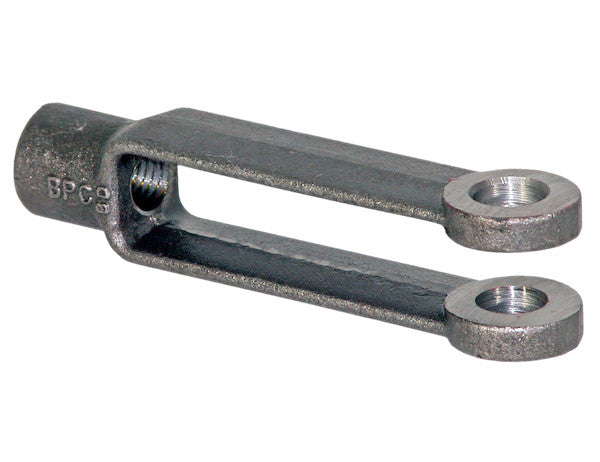
Adjustable Yoke Ends from Buyers Products are machine forged and meet SAE standards. Custom sizes and finishes are available.
Specifications
| Inner Arm to Arm (in.) | 0.563 " |
| Neck Dia. (in.) | 0.813 " |
| Neck Length (in.) | 1.125 " |
| Thread Size (in.) | 1/2-13 |
| Type | Standard |
| Clevis Pin Incl. (y/n) | No |
| Center Hole to Neck (in.) | 1.875 " |
| Finish | Zinc Plated |
| Hole Dia. (in.) | 0.500 " |
| Width (in.) | 1.125 " |
| Base to Hole Center (in.) | 3.000 " |
| Height of Yoke Arm (in.) | .813 |
| Material | Forged Steel |
Advanced Technical Overview: Precision-Engineered Adjustable Yoke End for Demanding Mechanical Linkages
The Adjustable Yoke End, featuring a 1/2-13 NC Thread and a 1/2-inch Diameter Thru-Hole with a Zinc Plated finish, represents a critical component in the design and construction of robust and adaptable mechanical linkage systems. Manufactured by Buyers Products, this component is precision-engineered from forged steel, ensuring exceptional durability and adherence to stringent SAE standards. Its primary function is to provide a reliable, articulable connection point in a wide array of industrial, agricultural, automotive, and construction applications, where precise length adjustment and superior mechanical integrity are paramount. This detailed exposition will delve into the technical specifications, material science, manufacturing processes, functional benefits, and diverse application contexts of this essential mechanical element.
Design and Functional Attributes
At the core of this adjustable yoke end's utility is its carefully considered design, which integrates several key features for optimal performance:
Threaded Connection: 1/2-13 NC Thread
The inclusion of a 1/2-13 NC (National Coarse) thread is a fundamental aspect that grants this yoke end its adjustability. The "1/2" denotes a nominal thread diameter of one-half inch, and "13" specifies 13 threads per inch. The "NC" designation signifies a National Coarse thread series, which is characterized by a larger thread pitch compared to National Fine (NF) threads. This coarse pitch offers several advantages in typical yoke end applications:
- Robustness: Coarse threads are inherently stronger in terms of shear strength and less susceptible to stripping in softer materials or under shock loads. The larger thread root area provides greater resistance to stress concentrations.
- Ease of Assembly: The larger pitch facilitates quicker engagement and disengagement, which is beneficial during installation, adjustment, or maintenance. It also makes them less prone to cross-threading.
- Tolerance for Contamination: Coarse threads are more forgiving of minor debris, paint, or plating buildup within the thread valleys, making them suitable for environments where cleanliness cannot always be guaranteed.
This threaded shaft allows the yoke end to be accurately positioned along a mating threaded rod or shaft, enabling precise control over the overall length of a linkage assembly. Such adjustability is vital for fine-tuning system geometry, compensating for manufacturing tolerances, or adapting to varying operational requirements. The thread's precise machining ensures smooth engagement and disengagement, contributing to the overall integrity and ease of use of the component.
Thru-Hole Mechanism: 1/2 Inch Diameter
The yoke end features a precision-machined thru-hole with a diameter of 0.500 inches (1/2 inch). This hole is designed to accommodate a clevis pin, bolt, or shaft of corresponding diameter, forming a pivot point in the mechanical linkage. The accuracy of this bore is critical for:
- Minimizing Play (Slop): A tightly toleranced hole diameter ensures minimal clearance between the pin and the yoke arms, reducing backlash and undesirable movement within the linkage. This is crucial for applications requiring high precision and responsiveness.
- Optimizing Load Distribution: A precise fit helps distribute shear loads evenly across the clevis pin and the yoke arms, preventing localized stress concentrations that could lead to premature wear or fatigue failure.
- Facilitating Articulation: While snug, the fit must still allow for smooth rotational movement of the clevis pin, enabling the linkage to articulate freely within its designed range of motion.
The dimensions specified for "Inner Arm to Arm (0.563")" and "Hole Dia. (0.500")" confirm that the design accounts for standard clevis pin dimensions and provides sufficient clearance while maintaining structural integrity. The "Center Hole to Neck (1.875")" and "Base to Hole Center (3.000")" dimensions are critical for determining the effective length of the component and its integration into a broader system geometry, influencing lever arms and force transmission.
Robust Yoke Geometry and Dimensions
The physical dimensions of the yoke end, as detailed in the specifications, are engineered for strength and compatibility:
- Inner Arm to Arm (0.563"): This critical dimension defines the maximum width of the mating component (e.g., clevis, bracket) that can fit between the arms of the yoke. It provides adequate clearance for a 1/2-inch clevis pin while ensuring robust material around the pinhole.
- Neck Dia. (0.813") & Neck Length (1.125"): These dimensions define the robust transition section between the threaded portion and the yoke arms. A substantial neck diameter provides strength where the threaded section meets the wider yoke, minimizing stress risers. The length ensures a smooth transition and provides ample material for structural integrity.
- Width (1.125"): This refers to the overall width of the yoke arms, contributing to the bending and shear strength of the component.
- Height of Yoke Arm (.813"): This dimension indicates the vertical extent of the yoke arms, further reinforcing their structural integrity and resistance to deformation under load.
Collectively, these dimensions ensure that the yoke end can withstand significant tensile, compressive, and shear forces commonly encountered in mechanical linkages without experiencing plastic deformation or catastrophic failure.
Material Science and Manufacturing Process
Forged Steel Construction
The designation "Forged Steel" is a paramount indicator of the superior mechanical properties of this yoke end. Forging is a manufacturing process that involves shaping metal using localized compressive forces, typically through hammering, pressing, or rolling. Unlike casting, which involves pouring molten metal into a mold, or machining from bar stock, forging offers distinct advantages:
- Enhanced Grain Structure: Forging refines the grain structure of the steel, aligning the grains along the lines of maximum stress. This creates a continuous grain flow that significantly improves the material's strength, ductility, and resistance to impact and fatigue. Cast parts, by contrast, have a more random, coarser grain structure, making them more brittle.
- Elimination of Internal Defects: The forging process compresses the metal, closing up internal voids, porosity, and gas pockets that might be present in cast components. This results in a denser, more homogeneous material with fewer stress concentrations.
- Superior Strength-to-Weight Ratio: Forged components can often achieve higher strength levels with less material compared to non-forged equivalents, contributing to more efficient designs.
- Improved Fatigue Resistance: Due to the optimized grain flow and lack of internal defects, forged steel components exhibit significantly better fatigue life under cyclic loading conditions, which are prevalent in most dynamic mechanical systems.
The use of "machine forged" further implies a controlled and repeatable process, often involving automated machinery, which ensures consistent quality and adherence to tight tolerances across production batches. The specific type of steel used would typically be a low to medium carbon steel (e.g., AISI 1018, 1035, or 1045), selected for its excellent forgeability, strength, and weldability, making it suitable for a wide range of industrial applications.
Zinc Plated Finish
The "Zinc Plated" finish serves a critical protective function. Zinc plating is an electroplating process where a thin layer of zinc is deposited onto the surface of the steel. This sacrificial coating provides robust corrosion resistance through two primary mechanisms:
- Barrier Protection: The zinc layer acts as a physical barrier, preventing moisture, oxygen, and corrosive agents from reaching the underlying steel substrate.
- Sacrificial Protection (Galvanic Action): Zinc is electrochemically more active than steel. In the presence of an electrolyte (e.g., moisture), the zinc corrodes preferentially, "sacrificing" itself to protect the steel substrate from rust. This protection persists even if the zinc coating is scratched or chipped, as long as a direct electrical connection between the zinc and steel remains.
Zinc plating offers a cost-effective and aesthetically pleasing solution for protecting components in moderate corrosive environments. Common types of zinc plating include clear (blue bright), yellow, or black chromate finishes, which further enhance corrosion resistance and provide specific aesthetic qualities. For outdoor or mildly aggressive industrial environments, zinc plating significantly extends the operational lifespan of the yoke end, reducing maintenance requirements and replacement costs.
Compliance with SAE Standards
The statement that these adjustable yoke ends "meet SAE standards" is a testament to their quality, reliability, and interchangeability. The Society of Automotive Engineers (SAE) develops and publishes technical standards for engineering professionals in various industries, including automotive, aerospace, and commercial vehicles. For components like yoke ends, SAE standards typically govern aspects such as:
- Material Specifications: Defining acceptable steel grades and their mechanical properties (e.g., tensile strength, yield strength, hardness).
- Dimensional Tolerances: Ensuring precise manufacturing and interchangeability with other standard components.
- Performance Requirements: Specifying minimum load capacities (tensile, compressive, shear), fatigue life expectations, and operational characteristics.
- Testing Procedures: Outlining methods for verifying compliance with material and performance criteria.
Adherence to SAE standards provides engineers and designers with confidence that the component will perform as expected in demanding applications, integrate seamlessly with other standard parts, and maintain a consistent level of quality. It reflects a commitment to engineering best practices and product excellence.
Diverse Application Spectrum
The robust construction, precise adjustability, and corrosion resistance of this adjustable yoke end make it indispensable across a vast range of industries and specific mechanical systems:
- Agricultural Machinery: Crucial for connecting hydraulic cylinders, control linkages, and implement adjustments on tractors, cultivators, planters, sprayers, and harvesting equipment. They allow for precise calibration of working depths, angles, and movements.
- Construction Equipment: Utilized in the steering, braking, suspension, and hydraulic control systems of excavators, bulldozers, loaders, graders, and cranes. They provide durable pivot points for linkages subjected to heavy loads and harsh environments.
- Industrial Machinery: Found in conveyor systems, packaging machinery, printing presses, textile machinery, and automation equipment, providing adjustable connections for actuators, sensors, and motion control systems.
- Automotive and Heavy-Duty Trucking: Employed in various linkages within steering mechanisms, throttle controls, clutch linkages, shift linkages, and suspension systems, especially in commercial vehicles where durability and reliability are paramount.
- Marine Applications: While zinc plating offers good protection, for direct exposure to saltwater, additional coatings or stainless steel variants might be considered. However, for shielded linkages in marine engines or control systems, zinc-plated components are often suitable.
- Custom Fabrication and OEM Integration: An ideal component for engineers and fabricators developing bespoke machinery or integrating standard components into original equipment designs where adjustability and strength are required.
- Specialty Vehicles: Used in utility vehicles, off-road equipment, and specialized transport systems for connecting various control rods and structural elements.
In each of these applications, the yoke end's ability to provide a strong, pivotable, and length-adjustable connection is vital for system functionality, maintenance, and longevity.
Technical Considerations for Selection and Integration
When incorporating this adjustable yoke end into a design, several engineering considerations are critical:
- Load Capacity: Engineers must assess the maximum anticipated tensile, compressive, and shear loads that the yoke end will experience. The forged steel construction provides high strength, but the weakest link in the system (e.g., the clevis pin, mating rod, or connecting bracket) must also be considered. Static and dynamic load ratings are crucial.
- Fatigue Analysis: For applications involving cyclic loading, the fatigue life of the yoke end and its mating components is paramount. Forged steel inherently offers excellent fatigue resistance, but proper sizing and avoidance of stress concentrators in the overall assembly are still necessary.
- Corrosion Environment: While zinc plating offers good general corrosion resistance, severely corrosive environments (e.g., direct saltwater exposure, strong chemical agents) may necessitate alternative finishes or materials (e.g., stainless steel, specialized coatings).
- Tolerance Stacking: The cumulative effect of manufacturing tolerances in all connecting components (yoke end, clevis pin, mating bracket) must be analyzed to ensure proper fit, alignment, and minimal backlash. The precise machining of the yoke end helps mitigate this.
- Thread Engagement: To achieve maximum strength from the 1/2-13 NC thread, sufficient thread engagement with the mating rod is required. General engineering practice suggests an engagement length equal to 1 to 1.5 times the nominal thread diameter for steel components.
- Maintenance and Lubrication: Although designed for durability, regular inspection for wear, especially in the thru-hole and around the clevis pin, is advisable in high-cycle applications. Lubrication of the pivot point can reduce friction and extend component life.
Conclusion
The Adjustable Yoke End with 1/2-13 NC Thread and 1/2-inch Diameter Thru-Hole, featuring a Zinc Plated finish and machine-forged steel construction, stands as a testament to precision engineering and robust manufacturing. Its inherent adjustability, superior material properties derived from the forging process, effective corrosion protection, and strict adherence to SAE standards make it an exceptionally reliable and versatile component. For engineers and designers seeking a high-performance solution for demanding mechanical linkages that require precise length adjustment and long-term durability, this Buyers Products yoke end offers an optimal balance of strength, functionality, and cost-effectiveness. Its broad applicability across numerous industries underscores its status as an indispensable element in modern mechanical systems.