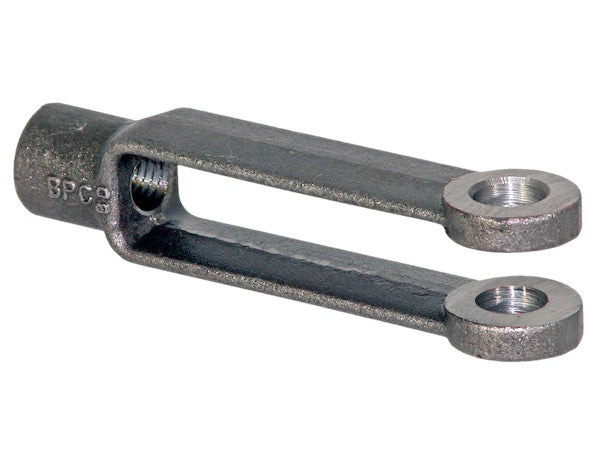
Adjustable Yoke Ends from Buyers Products are machine forged and meet SAE standards. Custom sizes and finishes are available.
Specifications
| Neck Length (in.) | 1.125 " |
| Material | Forged Steel |
| Neck Dia. (in.) | 0.813 " |
| Center Hole to Neck (in.) | 1.875 " |
| Height of Yoke Arm (in.) | .813 |
| Hole Dia. (in.) | 0.500 " |
| Clevis Pin Incl. (y/n) | No |
| Base to Hole Center (in.) | 3.000 " |
| Thread Size (in.) | 1/2-20 |
| Finish | Zinc Plated |
| Type | Standard |
| Width (in.) | 1.125 " |
| Inner Arm to Arm (in.) | 0.563 " |
Advanced Engineering and Performance: The Adjustable Yoke End with 1/2-20 NF Thread and 1/2 Inch Thru-Hole
The Adjustable Yoke End, featuring a 1/2-20 NF thread and a 1/2-inch diameter thru-hole, represents a critical component in the design and construction of robust mechanical linkages. Engineered for precision and durability, this product is meticulously crafted from forged steel and finished with a zinc plating, ensuring optimal performance across a wide array of industrial, automotive, and agricultural applications. Its adjustable nature provides unparalleled flexibility in design, allowing for fine-tuning of linkage lengths and angles, which is indispensable for achieving precise control and operational efficiency in complex mechanical systems. A yoke end, often referred to as a rod end clevis or clevis fork, serves as a pivotal connection point, translating linear motion from a threaded rod into an angular or pivot action. This component is fundamental in mechanisms requiring the transmission of force and motion while accommodating changes in alignment or enabling articulation. The specific design parameters of this Adjustable Yoke End – particularly its material composition, manufacturing process, thread specification, thru-hole diameter, and protective finish – collectively contribute to its exceptional strength, longevity, and adaptability, positioning it as an essential element for engineers and designers seeking reliable linkage solutions.Engineering Excellence: The Forged Steel Advantage
The selection of forged steel as the primary material for this Adjustable Yoke End is not arbitrary; it is a deliberate engineering choice driven by the demand for superior mechanical properties under stringent operational conditions. Forging is a manufacturing process that involves shaping metal through localized compressive forces, typically applied using hammers or presses. Unlike casting, which involves pouring molten metal into a mold, or machining from bar stock, forging fundamentally alters the grain structure of the metal, aligning it with the component's contours and optimizing its strength characteristics. **Key advantages derived from machine forging include:** * **Superior Strength-to-Weight Ratio:** Forged steel components exhibit significantly higher strength and fatigue resistance compared to their cast or machined counterparts. The forging process eliminates internal voids, porosity, and other defects that can compromise structural integrity, resulting in a dense, uniform material structure capable of withstanding extreme stresses. * **Enhanced Fatigue Resistance:** The aligned grain flow inherent in forged parts resists crack initiation and propagation more effectively. This is crucial for components subjected to repetitive loading cycles, dynamic forces, and vibration, ensuring a longer operational lifespan and reducing the risk of catastrophic failure. * **Exceptional Toughness and Impact Resistance:** The compressive deformation during forging refines the grain size and improves the metallurgical characteristics of the steel, endowing the yoke end with superior toughness and resistance to sudden impacts or shock loads. This is particularly vital in applications where components might experience abrupt force changes. * **Consistent Quality and Dimensional Accuracy:** Machine forging processes are highly controlled, ensuring uniformity in component properties from batch to batch. This consistency translates directly into reliable performance and precise dimensional adherence, which is critical for proper fitment and functionality within an assembly. * **Optimized Service Life:** By minimizing internal stresses and maximizing material density, forged steel components offer an extended service life, reducing maintenance requirements and overall operational costs over time. The forged steel utilized is typically a low to medium carbon alloy, carefully selected for its excellent forgeability, subsequent machinability for threading and hole creation, and its compatibility with surface treatments like zinc plating. This combination ensures that the Adjustable Yoke End possesses not only immense inherent strength but also the precision required for its specific function.Precision Threading: The 1/2-20 NF Specification
A fundamental characteristic of this Adjustable Yoke End is its 1/2-20 NF thread. This designation is critical for understanding the component's compatibility and functional benefits. * **1/2 Inch Nominal Diameter:** This refers to the major diameter of the thread, indicating it is designed to mate with a threaded rod or bolt that also has a 1/2-inch nominal diameter. * **20 Threads Per Inch (TPI):** This number defines the thread pitch, specifying that there are 20 complete helical grooves per linear inch. A higher TPI value indicates a "finer" thread. * **NF (National Fine):** This suffix signifies that the thread conforms to the National Fine thread series standard. The NF series is characterized by a finer pitch compared to the National Coarse (NC) series for a given diameter. **The advantages of utilizing a National Fine thread, such as 1/2-20 NF, are significant for precision mechanical linkages:** * **Increased Shear Strength:** Fine threads have a larger minor diameter and a greater number of threads per unit length engaging the mating component. This results in a larger cross-sectional area of thread in shear, providing superior tensile strength and resistance to stripping under high axial loads. * **Finer Adjustment Capability:** The smaller pitch of fine threads allows for more precise adjustments of the linkage length. Each turn of the yoke end on a threaded rod results in a smaller linear displacement, enabling extremely accurate positioning and calibration within a mechanical system. This is invaluable in applications requiring meticulous setup and operational accuracy. * **Greater Resistance to Loosening under Vibration:** The shallower helix angle of fine threads provides increased friction and resistance to loosening when subjected to dynamic loads, vibration, or shock. This enhanced self-locking characteristic makes fine threads a preferred choice in environments where maintaining connection integrity is paramount. * **Improved Load Distribution:** With more threads engaged over a given length, the load is distributed more evenly across a greater surface area. This reduces localized stress concentrations, contributing to the overall durability and fatigue life of the threaded connection. The precision with which the 1/2-20 NF thread is machined into the forged steel yoke end ensures a smooth, tight, and reliable engagement with mating threaded rods. This meticulous manufacturing process, combined with the inherent benefits of the NF thread series, guarantees that the adjustable feature of the yoke end is both highly functional and exceptionally robust.Robust Articulation: The 1/2 Inch Diameter Thru-Hole
Complementing the threaded neck is the precisely bored 1/2-inch (0.500") diameter thru-hole, which serves as the primary articulation point for the yoke end. This hole is designed to accommodate a clevis pin, bolt, or shaft of the corresponding diameter, facilitating pivotal motion within a mechanical assembly. **The accuracy and integrity of this thru-hole are paramount for the performance of the linkage:** * **Precision for Optimal Fitment:** The exact 0.500-inch diameter is critical for ensuring a snug yet free-moving fit with mating clevis pins. A precisely sized hole minimizes undesirable play or slop in the joint, which could lead to premature wear, reduced accuracy, and increased noise. Conversely, a hole that is too small would impede proper assembly or cause binding during operation. * **Load Bearing Capability:** The area surrounding the thru-hole in the yoke arms is engineered to withstand significant radial and axial loads transmitted through the clevis pin. The inherent strength and uniform grain structure of the forged steel are vital in preventing deformation, ovalization, or cracking of the hole under operational stresses. * **Smooth Articulation:** The smooth, deburred finish of the thru-hole interior promotes low-friction pivot action, reducing wear on both the yoke end and the clevis pin. This ensures consistent and reliable movement throughout the component's service life. * **Mating Component Selection:** The standardized 1/2-inch hole diameter facilitates the selection of readily available clevis pins, bolts, or bushings. It is essential to select pins of appropriate material strength and finish (e.g., hardened steel, zinc plated) to match the operational demands and environmental conditions, thereby maximizing the overall integrity and longevity of the pivot joint. The absence of a clevis pin included with this product underscores its role as a fundamental component to be integrated into a larger system, allowing engineers the flexibility to specify the most suitable pin for their specific application.Superior Corrosion Protection: The Zinc Plated Finish
The application of a zinc plated finish is a crucial protective measure that significantly enhances the durability and longevity of the Adjustable Yoke End. Zinc plating is an electroplating process where a thin layer of zinc metal is deposited onto the surface of the steel component. This surface treatment serves multiple vital functions in preserving the integrity and performance of the yoke end in various operational environments. **Benefits of Zinc Plating:** * **Barrier Protection:** The zinc layer acts as a physical barrier, isolating the underlying forged steel from direct exposure to atmospheric oxygen and moisture, thereby preventing the initiation of rust (iron oxide formation). * **Sacrificial Protection (Galvanic Action):** Zinc is a more electrochemically active metal than steel. In the presence of an electrolyte (such as moisture), the zinc corrodes preferentially, sacrificing itself to protect the steel substrate. This galvanic protection is highly effective even if the zinc layer is scratched or slightly damaged, as the surrounding zinc continues to protect the exposed steel. * **Improved Aesthetics:** Zinc plating provides a bright, clean, and uniform metallic appearance, which can be an important consideration for visible components or for maintaining a consistent aesthetic across an assembly. * **Enhanced Durability in Diverse Environments:** While not suitable for highly corrosive or marine environments without additional passivation (e.g., yellow chromate or specialized coatings), standard zinc plating offers excellent protection against general atmospheric corrosion, humidity, and light splash exposure. This makes it ideal for a wide range of indoor and outdoor applications where moderate corrosion resistance is required. * **Cost-Effectiveness:** Zinc plating is a highly cost-effective method of corrosion protection, offering significant benefits relative to its application cost. The quality of the zinc plating adheres to industry standards, ensuring uniform thickness and proper adhesion to the forged steel. This robust finish contributes directly to the extended service life of the yoke end, reducing the need for premature replacement due to corrosion-induced degradation and maintaining optimal functionality over time.Adherence to SAE Standards and Dimensional Precision
The statement that these Adjustable Yoke Ends "meet SAE standards" is a profound declaration of quality, reliability, and engineering integrity. SAE International (formerly the Society of Automotive Engineers) is a global association of engineers and technical experts in the aerospace, automotive, and commercial vehicle industries. SAE standards are globally recognized benchmarks that define best practices, performance criteria, and specifications for materials, components, and systems. **The significance of SAE compliance for this Adjustable Yoke End includes:** * **Guaranteed Performance and Reliability:** Adherence to SAE standards ensures that the component has been designed and manufactured to meet rigorous performance requirements, providing assurance of its strength, durability, and functional capabilities under specified operating conditions. * **Interchangeability:** SAE standards promote interchangeability of components across different manufacturers and systems. This means that a yoke end manufactured to SAE specifications will reliably mate and function with other standard components, simplifying design, assembly, and maintenance processes. * **Safety Assurance:** For critical mechanical linkages, particularly in automotive and industrial applications, compliance with recognized standards is paramount for operational safety, minimizing risks associated with component failure. * **Industry-Recognized Quality Benchmark:** SAE compliance serves as a universally understood mark of quality, indicating that the product has undergone stringent design and manufacturing processes aligned with established industry best practices. Beyond general SAE compliance, the detailed dimensional specifications provided are crucial for engineers designing and integrating these yoke ends into complex systems: * **Neck Length (1.125"), Neck Dia. (0.813"):** These dimensions dictate the interface with the mating threaded rod and the overall structural stability of the threaded connection. * **Center Hole to Neck (1.875"), Base to Hole Center (3.000"):** These measurements define the critical geometric relationship between the pivot point and the threaded connection, influencing linkage geometry, range of motion, and overall system kinematics. * **Height of Yoke Arm (.813"), Width (1.125"), Inner Arm to Arm (0.563"):** These dimensions are critical for ensuring proper clearance for the clevis pin and mating components, preventing binding, and ensuring the structural integrity of the yoke arms under load. The "Inner Arm to Arm" dimension, specifically 0.563 inches, defines the maximum width of the component that can be accommodated within the clevis arms. Precise control over these dimensions during the machine forging and subsequent machining processes is vital. Any deviation can lead to misalignment, increased wear, reduced efficiency, or complete system failure. The meticulous engineering behind these specifications ensures that the Adjustable Yoke End performs optimally within its intended application.Versatile Applications Across Industries
The robust construction, adjustable nature, and precise specifications of this Yoke End make it an exceptionally versatile component, finding application across a broad spectrum of industries and mechanical systems. Its ability to transmit force and motion while accommodating angular changes is indispensable in scenarios requiring reliable and adjustable linkages. **Key application areas include:** * **Automotive Industry:** Essential in various vehicle systems such as shifter linkages for manual and automatic transmissions, throttle control mechanisms, clutch linkages, emergency brake systems, and even certain suspension or steering components where articulation and adjustability are critical. Its use in heavy-duty trucks and trailers for various control rods and accessory linkages is also common. * **Agricultural Machinery:** Widely used in farm equipment for implement control rods, hydraulic cylinder linkages on tractors and plows, hitch mechanisms, and various adjustable components on cultivators, harvesters, and sprayers. The durability of forged steel and the corrosion resistance are particularly valuable in demanding agricultural environments. * **Construction Equipment:** Integrated into heavy machinery like excavators, bulldozers, cranes, and loaders. Applications include linkages for hydraulic cylinders, boom controls, bucket mechanisms, steering systems, and stabilizer arms, where the component must withstand high dynamic loads and harsh operating conditions. * **Industrial Machinery:** Employed in a diverse range of industrial equipment, including conveyor systems, packaging machinery, material handling systems, industrial actuators, robotic arms, and automated assembly lines. The adjustability allows for fine-tuning of machine movements and precise positioning. * **Marine Applications:** While zinc plating has limitations in prolonged direct saltwater exposure, it can be suitable for components in marine steering systems, engine controls, and other linkages that are not continuously submerged or in contact with highly corrosive marine environments, especially if supplemented with additional protective coatings or regular maintenance. * **HVAC Systems:** Used in the control mechanisms for dampers, valves, and other actuated components within heating, ventilation, and air conditioning systems, providing reliable and adjustable connections for precise environmental control. * **Specialty and Recreational Vehicles:** Applicable in off-road vehicles, ATVs, UTVs, and other recreational vehicles for steering linkages, suspension components, and control rods, where ruggedness and adjustability are highly valued. The inherent "adjustable" quality, facilitated by the 1/2-20 NF thread, means that this yoke end can be precisely positioned to achieve specific linkage lengths, compensating for manufacturing tolerances in other components or allowing for field adjustments. This adaptability significantly simplifies design and assembly processes, while also providing flexibility for maintenance and repair.Installation, Maintenance, and Longevity
Proper installation and periodic maintenance are crucial to maximizing the service life and ensuring the consistent performance of the Adjustable Yoke End. **Installation Considerations:** * **Thread Engagement:** Ensure adequate thread engagement with the mating threaded rod to fully leverage the strength of the 1/2-20 NF thread. Insufficient engagement can lead to premature thread stripping or failure. * **Clevis Pin Selection:** Choose a clevis pin of appropriate diameter (1/2 inch), material, and shear strength to match the expected loads. Ensure the pin is properly secured with a cotter pin, retaining clip, or other locking mechanism to prevent dislodgement. * **Alignment:** Install the yoke end to ensure proper alignment with the connecting components, minimizing angular misalignment that can induce bending stresses or premature wear on the pin and hole. * **Torque Specifications:** If mating with a threaded component, adhere to recommended torque specifications for the 1/2-20 NF thread to achieve a secure connection without over-stressing the material. **Maintenance for Extended Longevity:** * **Periodic Inspection:** Regularly inspect the yoke end, especially the clevis pin hole and threaded areas, for signs of wear, deformation, corrosion, or crack initiation. Any visual indication of degradation should prompt immediate attention. * **Lubrication:** For applications involving frequent or significant angular movement, appropriate lubrication (e.g., grease) at the pivot point between the clevis pin and the thru-hole can significantly reduce friction and wear, extending the life of both components. * **Corrosion Monitoring:** While zinc plating provides excellent protection, it is not impervious. In environments with higher humidity or occasional chemical exposure, periodic cleaning and re-inspection of the zinc finish for any signs of compromise or "white rust" (zinc corrosion) is advisable. By adhering to these installation best practices and implementing a routine maintenance schedule, the inherent durability of the forged steel, the precision of the threading, and the protection of the zinc plating will translate into an extended operational life, minimizing downtime and maximizing the return on investment for this critical component.Customization Potential and Buyers Products Advantage
The commitment of Buyers Products to offering custom sizes and finishes underscores their understanding of diverse engineering requirements and the need for tailored solutions. While the standard Adjustable Yoke End with its 1/2-20 NF thread and 1/2-inch thru-hole in zinc-plated forged steel meets a wide range of applications, specific projects may necessitate unique modifications. **Reasons for Customization:** * **Unique Dimensional Requirements:** Applications with very specific space constraints or kinematic demands might require slight alterations to neck length, arm width, or other critical dimensions. * **Specialized Environmental Protection:** For extreme conditions, such as continuous marine exposure, harsh chemical environments, or high-temperature applications, alternative finishes like specialized powder coatings, e-coating, or even different plating materials (e.g., nickel, chrome) might be required to ensure optimal long-term performance. * **Material Selection:** While forged steel is highly versatile, certain applications might benefit from specialized alloys with enhanced properties for extreme temperature, non-magnetic requirements, or specific strength-to-weight ratios. The ability of Buyers Products to provide customized options ensures that engineers can source components that are perfectly optimized for their unique designs, eliminating the need for costly and time-consuming in-house modifications. This flexibility, combined with the company's commitment to machine forging and adherence to SAE standards, solidifies the Adjustable Yoke End as a reliable, high-performance solution for demanding mechanical linkage applications.