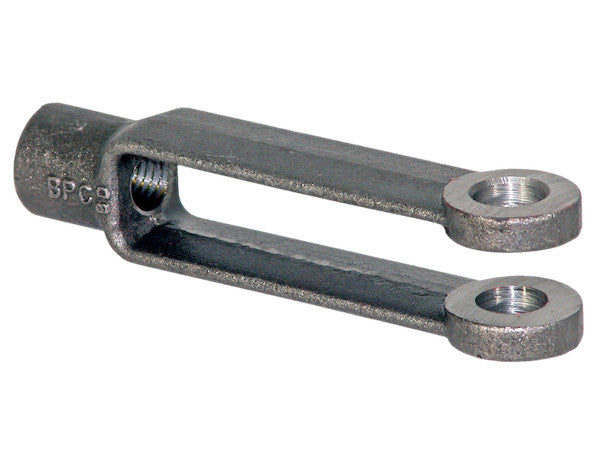
Adjustable Yoke Ends from Buyers Products are machine forged and meet SAE standards. Custom sizes and finishes are available.
Specifications
| Center Hole to Neck (in.) | 3.688 " |
| Clevis Pin Incl. (y/n) | No |
| Width (in.) | 1.375 " |
| Hole Dia. (in.) | 0.625 " |
| Inner Arm to Arm (in.) | 0.688 " |
| Height of Yoke Arm (in.) | 1.063 |
| Neck Length (in.) | 1.250 " |
| Material | Forged Steel |
| Base to Hole Center (in.) | 4.938 " |
| Type | Standard |
| Neck Dia. (in.) | 1.063 " |
| Finish | Plain |
| Thread Size (in.) | 5/8-11 |
The Adjustable Yoke End, featuring a 5/8-11 NC Thread and a 5/8 Inch Diameter Thru-Hole, represents a precision-engineered component critical for mechanical linkage systems requiring both robust connection and precise adjustability. Manufactured by Buyers Products, this component is distinguished by its machine-forged construction from high-grade steel, ensuring exceptional durability and adherence to rigorous SAE standards. This detailed description will delve into the technical specifications, material science, manufacturing processes, functional benefits, and diverse applications of this indispensable adjustable yoke end, providing a comprehensive understanding for engineers, designers, and industrial buyers seeking reliable and high-performance solutions.
Precision Engineering: The Adjustable Yoke End Functionality
At its core, an adjustable yoke end, also commonly referred to as a clevis end, serves as a pivotal connector in mechanical assemblies. Its primary function is to convert linear motion into angular motion or to connect two components that require both rotational freedom and length adjustment. The "adjustable" aspect is paramount, facilitated by the threaded shank which allows for fine-tuning the overall length of a linkage system. This adjustability is crucial in applications where precise alignment, tension, or stroke length is required, such as in hydraulic cylinder rod ends, control linkages, or steering mechanisms. By simply rotating the yoke end on a mating threaded rod, operators can achieve exact positioning, compensating for manufacturing tolerances or wear within the system. The integrated thru-hole, designed to accommodate a clevis pin, enables the rotational connection to another component, allowing for a controlled degree of articulation. This dual functionality of secure threading and a free-pivoting connection makes the adjustable yoke end an essential element in countless industrial and mobile equipment designs.
Technical Deep Dive: The 5/8-11 NC Thread Specification
The thread specification of 5/8-11 NC is a critical determinant of the yoke end's mechanical compatibility and performance. This designation breaks down into several key parameters: "5/8" refers to the nominal major diameter of the thread in inches, indicating the overall size of the threaded shank. "11" signifies 11 threads per inch (TPI), which defines the thread pitch. A higher TPI indicates finer threads, while a lower TPI, as in this case, denotes coarser threads. "NC" stands for National Coarse, which is a standard thread series known for its robust characteristics. National Coarse threads are generally preferred for general-purpose applications due to their larger thread profile, which provides greater strength and resistance to stripping, especially in materials like steel. The coarser pitch also makes them less susceptible to damage during assembly and disassembly, and less prone to galling. Furthermore, NC threads offer a good balance between strength and ease of machining, contributing to cost-effectiveness and broad availability of mating components. The choice of a 5/8-11 NC thread ensures a strong, reliable connection with compatible threaded rods, capable of transmitting substantial tensile and compressive loads within the linkage system, while also providing adequate surface area for the locking mechanisms (such as jam nuts) often employed to secure the adjustment.
Thru-Hole Precision: The 5/8 Inch Diameter
Complementing the robust threaded connection is the precisely machined 5/8 inch (0.625") diameter thru-hole located at the clevis end. This hole is engineered to facilitate a pivotal connection using a clevis pin, bolt, or similar shaft. The accuracy of this diameter is paramount, as it directly impacts the fit between the yoke end and its mating component, such as another clevis, bracket, or lever arm. A precise fit minimizes play and slop in the linkage, which is crucial for maintaining control accuracy, reducing wear on the pin and bore, and extending the lifespan of the entire assembly. Excessive clearance can lead to rattling, premature fatigue, and inefficient power transmission, while insufficient clearance can hinder assembly or cause binding. The 0.625" diameter is a common standard size, ensuring broad compatibility with readily available clevis pins. The specification "Clevis Pin Incl. (y/n): No" indicates that while the yoke end is designed for such a pin, the pin itself is supplied separately, allowing users to select the appropriate pin material, length, and retaining mechanism (e.g., cotter pin, clip, or bolt with nut) based on their specific application requirements. This design flexibility ensures that the critical pivot point can be optimized for various load conditions and environmental factors.
Superior Material and Manufacturing: Forged Steel and Machine Forging
The selection of forged steel as the material for this adjustable yoke end is a cornerstone of its exceptional performance and reliability. Forging is a manufacturing process that involves shaping metal by localized compressive forces using hammers or dies. Unlike casting, which involves pouring molten metal into a mold, forging mechanically works the metal, resulting in significant improvements in its mechanical properties. Forged steel exhibits a superior grain structure that is refined and aligned with the shape of the part, providing enhanced strength, toughness, and fatigue resistance compared to cast alternatives. It eliminates internal voids, porosity, and other defects common in castings, leading to a much denser and more homogeneous material. This makes forged steel ideal for components subjected to high stress, shock loads, and cyclic fatigue, which are typical conditions for yoke ends in heavy-duty applications. The "machine forged" designation further specifies that the forging process is carried out using advanced machinery, such as hydraulic presses or mechanical hammers, under precisely controlled conditions. This ensures consistent quality, dimensional accuracy, and repeatable metallurgical properties across every manufactured unit. Machine forging also allows for tighter tolerances and a smoother surface finish than traditional hand forging, reducing the need for extensive secondary machining operations and ultimately contributing to a more robust, cost-effective, and high-performing final product. The inherent strength of forged steel minimizes the risk of sudden failure, providing an elevated level of safety and operational continuity.
Adherence to SAE Standards: A Benchmark of Quality
The assurance that these Adjustable Yoke Ends meet SAE (Society of Automotive Engineers) standards is a crucial indicator of their quality, reliability, and engineering integrity. SAE International is a global association of engineers and technical experts in the aerospace, automotive, and commercial vehicle industries that develops standards for various components and systems. For a product to meet SAE standards signifies that it has been designed, manufactured, and tested to specific criteria regarding material composition, mechanical properties, dimensional tolerances, performance characteristics, and testing methodologies. For yoke ends, this could encompass standards related to thread engagement, material strength, fatigue life, and compatibility. Adherence to SAE standards provides several benefits: it ensures interchangeability with other SAE-compliant components, simplifying design and procurement; it guarantees a baseline level of performance and safety, reducing the risk of premature failure; and it signifies a commitment to industry best practices and quality control. This compliance is particularly vital in sectors such as automotive, heavy-duty trucking, agricultural machinery, and construction equipment, where components must withstand harsh operating environments and critical loads without compromise. Buyers Products' commitment to SAE standards provides customers with confidence that they are integrating a rigorously tested and proven component into their assemblies.
Detailed Dimensional Analysis and Functional Implications
Understanding the specific dimensions of this adjustable yoke end is critical for proper integration and optimal performance within any mechanical system. Each measurement listed in the specifications table plays a vital role:
- Center Hole to Neck (3.688"): This dimension defines the effective length from the center of the clevis pin hole to the start of the threaded neck. It is crucial for calculating overall linkage length, lever arm ratios, and ensuring adequate clearance for rotational movement without interference.
- Width (1.375"): This refers to the overall maximum width of the yoke end, typically across the clevis arms. It dictates the spatial footprint of the component and is important for clearance considerations within the assembly.
- Hole Dia. (0.625"): As previously discussed, this is the diameter of the thru-hole, precisely machined to accommodate a 5/8 inch clevis pin or shaft, enabling the pivotal connection.
- Inner Arm to Arm (0.688"): This measurement specifies the internal clearance between the clevis arms, indicating the maximum thickness of a mating component (e.g., a bracket or lever) that can be inserted into the yoke end for connection. A precise fit here minimizes lateral movement and enhances stability.
- Height of Yoke Arm (1.063"): This dimension indicates the vertical extent of the clevis arms. It is important for determining the strength and load-bearing capacity of the arms around the clevis pin, ensuring they can withstand bending and shear forces.
- Neck Length (1.250"): This refers to the length of the threaded portion of the shank. A sufficient neck length ensures adequate thread engagement with the mating component (e.g., a threaded rod or sleeve), providing a strong and secure connection that can handle axial loads without stripping.
- Base to Hole Center (4.938"): This provides an overall measurement from the very end of the threaded shank (the base) to the center of the clevis pin hole. This holistic dimension is crucial for comprehensive spatial planning and calculating overall assembly length in conjunction with the mating rod.
- Type (Standard): This classification indicates that the yoke end conforms to commonly accepted industry dimensions and designs, simplifying interchangeability and broad applicability.
- Neck Dia. (1.063"): This is the diameter of the unthreaded portion of the shank just before the clevis arms begin. It is a critical indicator of the strength of the shank in tension and shear, ensuring the component can withstand the forces transmitted through the linkage without yielding.
- Finish (Plain): A "plain" finish typically refers to the natural surface finish of the forged steel, without additional coatings. While plain finishes are cost-effective, they may require supplemental corrosion protection in certain environments, which can be achieved through painting or other treatments.
- Thread Size (5/8-11): Reiterating its importance, this specifies the threading for secure and adjustable attachment to mating components.
Collectively, these meticulously engineered dimensions define the mechanical envelope and functional capabilities of the adjustable yoke end, allowing for precise integration into a wide array of mechanical systems.
Versatile Applications Across Industries
The inherent adjustability, strength, and standardized design of this 5/8-11 NC Adjustable Yoke End make it exceptionally versatile, finding critical roles in numerous industries and applications. Its primary function as a reliable connection point in linkage systems makes it indispensable in:
- Heavy-Duty Mobile Equipment: Essential for control linkages in construction machinery (excavators, loaders), agricultural equipment (tractors, implements), and commercial vehicles (trucks, trailers) for steering, braking, and implement control systems.
- Hydraulic and Pneumatic Systems: Frequently used as rod ends for hydraulic and pneumatic cylinders, allowing precise adjustment of stroke length and providing a flexible connection point for the cylinder's piston rod to its load.
- Industrial Machinery: Integral in manufacturing and processing equipment for connecting levers, control arms, and actuation mechanisms, ensuring accurate and repeatable movements.
- Material Handling: Used in conveyor systems, lift mechanisms, and other material handling equipment where adjustable linkages are required for alignment and operation.
- Automotive and Marine: While the primary market might be heavy-duty, smaller versions or specific custom applications can be found in robust automotive linkages or marine steering and control systems.
- Custom Fabrication: Due to its adjustability and robust construction, it's a preferred component for custom builds and prototyping where precise, strong, and flexible connections are needed.
The ability to fine-tune linkage lengths is a significant advantage in these applications, facilitating easy assembly, maintenance, and field adjustments to optimize performance and compensate for wear over time.
Customization for Specific Demands
While the standard configuration of this adjustable yoke end is designed to meet a broad range of requirements, Buyers Products also offers custom sizes and finishes. This customization capability is invaluable for applications with unique environmental conditions, specific dimensional constraints, or aesthetic considerations. For example, a custom finish such as zinc plating, powder coating, or hot-dip galvanizing can significantly enhance corrosion resistance in marine, agricultural, or highly corrosive industrial environments, extending the component's lifespan and reducing maintenance. Custom sizes allow engineers to optimize designs for specific load capacities or to fit into constrained spaces where standard dimensions may not suffice. This flexibility ensures that the adjustable yoke end can be perfectly tailored to integrate seamlessly into highly specialized or demanding systems, offering a bespoke solution without compromising on the core benefits of forged steel strength and SAE compliance.
Installation, Maintenance, and Longevity Considerations
Proper installation and regular maintenance are crucial to maximizing the service life and ensuring the continued reliability of the adjustable yoke end. During installation, it is imperative to ensure correct thread engagement with the mating rod, typically secured with a jam nut to prevent loosening under vibration or dynamic loads. The clevis pin should be correctly inserted and secured with an appropriate retaining mechanism (e.g., cotter pin, R-clip, or castle nut and pin), allowing for free rotation while preventing dislodgement. Lubrication of the clevis pin and bore is recommended in high-cycle or high-load applications to minimize friction and wear. Regular inspections for signs of wear, corrosion, or damage to the clevis arms, pin hole, and threaded shank are advised, especially in harsh operating conditions. The robust forged steel construction, combined with adherence to SAE standards, inherently contributes to the longevity of this component. With proper care and attention, this adjustable yoke end is engineered to provide years of dependable service, standing up to the rigorous demands of industrial and mobile applications and maintaining the integrity of critical linkage systems.
Conclusion
The Adjustable Yoke End with 5/8-11 NC Thread and 5/8 Inch Diameter Thru-Hole from Buyers Products is a testament to precision engineering, material excellence, and manufacturing rigor. Its machine-forged steel construction, compliance with SAE standards, and carefully specified dimensions ensure an exceptionally strong, reliable, and adjustable connection element. From the robust thread characteristics to the precise clevis pin bore, every aspect of this component is designed for optimal performance in demanding mechanical linkage systems. Its versatility extends across a multitude of industries, providing engineers and designers with a dependable solution for applications requiring both adjustability and unyielding strength. By offering custom sizes and finishes, Buyers Products further enhances the utility of this essential component, ensuring it can meet the exact specifications of even the most specialized projects. Choosing this adjustable yoke end means investing in a high-quality, long-lasting component that will contribute significantly to the safety, efficiency, and operational integrity of any system it is integrated into.