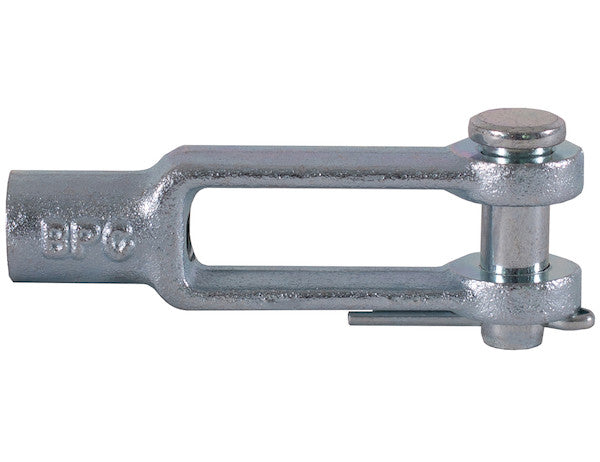
Buyers Products Clevis Rod End with Pin and Cotter Pin is used for pivot point linkages on air cylinders, shafts, rods, and other assemblies. The kit comes complete with a clevis pin and cotter pin for fast assembly. It is zinc-plated for corrosion resistance and comes in multiple sizes for a variety of applications.
Specifications
| Base to Hole Center (in.) | 1.903 |
|---|---|
| Bottom of Clevis Pin Head to Bottom of Pin (Maximum Usable Length) | 1.563 |
| Center Hole to Neck (in.) | 1.250 |
| Chamfer Angle | 15 |
| Chamfer Length | .156 |
| Clevis Pin Diameter | .500 |
| Clevis Pin Head Bevel Length | .156 |
| Clevis Pin Head Diameter | .625 |
| Clevis Pin Hole Dia. (in.) | 0.969 |
| Clevis Pin Hole Drill Number | 29 |
| Clevis Pin Incl. (y/n) | Yes |
| Color | Zinc |
| Finish | Zinc Plated |
| Height of Yoke Arm (in.) | 0.847 |
| Hole Dia. (in.) | 0.500 |
| Inner Arm to Arm (in.) | 0.594 |
| Material | Forged Steel |
| Neck Dia. (in.) | 0.844 |
| Neck Length (in.) | 0.563 |
| NOTUSED | 1.344 |
| Overall Pin Length | 1.750 |
| Thread Size (in.) | 5/8-18 |
| Type | Standard |
| Width (in.) | 1.281 |
The B27087C 5/8 Inch Clevis with Pin and Cotter Pin Kit: An In-Depth Technical Overview
The B27087C clevis with pin and cotter pin kit represents a robust and precisely engineered solution for creating reliable pivot point linkages across a diverse range of industrial and mechanical applications. Designed and manufactured by Buyers Products, a leader in robust component solutions, this kit embodies a commitment to durability, operational efficiency, and straightforward integration. This comprehensive description delves into the technical intricacies, material science, application versatility, and performance benefits of the B27087C system, providing engineers, designers, and maintenance professionals with the detailed insights necessary for optimal system design and implementation.
Precision Engineering for Critical Pivot Points
At its core, the B27087C clevis functions as a critical mechanical connector, specifically designed to establish a single-axis pivot point. This mechanism is indispensable in systems requiring controlled angular motion, linear actuation, or the transmission of forces through a flexible joint. Unlike rigid connections, the clevis allows for relative rotation between connected components, preventing bending stresses in linear actuators or shafts and accommodating slight misalignments inherent in dynamic systems. The B27087C’s 5/8-inch threaded shank (5/8-18 Unified National Coarse thread, a standard and robust thread form) is engineered for secure attachment to corresponding threaded rods, shafts, or other mechanical elements, forming an integral part of a linkage assembly.
The design of the clevis involves a ‘yoke’ or ‘forked’ end with two parallel arms, each containing a precisely bored hole. These holes are designed to perfectly accommodate the supplied 0.500-inch diameter clevis pin. The pin then passes through these arms and a corresponding hole in the mating component, effectively forming the pivot. The exact dimensions, such as the Inner Arm to Arm measurement of 0.594 inches, are critical for ensuring proper fit and minimizing lateral play, thereby enhancing the precision and longevity of the joint. The Hole Diameter of 0.500 inches precisely matches the Clevis Pin Diameter, guaranteeing a snug fit essential for efficient force transmission and reducing wear over time.
Comprehensive Component Breakdown: Form and Function
The B27087C kit is deliberately assembled to provide all necessary elements for immediate and secure deployment, reducing procurement complexity and ensuring compatibility. Each component is meticulously engineered to contribute to the overall integrity and performance of the linkage:
The Clevis Rod End (Forged Steel Construction)
The primary structural component, the clevis rod end, is fabricated from forged steel. Forging enhances the material's structural integrity by refining its grain structure, resulting in superior strength, toughness, and fatigue resistance compared to cast or machined components. This is paramount for components subjected to repetitive loading, shock, or high static forces in demanding operational environments. The precise dimensions of the clevis are detailed in the specifications, each serving a specific engineering purpose:
- Thread Size (5/8-18): This standard thread provides a secure mechanical connection to a mating threaded rod or shaft. The 18 threads per inch (TPI) offer a balance between thread strength and ease of assembly.
- Neck Diameter (0.844 in.) and Neck Length (0.563 in.): These define the robust connection point, ensuring adequate material strength around the threaded section to withstand axial and torsional loads.
- Base to Hole Center (1.903 in.): This measurement is crucial for determining the overall effective length of the linkage and for calculating lever arms in mechanical advantage applications.
- Center Hole to Neck (1.250 in.): Provides adequate spacing between the pivot point and the threaded shank, allowing for necessary clearance and proper articulation.
- Inner Arm to Arm (0.594 in.): This critical dimension dictates the maximum width of the mating component that can be housed within the clevis yoke, minimizing lateral movement and potential for binding.
- Hole Diameter (0.500 in.): The diameter of the bore through the clevis arms, designed for precise fit with the 0.500-inch clevis pin.
- Height of Yoke Arm (0.847 in.) and Width (1.281 in.): These dimensions contribute to the structural rigidity of the yoke, ensuring it can withstand shear forces transmitted through the pin without splaying or deforming.
- Chamfer Angle (15°) and Chamfer Length (0.156 in.): These features provide a lead-in for easy pin insertion, minimize stress concentrations, and enhance safety during handling.
The Clevis Pin (0.500 Inch Diameter)
The clevis pin is the central element of the pivot point, subjected to significant shear stress during operation. For the B27087C kit, a 0.500-inch diameter pin is included, manufactured to precise tolerances for optimal fit and performance. Key specifications of the pin include:
- Overall Pin Length (1.750 in.): Ensures the pin can fully traverse the clevis arms and the intermediate component, with sufficient length remaining for the cotter pin.
- Bottom of Clevis Pin Head to Bottom of Pin (Maximum Usable Length) (1.563 in.): This critical dimension represents the effective length of the pin that can engage components. It is vital to ensure the combined thickness of the clevis arms and the mating component does not exceed this value.
- Clevis Pin Head Diameter (0.625 in.) and Head Bevel Length (0.156 in.): The head prevents the pin from passing completely through the assembly, distributing load and providing a purchase for removal.
- Clevis Pin Hole Dia. (in.) (0.969 in.) and Clevis Pin Hole Drill Number (29): The 'Clevis Pin Hole Dia.' of 0.969 inches is notably large for a cotter pin on a 0.500-inch pin; this may indicate a field mislabel or an internal manufacturing reference. In practice, the hole for the cotter pin is significantly smaller and accurately drilled (as per Drill Number 29, equating to 0.1360 inches) to accept a standard cotter pin for retention. Users should verify cotter pin dimensions if this specific dimension is critical.
The Cotter Pin
The cotter pin serves as the essential retaining device, preventing the clevis pin from dislodging due to vibration, dynamic loads, or gravitational forces. Typically made from steel and often zinc-plated for consistency with the clevis and pin, it is inserted through the cross-drilled hole at the end of the clevis pin and its ends are bent to secure it. This simple yet effective mechanism ensures the integrity of the pivot joint under operational conditions, providing a fast, secure, and easily removable fastening solution.
Advanced Corrosion Protection: Zinc Plating
The B27087C kit components feature a zinc-plated finish, a crucial engineering specification that significantly extends the service life and maintains the aesthetic integrity of the hardware, particularly in environments susceptible to moisture, chemicals, or atmospheric corrosives. Zinc plating provides cathodic or sacrificial protection, meaning the zinc coating corrodes preferentially to the underlying steel substrate when exposed to corrosive elements. This electrochemical process prevents rust and oxidation of the vital forged steel components, preserving their structural strength and functional reliability. Key advantages of zinc plating include:
- Enhanced Durability: Provides a robust barrier against environmental degradation, prolonging the lifespan of the linkage assembly.
- Aesthetic Appeal: The bright, silvery-white appearance of zinc plating offers a clean, professional finish, suitable for exposed applications.
- Cost-Effectiveness: Zinc plating is a widely adopted and economical method for corrosion protection, offering excellent value.
- Reduced Maintenance: By inhibiting rust and corrosion, the need for frequent inspection, cleaning, and replacement of components is significantly reduced.
- Environmental Adaptability: Suitable for a broad range of industrial, automotive, and agricultural environments, though specific harsh chemical exposures may require assessment.
Diverse Applications Across Industries
The inherent versatility, robustness, and standardized dimensions of the B27087C clevis kit make it an indispensable component across a multitude of sectors requiring reliable mechanical linkages. Its application spans from heavy-duty industrial machinery to precision control systems:
- Hydraulic and Pneumatic Cylinder Actuation: Commonly used to connect the rod end of hydraulic or pneumatic cylinders to a driven load or a fixed anchor point, facilitating linear motion with angular flexibility.
- Agricultural Equipment: Critical for linkages on tractors, implements, and trailers, where robust, corrosion-resistant pivot points are essential for hitching, steering mechanisms, and control arms subjected to harsh outdoor conditions.
- Construction Machinery: Found in excavators, loaders, and cranes for boom linkages, bucket attachments, and steering systems, enduring high loads and abrasive environments.
- Material Handling Systems: Integral in conveyors, hoists, and lifting equipment, providing articulation for trolleys, arms, and gate mechanisms.
- Automotive and Transportation: Utilized in trailer hitches, suspension linkages, and certain control rod connections, where safety and reliability are paramount.
- Industrial Automation and Robotics: Employed in robotic arms, gantry systems, and automated machinery to create durable and precise pivot points for end-effectors, sensors, and structural members.
- Marine Applications: While zinc plating offers good initial protection, in direct saltwater exposure, regular inspection and maintenance, or selection of marine-grade stainless steel alternatives, may be considered for prolonged use in highly corrosive saltwater. For general atmospheric marine environments, zinc plating provides significant benefits.
- HVAC Systems: Used in damper controls and ventilation linkages, requiring smooth and reliable pivot action.
Installation, Maintenance, and Longevity Considerations
The design of the B27087C kit emphasizes ease of installation and long-term reliability. Proper installation involves threading the clevis onto the mating rod or shaft to the appropriate depth, ensuring secure engagement of the 5/8-18 threads. The mating component is then positioned between the clevis arms, the 0.500-inch clevis pin is inserted through all aligned holes, and finally, the cotter pin is installed through the cross-drilled hole in the clevis pin and bent to prevent dislodgment.
For sustained performance, routine inspection is recommended. This includes checking for:
- Wear and Tear: Inspecting the clevis arms, pin, and mating component for signs of excessive wear, elongation of holes, or deformation.
- Corrosion: While zinc plating provides excellent resistance, in severely aggressive environments, signs of red rust or white rust should prompt evaluation.
- Cotter Pin Integrity: Ensuring the cotter pin is present, properly bent, and not fatigued or damaged.
- Threaded Connection: Verifying the clevis remains tightly fastened to its threaded rod, preventing loosening under vibration or dynamic loads.
The forged steel construction and zinc-plated finish contribute significantly to the expected longevity of the B27087C kit under normal operating conditions. Adherence to specified load limits and environmental guidelines will further maximize its service life.
Detailed Technical Specifications and Engineering Implications
A granular understanding of each specification provided is essential for precise engineering and integration:
- Base to Hole Center (1.903 in.): This critical dimension defines the effective length from the attachment point to the pivot axis, essential for calculating linkage geometry and motion profiles.
- Bottom of Clevis Pin Head to Bottom of Pin (Maximum Usable Length) (1.563 in.): This dictates the total permissible stack-up thickness of components (clevis arms plus intermediate linkage element) the pin can accommodate.
- Center Hole to Neck (1.250 in.): This measurement contributes to the overall length and is important for clearance considerations within an assembly.
- Chamfer Angle (15°) and Chamfer Length (0.156 in.): These features on the bore entrance facilitate easier pin insertion, reducing assembly time and mitigating stress concentrations.
- Clevis Pin Diameter (0.500 in.): This is the fundamental load-bearing dimension for shear forces. Its precise manufacturing ensures minimal play within the clevis holes (0.500 in.), directly impacting joint stiffness and wear rates.
- Clevis Pin Head Bevel Length (0.156 in.) and Clevis Pin Head Diameter (0.625 in.): The head provides a positive stop and distributes load against the outer clevis arm, preventing pull-through and aiding retention.
- Clevis Pin Hole Dia. (in.) (0.969 in.): As noted, this dimension is unexpectedly large for a cotter pin hole on a 0.500-inch pin, likely an internal reference or mislabel. The actual cotter pin hole will be appropriately sized for standard cotter pin retention.
- Clevis Pin Hole Drill Number (29): Specifies the precise drill bit size (0.1360 inches) for the cotter pin hole, ensuring consistent and reliable cotter pin insertion.
- Clevis Pin Incl. (y/n) (Yes): Confirms that the kit is complete with its essential fastening element for immediate use.
- Color (Zinc) and Finish (Zinc Plated): These attributes confirm the protective coating, offering immediate visual identification and reassurance of corrosion resistance.
- Height of Yoke Arm (0.847 in.): This provides strength and rigidity to the clevis arms, preventing them from splaying apart under load, which would compromise the pivot.
- Hole Dia. (in.) (0.500 in.): This is the internal diameter of the bore through the clevis arms, directly matching the clevis pin diameter for a precise fit.
- Inner Arm to Arm (0.594 in.): This critically important dimension defines the maximum permissible thickness of the component that can be mounted between the clevis arms, crucial for proper function and to prevent binding.
- Material (Forged Steel): Denotes a high-strength, ductile, and fatigue-resistant material, ideal for demanding mechanical linkages.
- Neck Dia. (0.844 in.) and Neck Length (0.563 in.): These dimensions specify the robust proportions of the transition area between the threaded shank and the main body of the clevis, critical for resisting bending and shear forces at the thread root.
- Overall Pin Length (1.750 in.): The total length of the clevis pin, ensuring adequate material for all engaged components and the cotter pin retention feature.
- Thread Size (in.) (5/8-18): A precise mechanical interface standard for attachment. This signifies compatibility with 5/8-inch diameter rods featuring 18 threads per inch.
- Type (Standard): Indicates a conventional design that adheres to established engineering practices and is broadly compatible with existing systems.
- Width (in.) (1.281 in.): The overall maximum lateral dimension of the clevis body, important for clearance in tight installations.
Engineering Considerations for Optimal Performance
When integrating the B27087C clevis kit into a mechanical system, several engineering principles should be considered:
- Load Capacity: The ultimate load capacity is determined by the weakest link, which can be the shear strength of the pin, the bearing strength of the clevis arms, or the tensile strength of the threaded rod. Designers must perform calculations to ensure components meet or exceed maximum anticipated loads.
- Fatigue Life: For applications involving repetitive cyclic loading, the fatigue properties of the forged steel and pin material are critical. Design should ensure stresses remain below the material's fatigue limit.
- Alignment and Angularity: Clevis joints accommodate angular misalignment within limits. Understanding the required range of motion and ensuring the design does not induce excessive binding or stress concentrations is vital.
- Vibration and Loosening: The cotter pin effectively resists loosening of the clevis pin. For the threaded connection, standard industrial practices such as thread lock compounds or jam nuts may be employed if severe vibration is anticipated.
- Environmental Factors: While zinc plating provides substantial protection, extreme temperatures, direct exposure to highly corrosive chemicals, or continuous immersion may necessitate alternative materials or more specialized coatings.
Conclusion: A Reliable Foundation for Mechanical Linkages
The B27087C 5/8 Inch Clevis with Pin and Cotter Pin Kit from Buyers Products stands as a testament to precision engineering, robust material selection, and effective corrosion protection. Its forged steel construction provides exceptional strength and durability, while the zinc-plated finish ensures longevity in challenging environments. The comprehensive kit, including the precisely dimensioned clevis, pin, and cotter pin, offers a ready-to-deploy solution for establishing secure and flexible pivot point linkages. From heavy machinery and agricultural equipment to industrial automation and material handling, the B27087C provides the reliability and performance required for critical mechanical connections, ensuring efficient operation and sustained service life. For design engineers and maintenance personnel, this kit represents a meticulously specified and dependable choice, streamlining assembly and contributing to the overall integrity of any mechanical system.