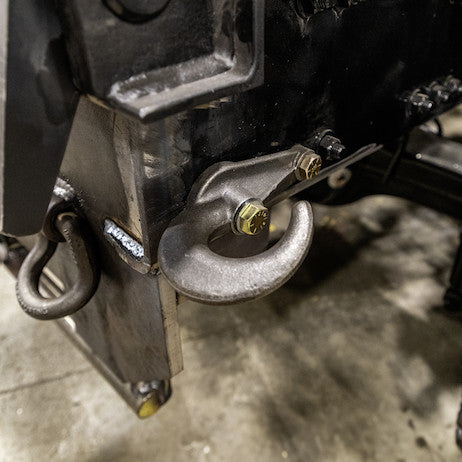
Drop-Forged Towing Hook Pairs from Buyers Products are installed on a bus or truck to allow it to be efficiently pulled from a ditch or other recovery towing situation. The hooks are bolted to the right and left sides of the front or rear of the frame for easy access to the towing vehicle. They are rated for a working load limit of 13,500 lb. The hooks come in pairs of right- and left-hand patterns. Choose from black powder-coated or chrome-plated finishes, or no finish.
Specifications
| Capacity (lbs) | 13,500 |
|---|---|
| Finish | Plain |
| Material | Forged Steel |
| Mounting Hole Diameter (in.) | .78 |
| Mounting Holes Center to Center (in.) | Vertical 4.25 |
In the demanding realm of commercial vehicle operations, the reliability and robust engineering of recovery equipment are not merely beneficial, but absolutely paramount. The Plain Finish Drop Forged Towing Hook Pairs offered by Buyers Products represent a critical component in ensuring the expeditious and safe recovery of heavy-duty vehicles such as buses and trucks from challenging situations, including ditches, soft terrain, or post-incident scenarios. These towing hook pairs are meticulously engineered to provide secure and accessible attachment points, thereby significantly enhancing operational readiness and mitigating potential downtime associated with vehicle immobilization.
The inherent strength and durability of these towing hooks are primarily attributed to their manufacturing process: drop forging. Drop forging is a sophisticated metal forming technique wherein a metal workpiece, heated to a plastic state, is subjected to compressive forces from repeated blows by a hammer or press. This process fundamentally refines the internal grain structure of the steel, aligning it with the contours of the hook's shape. Unlike casting, which involves pouring molten metal into a mold and can introduce internal voids, porosity, and anisotropic grain structures that compromise strength, drop forging compresses and elongates the metal. This results in a continuous grain flow that follows the part's shape, leading to vastly superior mechanical properties, including enhanced tensile strength, yield strength, impact toughness, and fatigue resistance. For a component subjected to the intense, often unpredictable, dynamic loads of vehicle recovery, the integrity afforded by drop forging is indispensable. The absence of internal defects and the optimized grain structure ensure that stress is uniformly distributed, minimizing the risk of catastrophic failure under extreme conditions. This rigorous manufacturing approach substantiates the product's suitability for high-stress applications, offering a significant safety margin beyond what could be achieved through less intensive manufacturing methods.
The material chosen for these towing hooks is high-grade forged steel, a decision predicated on its superior metallurgical characteristics vital for recovery operations. Forged steel, particularly when properly alloyed and heat-treated, exhibits an exceptional balance of hardness, strength, and ductility. Key mechanical properties include a high tensile strength, which is the maximum stress the material can withstand while being stretched or pulled before breaking, and a robust yield strength, representing the stress level at which the material begins to deform permanently. Furthermore, forged steel provides excellent impact toughness, meaning it can absorb significant energy from sudden impacts or shock loads without fracturing, a common occurrence in recovery scenarios where forces can be abrupt and uneven. The inherent resistance to abrasion and wear ensures a prolonged service life, even with repeated exposure to harsh environmental conditions and mechanical stresses. The specific grade of steel employed is selected for its ability to accept various heat treatments post-forging, such as quenching and tempering. Quenching involves rapidly cooling the steel from a high temperature to harden it, while tempering subsequently reduces brittleness and improves ductility and toughness without significantly compromising hardness. This precise control over the material's microstructure is pivotal in achieving the 13,500 lb Working Load Limit (WLL) while maintaining a substantial safety factor against ultimate breaking strength.
The design and engineering of these towing hook pairs reflect a deep understanding of practical recovery mechanics. Each hook features a thoughtfully configured geometry, including an optimized throat opening that facilitates easy connection with various towing straps, chains, or ropes, while also ensuring secure retention during recovery operations. The radius of the hook's bend is engineered to distribute stress effectively, preventing stress concentrations that could lead to premature material fatigue or failure. The shank of the hook is designed for secure bolting to the vehicle's frame, presenting a robust interface for load transfer. Crucially, the hooks are provided in right- and left-hand patterns. This symmetrical configuration is not merely an aesthetic choice; it ensures that the hooks can be mounted in a balanced manner on either side of the vehicle frame, providing ergonomically sound access and, more importantly, ensuring even load distribution during a pull. Symmetrical mounting minimizes torsional stresses on the vehicle frame and offers consistent performance regardless of the approach angle of the recovery vehicle, thereby enhancing the safety and efficiency of the entire operation. Adherence to industry-recognized design principles for recovery points ensures that these hooks perform predictably and reliably under their specified load conditions.
This particular product variant features a "Plain Finish," which, in an industrial context, signifies that the forged steel component is provided in its raw, unfinished state, without any protective coating such as paint, powder coat, or plating. This choice offers several distinct advantages for specific applications. Primarily, a plain finish is cost-effective, reducing the overall product expense by eliminating the need for additional surface treatment processes. More significantly, it provides immense versatility for end-users. A plain finish allows for custom painting to match a vehicle's existing color scheme, or for the application of specialized coatings tailored to unique environmental challenges, such as extreme corrosion resistance in marine environments or chemical resistance in industrial settings. Furthermore, for fabrication shops or vehicle manufacturers who integrate these hooks into larger assemblies, a plain finish is ideal for welding applications. The absence of an existing coating eliminates the need for preparatory grinding or stripping, simplifying the welding process and ensuring superior weld integrity. While a plain finish offers these benefits, it also necessitates a consideration for corrosion prevention. In environments where the hooks will be exposed to moisture, road salts, or other corrosive agents, the end-user will need to apply a suitable protective coating or ensure regular maintenance to prevent surface oxidation and rust, thereby preserving the structural integrity and aesthetic appeal of the component over its service life.
The 13,500 lb Working Load Limit (WLL) is a critical specification, directly indicating the maximum static load that these towing hooks are designed to safely support in a recovery operation. It is imperative to understand that WLL is distinct from the ultimate breaking strength (UBS). The WLL incorporates a significant safety factor, typically 3:1 or 4:1 for towing and lifting equipment, meaning the UBS is considerably higher than the stated WLL. This safety factor is intentionally integrated into the design to account for various unpredictable variables encountered during actual use, including dynamic loading, shock loads, minor material imperfections, and potential misuse. Dynamic loads, which are forces that change over time, are particularly relevant in towing and recovery, as sudden jerks or movements can momentarily exert forces far exceeding a static load. The WLL provides a clear operational threshold, and under no circumstances should this limit be exceeded, as doing so can lead to material deformation, structural damage to the hook, or, in severe cases, catastrophic failure, posing grave safety risks to personnel and property. Proper load assessment, careful selection of recovery equipment, and adherence to the WLL are fundamental to executing safe and successful vehicle recovery operations. This capacity rating positions these hooks firmly within the heavy-duty segment, suitable for a wide array of commercial trucks, utility vehicles, and municipal fleet assets.
The precision mounting specifications – a .78-inch mounting hole diameter and a 4.25-inch vertical center-to-center spacing – are engineered for optimal compatibility and secure attachment to heavy-duty vehicle frames. The .78-inch diameter hole is dimensioned to accommodate common high-strength fasteners, typically 3/4-inch diameter bolts (e.g., SAE Grade 8 or ASTM A325 structural bolts), which are standard in heavy-duty vehicle construction. The selection of appropriately graded fasteners is as crucial as the hook itself; bolts should be chosen for their shear and tensile strength properties to match or exceed the stresses imposed during recovery. The 4.25-inch vertical center-to-center spacing is a common industry standard for mounting various accessories on vehicle frame rails, ensuring broad compatibility with a multitude of truck and bus chassis designs. This standardized spacing facilitates straightforward installation, whether as original equipment or as an aftermarket upgrade, by often aligning with existing frame holes or providing a predictable pattern for new drilling. Precise drilling, reaming, and alignment during installation are paramount to prevent undue stress concentrations around the bolt holes. The use of hardened washers under both the bolt head and nut is recommended to distribute clamping force over a larger area, minimize wear on the frame, and prevent fastener pull-through. Furthermore, proper torque application, as specified by fastener manufacturers and vehicle engineers, is essential to achieve the designed clamping force, which prevents loosening under vibration and dynamic loads, thereby ensuring the long-term integrity and safety of the installation. Consideration should also be given to the structural integrity of the vehicle frame at the mounting points; additional frame reinforcement might be necessary depending on the specific vehicle and anticipated recovery forces, always in accordance with vehicle manufacturer guidelines.
The operational applications for these Plain Finish Drop Forged Towing Hook Pairs are extensive, spanning a broad spectrum of commercial sectors. They are indispensable for municipal service vehicles, including sanitation trucks, snow plows, and utility repair trucks, which frequently operate in challenging urban and off-road environments. Construction and agricultural vehicles, often working on uneven or soft ground, rely heavily on such recovery points. Over-the-road transport vehicles, including tractor-trailers and delivery trucks, can become immobilized due to breakdowns, accidents, or adverse weather, making these hooks essential for roadside assistance and accident recovery services. Emergency service vehicles, while typically equipped with their own towing capabilities, may also require recovery points for specialized circumstances. Typical recovery scenarios include pulling a vehicle from a roadside ditch, extricating it from muddy or sandy terrain, repositioning a disabled vehicle at a loading dock, or safely moving a vehicle involved in a minor incident. Beyond the equipment, rigorous safety protocols are paramount during any recovery operation. This includes comprehensive pre-use inspection of the hooks, fasteners, and the surrounding frame area for any signs of wear, damage, or deformation. Personnel must be trained in proper connection techniques, ensuring the towing line is securely attached and free from kinks or twists. Maintaining a safe working distance, establishing clear communication protocols between the recovery vehicle operator and ground personnel, and ensuring that all bystanders are well clear of the operational zone are non-negotiable safety mandates. The selection of appropriate towing lines, chains, or straps, with capacities matching or exceeding the WLL of the hooks, is also critical to ensure the safety and success of the recovery.
The inherent durability of drop-forged steel, combined with robust design principles, contributes significantly to the longevity and minimal maintenance requirements of these towing hooks. However, even the most durable components benefit from a proactive maintenance regimen. Regular visual inspections are critical to detect any signs of wear, such as thinning of the hook's cross-section in high-contact areas, or any discernible deformation, which could indicate overloading or material fatigue. Cracks, especially at high-stress points or near weld seams (if present), warrant immediate replacement. Surface corrosion, while expected with a plain finish if unprotected, should be monitored to ensure it does not compromise the structural integrity. Cleaning off accumulated dirt, mud, and road salt can prevent accelerated corrosion and allow for more accurate inspections. Periodically re-torquing the mounting fasteners to their specified values is crucial to counteract the effects of vibration and dynamic loading, which can cause bolts to loosen over time. Any hook exhibiting permanent deformation, significant material loss, or stress cracking should be immediately removed from service and replaced to prevent potential failure during subsequent use. Proper storage when not in use, away from prolonged exposure to harsh elements, can further extend the lifespan of these valuable recovery assets. This proactive approach to maintenance and inspection not only preserves the functional integrity of the hooks but also underpins the overall safety of vehicle recovery operations, maximizing return on investment through extended service life and unwavering reliability.
Adherence to industry standards and regulatory compliance is an integral aspect of the design and application of the Plain Finish Drop Forged Towing Hook Pairs. While specific standards for dedicated vehicle recovery hooks can vary by region, their design and material selection are typically informed by broader standards governing lifting and rigging hardware (e.g., ASME B30.26 for detachable rigging hardware), automotive components (e.g., various SAE International standards related to vehicle connections and structural integrity), and material specifications (e.g., ASTM International standards for steel properties). The manufacturers of these hooks commit to engineering principles that align with best practices for heavy-duty applications, ensuring that the WLL is established with appropriate safety factors and that the materials and manufacturing processes yield a product capable of performing reliably in demanding conditions. Furthermore, end-users are encouraged to consult their vehicle manufacturer's guidelines regarding the installation of accessories and the modification of vehicle frames, as improper installation can void warranties or compromise the vehicle's structural integrity. Compliance with all local, state, and federal Department of Transportation (DOT) regulations pertaining to vehicle safety and recovery equipment is also essential for safe and legal operation. By providing a product that meets rigorous performance criteria and facilitates compliant recovery operations, these towing hooks serve as a responsible and effective solution for commercial fleet management.
In conclusion, the Plain Finish Drop Forged Towing Hook Pairs from Buyers Products are more than just simple metal components; they are engineered solutions critical to the operational continuity and safety of commercial vehicle fleets. Through the advantages of drop forging, the inherent strength of high-grade steel, meticulous design, a practical plain finish, and a rigorously tested 13,500 lb WLL, these hooks provide robust, reliable, and accessible recovery points. Their standardized mounting pattern ensures broad compatibility and ease of installation, while their capacity and durability make them indispensable for a wide array of demanding recovery scenarios. Investing in these technically superior towing hooks represents a commitment to safety, efficiency, and longevity, safeguarding both valuable vehicle assets and the personnel involved in their operation. They embody the blend of material science, precision engineering, and practical functionality required to meet the challenges of heavy-duty vehicle recovery in any environment.