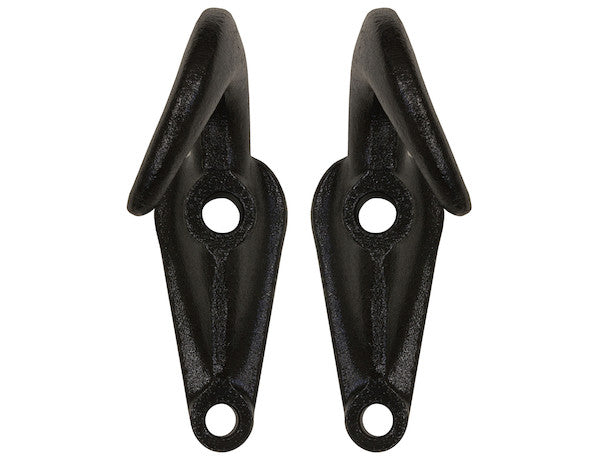
Drop-Forged Towing Hook Pairs from Buyers Products are installed on a bus or truck to allow it to be efficiently pulled from a ditch or other recovery towing situation. The hooks are bolted to the right and left sides of the front or rear of the frame for easy access to the towing vehicle. They are rated for a working load limit of 13,500 lb. The hooks come in pairs of right- and left-hand patterns. Choose from black powder-coated or chrome-plated finishes, or no finish.
Specifications
| Capacity (lbs) | 13,500 |
|---|---|
| Color | Black |
| Finish | Powder-Coat |
| Material | Forged Steel |
| Mounting Hole Diameter (in.) | .794 |
| Mounting Holes Center to Center (in.) | Vertical 4.25 |
The Black Powder Coated Drop Forged Towing Hook Pairs represent a pinnacle of engineering and material science applied to critical vehicle recovery operations. Designed with precision and manufactured to exacting standards, these towing hooks are indispensable components for buses, heavy-duty trucks, and utility vehicles requiring robust and reliable recovery points. This comprehensive technical overview delves into the core attributes, manufacturing processes, performance specifications, and operational considerations that define the superior quality and functionality of these essential vehicle accessories.
At the heart of these towing hooks lies the advanced manufacturing technique of drop forging. Drop forging is a metal forming process that involves shaping metal, typically steel, by subjecting it to localized compressive forces using hammers or presses within custom-designed dies. Unlike casting, which involves pouring molten metal into a mold, or machining, which removes material, forging rearranges the internal grain structure of the metal. This process is initiated by heating a metal billet to its plastic deformation temperature, then placing it between open or closed dies. The application of repeated, high-impact blows or continuous pressure forces the metal to conform to the die cavity. The primary advantage of drop forging, particularly for components subjected to high dynamic and static stresses like towing hooks, is the creation of a continuous grain flow that follows the contours of the part. This optimized grain structure significantly enhances the material's mechanical properties, including tensile strength, yield strength, fatigue resistance, and impact toughness, making the forged part substantially stronger and more durable than parts produced by other methods. For a towing hook, which must withstand immense, often sudden, forces during vehicle recovery, this inherent strength and metallurgical integrity are paramount for ensuring operational safety and product longevity. The absence of internal voids or porosity, common in cast components, further reduces the risk of catastrophic failure under extreme loads.
Complementing the inherent strength of drop-forged steel is the protective and aesthetic black powder-coated finish. Powder coating is a dry finishing process where finely ground particles of pigment and resin are electrostatically charged and sprayed onto a grounded metal substrate. The charged powder particles adhere to the electrically grounded surfaces until heated and fused into a smooth coating in a curing oven. This process results in a durable finish that is significantly tougher than conventional liquid paint. The black powder coating on these towing hooks offers multi-faceted benefits. Firstly, it provides exceptional corrosion resistance, forming a robust barrier against environmental aggressors such as moisture, road salts, chemicals, and UV radiation, which are prevalent in outdoor and automotive environments. This resistance is crucial for maintaining the structural integrity of the steel over time and preventing rust, which can compromise the hook's load-bearing capacity. Secondly, the powder coat offers superior abrasion and impact resistance, safeguarding the hooks from chips, scratches, and minor mechanical damage that can occur during use or storage. This not only preserves the aesthetic appearance but also protects the underlying steel from exposed areas where corrosion could initiate. Thirdly, the black finish offers a professional and understated aesthetic that complements the rugged utility of heavy-duty vehicles. The absence of volatile organic compounds (VOCs) in the powder coating process also makes it an environmentally responsible choice, aligning with modern industrial sustainability practices. This combination of advanced forging and resilient surface treatment ensures that the towing hooks maintain their peak performance and appearance throughout their operational lifespan.
The specified Working Load Limit (WLL) of 13,500 lb for these towing hook pairs is a critical performance metric. WLL is defined as the maximum static load that a piece of lifting or towing equipment can safely support when new and in good condition, without fear of deformation or failure. It is typically calculated with a significant safety factor, often between 3:1 and 5:1, meaning the ultimate breaking strength of the hook is considerably higher than its stated WLL. This inherent safety margin is crucial for operations where unexpected dynamic loads, shock loads, or misaligned forces can temporarily exceed the nominal static load. For a vehicle recovery situation, where the exact forces involved can be unpredictable and include substantial inertial components, adherence to the WLL is non-negotiable for operator safety and equipment preservation. Exceeding the WLL can lead to permanent deformation, structural failure, and potentially dangerous projectile hazards. Users are strongly advised to always verify that the combined weight of the vehicle being recovered and any additional resistance (e.g., mud, incline, friction) does not surpass the rated WLL of the hooks. The explicit WLL rating provides a clear benchmark for safe operation, reflecting rigorous design and testing protocols that ensure the hooks perform reliably under severe conditions.
The design and material specifications further underscore the robust engineering of these towing hooks. Crafted from "Forged Steel," the choice of material is foundational to the hooks' performance. While specific alloy compositions can vary, forged steel for such applications typically refers to high-strength carbon or alloy steels, selected for their optimal balance of hardness, toughness, and ductility. These material properties ensure that the hooks can withstand high tensile and shear stresses without brittle fracture, and can absorb significant impact energy. The hooks are provided in "pairs of right- and left-hand patterns," which is crucial for balanced load distribution and correct vehicle integration. This design allows for symmetrical installation on the vehicle's frame, ensuring that towing forces are evenly distributed across two robust mounting points, thereby minimizing stress concentrations on the vehicle's chassis. Mounting is achieved by bolting the hooks to the "right and left sides of the front or rear of the frame." This standardized mounting approach facilitates easy access for towing vehicles and ensures that the recovery points are directly integrated into the most structurally sound components of the bus or truck frame. The specified "Mounting Hole Diameter (in.)" of 0.794 inches indicates a precise bore for accommodating heavy-duty fasteners, typically Grade 8 or equivalent bolts, which are designed to resist high shear and tensile forces. The "Mounting Holes Center to Center (in.) Vertical 4.25" further specifies the bolt pattern, crucial for ensuring compatibility with common vehicle frame configurations and for allowing secure, rigid attachment. This precise vertical spacing is engineered to provide maximum leverage and stability for the bolted connection, preventing rotation or excessive stress on individual fasteners during dynamic towing events.
Installation of these Black Powder Coated Drop Forged Towing Hook Pairs requires careful consideration and adherence to best practices to ensure optimal safety and performance. While the hooks are designed for straightforward bolting to the vehicle frame, several factors are paramount. Firstly, the structural integrity of the vehicle frame at the proposed mounting points must be thoroughly assessed. Any signs of corrosion, fatigue, or previous damage to the frame should be addressed before installation. Secondly, the correct grade and size of fasteners (bolts, nuts, and washers) are essential. Given the 0.794-inch mounting hole diameter, suitable high-strength bolts, such as ASTM A490 or SAE Grade 8, are recommended to match the strength of the forged steel hooks and withstand the significant shear and tensile loads encountered during towing. These fasteners must be torqued to the vehicle manufacturer's specifications or industry standards for heavy-duty applications to ensure a secure, permanent attachment that resists loosening due to vibration or dynamic forces. Using thread-locking compounds can further enhance fastener retention. Thirdly, the left and right-hand patterns must be correctly identified and installed to ensure proper orientation and ergonomic access. The symmetrical placement on the front or rear of the vehicle frame is critical not only for balanced load distribution but also for maintaining the vehicle's stability and steering control during recovery operations. Professional installation is highly recommended to ensure all aspects of mounting, fastener selection, and torque specifications are correctly applied, thereby maximizing the safety and effectiveness of the towing hooks.
Beyond initial installation, ongoing maintenance and inspection are vital for ensuring the continued reliability and safety of the Black Powder Coated Drop Forged Towing Hook Pairs. Heavy-duty towing equipment operates in demanding environments, subjected to varying weather conditions, road debris, and substantial mechanical stresses. Regular visual inspections should be performed before and after each use, and periodically even when not in active service. Key areas of inspection include: the integrity of the powder coat finish for signs of chipping, peeling, or significant abrasion that could expose the underlying steel to corrosion; the presence of any cracks, deformation, bending, or excessive wear on the hook body, particularly around critical stress points like the hook throat, eye, or mounting holes; and the condition of the mounting hardware, ensuring bolts are tight, washers are intact, and there is no evidence of elongation in the bolt holes or frame material. Any signs of damage, fatigue, or compromise to the hook or its mounting points necessitate immediate replacement. Attempting to repair or straighten a damaged hook is strictly prohibited, as it can alter the metallurgical properties of the forged steel and compromise its WLL, leading to unpredictable failure. Maintaining a clean finish on the hooks can also aid in early detection of potential issues. Proactive maintenance and a rigorous inspection regimen are foundational to extending the service life of the hooks and, most importantly, ensuring the safety of personnel and equipment during critical recovery operations.
In summary, the Black Powder Coated Drop Forged Towing Hook Pairs are engineered components designed for unparalleled performance in demanding vehicle recovery scenarios. Their superior strength is derived from the precision drop-forging process, which optimizes the internal grain structure of high-quality steel for enhanced tensile strength, fatigue resistance, and impact toughness. The resilient black powder-coated finish provides advanced protection against corrosion, abrasion, and environmental degradation, ensuring longevity and maintaining a professional appearance. With a robust Working Load Limit of 13,500 lb, these hooks offer a clear and reliable safety margin for heavy-duty applications. The meticulously designed right and left-hand patterns, combined with specific mounting hole dimensions and spacing, facilitate secure and balanced integration with vehicle frames. Adherence to professional installation guidelines, including the use of appropriate high-grade fasteners and correct torque specifications, is essential for maximizing their operational integrity. Furthermore, a diligent program of regular inspection and maintenance is critical for identifying and addressing any potential wear or damage, thereby ensuring the continued safety and reliability of these vital recovery components. These towing hooks are not merely accessories but fundamental safety devices, reflecting a commitment to engineering excellence and operational robustness for the most challenging recovery situations encountered by buses and heavy-duty trucks.