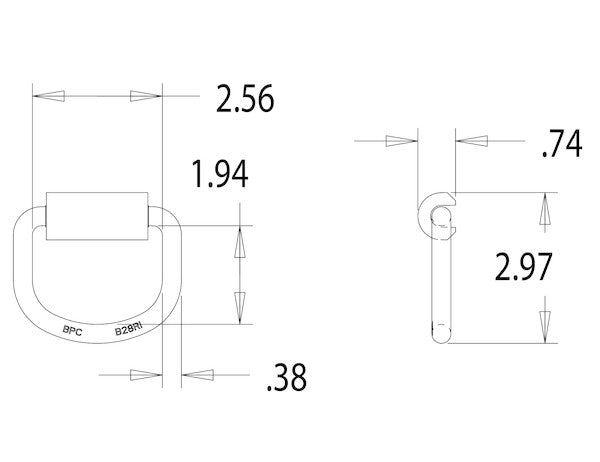
Buyers Products Heavy Duty Rope Ring is made of zinc-plated steel and carries a working load limit of 2,000 lb. The durable weld-on bracket can be installed on a wide range of surfaces. Rope rings are not approved for lifting.
Specifications
| Min. Breaking Strength (lbs) | 6,000 |
|---|---|
| Mount Type | Weld-On |
| W.L.L. (lbs) | 2,000 |
Advanced Technical Overview: 3/8 Inch Heavy Duty Rope Ring with Weld-On Mounting Bracket, Zinc Plated
The Buyers Products 3/8 Inch Heavy Duty Rope Ring with Weld-On Mounting Bracket represents a critical component in advanced cargo securement systems for a diverse range of industrial, commercial, and recreational applications. Engineered for superior durability and performance, this rope ring is specifically designed to provide robust, permanent attachment points for securing various types of loads. Its technical specifications and material composition underscore its suitability for demanding environments where reliable cargo retention is paramount.
Material Science and Corrosion Resistance: Zinc-Plated Steel Construction
The foundation of this heavy-duty rope ring's performance lies in its material — high-grade steel, enhanced with a zinc-plated finish. Steel, renowned for its excellent strength-to-weight ratio and inherent mechanical properties, provides the structural integrity necessary to withstand significant tensile and shear forces encountered during cargo securement. The specific grade of steel employed ensures a balance of hardness, ductility, and fatigue resistance, critical for components subjected to dynamic loads and vibrations.
The application of a zinc-plated coating is a deliberate engineering choice aimed at significantly enhancing the rope ring's longevity and performance in challenging environmental conditions. Zinc plating, a form of galvanization, involves electrodepositing a thin layer of zinc onto the steel substrate. This process imparts several key advantages:
- Sacrificial Corrosion Protection: Zinc acts as a sacrificial anode. In the presence of moisture and oxygen, zinc preferentially corrodes before the underlying steel, thereby protecting the steel base metal from rust and oxidation. This galvanic protection is particularly effective even if the coating is scratched or slightly damaged, as the surrounding zinc will continue to protect the exposed steel.
- Barrier Protection: The zinc layer physically separates the steel from corrosive elements in the environment, forming a robust barrier against moisture, salt spray, chemicals, and industrial pollutants. This is crucial for components exposed to outdoor elements, road salts, and harsh weather conditions.
- Enhanced Durability: The zinc coating provides a harder outer surface, offering improved resistance to minor abrasions and wear, thereby extending the service life of the rope ring.
- Aesthetic Retention: Beyond its functional benefits, zinc plating maintains a clean, professional appearance over time, resisting the unsightly red rust typically associated with untreated steel.
The selection of zinc-plated steel ensures that the rope ring maintains its structural integrity and aesthetic quality over an extended operational lifespan, minimizing maintenance requirements and replacement costs.
Dimensional Engineering: The Significance of 3/8 Inch Gauge
The "3/8 inch" designation refers to the nominal diameter or thickness of the steel stock used to form the rope ring itself. This dimension is not arbitrary; it is a critical engineering parameter that directly correlates with the component's load-bearing capacity and structural rigidity. A 3/8 inch (approximately 9.5 mm) diameter signifies a substantial cross-sectional area for the steel, which is fundamental to achieving the specified Working Load Limit (WLL) and Minimum Breaking Strength (MBS).
- Load Distribution: A thicker gauge allows for better distribution of stress across the material, reducing localized stress concentrations that could lead to deformation or failure under load.
- Resistance to Deformation: The 3/8 inch thickness provides inherent stiffness, resisting bending, twisting, and ovalling under the dynamic forces exerted by cargo straps, ropes, or chains.
- Compatibility: This gauge is appropriately sized to accommodate a wide range of common cargo securement devices, including various hook sizes, ropes, and webbing straps, ensuring versatility without compromising strength.
The substantial 3/8 inch construction directly contributes to the rope ring's "Heavy Duty" classification, making it suitable for securing medium to heavy loads with confidence.
Load Ratings: WLL (2,000 lbs) and MBS (6,000 lbs) – A Critical Analysis
Understanding the specified load ratings is paramount for safe and effective operation. The Buyers Products Rope Ring is rated with a Working Load Limit (WLL) of 2,000 lbs and a Minimum Breaking Strength (MBS) of 6,000 lbs. These figures are not mere indicators of strength but are derived from rigorous testing and industry safety standards.
- Working Load Limit (WLL): The WLL represents the maximum static load that a piece of equipment, such as this rope ring, can safely support under normal operating conditions when properly applied. It is a conservative rating designed to prevent permanent deformation or material fatigue over time. The 2,000 lb WLL indicates that the rope ring is engineered to reliably secure loads up to this weight, assuming correct installation and proper securement techniques are employed.
- Minimum Breaking Strength (MBS): Also known as Ultimate Breaking Strength (UBS), the MBS is the minimum force at which the rope ring is guaranteed to fail or break under a single, direct, destructive load. The 6,000 lb MBS provides a critical safety margin. The ratio of MBS to WLL (6,000 lbs / 2,000 lbs = 3:1) is known as the safety factor.
- Safety Factor (3:1): A safety factor of 3:1 is standard for many cargo securement components. This means the product is designed to withstand three times its stated WLL before ultimate failure. This inherent overdesign accounts for various unpredictable factors in real-world applications, including dynamic loads (sudden braking, acceleration, turns), shock loads, material imperfections, temperature variations, and potential misuse or wear over time. It provides a crucial buffer to prevent catastrophic failure, even under unforeseen stresses.
It is imperative to note the explicit caution: "Rope rings are not approved for lifting." This statement is a critical safety directive. While the rope ring possesses significant strength, its design and intended application are solely for cargo securement (tie-down) purposes, where loads are restrained against movement on a surface. The forces involved in lifting operations are fundamentally different, involving complex tensile, shear, and rotational stresses that specialized lifting hardware is designed to accommodate. Using a tie-down rope ring for lifting applications could lead to unpredictable failure modes, property damage, severe injury, or even fatalities, and would void any manufacturer's warranty or liability.
Mounting Mechanism: The Advantages of a Weld-On Bracket
The choice of a weld-on mounting bracket is a defining feature that distinguishes this heavy-duty rope ring from bolt-on alternatives, offering superior structural integration and load transfer capabilities.
- Permanent and Integrated Connection: Welding creates a metallurgical bond between the bracket and the host structure (e.g., trailer frame, truck bed, utility vehicle chassis). This permanent connection essentially makes the rope ring an integral part of the vehicle's structure, eliminating the potential for loosening, rattling, or fastener failure that can occur with bolted connections over time, especially under heavy vibration and dynamic loads.
- Superior Strength and Load Transfer: A properly executed weld joint can often be stronger than the base material itself. Welding allows for a broad surface area of attachment, distributing loads more evenly into the vehicle's frame or body. This results in significantly higher shear and tensile strength compared to mechanical fasteners, which concentrate stress at specific bolt holes. This enhanced load transfer is crucial for securing heavy, shifting cargo.
- Versatility in Installation: The weld-on design offers significant flexibility in positioning. It can be affixed to virtually any steel surface with adequate thickness and structural integrity, allowing for highly customized securement configurations tailored to specific cargo types or vehicle designs. This is particularly advantageous for custom fabrication, trailer modifications, and specialized equipment transport.
- Reduced Protrusion: Weld-on brackets often have a lower profile than some bolted designs, potentially reducing snagging hazards or interference with cargo placement.
Technical Considerations for Welding: Professional installation is strongly recommended for weld-on brackets. Key considerations include:
- Base Material Compatibility: The bracket must be welded to a compatible steel substrate of sufficient thickness and quality to support the anticipated loads.
- Welding Process: Common welding processes like MIG (Gas Metal Arc Welding) or TIG (Gas Tungsten Arc Welding) are typically employed, requiring skilled operators and appropriate welding parameters (current, voltage, wire feed speed, shielding gas).
- Surface Preparation: The welding area must be thoroughly cleaned, free of paint, rust, grease, and other contaminants to ensure a strong, defect-free weld bead.
- Post-Weld Inspection: Welds should be visually inspected for uniformity, penetration, and absence of cracks or porosity. Non-destructive testing (NDT) may be employed in critical applications.
- Heat Management: Proper heat input control is essential to prevent warping or metallurgical changes to the base material or the bracket itself.
The weld-on mounting bracket transforms the rope ring from a simple accessory into a structurally integrated, high-strength securement point, maximizing safety and reliability.
Applications and Operational Context
The 3/8 Inch Heavy Duty Rope Ring with Weld-On Mounting Bracket is indispensable across a broad spectrum of industries and operational scenarios:
- Commercial Trucking and Logistics: Essential for flatbed trailers, enclosed dry vans, and specialized heavy-haul trailers for securing everything from construction materials (lumber, steel beams, pipes) to machinery (skid steers, forklifts, generators), agricultural equipment, and industrial components.
- Utility Vehicles and Service Trucks: Provides reliable tie-down points on utility bodies, service trucks, and custom fabrication vehicles for securing tools, equipment, spare parts, and specialized gear.
- Agricultural Sector: Used on farm trailers, implements, and utility vehicles for securing agricultural loads, feed, hay bales, and smaller machinery.
- Recreational and Marine Transport (Non-Lifting): Suitable for securing ATVs, UTVs, snowmobiles, motorcycles, or even small watercraft to trailers during transport. For marine environments, the zinc plating offers valuable corrosion protection against saltwater spray, though regular inspection remains vital.
- Construction and Industrial Sites: Integral for creating permanent securement points on job site equipment, stationary machinery bases, or custom-built jigs and fixtures where components need to be temporarily but firmly restrained.
- Custom Fabrication and OEM Integration: An ideal component for original equipment manufacturers (OEMs) and custom fabricators looking to integrate robust and reliable tie-down points into their product designs, such as specialty trailers, mobile workshops, or custom cargo solutions.
In all these applications, the primary function is to provide a reliable anchor point for various cargo securement devices such as ratchet straps, cam buckle straps, ropes, or chains, ensuring that the load remains stable and secure throughout transit, preventing shifting, tipping, or falling.
Compliance, Safety, and Maintenance
While the rope ring itself is a component, its proper use contributes to compliance with broader cargo securement regulations, such as those set forth by the Department of Transportation (DOT) in North America, and similar standards internationally. These regulations mandate adequate securement to prevent cargo movement that could endanger road users or cause damage.
Safety Protocols:
- Adherence to WLL: Never exceed the stated Working Load Limit of 2,000 lbs. Always consider the aggregate WLL of all securement devices used for a given load.
- Proper Securement Techniques: Utilize appropriate straps, ropes, or chains that also meet or exceed the load requirements. Ensure even tensioning and proper routing to prevent chafing or slack.
- Regular Inspection: Prior to each use, inspect the rope ring and its weld for any signs of wear, deformation, cracks, rust, or damage to the zinc plating. If damage is present, the component should be repaired or replaced immediately.
- Professional Installation: Emphasize that installation should only be performed by qualified welders who understand material compatibility, weld procedures, and safety standards.
- No Lifting: Reiterate, as a fundamental safety principle, that this product is strictly for tie-down and securement purposes and must never be used for overhead lifting or any other lifting operations.
By adhering to these guidelines, operators can maximize the safety, efficiency, and longevity of their cargo securement systems, leveraging the robust capabilities of the 3/8 Inch Heavy Duty Rope Ring.
Conclusion
The Buyers Products 3/8 Inch Heavy Duty Rope Ring with Weld-On Mounting Bracket, Zinc Plated, is a meticulously engineered component designed to deliver uncompromising reliability and durability in demanding cargo securement applications. Its construction from zinc-plated steel ensures superior corrosion resistance and extended service life. The substantial 3/8 inch gauge and precise load ratings (2,000 lb WLL, 6,000 lb MBS) provide a clear indication of its heavy-duty capacity and inherent safety factor. The weld-on mounting bracket ensures a permanent, high-strength structural integration, surpassing the performance of many mechanical fastening methods.
Critically, the explicit exclusion from lifting operations underscores a commitment to safety and clarifies the product's intended function as a dedicated tie-down anchor. For professionals in trucking, logistics, construction, agriculture, and custom fabrication, this rope ring offers a robust, permanent, and highly reliable solution for securing valuable cargo, ensuring peace of mind and compliance with safety standards across a multitude of heavy-duty transport and industrial scenarios. Its technical design, material science, and operational specifications combine to make it an essential component for any serious cargo management system.