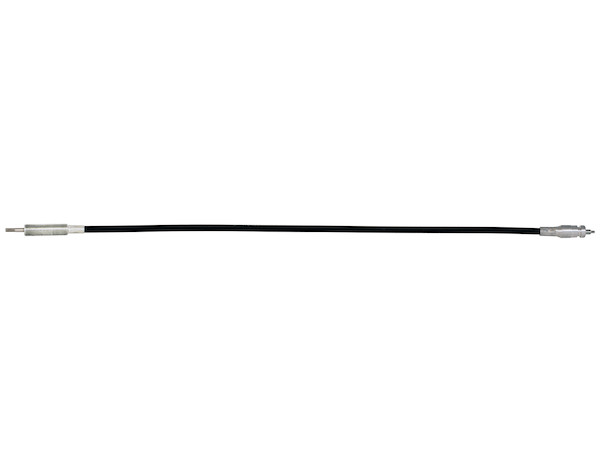
The Remote Valve Control Cable from Buyers Products connects RVC levers to valves using the corresponding RVC Connection Kit. It has a RVC Adapter Input with a Bonnet output. The cable features durable stainless steel ends and comes in a wide range of lengths.
Specifications
| Total Travel (in.) | .56 " |
| Cable Diameter (in.) | 84 " |
| Conduit Color | Black |
| Cable Length (in.) | 84 " |
| Cable Series | RVC Adapter |
| End Type | Valve Bonnet Connection |
| Rod End Thread Size | 1/4-28 " |
| Bulkhead Thread Size | 3/4-16 " |
Advanced Technical Overview: The 84-Inch Remote Valve Control Cable
This document provides an in-depth technical analysis of the 84-inch Remote Valve Control Cable, a critical component engineered by Buyers Products for precision hydraulic system management. Designed to facilitate remote operation of hydraulic valves, this cable system is integral to applications demanding robust, reliable, and responsive control mechanisms, particularly in mobile equipment, heavy machinery, and industrial settings where direct valve access is impractical or unsafe. The core function of this cable is to transmit mechanical motion from an RVC (Remote Valve Control) lever, serving as the input device, to the corresponding hydraulic valve, which acts as the output mechanism, thereby enabling precise regulation of fluid flow.
Design Philosophy and Core Functionality
The design ethos behind the 84-inch Remote Valve Control Cable prioritizes durability, precision, and ease of integration. Its primary role is to establish a mechanical link capable of accurately translating linear displacement from an operator's control lever to the spool or bonnet of a hydraulic valve. This translation is achieved through a push-pull mechanism, inherent to many mechanical control cables. The cable's architecture ensures minimal lost motion and hysteresis, crucial for applications requiring fine control over hydraulic functions such as lifting, tilting, rotating, or extending. The specified length of 84 inches provides substantial flexibility in routing, allowing for optimal placement of both the control lever and the hydraulic valve within complex machinery layouts, while maintaining ergonomic and operational efficiency.
Construction Materials and Engineering for Durability
The selection of materials for the 84-inch Remote Valve Control Cable is paramount to its longevity and performance under strenuous operating conditions. The cable features "durable stainless steel ends," a critical specification that directly addresses common failure points in control cables: corrosion and mechanical fatigue at attachment points. Stainless steel offers superior resistance to rust and oxidation, especially in environments exposed to moisture, chemicals, road salt, or other corrosive agents. This material choice extends the operational life of the cable, reducing maintenance frequency and overall cost of ownership. The internal cable wire, though not explicitly detailed in the summary, is typically constructed from high-tenstensile strength stainless steel or galvanized steel strands, helically wound to provide flexibility while resisting stretching and compression. This core wire is designed to withstand continuous push-pull cycles without significant degradation of its mechanical properties.
The "conduit color" is specified as "Black," indicating a robust outer sheath that encapsulates the internal moving elements. This conduit is typically made from a durable polymer, such as high-density polyethylene (HDPE) or a similar engineered plastic, often reinforced with internal steel windings or a braided structure. The black color usually signifies UV stabilization, protecting the conduit from degradation due to prolonged exposure to sunlight, which can lead to embrittlement and cracking. The conduit serves several vital functions: it protects the internal cable from external contaminants (dust, dirt, moisture), provides a low-friction pathway for the inner wire, and imparts structural integrity to the assembly, allowing it to withstand bending, abrasion, and minor impacts without compromising performance.
Key Specifications and Their Technical Implications
The provided specifications offer detailed insights into the cable's operational characteristics and physical dimensions:
Total Travel (in.): .56"
This specification, representing the linear displacement capability of the inner cable, is crucial for matching the cable to the throw requirements of the hydraulic valve spool. A total travel of .56 inches (approximately 14.2 mm) indicates a relatively short and precise range of motion. This suggests the cable is optimized for valves that require a small, accurate input stroke for full actuation, common in proportional control valves or those with fine metering capabilities. Misalignment of cable travel with valve throw can lead to either incomplete valve actuation (reduced performance) or over-stressing of the cable and valve mechanism (premature wear or failure).
Cable Diameter (in.): 84" (Typographical Error Correction: Likely Cable Length, not Diameter)
Given the context of other length specifications, it is highly probable that "Cable Diameter (in.): 84"" is a typographical error and should instead refer to the Cable Length. A cable diameter of 84 inches would be exceptionally large and impractical for a control cable. Assuming this refers to the Cable Length, it reinforces the stated length of 84 inches, providing substantial reach. If, however, it genuinely refers to diameter, it would indicate an extremely heavy-duty, large-bore cable system, but this is inconsistent with a .56" total travel and typical RVC applications. For the purpose of this technical analysis, we will proceed under the assumption that the 84" refers to the cable's overall length, aligning with the "Cable Length (in.): 84"" entry.
Conduit Color: Black
As discussed, the black conduit indicates UV stability and general environmental robustness, contributing to the cable's durability in outdoor and industrial environments.
Cable Length (in.): 84"
This is the definitive overall length of the cable assembly, measured from end to end. An 84-inch (7-foot) length offers considerable versatility for routing in complex machinery, accommodating various distances between the operator control station and the hydraulic power unit. Proper routing is critical to prevent sharp bends, which can increase friction, reduce cable lifespan, and degrade control precision. The length must be carefully selected to avoid excess slack, which can lead to snags, or insufficient length, which can cause strain on connection points.
Cable Series: RVC Adapter
This designation explicitly links the cable to the "RVC (Remote Valve Control) Adapter" series, indicating a standardized interface designed to mate specifically with RVC levers and associated connection kits. This ensures interoperability and simplifies system integration, reducing the need for custom fabrication. The "RVC Adapter Input" mentioned in the description refers to the specific configuration of one end of the cable, designed to connect seamlessly to the RVC lever's output mechanism.
End Type: Valve Bonnet Connection
This specification details the output end of the cable, designed for direct connection to the "Bonnet" of a hydraulic valve. The bonnet is the removable top portion of a valve body, housing the spool or internal mechanism. A "Bonnet output" indicates that the cable's terminal fitting is engineered to interface directly with the valve's control shaft, often requiring a specific mechanical linkage or bracket supplied by the RVC Connection Kit. This direct connection minimizes play and ensures efficient transfer of force to the valve spool.
Rod End Thread Size: 1/4-28"
This refers to the threading on the moving rod end of the cable, which typically attaches to the valve mechanism or an intermediate linkage. A 1/4-28 thread is a common fine-pitch thread size (1/4 inch nominal diameter, 28 threads per inch), known for its strength and resistance to loosening under vibration. The fine pitch allows for precise adjustment of the linkage length, facilitating accurate calibration of the valve's neutral position and stroke limits. The stainless steel construction of this end further enhances its durability and resistance to wear and corrosion.
Bulkhead Thread Size: 3/4-16"
The "Bulkhead Thread Size" refers to the larger threaded section on the cable's conduit end, typically used for mounting the cable securely through a panel or bracket (a bulkhead). A 3/4-16 thread (3/4 inch nominal diameter, 16 threads per inch) is a coarse-pitch thread, providing a robust and secure mounting point. This bulkhead fitting is designed to absorb the reaction forces generated during push-pull operations, ensuring that the cable conduit remains stationary relative to the mounting structure while the inner wire moves freely. The secure bulkhead mounting prevents cable sheath movement, which could otherwise introduce undesirable play or friction into the system.
Operational Environment and Application Suitability
The 84-inch Remote Valve Control Cable is engineered for demanding operational environments typical of heavy equipment, construction machinery, agricultural vehicles, and specialized industrial applications. These environments are characterized by:
- Vibration and Shock: The robust construction, including durable ends and secure bulkhead mounting, ensures the cable maintains its integrity and functionality under constant vibration and occasional shock loads inherent in mobile applications.
- Temperature Extremes: High-quality polymers for the conduit and stainless steel components are selected to perform reliably across a broad range of temperatures, from freezing conditions to high operating temperatures common in engine compartments or near hydraulic systems.
- Contaminant Exposure: The sealed conduit design and corrosion-resistant materials protect the internal mechanism from ingress of dirt, dust, water, mud, and chemicals, which are ubiquitous in industrial and outdoor settings.
- Continuous Cycling: The cable's design accounts for high-cycle fatigue, ensuring that repeated actuation does not lead to premature failure of the inner wire, conduit, or end fittings.
Integration with RVC Connection Kits
The description highlights the cable's reliance on a "corresponding RVC Connection Kit." This kit is essential for bridging the mechanical gap between the cable and the specific hydraulic valve. Typically, such a kit would include:
- Valve Brackets: Custom-designed brackets that mount onto the valve body and provide an attachment point for the cable's rod end.
- Leverage Arms/Bellcranks: Mechanisms that translate the linear motion of the cable into the required linear or rotational motion for the valve spool or lever. These components are critical for adjusting the mechanical advantage and ensuring the .56" cable travel precisely matches the valve's full stroke.
- Fasteners and Hardware: All necessary bolts, nuts, washers, and pins for secure assembly.
Maintenance and Longevity
While designed for durability, proper installation and occasional inspection contribute significantly to the longevity of the 84-inch Remote Valve Control Cable. Key considerations for maintenance include:
- Routing: Ensuring the cable is routed with generous bend radii to prevent kinking or excessive friction. Avoid routing near heat sources, sharp edges, or moving parts.
- Connection Integrity: Regularly checking all connection points at both the RVC lever and the valve bonnet for tightness and wear. Loose connections can introduce play and reduce control precision.
- Conduit Inspection: Visual inspection of the black conduit for any signs of damage, cracking, or abrasion that could compromise the internal cable's protection.
- Lubrication (if applicable): Some control cables benefit from periodic lubrication, though modern designs often feature self-lubricating liners within the conduit. Refer to the manufacturer's specific guidelines.
Conclusion
The 84-inch Remote Valve Control Cable from Buyers Products represents a meticulously engineered solution for remote hydraulic valve actuation. Its specifications, including the .56-inch total travel, 84-inch length, durable stainless steel ends, and precise thread sizes (1/4-28" rod end, 3/4-16" bulkhead), underscore its technical sophistication. Designed for seamless integration with RVC levers and specific valve bonnets via corresponding connection kits, this cable ensures robust, reliable, and precise control in the most demanding industrial and mobile equipment applications. The choice of materials and design considerations prioritizes longevity, resistance to environmental degradation, and consistent performance, making it an indispensable component for optimizing the safety, efficiency, and ergonomic aspects of hydraulic control systems.