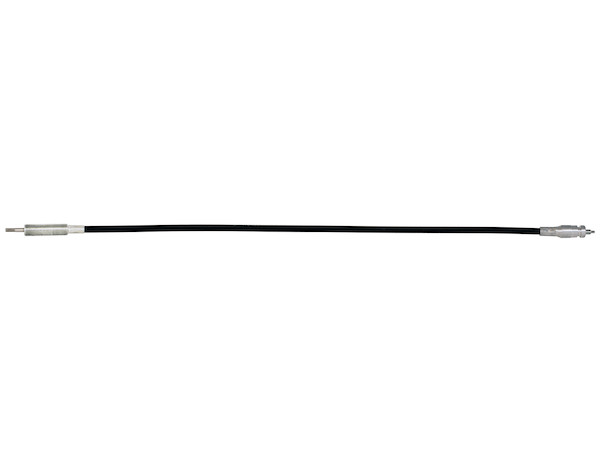
The Remote Valve Control Cable from Buyers Products connects RVC levers to valves using the corresponding RVC Connection Kit. It has a RVC Adapter Input with a Bonnet output. The cable features durable stainless steel ends and comes in a wide range of lengths.
Specifications
| End Type | Valve Bonnet Connection |
| Cable Length (in.) | 96 " |
| Cable Diameter (in.) | 96 " |
| Total Travel (in.) | .56 " |
| Conduit Color | Black |
| Cable Series | RVC Adapter |
| Bulkhead Thread Size | 3/4-16 " |
| Rod End Thread Size | 1/4-28 " |
In the realm of modern machinery and industrial applications, precision and reliability in remote control systems are paramount. The 96 Inch Remote Valve Control Cable from Buyers Products exemplifies these critical attributes, serving as a vital mechanical linkage within complex operational architectures. Engineered for robust performance and seamless integration, this control cable facilitates the accurate and consistent actuation of hydraulic and pneumatic valves from a remote operator station, ensuring optimal machine control, enhanced safety, and ergonomic operational efficiency.
At its core, the primary function of this 96-inch cable is to establish a secure and efficient connection between an RVC (Remote Valve Control) lever and its corresponding valve. This mechanical linkage system is not merely a passive connector but an active component designed to translate precise manual inputs into direct valve movements. The requirement for remote control arises from diverse operational challenges, including situations where the valve itself is located in an inaccessible, hazardous, or physically separated environment from the operator. Such scenarios are common in heavy-duty vehicles like snowplows, salt spreaders, refuse trucks, construction machinery, agricultural equipment, and a wide array of industrial applications where human intervention at the valve site is impractical or unsafe. By providing a reliable conduit for control signals, the cable mitigates risks, improves operator comfort, and streamlines operational workflows.
The design philosophy behind the Buyers Products 96 Inch Remote Valve Control Cable centers on durability, precision, and ease of integration. Its construction is a testament to meticulous engineering, utilizing high-grade materials and manufacturing processes to ensure longevity and consistent performance under arduous conditions. The cable's architecture typically comprises a flexible inner core, often a multi-strand stainless steel wire rope, encased within a robust, protective conduit. This inner core is specifically designed to transmit both push and pull forces with minimal friction and maximum efficiency. The multi-strand configuration allows for exceptional flexibility, crucial for routing the cable through intricate machine frameworks, while simultaneously providing high tensile and compressive strength necessary for valve actuation. The inherent properties of stainless steel, particularly its high resistance to corrosion and fatigue, make it an ideal material for the core, ensuring reliability even when exposed to moisture, chemicals, or extreme temperatures prevalent in outdoor and industrial settings.
The protective conduit, colored black as specified, serves several critical functions. Firstly, it shields the inner core from external elements such as dirt, dust, moisture, and abrasive debris, which could otherwise impede smooth operation or accelerate wear. Secondly, it provides structural integrity, preventing kinking or buckling of the inner wire, which could lead to erratic control or complete system failure. The black color often indicates a material with good UV resistance, preventing degradation from prolonged sun exposure, a common concern for outdoor machinery. The specific material composition of the conduit, while not explicitly detailed beyond color, is typically a high-density polymer or a composite, chosen for its balance of flexibility, abrasion resistance, and temperature stability. Internal liners within the conduit, often made from low-friction polymers like PTFE (polytetrafluoroethylene), further enhance the cable's performance by minimizing drag on the inner wire, ensuring smooth, responsive lever action with reduced effort for the operator.
A critical specification for this particular cable is its length: 96 inches. This precise dimension is a key factor in system design, dictating the permissible distance between the RVC lever and the valve. The availability of a specific length, such as 96 inches, ensures that engineers can select the exact component required, minimizing excess slack which could lead to routing difficulties or undesirable control lag, while also ensuring sufficient reach for the intended application. The manufacturing process for these cables involves precise cutting and assembly to meet exact length tolerances, guaranteeing consistent fit and function across installations. This exact length is often selected to optimize routing pathways, avoiding sharp bends that could compromise cable integrity or increase friction, and ensuring a clean, organized installation within the equipment's chassis.
The total travel of the cable, specified at 0.56 inches, is another crucial technical detail. This figure represents the maximum linear displacement that the cable can effect, directly correlating to the extent of valve actuation. A travel of 0.56 inches indicates a relatively short-throw application, suggesting a need for very precise and controlled movement of the valve spool or stem. This level of precision is often required in applications where fine modulation of flow or pressure is necessary, rather than simple on/off switching. For instance, in hydraulic systems, a short travel might correspond to a spool valve designed for proportional control, allowing for subtle adjustments in fluid dynamics. The engineering behind achieving such precise and consistent travel, even under varying loads and environmental conditions, relies heavily on the low-friction design of the cable assembly and the inherent rigidity of its components to prevent unwanted elastic deformation or backlash.
The interface points of the control cable are meticulously designed to ensure secure, efficient, and standardized connections within a broader mechanical system. The input side features an RVC Adapter Input, designed to mate seamlessly with various RVC levers. This adapter design promotes modularity, allowing the cable to be integrated into diverse control setups without requiring custom fabrication for each lever type. The precision of this input connection is critical for accurately transmitting the operator's commands. The mechanical integrity of this connection is further bolstered by the specified Bulkhead Thread Size of 3/4-16 inches. A bulkhead connection is typically used to pass the cable through a panel or enclosure, providing a secure and sealed mounting point. The 3/4-16 thread designation refers to a Unified National Fine (UNF) thread with a nominal diameter of 3/4 inch and 16 threads per inch. This standard thread form ensures robust mechanical engagement, resistance to vibration-induced loosening, and often allows for a sealed connection, preventing ingress of contaminants into the operator's cabin or internal machinery. The ability to securely anchor the cable at a bulkhead point prevents unwanted movement or stress on the cable assembly during operation, thus prolonging its lifespan and maintaining control accuracy.
Complementing the bulkhead connection is the Rod End Thread Size of 1/4-28 inches. This specific thread is typically found at the very end of the inner core, designed to connect directly to the RVC lever mechanism. The 1/4-28 UNF thread, with a nominal diameter of 1/4 inch and 28 threads per inch, is a fine-pitch thread commonly used in applications requiring precise adjustment and secure fastening in a compact form factor. Rod ends, often incorporating spherical bearings, allow for a degree of angular misalignment while maintaining a positive mechanical linkage, essential for absorbing minor operational variations and ensuring smooth articulation of the lever. The combination of these thread sizes reflects a deliberate engineering choice to provide robust, adjustable, and reliable connections at the control input point, capable of withstanding repetitive operational cycles and transmitting forces effectively.
On the output side, the cable terminates with a Bonnet output, specifically identified as a Valve Bonnet Connection. This connection type is indicative of a direct interface with the valve's bonnet—the housing that contains the valve stem, packing, and guiding elements, and through which the stem protrudes for actuation. This direct connection approach ensures a highly efficient transfer of force from the cable to the valve mechanism, minimizing losses and maximizing responsiveness. The choice of a bonnet connection highlights compatibility with a wide range of industrial valves, including many hydraulic and pneumatic spool valves, globe valves, or gate valves that require linear actuation of a stem or plunger. The design of this output end is critical for maintaining a leak-free and robust connection to the valve, often incorporating features that prevent rotation and ensure precise linear movement. The mechanical integrity of this connection is paramount, as it is the final link in the control chain, directly responsible for the critical function of the valve. It must withstand not only the forces transmitted by the cable but also any reactionary forces generated by the valve mechanism itself, ensuring reliable opening, closing, or modulation of fluid flow or pressure.
The use of durable stainless steel ends throughout the cable assembly, as highlighted in the product description, is a significant advantage. Stainless steel, particularly grades like 304 or 316, offers exceptional corrosion resistance, making these cables suitable for environments exposed to moisture, salt spray (e.g., marine or road de-icing applications), chemicals, and aggressive industrial fluids. Beyond corrosion resistance, stainless steel provides superior tensile strength and wear resistance compared to other materials, ensuring that the critical connection points, which experience repetitive stress and potential abrasion, maintain their integrity over thousands of operational cycles. The inherent strength of stainless steel also contributes to the cable's ability to handle significant push-pull forces without yielding or deforming, thus preserving the precision of the 0.56-inch total travel. This material choice translates directly into a longer service life, reduced maintenance requirements, and ultimately, a lower total cost of ownership for the end-user. Moreover, the low-friction surface properties of polished stainless steel can further contribute to smoother operation and reduced effort at the control lever.
Integrating this 96 Inch Remote Valve Control Cable into a complete system involves careful consideration of routing, installation, and the accompanying RVC Connection Kit. The connection kit, mentioned as a necessary component, likely includes specialized fittings, mounting hardware, and perhaps detailed instructions or templates to ensure proper alignment and secure installation. Correct routing of the cable is crucial; it must avoid sharp bends that could stress the inner wire or conduit, as well as pinch points or areas of high heat or vibration that could damage the assembly. Proper securing of the cable along its path, typically with clamps or clips, prevents unwanted movement and maintains the integrity of the control linkage. While the cable is designed for minimal maintenance due to its robust construction and material choices, periodic inspection for any signs of wear, damage, or binding is recommended to ensure continued optimal performance. Any issues like increased friction or 'stickiness' in the lever action could indicate internal wear or contamination and should be addressed promptly to prevent system malfunction.
The Buyers Products brand, synonymous with quality and reliability in the heavy-duty equipment sector, stands behind the engineering and manufacturing of this remote valve control cable. Their commitment to producing components that meet rigorous performance standards is reflected in the design choices, material selection, and precise specifications of this cable. For operators and technicians who depend on their equipment working flawlessly, particularly in demanding environments, the choice of a control cable from a reputable manufacturer like Buyers Products provides assurance of dependable performance and longevity. This cable is not merely a component; it is an integral part of an engineered system designed to deliver precise, responsive, and reliable remote control over critical hydraulic and pneumatic functions, thereby enhancing the operational capabilities and safety of a wide array of industrial and mobile machinery.
In conclusion, the 96 Inch Remote Valve Control Cable from Buyers Products represents a high-performance solution for mechanical remote control applications. Its precise length, specialized RVC Adapter Input and Valve Bonnet Connection, robust stainless steel ends, and carefully engineered total travel of 0.56 inches collectively ensure an unparalleled level of precision, durability, and operational reliability. From its sturdy inner core and protective conduit to its meticulously designed connection threads, every aspect of this cable is optimized for seamless integration and long-term service in demanding industrial and mobile environments. It empowers operators with precise control from a safe and ergonomic distance, making it an indispensable component for modern, high-efficiency machinery where consistent and accurate valve actuation is paramount.